Unearthing 2,000 Years of Board Games in Scotland

Breaking out the board games on a rainy day? From Roman soldiers to medieval nobles, noughts and crosses to chess, expert Mark Hall explains how people in Scotland have been gaming for over a thousand years.
Game On
Wherever there have been people there has always been play. But why do we do it? It is a persistent human trait that we share with other animals with links to evolution. Play has a close link with ritual and religious behaviour, for example play with miniature objects, divination and the manipulation of chance or fate. It is also tied up with learning. But perhaps most importantly, we do it because it’s fun.
Rolling with the Romans
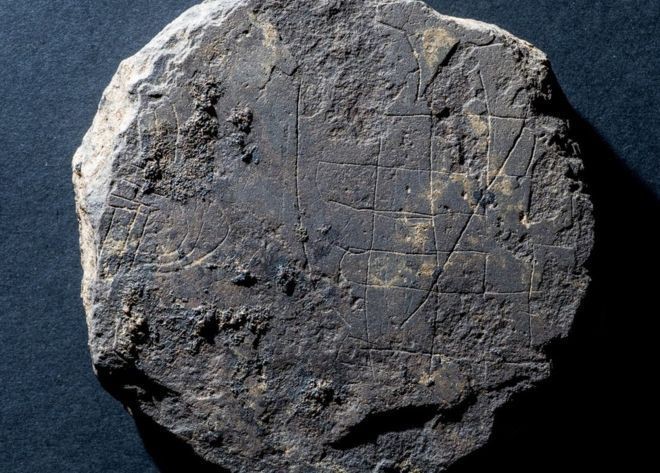
Based on current evidence, the key moment of board games moving into Northern and Western Europe was the spread of Roman colonisation and interaction. Soldiers of the Roman empire had first invaded Scotland around 70 AD, with a second invasion under Emperor Antoninus Pius around 70 years later resulting in a vast number of forts, roads and boundaries across today’s lowland and central Scotland, in particular the Antonine Wall, which stretched between Bridgeness in Falkirk and Old Kilpatrick just outside Glasgow.
The board games the Romans brought with them were either played in and around Roman forts, notably in bathhouses, or were sent north beyond the Roman frontier. The 12 gaming pieces found at Tarland in Aberdeenshire (probably Roman 3rd-4th century AD) were made of quartzite, dark blue glass and mosaic glass, and may have been destined as a gift for a powerful northern prince.
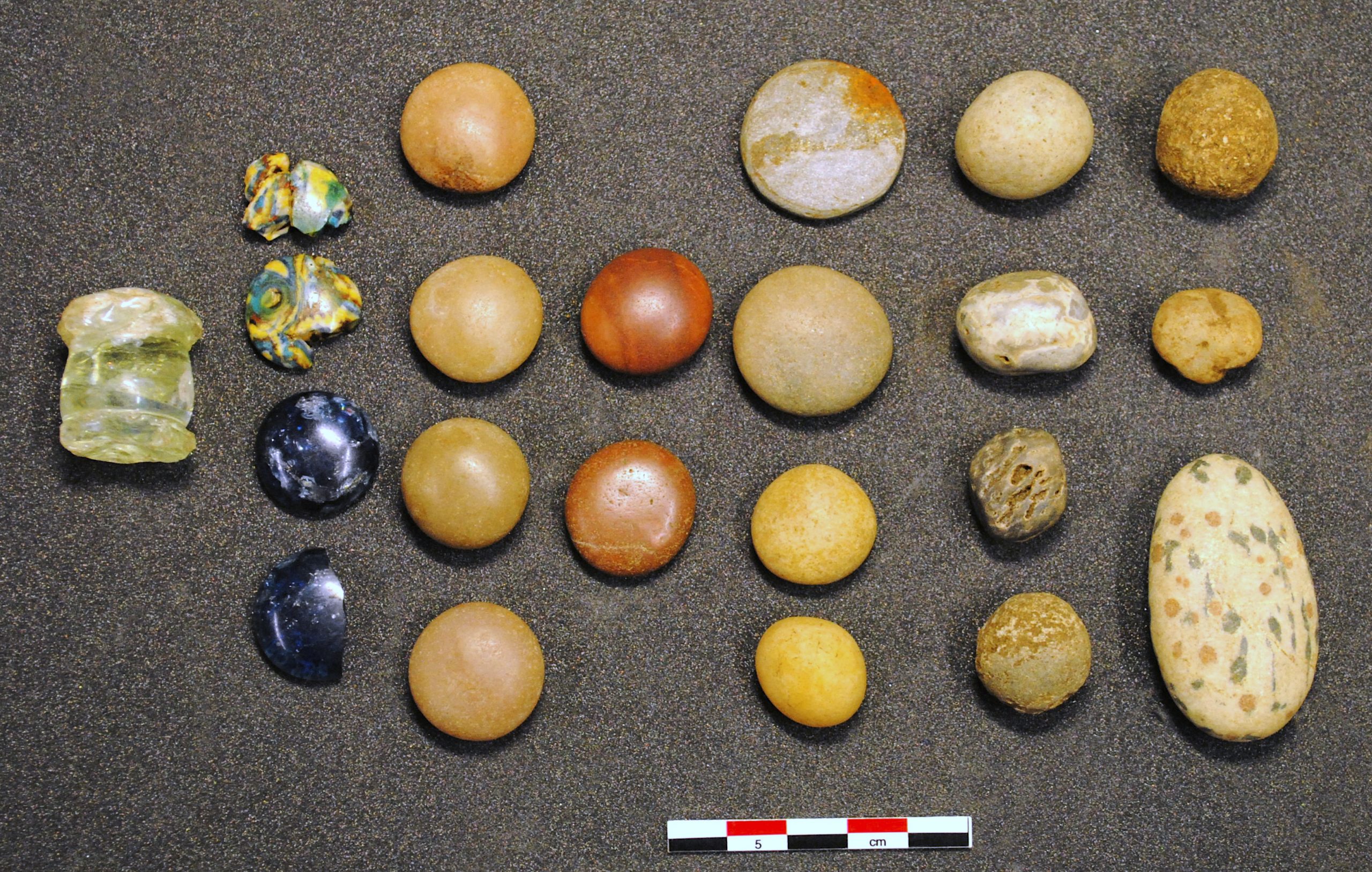
Glass gaming pieces from Tarland (Image Credit: Mark A Hall)
Tables, Tafl and Mill
In early medieval times, there were three key groups of games across Europe. We can broadly label these as tables, tafl and mill.
Tables designates a group of games that today we know as backgammon, and which in the later medieval period was widely known as tric-trac.
Mill (or morris or merels) at its simplest is the game we know as noughts and crosses, which increases in complexity with the number of pieces used (for e.g. nine men’s morris) and was again a game that spread with Roman influence. The evidence for these two games in early medieval Scotland is sparse (but is much more common from the twelfth century onwards).
We have much more evidence for the tafl group, which seems to have evolved from the Roman strategy board game ludus latrunculorum, played on a lattice-like board of square cells. We do not know what the Picts called their versions of this game, but it was possibly related to the British gwyddbyll.
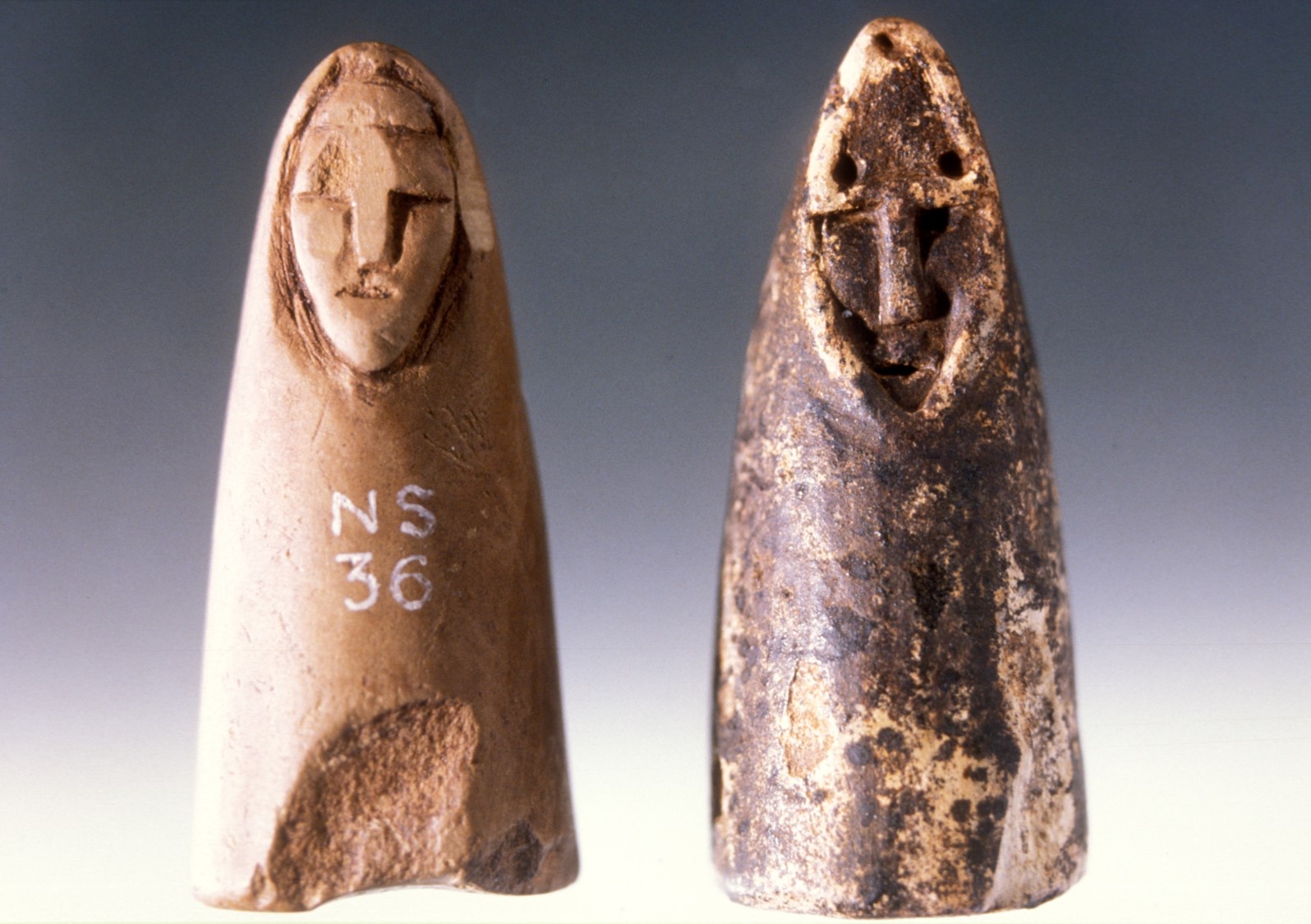
Mail and Scalloway gaming pieces (Image Credit: © National Museums Scotland)
The variants in the Scandinavian world and in Ireland were known as hnefatafl and fidcheall. There are a number of carved stone boards, notably from the Orkneys, the designs of which reveal they were for this type of game, as well as two probable playing pieces from Shetland, among the most spectacular examples found in Scotland. One of them, a sixth century piece was found during an excavation of a much earlier broch (an Iron Age round tower) in Scalloway and could be a hnefi, or king-piece, from a tafl-type game.
Traces of staining may suggest that this piece was originally coloured. A fascinating feature is the sunken triangular panel above the brow with small holes at each angle; this space likely held a decorative inset of amber, glass or metal, which may have helped to distinguish the piece as a key one. It also has a pierced base, which may have been to support it on a spike or peg for use on a wooden peg-board.
Check Mate
If we jump ahead to the Scottish Middle Ages, we find chess is the new game on the block. Originating in India and/or China, this game moves westward on the Silk Roads, changing and developing until it reaches Western Europe in the late 10th or early 11th century.
Scotland can justifiably boast one of the most spectacular survivals of the game, namely the pieces from Leòdhas (Lewis) in Na h-Eileanan Siar (the Outer Hebrides), where elements of multiple sets of chess pieces and other games were discovered on a beach in the early 19th century.
The Lewis chess pieces show an early and impressive use of figurative carving to depict recognisable social figures – kings, queens, bishops and knights. They are part of a large hoard of gaming pieces that represent at least four games: chess, tables, merels and hnefatafl (though surprisingly no dice or board elements have survived).
The accumulation of sets of gaming pieces in this hoard is testament to the giving of such items as gifts – and, like the gift-given boards we play with today, these historical ones were likely designed to help bring people together. However, many later medieval Romances describe the use of chessboards and pieces to physically attack their opponents and others (not unlike our modern board games).
Header Image: Hnefatafl (Credit: Aline Molleri via Flickr at http://bit.ly/2LMcvy0, CC BY-SA 2.0)
