Archaeology Diaries: Roundhouses in Wester Ross
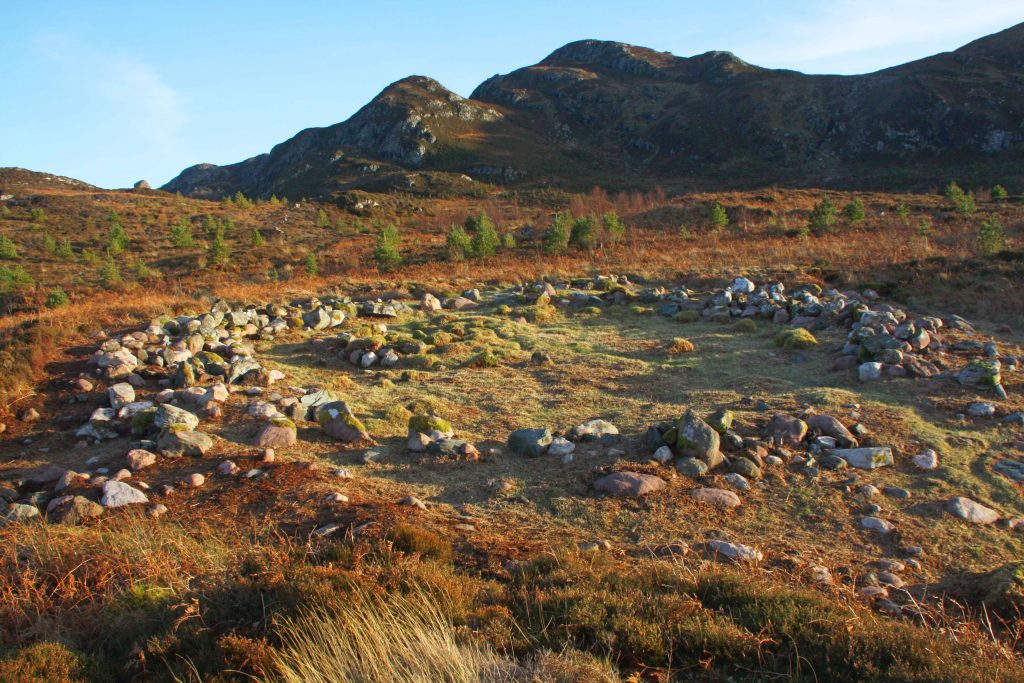
Archaeology is often discovered unexpectedly. That’s what happened when Jeremy Fenton moved to Gairloch ten years ago. In Gairloch Museum one day he noticed a map which showed six “roundhouses” in the area just behind his house. Over the next year he found five of these rough circles of stones buried nearby, hidden in vegetation. He began to dig deeper into their history and here’s what he found…
What is a Roundhouse?
A roundhouse (or more specifically an ‘Atlantic roundhouse’) is a prehistoric drystone tower residence with a single entrance. Atlantic roundhouses are unique to Scotland and mostly found in the northern and western mainland, the Northern Isles and the Hebrides.
The entrances to roundhouses normally face south-east, probably to provide shelter and morning light. There was a conical thatched roof, supported on wooden posts, ring beams and rafters, which required up to 50 tress to make. They were built during the Scottish Iron Age (c.800BC to 500AD) in different shapes and for different purposes which archaeologists still debate today.

Whithorn & Ninian, April 2017 (Image Credit: Clive via Flickr at https://bit.ly/2R97Jxc, CC BY-NC-ND 2.0)
There was one enormous roundhouse on the map which I thought looked particularly special. Once the vegetation was removed, it became clear that it was comprised of a ruined wall 17.5 metres in diameter and 2 metres thick, originally well built with large stones.
As a bonus there was a shieling hut (a dwelling for farmers and their families to use during the summer while their livestock grazed common land) inside it and another outside it. It had a fine outlook to An t-Eilean Sgitheanach (the Isle of Skye), and the entrance appeared to be in the south-west; this seemed odd as it would have been facing the oncoming weather. Why would the builder choose this direction?
The WeDigs Project
At this point I got to know local archaeologist Anna Welti of Ullapool, who had started a project to record all the roundhouses of Wester Ross (over 400). The 2012 WeDigs community archaeology project was organised to learn more about these fascinating sites. In spite of the midges, the excavations attracted large numbers of volunteer diggers, visitors and school parties to dig at three roundhouses around Gairloch (for the latest analysis (May 2020) on these roundhouses by archaeologist Hannah Genders Boyd, click here).
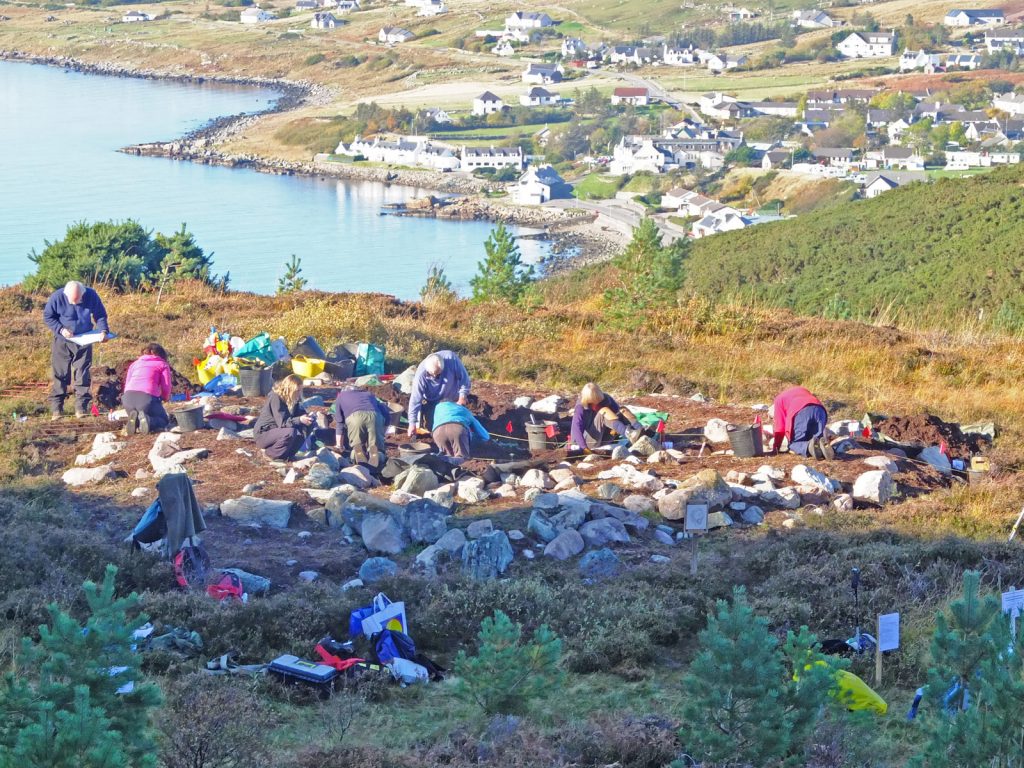
Volunteers digging above Gairloch (Douglas Gibson at Visit Wester Ross)
The first trench, at a small roundhouse with a fine view, revealed that the site began as a turf- or earth-walled house, on which a stone wall was later built. Evidence of the early earth house included a wonderful post-hole with a large flat-topped beach cobble acting as a post-pad (more on these here). We didn’t find the hearth from this earlier dwelling, but charcoal from the hearth belonging to the roundhouse’s second phase gave a radiocarbon date centred on 726 BC, showing that it was lived in more than 2,700 years ago.
Our second site close by was a huge surprise; it was not a house, but a cobbled work area more than 4,500 years old. Inside we found around 80 pieces of quartz, a hard, white mineral used to make sharp tools. The pieces found here were chips, blocks, and one tool: a borer, used by a late-Neolithic craftsperson to make holes in leather. The excavations here also uncovered an intriguing stone circle added to the site around 1,000 years later, sometime after 1,391 BC. It looks as if people continued to use this same location into the Bronze Age, and for an unknown reason surrounded it with stones.
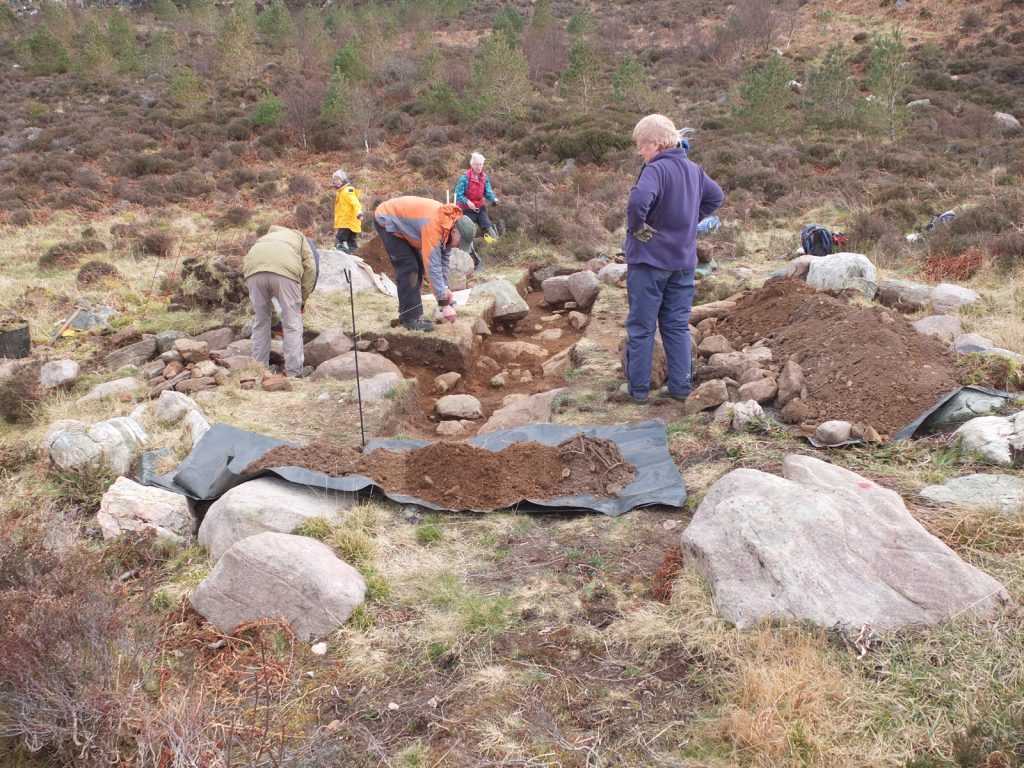
Uncovering Neolithic evidence (Douglas Gibson at Visit Wester Ross)
The third dig excavated the huge roundhouse near my house. This site posed several big questions which we hoped to answer: Why was the roundhouse built on such a massive scale, which would have taken considerable communal effort? Why was the entrance facing south-west and the oncoming weather?
But we had even more questions after the dig: Why was there no evidence found of habitation or a floor? We found traces of an intensely hot fire dating from the Early to Mid-Iron Age, around 2,250 years ago, in the soil at the centre of the roundhouse, but our findings showed that the fire had burned much hotter than would have been expected in a domestic hearth. Could it have been used for something else? During our excavation we got closer to finding the answers to some of our burning questions.
The Results
We had a hunch about the reason why the Iron Age builders of my local roundhouse built the entrance facing south-west in spite of oncoming weather. At the next winter solstice, I managed to photograph the sunset from the roundhouse’s centre and it was exactly through the entrance! I like to think that this circle was built for celebrations, with a midwinter fire to remind the sun to turn back north. Was it the idea of some Iron Age chief with a big imagination, a lot of local clout, and a fear of eternal darkness? We don’t have standing stones or henges in this region; could this be our (much later) equivalent?
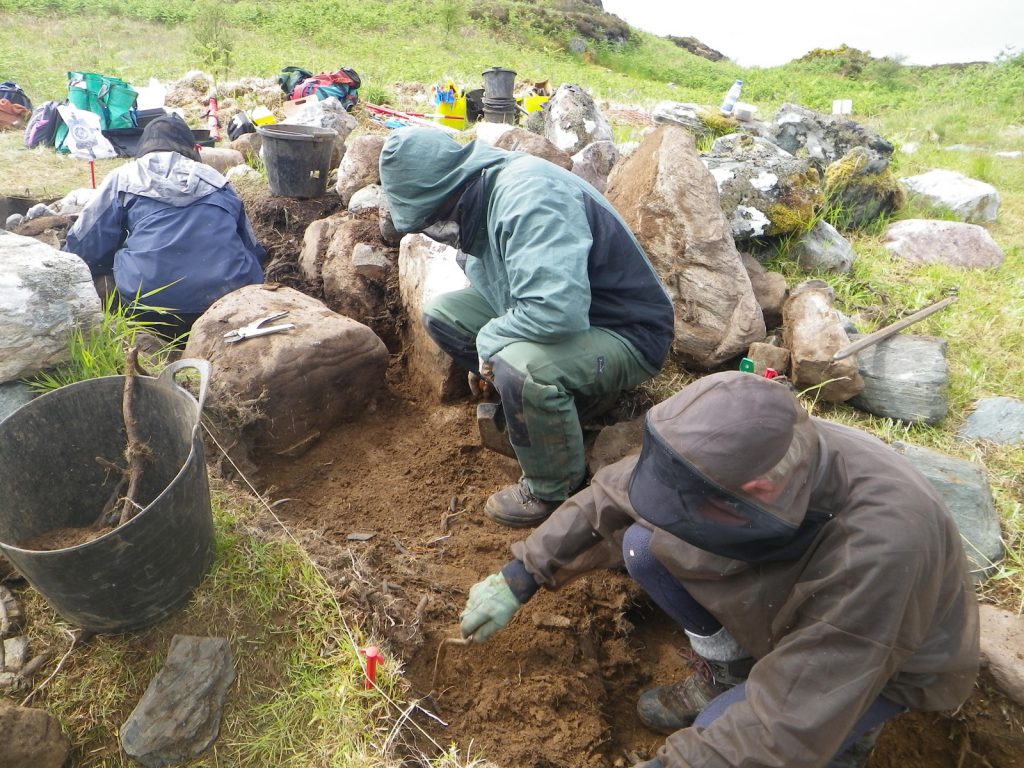
Volunteers in the “big one” wall trench protecting themselves from midges (Douglas Gibson at Visit Wester Ross)
Overall, the WeDigs project investigated the remains of three prehistoric stone circles with three completely different purposes, and only one a house! But the story doesn’t end there; in 2015 we held a short dig in a fourth roundhouse and revealed an amazing 2,500-year-old slab hearth, cracked into the style of crazy paving by heat. Near this was a burial cairn, stones piled on a small knoll and sprinkled with smooth beach pebbles. But sadly someone had been there before me: where the burial cist (a small stone-built box used to hold the bodies of the dead) might have been there was only a hole.
If you’d like to do a bit of armchair travelling, download the Achtercairn Archaeology Trail from Jeremy’s website, a self-guided walk starting from the new Gairloch Museum.
By Jeremy Fenton, a former teacher and local history and heritage expert based in Gairloch. He’s also a fan of hill-walking, the outdoors, wildlife and geology.
Featured Image: The “big one” (Douglas Gibson at Visit Wester Ross)
