Think Twice Before Excavating a Mound: Orkney Folklore and Excavations

The year was 1862. James Farrer’s “Notice of Runic Inscriptions Discovered During Recent Excavations in the Orkneys made by James Farrer, M.P.” had just been printed and bound, documenting the chance discovery of around 32 runic inscriptions inside the now well-known prehistoric chambered cairn Maeshowe in Stenness, Orkney.
Mound Dwellers
Flicking through the freshly printed pages, the reader’s eyes might have caught the peculiar footnote at the bottom of page 12: “The country people state that the building was formerly inhabited by a person named Hogboy, possessing great strength”[1].
To any of Farrer’s friends in London or Durham this footnote would have been entirely enigmatic. Indeed, some familiarity with Orkney traditions would have been needed to understand its meaning: ‘Hogboy’ is one of the local names Orcadians have given to the spirits that reputedly haunt various mounds across the archipelago. Above all, the notion of a mound dweller would have normally been enough to deter people from excavation.

Maeshowe, Stenness, Orkney. Before the first recorded excavation took place in 1861, the site was reputed to be inhabited by an enigmatic mound spirit (Photo Credit: Nela Scholma-Mason)
There is no definition of a ‘mound dweller’ other than that they are a being that lives inside a mound. The hillock is often an ancient site, but this does not have to be the case: even natural mounds can have mound dweller associations.
The phenomenon of a mound spirit also occurs in Scandinavia, Iceland and – in slightly different form – in Ireland, among other countries. What the mound dweller looks like depends entirely on the area and time in which the tale is recorded or told.
A Supernatural Warning
Many mound dweller tales feature people wanting to excavate a hillock, before being warned against it by locals, or stopped in their tracks by a sudden apparition. Other versions simply tell us about the way in which a positive relationship is maintained between mound dweller and farmer.
We cannot know whether Farrer received the information about the Maeshowe Hogboy in the form of a genuine warning, a jovial remark over a brandy, or a casual note of interest. We don’t even know who it was that told him. What we do know is that Farrer was far from the only one to record local rumours of mound spirits.
Similar anecdotes are woven into antiquarian reports from across Scotland, with another Orcadian example coming from the isle of Rousay: In early summer 1898, Eliza Traill-Burroughs carefully recorded the first excavation of Taversoe Tuick. As soon as it became clear that they had come upon an ancient tomb, one of the workmen’s faces “was dark.”, Traill-Burroughs writes, “The Inhabitants don’t much like finding these burials”[2].
The fact that a thunderstorm broke out the very moment they spotted the burials will have added somewhat to the tension! Within the same evening, the story of the discovery had been passed around the island, now having acquired supernatural attributes.
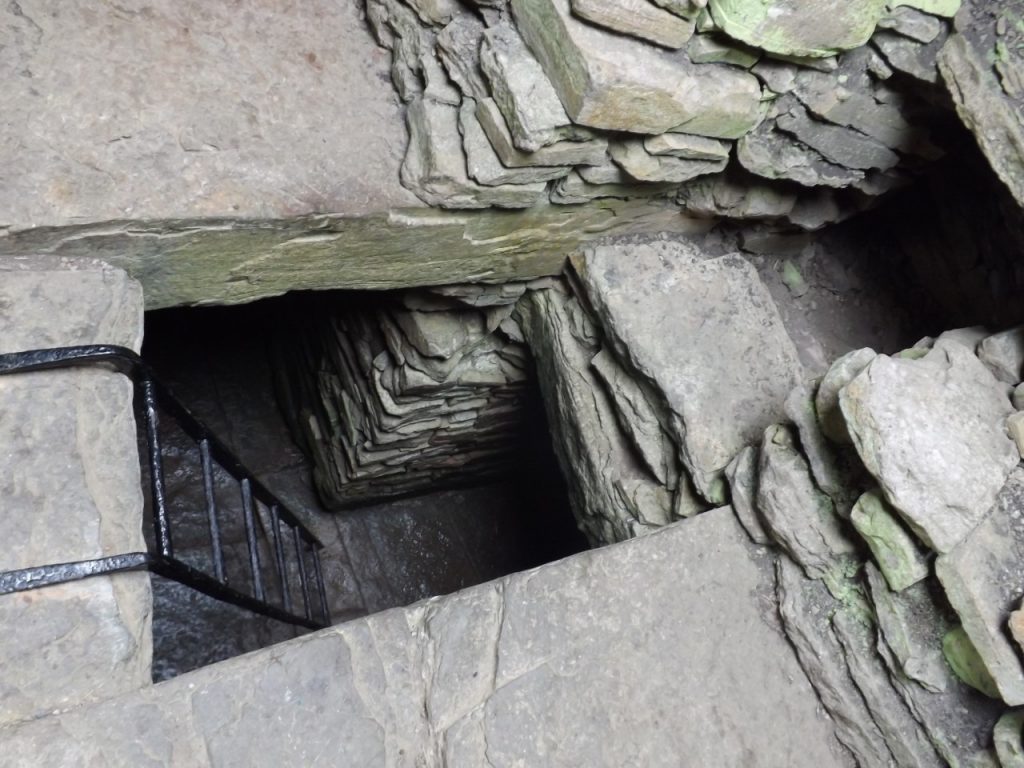
Taversoe Tuick, Rousay, Orkney: View from the top chamber into the lower chamber (Photo Credit: Nela Scholma-Mason)
What antiquarian reports and recorded tales agree on is that locals were keen to keep these sites undisturbed. Orcadian folklore is replete with accounts of mound dwellers turning against people once they feel slighted, and the consequences of this can be dire, often resulting in storms, the death of cattle or marital drama. Such is the impact of these tales that even into more recent decades, storms following archaeological digs in Orkney have been directly linked to opening ground that should not have been opened.
More than a Tall Tale
To us today, these might seem like entertaining stories – and they certainly are – but they are not only that. One could go as far as to argue that the supernatural creatures are merely a means of bringing the message across more vividly – they are not really what these tales are about.
Very profound themes lie at the core of these narratives: these stories are about survival from the land as well as enduring its perils; coping with loss and mortality; treating the spirits of the land with respect to ensure health and welfare – all of these are among the oldest and most basic human concerns, while remaining relevant today. Farming communities have settled across Orkney for over 5,000 years; maintaining a good relationship with the land from which they lived was of vital importance.
While it is not possible to precisely date something as intangible as a story, it is possible that fundamental coping mechanisms will have been passed down for generations, with echoes of them resounding in the folk tales we know today.
The Archaeology of Folklore
For archaeologists in particular, folk tales are impactful in that they change the physical development, as well as our knowledge, of the landscape: we know that people have chosen to build around mounds (rather than destroying them).
In other cases, vanished sites were kept firmly on the map through their associated stories: the now levelled mound of Hellihowe / Cot Brae in Sanday is preserved in the locally well-known tale of the ‘Hogboon of Hellihowe’ (a tale in which the relationship between farmer and mound dweller turns sour). Without this tale, far fewer people would know that there ever was a mound on that site.
In our studies of the past, the way ancient sites are dealt with in folk tales is worth paying attention to. It might allow us to catch a glimpse of bygone ideas – even though we can never expect to fully understand them.
If you’d like to know more, check out Nela Scholma-Mason’s article (‘Those Who Dwell under the Hills: Orkney’s Mound Lore and Its Wider Context’) in the Folklore journal or visit Orkneyology.com to enjoy number of short audio files of Orkney storyteller Tom Muir telling folk tales, including “The Hogboon of Hellihowe” and “The Dancers under the Hill” which feature excavations and mound dwellers. In “The Hogboon…” Tom speaks about Farrer’s encounter in 1861, and in “The Dancers…” he tells about his own experience while excavating Howe, Orkney, in 1978 and how a storm broke after the mound was opened.
By Nela Scholma-Mason, who has degrees in archaeology from the University of Muenster, Germany; the University of Oxford (Keble College) and a PhD from the University of York, examining archaeology and folklore in the Orkney Islands.
[1] Citation from: Farrer, J. (1862) Notice of Runic Inscriptions Discovered during Recent Excavations in the Orkneys made by James Farrer, M.P., Printed for private circulation.
[2] Citation from: Reynolds, D. M., ‘How we found a tumulus’ a story of the Orkney Islands—The Journal of Lady Burroughs’ in Proc Soc Antiq Scot, 115 (1985), 115-124.
Header Image: © VisitScotland / Kenny Lam
