Finding a Pictish Power Centre: Bennachie’s Mither Tap | Archaeological Research in Progress

The Picts are a ‘lost people of Europe’ and continue to be a society of enduring public fascination.
First mentioned in late Roman sources as a collective name for troublesome, barbaric peoples living north of the Roman frontier, the Picts went on to dominate a large part of Scotland until the late first millennium AD (around 1,100 years ago).
The major legacies of the Picts include iconic symbol stones, but other than this, the archaeological and historical record for this region c.300-900 AD is diffuse and difficult – famously dubbed the ’Problem of the Picts’.
The Northern Picts project at the University of Aberdeen was established in 2012 to investigate an area stretching from Aberdeenshire to Easter Ross, covering the probable extent of the Pictish kingdoms of Fortriu and a territory of Pictland known as Ce.
‘The Ravaging of Bennachie’
The Pictish period has been difficult to put into content due in part to the lack of settlement evidence from this period. After the 3rd century AD (around 1,720 years ago), it is exceptionally difficult to trace due to changes in how houses and buildings were constructed.
Compared to the hundreds if not thousands of settlements from the preceding Iron Age we literally have a handful of Pictish sites known. Very occasionally we have place-name evidence or historical evidence to help target our work.
That was the case with one site investigated in the summer of 2019. The place-name Bennachie, the site of a hillfort known as the Mither Tap, has been translated as ‘Mountain of Ce’. Ce is mentioned in an ancient legendary section of the Pictish king-lists.
The place-name evidence suggests Bennachie could have been the pre-eminent site in this region. The site and region is also possibly referred to in the two lost Gaelic sagas; Orgain Benne Ce, ‘The Ravaging of Bennachie’, which hints of a catastrophic battle or event at the site; and Orgain Maige Ce la Galo mac Febail, ‘The Ravaging of the Plain of Ce by Galo son of Febal’, which suggests further conflict in the region around Bennachie.
Extreme Archaeology
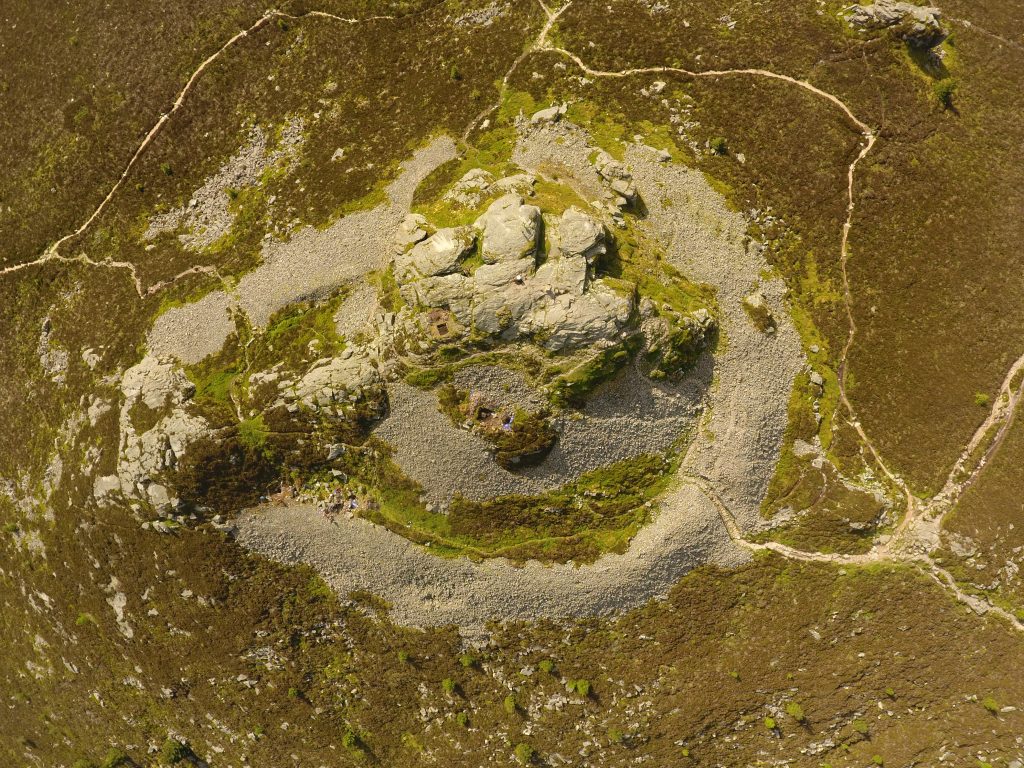
The hillfort of the Mither Tap consists of two large, but now collapsed, stone walls (an upper and lower citadel) with surrounding a distinct granite torr (outcrop) that is highly visible in the surrounding landscape.
The site was investigated in the 1870s by Christian Maclagan, one of Scotland’s earliest female archaeologists. Maclagan’s 1881 publication on the site produced a detailed plan of the fort showing the upper and lower ramparts, traces of possible roundhouses in both citadels and the location of a well within the lower citadel.
Small-scale excavations conducted as part of path improvement by Forestry Commission Scotland (now Forestry and Land Scotland) confirmed activity at the site, but no large-scale modern work had been carried out.
In June 2019, the Northern Picts team undertook another extreme archaeology season trekking up the hill to evaluate it more comprehensively.
Excavations of the well, forgotten since the 19th century, exposed steps leading down to a small wall chamber, and miraculously after removing backfill, the well started functioning again, collecting water runoff from the hill (pictured in header).
Within the lower citadel they found extensive midden (waste) deposits full of cattle, pig and even fish bone with traces of large platforms built-up within the lower fort to create level stances for buildings.
In the upper citadel of the fort they found more evidence for early medieval occupation (over 1,100 years ago) and the finds from across the site included evidence for high-status metalworking and locally made pottery, an extremely rare find from Pictish sites.
Radiocarbon dating (a method for determining the age of an object) shows that the Mither Tap was in use in the 7th and 8th centuries AD, a time that marks the height of the Pictish kingdoms before their demise towards the end of the 9th century AD.
You can find out more by following the project on Facebook and Twitter, or reading the project book, ‘The King In The North: The Pictish Realms of Fortriu and Ce’, published by Birlinn.
By Gordon Noble, a Professor of Archaeology at the University of Aberdeen. He specialises in the prehistoric and early medieval archaeology of Scotland and has directed excavations on sites from the Mesolithic to the 19th century across Scotland.
(Image Credits: Northern Picts/University of Aberdeen)
The Northern Picts project, funded by a donation to the University of Aberdeen Development Trust, was designed to take on the challenge of finding new archaeological sites in a period with few identified sites either in the written sources or the archaeological record. A new project in 2017, the Comparative Kingship project funded by the Leverhulme Trust has also contributed to an unprecedented research focus on the Picts. Visit the University of Aberdeen website to find out more.
This article was produced as part of Archaeological Research in Progress 2020, an online version of the annual conference which presents new research findings and best practice in archaeology covering all periods from across Scotland and beyond. It is organised in alternate years by Archaeology Scotland and the Society of Antiquaries of Scotland, with support from Historic Environment Scotland.
