8,000 years of Deer and Aden: Aberdeenshire’s lost monastery and country park mysteries | Archaeological Research in Progress

Aberdeenshire’s history stretches back thousands of years and two archaeology projects – focusing on Leabhar Dhèir (the Book of Deer) and Aden Country Park – have been digging into this story for decades.
Aden Country Park’s Prehistoric Past
A number of sites were known within Aden Country Park and it was even thought that a stone circle had been located in the area and later removed.[1]
Although the site has never been found, a team systematically walked across ploughed fields (known as fieldwalking) in 2017 and discovered hundreds of Neolithic flints (pieces of rock) and one Mesolithic core (a stone artefact created by chipping away flakes – pictured below), which suggest that people were making tools in this area over 7,000 years ago.
Near the Neolithic flints, the team also found and excavated a sub-rectangular alignment of post-hole bases around 25m long and 15m wide. The site had been very damaged by agriculture, but samples have produced charcoal which will help narrow down the date. It is probably the remains of a Neolithic enclosure which included posts as well as living trees; tree throws (a pit left when a tree falls) were excavated and appear to be part of the structure.

Searching for a medieval monastery
Since 2014, archaeologists have reignited the search for the early medieval monastery of Deer where the earliest known Gaelic was written in the margins of Leabhar Dhèir (a small book containing sections from the Bible with early Gaelic texts copied into spaces left on the pages) around 1,000 years ago. Test pitting in a field near the park produced no early medieval evidence, but in 2017, a geophysical survey (a non-intrusive method of detecting and assessing features below the surface) around the ruins of Deer Abbey (which was founded after the book was written) finally revealed interesting anomalies.
Excavation produced a hearth and stone path probably dating to the period before Deer Abbey was started in 1219, as well as a gaming board (pictured below). Post-holes in another trench (pictured in the header image) were dated to as early as the late 7th to early 8th century and there were at least 6 structures in one 6x6m trench. It is hoped that they will raise money for a strip and map in 2022, which would allow selective excavation and dating.

Late medieval house or chapel?
Aden Country Park is also home to a T-shaped stone foundation which was thought to be the remains of either the Keith family’s lost tower house (the estate owners in the medieval period) or have been built as a chapel in the post-Reformation period (after 1560) and then used by Episcopalians (who advocate government of a Church by bishops) in 1700s when they were banned from meeting in large groups and met in secret (the Church of Scotland rejected episcopal government). This site would have been perfect because it was hidden in woods and in the estate of the Keiths – who would have been sympathetic to their cause – until mid 18th century.
Excavations revealed that the structure had 5 doors, walls 0.8m thick (with a clay surface treatment) and was built in one phase. Finds included 17th-century coins, spectacles and a heart-shaped copper alloy brooch, as well as several hundred sherds of window glass. These were divided into two types, the earliest dated to the late 16th to early 17th century and the later group to the late 17th century.
Burnt wood on the floor – probably from demolition – was dated to the early 18th century. They were from the wooden floors and beams which were left behind when the rest of the building was dismantled. These would have collapsed onto the floor when the building burnt down.
It’s now believed that the stones used in the wall construction were too small to support a building over one storey high. The team also found no domestic refuse or internal partitions for supporting upper floors, so it is more likely that this is the chapel, which was so large that it would have seated over 100 people.

The search for the Keith house continued at the ruined Aden Mansion House, which was started from the 1750s by the Russell family who purchased the estate. Geophysical survey and test pitting revealed an earlier phase of the house under one of the walls, but it was not possible to fully investigate.
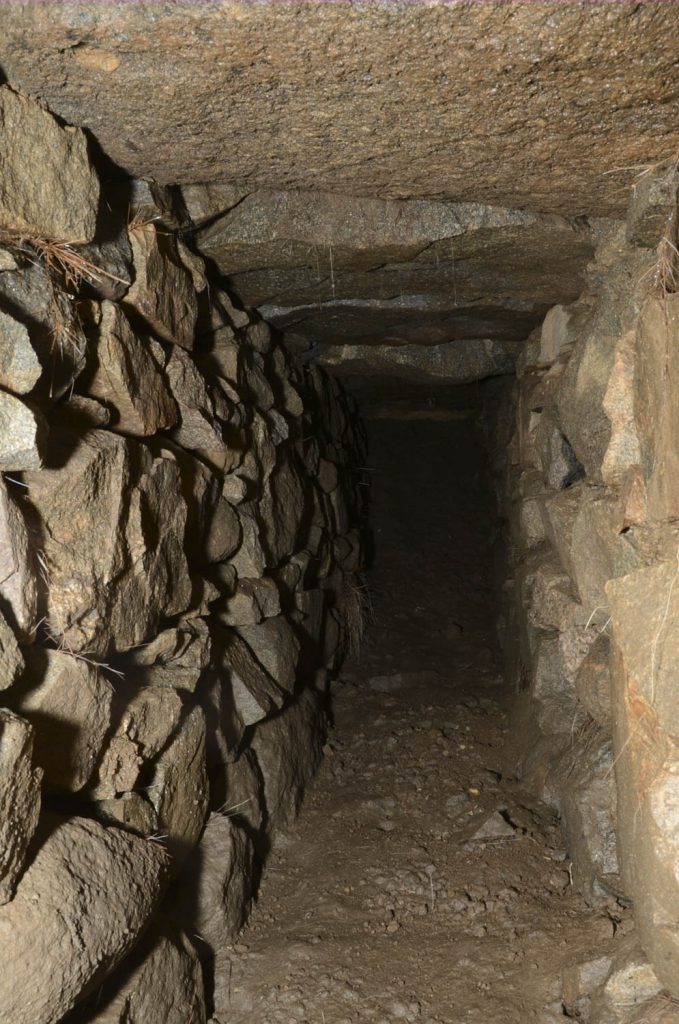
However, the team did record a 1m deep stone-lined drain (pictured below), which was an expensive water management for the estate. Aden House had a laundry, water supply and other buildings which used water and the drain took it from various places in the estate and channelled it down under the garden into the river nearby – the South Ugie water. The current manager of the estate knew that it was there, but wasn’t sure of its exact location until now.
They team also found a concrete pond base while digging test pits to track and map the drain. Although it appeared on the geophysical survey and the 1st edition Ordnance Survey Map (as a central garden feature), they couldn’t confirm that it was a pond until it was excavated. The concrete base had been sited at the centre of the late 19th-century garden but was broken up and thrown into a pit when the garden was levelled in the 20th century.
A modern training ground
In the woods at the north of the park, trenches (which now appear as lumps and bumps) were recorded by plane table survey, a method which uses a flat surface and basic equipment to draw maps and make field drawings. The trenches were probably used to train soldiers in the late 19th and early 20th century before being backfilled up to 100 years ago.
Both projects train students and volunteers and invited school classes to visit the digs, so they have given thousands of primary and secondary school pupils the chance to dig, record and study finds.

If you’d like to know more, you can follow the Book of Deer Project on Facebook and Twitter, or the Archaeology at Aden project on Facebook.
By Ali Cameron from Cameron Archaeology Ltd. Ali went to the Brough of Birsay in Orkney digging with Chris Morris straight after A levels in 1980 and was hooked on archaeology. She studied Archaeological Sciences in the early 1980s at Bradford University then specialised in human remains and came to Aberdeen in 1985 to carry out a six-month contract at the University studying the Aberdeen Carmelite skeletons, loved the city and stayed. She worked for Aberdeen City Council 1986-2010 carrying out large excavations of deeply stratified waterlogged sites and St Nicholas East Kirk excavations. Ali left in 2010 and started Cameron Archaeology where she carries out archaeological work in Aberdeenshire, Moray and Angus.
[1] Aberdeenshire Council venue Aden Country Park received funding from Historic Environment Scotland, The National Lottery Heritage Fund, Aberdeenshire Council and the Friends of Aden in 2017.

This article was produced as part of Archaeological Research in Progress 2020, an online version of the annual conference which presents new research findings and best practice in archaeology covering all periods from across Scotland and beyond. It is organised in alternate years by Archaeology Scotland and the Society of Antiquaries of Scotland, with support from Historic Environment Scotland.
