Top Four Archaeological Sites in the Scottish Borders
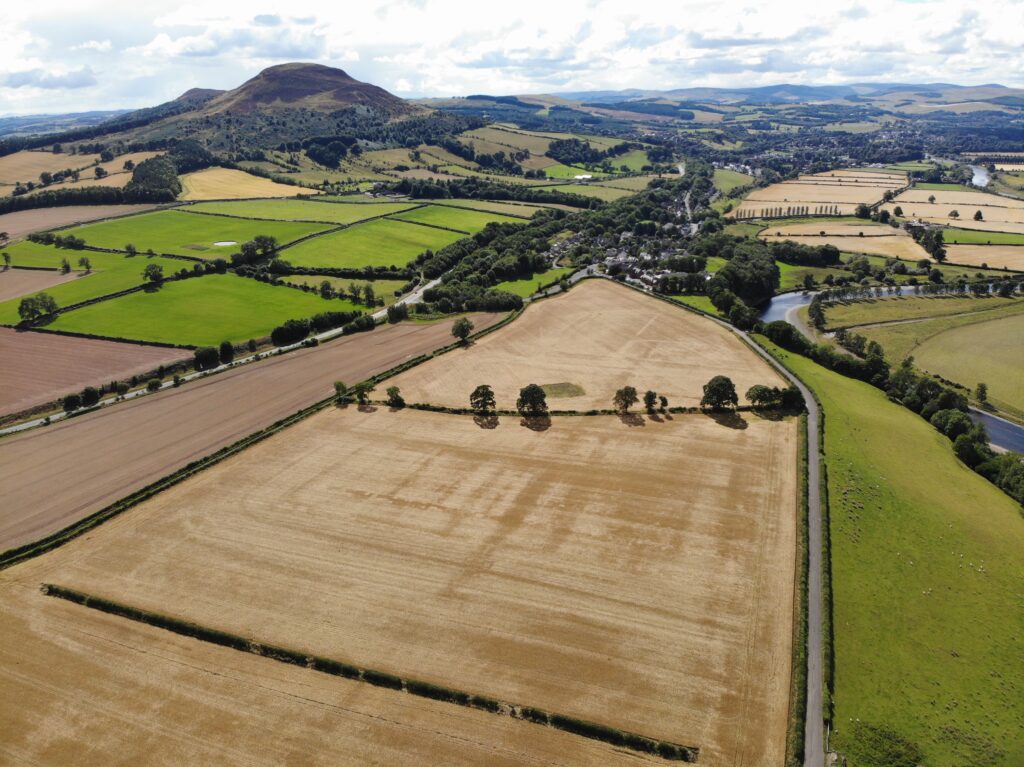
Iron Age complexes, Roman forts, medieval abbeys and more await in the Borders!
Edin’s Hall Broch or Roundhouse
Edin’s Hall Broch was built around 2,500 years ago and is one of the few Iron Age brochs (towers) in lowland Scotland – although many believe it’s closer to roundhouse largely due to the massive diameter (22m).
The ruins are surrounded by an earlier hillfort with double ramparts that stand up to 4.5m high in places. The remains of another large round house can also be found in the fort, and it’s thought that this was the most important building before the tower was constructed. The remains of other roughly circular structures hint at a settlement which may have been built before or after the broch.
According to Canmore, the broch and several of the smaller structures were excavated at various times prior to 1879, resulting in the discovery of a stone whorl, a piece of a jet ring, an amber bead, bones, teeth, an oyster shell, a fragment of a translucent bracelet made of re-used Roman glass, a bronze or brass stud, and an octagonal buckle of bronze or brass (probably from the late 1400s).
Other finds include stone tools such as a whetstone for sharpening implements, a stone spindle whorl for spinning textiles, pottery sherds and ingots (metal blocks) derived from local copper mines which may show how the inhabitants obtained their wealth and prestige.
Wondering where the name comes from? Several 19th-century accounts suggest that it refers to a giant called Etin or Edin who once plagued the area!
The broch is free to visit and open year-round.

Edin’s Hall Broch © Crown Copyright HES
Trimontium (Newstead) Roman Fort
Occupied around 1,800 years ago, Trimontium at modern-day Newstead near Melrose was the biggest Roman fort and settlement in Scotland.
Thanks to various archaeological techniques including excavation and aerial photography, we know that it was constructed in multiple phases as a base for the conquest of the surrounding area and was abandoned and reoccupied several times over a hundred years or more.
Over time, the soldiers built a bathhouse, annexes for manufacturing, training and the temporary housing of troops, and even an amphitheatre. The population may have been anywhere between 2,000 and 5,000 which included troops, manufacturers, craftspeople and traders.
Trimontium is also the site of one of the largest concentrations of Roman military-related finds in Britain – many of which can be seen in the museum. In 1905-10, James Curle excavated the site on behalf of the Society of Antiquaries of Scotland (who coordinate Dig It!) and uncovered over 100 pits containing armour, horse harnesses, saddle plates, ornate cavalry helmets and more. Other discoveries include an inscribed tablet, a human skeleton, an altar dedicated to Jupiter, a coin of Hadrian, soles of shoes, a sculptured figure of a boar and a large bronze wine jug.
No structural remains have survived on the surface, but shapes in the landscape give clues as to what lies below. The amphitheatre, the northernmost discovered in the Roman Empire, is even visible as a grassy hollow with substantial banking to the northern (river) side.
Thanks to the Trimontium Trust (who also run the museum and organise guided walks), information boards and memorial stones can also be found around the fort site.
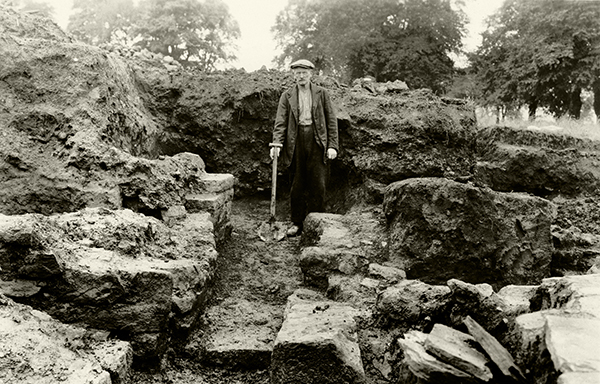
Trimontium excavations in 1905 (© Trimontium Museum)
Jedburgh Abbey Grounds and Visitor Centre
Jedburgh Abbey was established in the 1100s and still features chunky cylindrical pillars, delicate pointed-arch arcades and an impressive rose window despite being caught up in the medieval conflict between Scotland and England.
Major excavations took place in the 1930s and later in the 1980s, which revealed a lot of the cloister complex where the priests ate and slept. Archaeologists also unearthed one of the largest collections of window glass (about 270 items) from any Scottish monastic or ecclesiastical site, including painted fragments.
Other finds include lamps, cooking pots, writing equipment, gaming tokens, a seal pendant with a bird motif, part of a Roman altar dedicated to a god which had been incorporated into the walling, a fragment of a richly carved stone sarcophagus and an intricate comb made of walrus ivory featuring a knight fighting a dragon.
In 2022, Historic Environment Scotland implemented a new approach to the inspection of historic properties in response to the effects of climate change which meant that access to some sites, including the abbey church, would be restricted to enable surveys to be conducted. However, the excavated grounds and visitor centre (where you can see many of the artefacts) are still open.

Jedburgh Abbey (Image Credit: VisitScotland / Kenny Lam)
Stobs Camp
In 1903, Stobs Camp near Hawick was established as the main training base for British soldiers in Scotland and hosted over 20,000 soldiers in the first year alone. The campsite covered a large area and featured rifle ranges, practice trenches and buildings and was serviced by a network of roads and a light railway.
During the First World War, it was updated to house German prisoners-of-war (POWs) and German citizens living in the UK. At this point, the camp could accommodate 4,500 people in around 80 huts and was surrounded by barbed wire fences overlooked by sentry towers. In addition to barrack buildings, the site now included cookhouses, dining rooms, recreation grounds, YMCA huts, a large hospital, its own bakery and a post-office.
By 1916, the last of the civilian internees had been either freed or sent to an internment camp on the Isle of Man, but Stobs continued to hold German soldiers and sailors until they were released in 1919. By the early 1960s, all military connections had been severed and the camp was closed and dismantled.
According to the Stobs Camp Project, the mix of army training camp and prisoners of war and internees in one place is unique to Scotland, as is the surviving visible remains. Within the UK, “no First World War prisoner of war camp has upstanding buildings remaining, no internees’ camp survives on the mainland, and no training camps survive to the same level of preservation.”
In 2017, an archaeology project was launched by this community-led initiative to develop a plan for the site, improve access for visitors, and create interpretation materials to ensure that its important role was remembered. Along with a team of volunteers, the Stobs Camp Project set out to conduct a detailed survey of the POW camp, record the camp buildings and undertake targeted excavation.
If you visit the site today, their heritage trail can guide you around the camp and let you explore what it was like during the First World War.
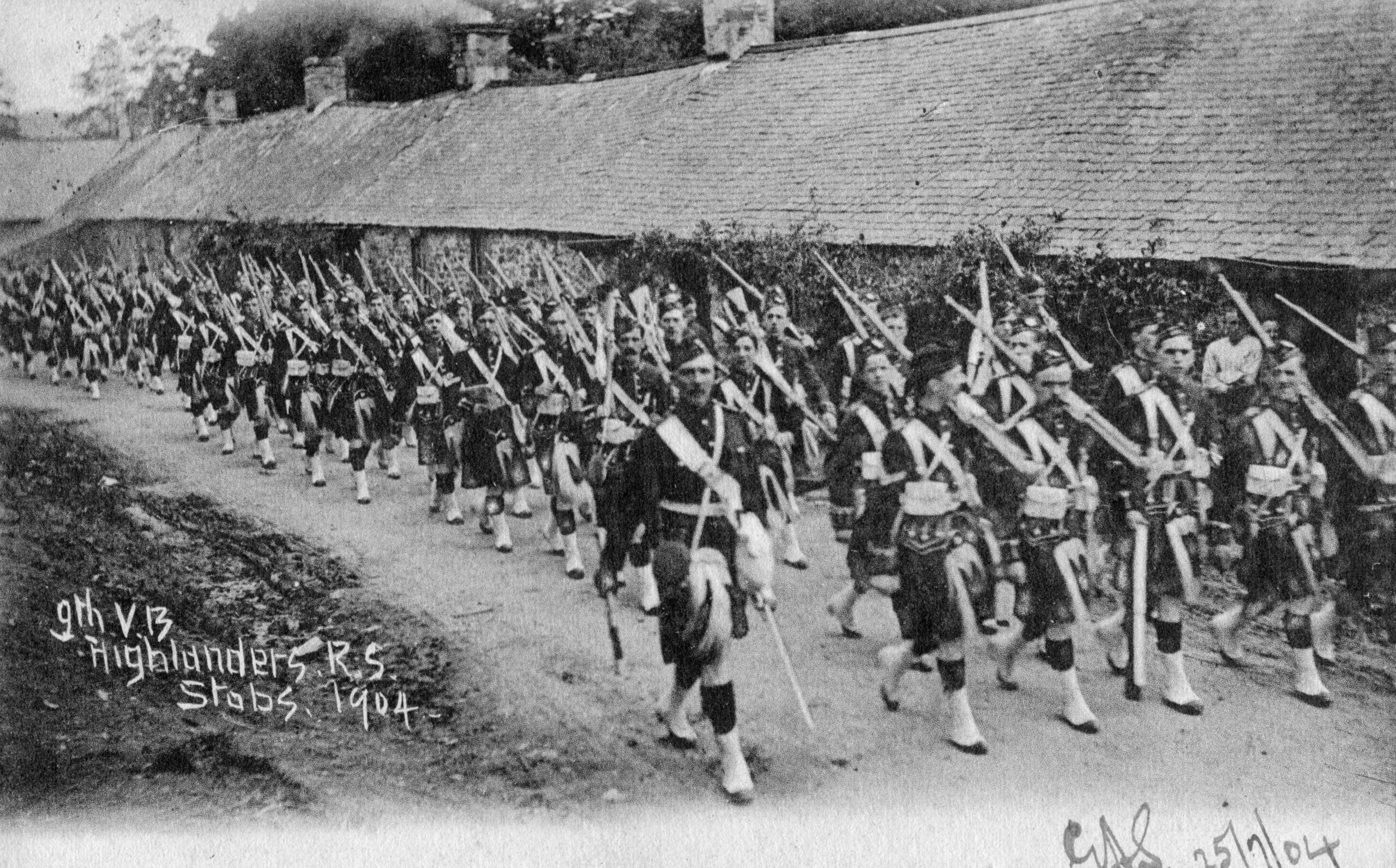
Stobs Camp (Image Credit: The Ian Lowes Collection)
Want to keep exploring archaeological sites by region? Check out the rest of our Designation Archaeology series.
Header Image: The remains of Trimontium fort are still visible today from the air as cropmarks (© Trimontium Museum)