What can small archaeological finds reveal about individuals from Scotland’s past?
Archaeologists don’t dig for treasure, but they do get excited about recovering artefacts which can help them construct a story about the place they’re excavating, and the people who once lived there.
For instance, sherds of pottery from middens (historic rubbish heaps) or pressed into floors and surfaces may provide clues on trade, diet and the manufacturing of ceramics. Nails, rivets and other iron fittings can tell us what buildings and their furnishings looked like. We can even identify the presence and activities of specialists, such as craftspeople, from the debris of their work and discarded tools or pieces of equipment.
But sometimes, we can go a step further and piece together details about the individuals who interacted with these objects. An extensive archaeological project at Finlaggan, an important medieval settlement on Ìle (the island of Islay), has produced thousands of artefacts, some of which can tell stories about the people who lived at and visited Finlaggan over 600 years ago.
A French Connection
This small copper alloy shield-shaped pendant is decorated with a version of the French royal arms, which was used until the late 14th century AD (around 650 years ago). Heraldic pendants like this are normally identified as horse-harness mounts, but the mount at the top of this example has broken off.
They are not an uncommon find and many pendants with enamelled arms have been identified as belonging to noble owners in the 14th century. However, it seems unlikely that the Finlaggan pendant was the property of a French king, or even a possession of a senior member or retainer of the French royal family. And while a Scottish alliance with France led to French forces appearing in Scotland in AD 1384 and 1385, these didn’t lead to military activity anywhere near Ìle.
But could the ownership of the pendant have any more significance than that it was a pretty design? We could look for other examples of French royal arms on artefacts found in Scotland, and circumstances in which a Scot might legitimately have shown off their French connections. But for now, we can wonder about the story of the individual who owned this artefact and how it ended up at Finlaggan.
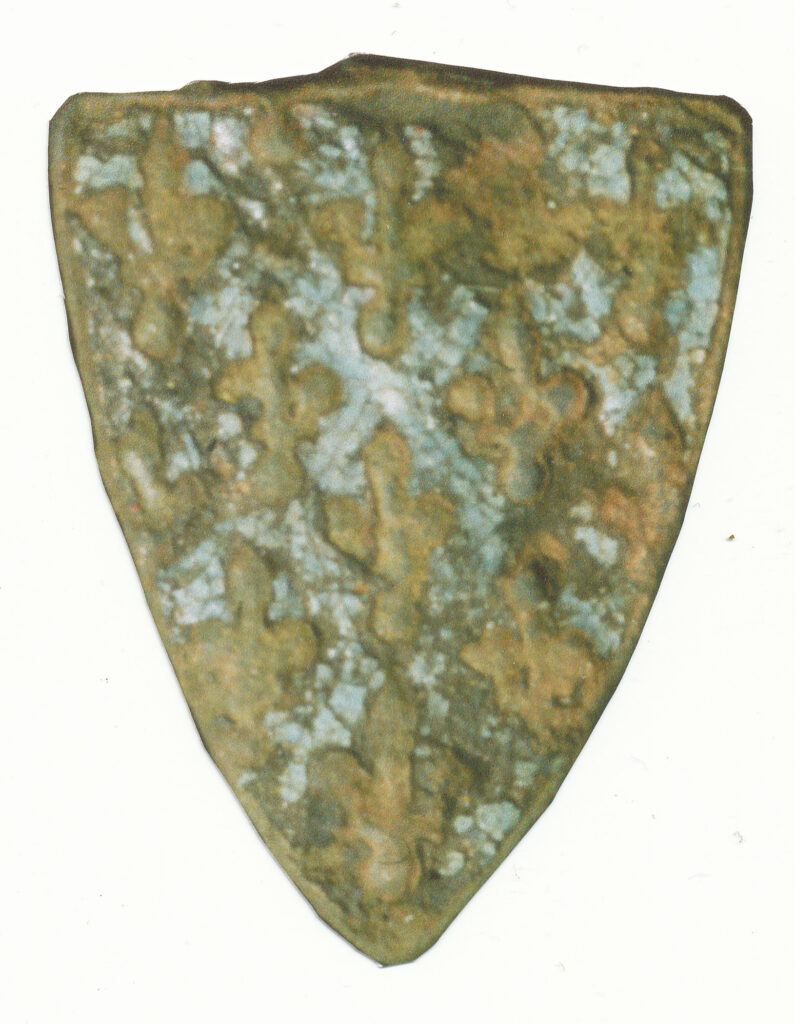
Heraldic pendant decorated with the French royal arms. There are now no traces of gilding and the enamel has turned pale blue (David H Caldwell)
A Pilgrimage to Rome
In 1994, half of a lead pilgrim’s badge was also discovered at Finlaggan. It was neatly broken in two sometime in the past and had corner piercings so that it could be sewn on to clothing. The surviving piece has an image of St Peter with a key, and the missing half would have featured St Paul.
This is a well-known type of pilgrim souvenir from Rome and suggests that someone visited the city, perhaps in AD 1300 at the time of the first Papal Jubilee when a plenary indulgence (a powerful pardon granted by the Catholic Church to cleanse a person of their sins) was granted to pilgrims visiting the basilicas of both St Peter and St Paul. A fragment of another similar badge was recovered from excavations at Whithorn in Wigtownshire*.
The significance of this Finlaggan find is that it suggests that pilgrims travelled from Na h-Eileanan a-staigh (the Inner Hebrides) to Rome, a journey that is not recorded in surviving documentary records. The pilgrim would have been a devout person, not necessarily of great wealth. Perhaps the adventure was made as the result of a vow, or to impress a prospective spouse.
The deliberate halving of this badge may have been done so that the other piece could be worn by a partner, friend or relative who had stayed at home. Finds like this help us to picture one particular person and be drawn into understanding their world and the beliefs and relationships that were important to them.
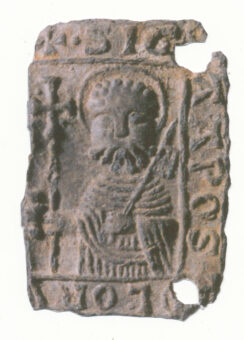
Medieval pilgrim’s badge acquired in Rome (David H Caldwell)
Canine Companions
We’ll never know the names of the owners of the heraldic pendant and the pilgrim badge. There is, however, a third find from Finlaggan for which ownership can be identified with some certainty, even though there are no inscriptions or heraldry (badges relating to a particular family) to back up this judgement.
This find consists of a group of copper alloy mounts, originally covered thinly with gold leaf or gold paint, which represent the remains of a pair of dog-collars and leashes. There are several dome-headed rivets which would’ve decorated the collars, and two complex mounts with swivel rings (decorated with dragonesque heads), loops and strap-ends to close the collars and attach the leashes.
This group of artefacts was recovered from a midden which accumulated in the 13th Century AD (around 700 to 800 years ago) at the bottom of the loch next to the large stone tower which was the residence of the owner of Finlaggan.
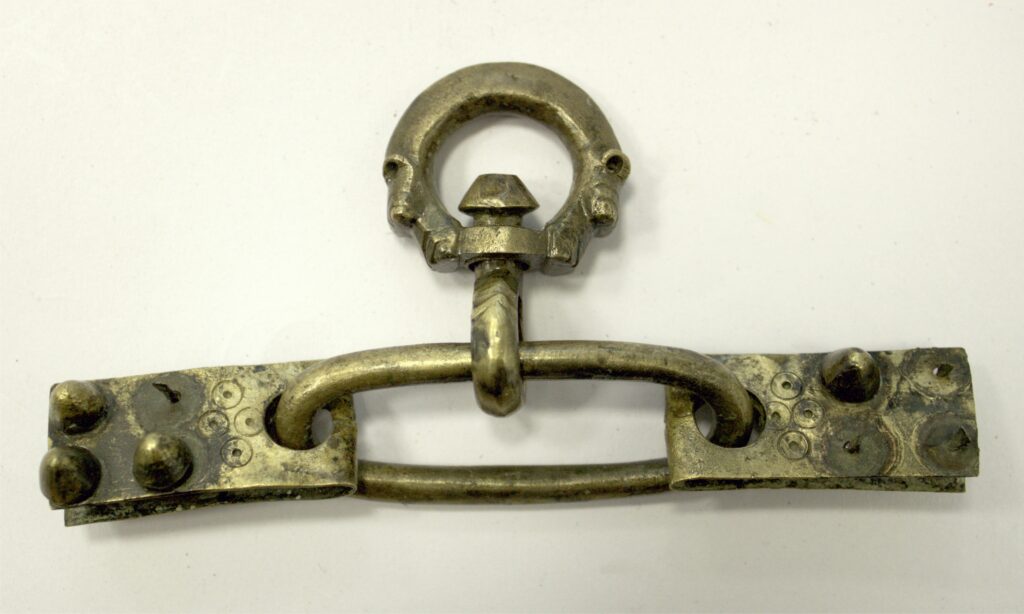
Mount from a medieval dog collar (David H Caldwell)
Given that leather has survived well in this midden, it might seem surprising that no other examples of leather were found attached to this group of objects. However, one of the strap-end mounts has some traces of cloth trapped inside it, indicating that the collars were made of textile, perhaps expensive and colourful.
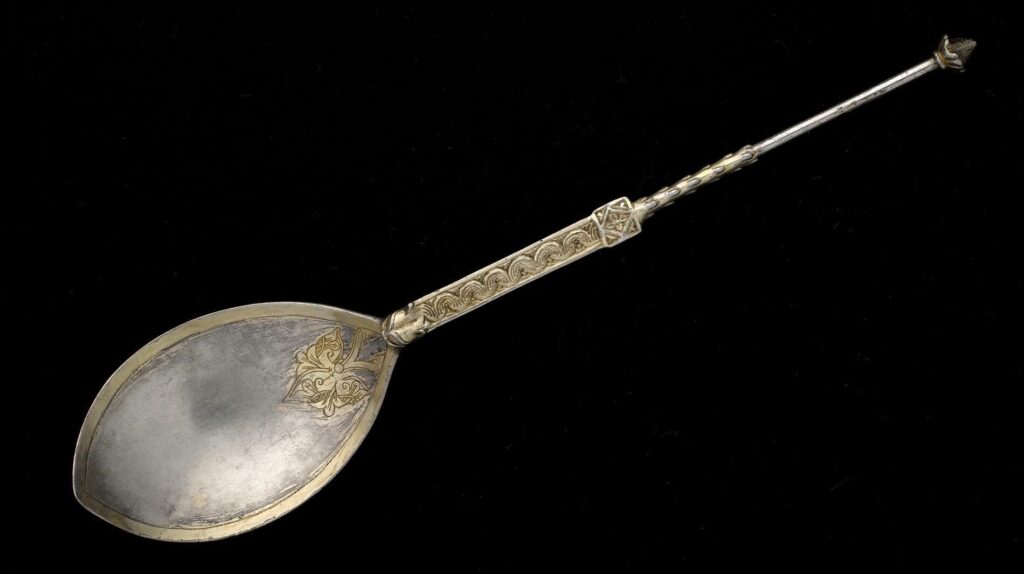
The mounts are of a high standard of design and workmanship, particularly the dragonesque heads. They’re similar to the animal heads joining the stems to the bowls of silver spoons (see header image), thought to date to about AD 1200, around 800 years ago, from a hoard deposited in the Augustinian nunnery on Eilean Ì (the island of Iona). The spoons are now in the National Museum of Scotland in Edinburgh. It would surely not be surprising if these spoons and the Finlaggan mounts were made by the same Isles’ craftsperson, working for high status patrons. In medieval Scotland, the rich kept dogs for hunting, and these Finlaggan mounts can help us assess the culture and sophistication of the leaders of Isles’ society; they were clearly not the barbarians that some outsiders believed them to be.
But even more than that, we know that in the mid to late 13th century AD, Finlaggan was the residence of Aonghus Mór mac Domhnaill, a great man in the world of the Isles, West Highlands and Ireland. There is a praise poem composed for Aonghus by an Irish poet in the mid-13th century** describing how he inherited his hounds with their leashes from his father. Could we have discovered the very collars and leashes seen by the Irish poet 750 years ago?
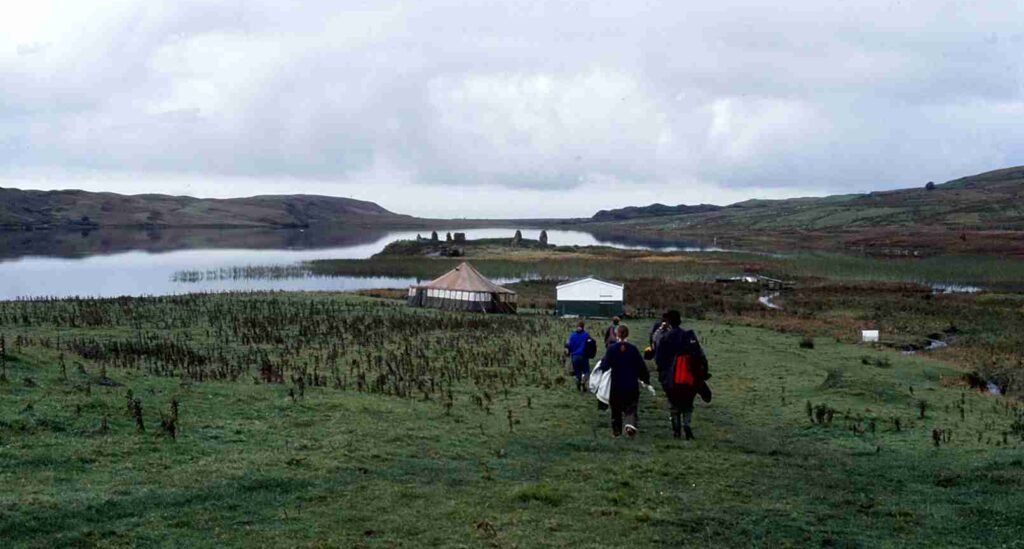
The historic site of Finlaggan is on two islands in a freshwater loch. This view shows some of the excavation team heading for our site hut in 1992 (David H Caldwell)
Excavations took place at Finlaggan from 1990 to 1998. Dr David H Caldwell is now getting close to completing his final report on the project. Some of the finds, including those mentioned here, are displayed in the Finlaggan Visitor Centre, close to the site itself and is well worth a visit.
BY DR DAVID H. CALDWELL FSASCOT. DAVID WORKED AS A CURATOR IN THE NATIONAL MUSEUM OF SCOTLAND FOR 38 YEARS UNTIL HIS RETIREMENT IN 2012 AND WAS PRESIDENT OF THE SOCIETY OF ANTIQUARIES OF SCOTLAND (WHO COORDINATE DIG IT!) FROM 2016 TO 2020.
*Hill 1997: 395, illus 10.78, no 2 – ie Peter Hill 1997 Whithorn & St Ninian The Excavation of a Monastic Town 1984-91. Stroud.
**It appears in Clancy, TO 1998 The Triumph Tree Scotland’s Earliest Poetry AD 550-1350, Edinburgh: Canongate.
Header Image: Spoon, cast in silver, decorated with engraved foliaceous designs and gilt incised lines, found under the floor at Iona Nunnery, 13th century: Scottish or English, c. 1200 (© National Museums Scotland)
