What Happens When Human Remains Are Found in Scotland?
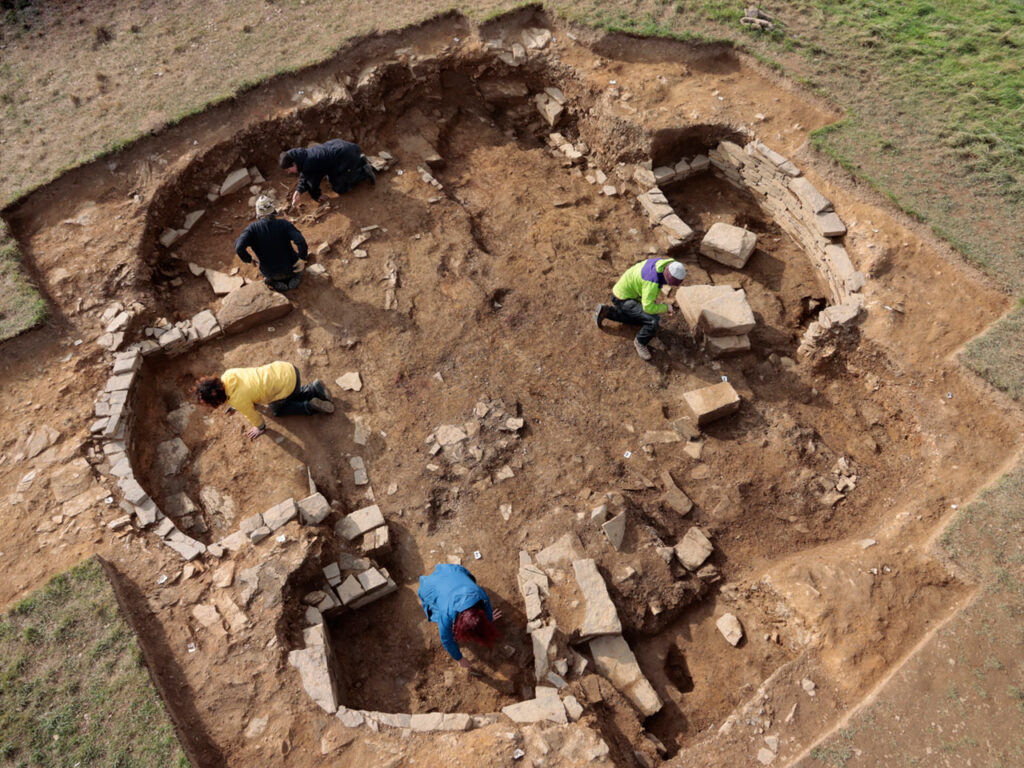
With over 12,000 years of human history beneath our feet, the remains of people who lived in Scotland before us are found frequently, and often in unexpected places.
They’ve been uncovered by dogwalkers on beaches after a storm has eroded the coastline, by archaeologists excavating in advance of the construction of new roads and housing, in agricultural fields, in gardens, and even under floors.
We asked archaeologists to explain what happens when human remains are found in Scotland and what you should do if you come across them.
[NOTE: Article contains images and descriptions of human remains]
What Should I Do If I Find Human Remains in Scotland?
All human remains found in Scotland must be reported to the police in the first instance, whether they’re discovered by the public or archaeologists.
If you find human remains in Scotland, don’t disturb them. If they’re recent, you could be disturbing a crime scene which is a criminal offence. If they’re of archaeological significance, the context of their discovery is also crucial to finding out more about them.
Instead, report them to Police Scotland by calling 999. You can also contact your local authority archaeologist by finding their details through ALGAO: Scotland. If they’re at risk of being lost before the police can respond (for example, by an oncoming tide), you may be asked to photograph the remains as you found them before moving them to a safer nearby location.
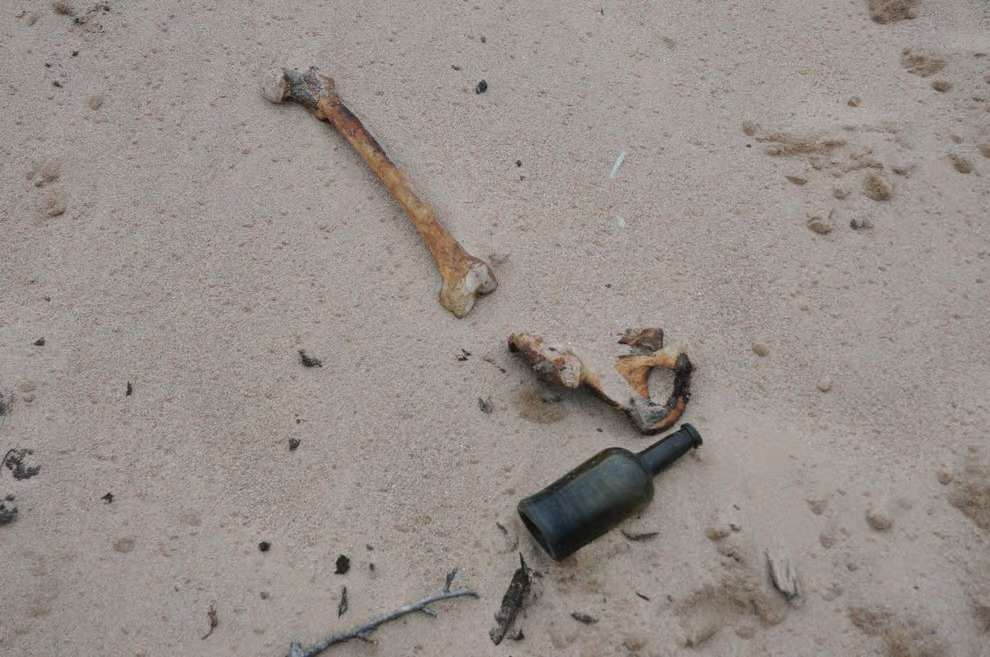
Part of a human skeleton as found on a beach in Aberdeen shortly after shifting sands had exposed an 18th century burial (Credit: Police Scotland).
If you can, take a note of where the remains have been found with details such as a National Grid Reference or a What3Words location, and take photos of the remains and the area as a record. It’s essential that you don’t post these to social media or share them with friends and family. If the remains turn out to be recent and an investigation into a death takes place, sharing photos could lead to criminal prosecution.
When reporting the discovery, you’ll be asked follow-up questions by the police, and potentially by an archaeologist as well. These are nothing to worry about. They’re simply to help them understand how the remains were found, whether they’ve been disturbed since, and gather any other details that could help clarify how the remains got there.
Once reported, the police will work the local authority archaeologist, and sometimes with the Centre for Anatomy and Human Identification (CAHID) at the University of Dundee, to confirm that the remains are human. An expert will give their professional opinion on whether they’re recent or historic. If they’re suspected to be older than 100 years, the police will seek guidance from the local authority archaeologist on next steps.
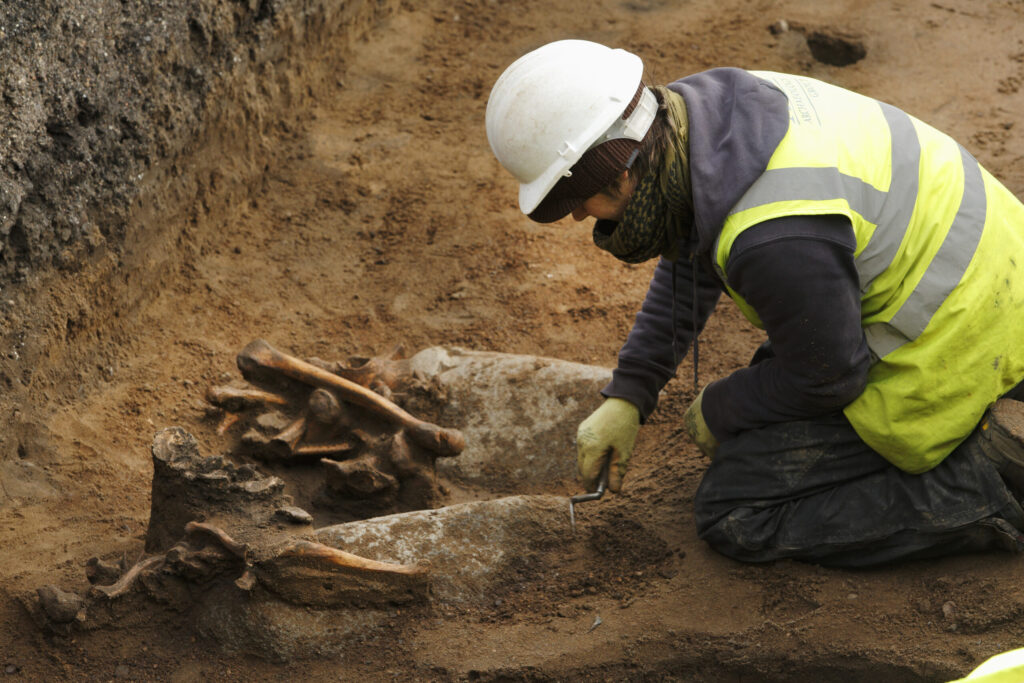
Excavation of ‘’Newhaven Pirate’’ by AOC Archaeology, Newhaven Edinburgh (© The City of Edinburgh Council)
What Happens When Human Remains Are Found by the Public?
When a local authority archaeologist is informed of the discovery of human remains in a location not associated with planning conditions (for example, when they’ve been revealed by coastal erosion or agricultural activity), they will usually notify Historic Environment Scotland who will employ the human remains and emergency archaeology call-off contract.
This contract coordinates the rapid response to these discoveries, which is then followed up by post-excavation analysis and the sharing of the results of the investigation.
Human remains found with objects (what archaeologists call “material culture”) pass through the Treasure Trove system and are allocated with those objects by the Scottish Archaeological Finds Allocation Panel (SAFAP) to a relevant accredited museum or institution. As of 2024, human remains without associated objects could also be allocated to museums through the Treasure Trove system (you can read more about that in this article).
For example, in 2017 a sighting of human remains eroding out of sand dunes on Ìle (Islay) in Na h-Eileanan a-staigh (the Inner Hebrides) was reported to the local police who requested assistance from Historic Environment Scotland via the human remains and emergency archaeology call-off contract.
No artefacts or grave goods were found as part of the burial, but analysis of the bones (now curated by National Museums Scotland) revealed that the skeleton belonged to a male aged between 26 and 35 years old who lived in the Mid-Iron Age (around 2,200 years ago). The investigation of these human remains is important for what they can reveal to us about the nature and date of the varying burial rites practised throughout this region during the Iron Age.
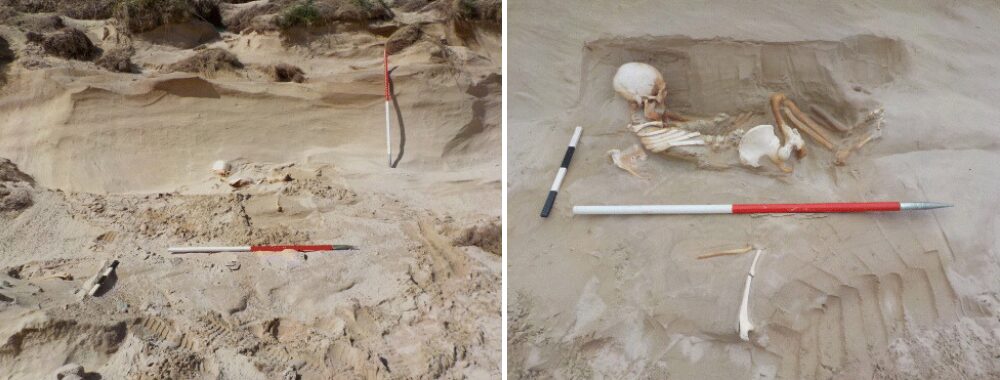
Inhumation and old ground surfaces and the excavated skeleton (© Donna Hawthorne and Kevin Paton, CC BY-NC 4.0)
What Happens When Archaeologists Find Human Remains on a Dig in Scotland?
Even when archaeologists find human remains on a dig, their discovery is still reported to the police before the archaeologists proceed with excavation.
The Chartered Institute for Archaeologists (CIfA) and the British Association of Biological Anthropology and Osteoarchaeology (BABAO) provide guidance for archaeologists working on sites where human remains are present to promote and guide standardised recording, so that human remains are excavated and analysed according to recognised codes of ethical practice. An example of what this recording might look like can be found in the Scottish Historical and Archaeological Internet Report on the treatment of the dead identified at Jedburgh Abbey in the Borders (here).
What Happens When Archaeologists Find Human Remains During Development Works in Scotland?
The vast majority of archaeological work which takes place in the UK happens through developer-led archaeology, which is undertaken to offset the impact that development (such as the building of new houses, schools or roads) has on our historic environment.
Archaeologists will advise developers on locations where there’s a risk of disturbing human remains. Where there’s a suspicion that they might be found, the local authority archaeologist will place conditions on planning consents. This might mean the excavation of the burials before building works begin or sensitive construction which enables burials to remain in-situ (in their original location).
The developer is responsible for ensuring appropriate treatment of the human remains, just as they are when other archaeological remains are discovered during the course of works. The excavation and analysis of human remains is a specialised task, which can be time consuming and expensive. If it’s possible to avoid disturbing them, this is usually the best option.
In 2019, archaeological work was carried out by AOC Archaeology ahead of a new residential development by D J Laing at Carnoustie in Angus which revealed evidence of a long‑lived settlement and burial landscape. The site was used at different times from the Neolithic (which began around 6,100 years ago) through to the medieval period (which ended around 500 years ago).
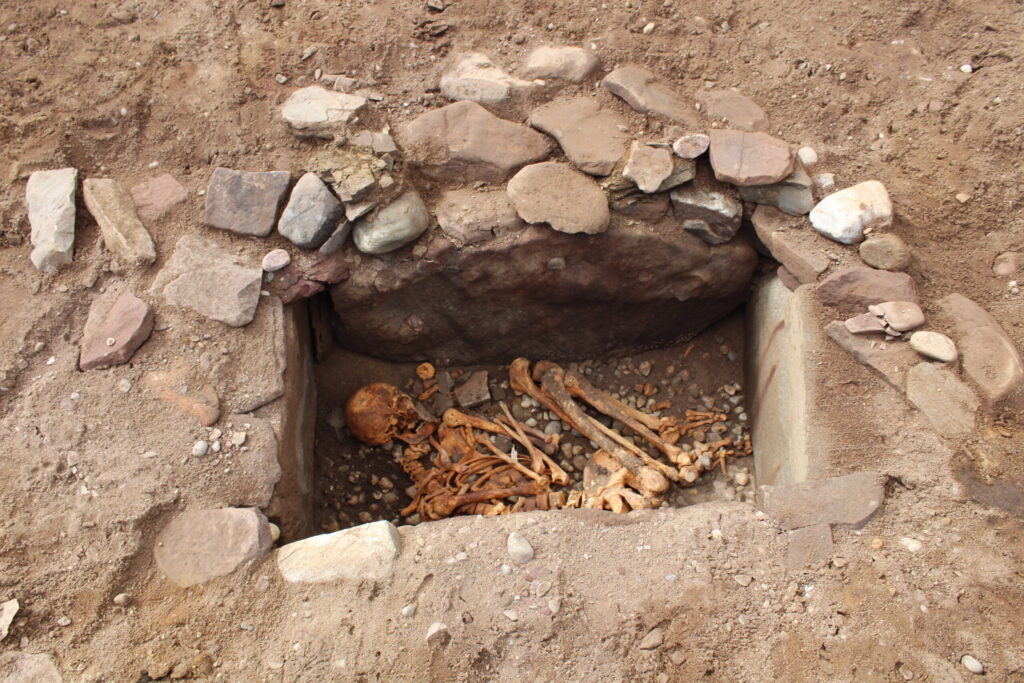
One of several cist burials uncovered at Carnoustie (© AOC Archaeology Ltd.)
The most striking discovery was a “potentially nationally significant” Bronze Age cemetery made up of eight stone‑lined graves known as cists. Some of these contained well‑preserved human remains buried in crouched positions, along with grave goods such as pottery beakers, stone blades, textiles and decorated bone objects.
One grave held the remains of at least three individuals, including an adult wrapped in a possible hide or fabric shroud (an incredibly rare find as textiles rarely survive in Scotland’s acidic soil), a juvenile and the cremated remains of someone else, all carefully placed on a bed of quartz pebbles. The arrangement of the pebbles has led archaeologists to suggest that people may have returned to tend to the deceased and potentially add other individuals to the burial site over time.
Together, these burials provide a valuable insight into Bronze Age burial practices, beliefs and daily life in the area. As of March 2026, ongoing post-excavation analysis includes aDNA sampling to hopefully establish whether any of the individuals were related to each other, especially for the burial which contained three people.
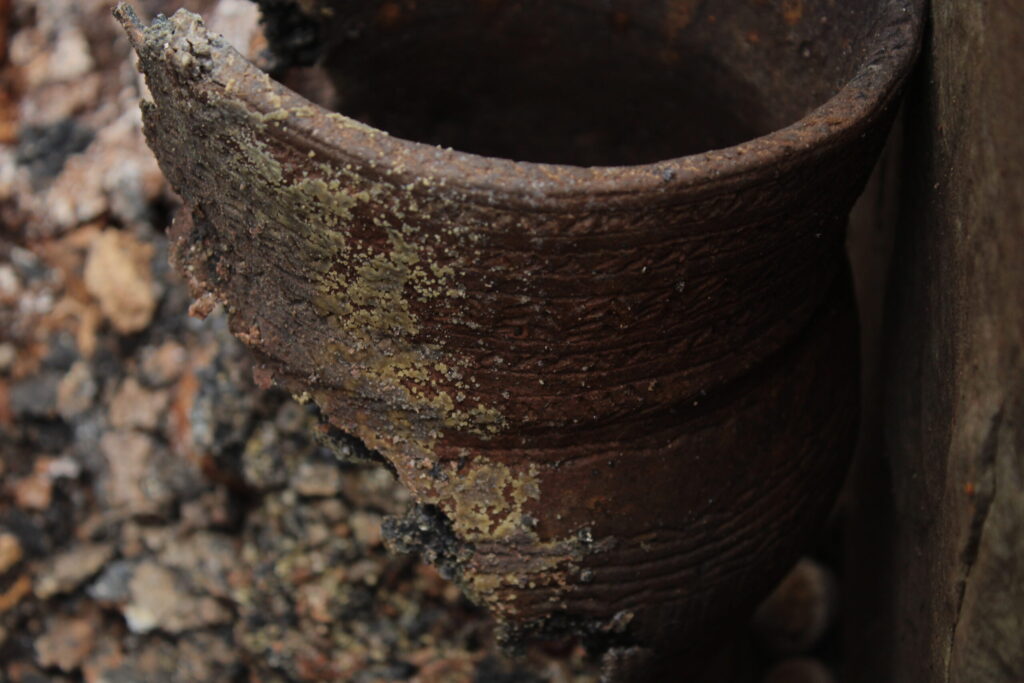
One of the Carnoustie cist burials containing a broken beaker pot, with prehistoric textile attached (© AOC Archaeology Ltd.)
What Happens When Human Remains Are Found on Digs Involving Universities, Museums and Community Groups in Scotland?
While archaeologists working on developer-led sites will normally excavate human remains which need to be investigated in advance of development, other archaeological digs may excavate human remains which are not under threat from development, and in these circumstances, this must be strongly justified in the research design. These research questions could be provided by the Scottish Archaeological Research Framework (ScARF), the go-to research resource for Scottish archaeology coordinated by the Society of Antiquaries of Scotland.
Since 2023, National Museums Scotland and Cardiff University have been excavating a lost Neolithic passage-grave in Blomuir in Orkney. This incredibly rare site is around 5,000 years old and contained the remains of at least 33 individuals; men, women and children. 23 of them were preserved as articulated skeletons (where the bones were still connected), mostly in flexed positions which is very unusual for Neolithic tombs which tend to contain disarticulated remains (where the bones are separate from each other). No grave goods were recovered, but a cattle tooth, pig incisor and fish bone were found amongst the burials.
The remains were transferred to the National Museums Collection Centre in Granton, Edinburgh, for cleaning and post-excavation analysis, including aDNA and stable isotopes, which continues into 2026. As with developer-led excavation assemblages, the human remains will be allocated to a museum through the Treasure Trove process alongside the material culture found alongside them, following full publication.
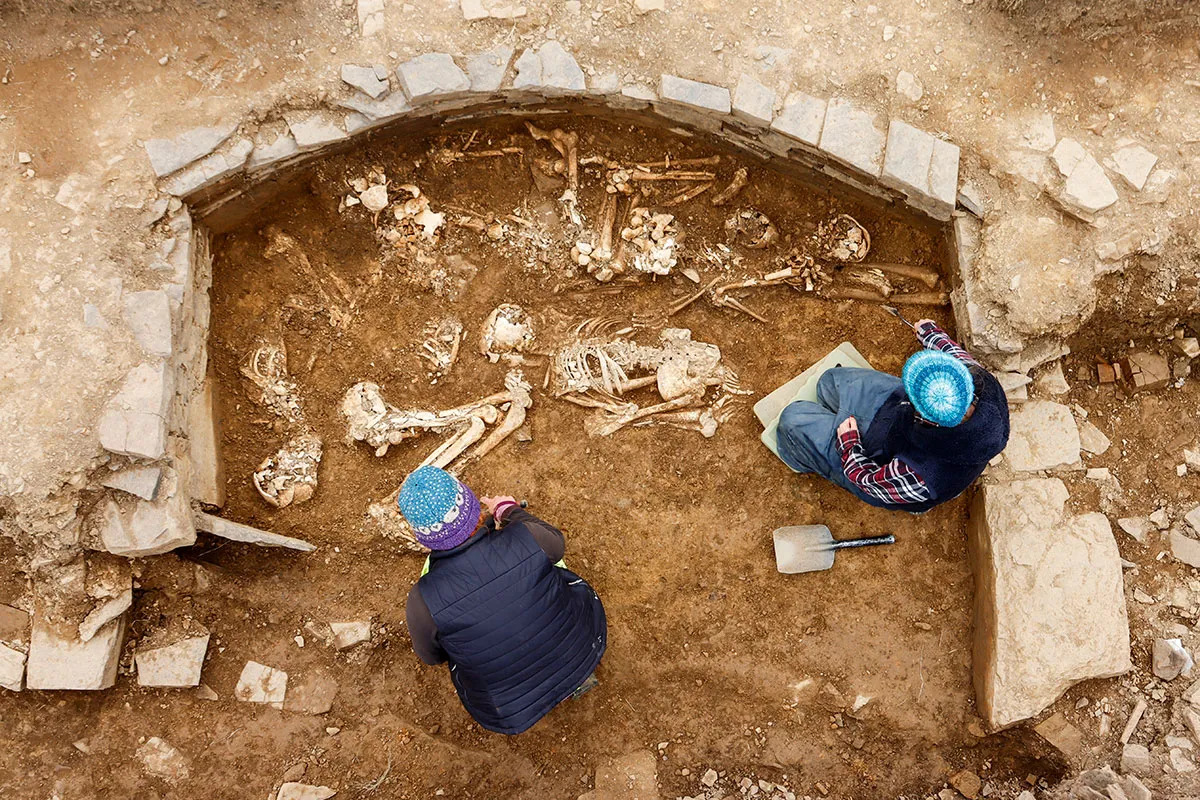
Articulated Neolithic burials in the south cell of Blomuir passage grave under excavation in 2023 (© National Museums Scotland)
Osteoarchaeologists (specialists in the study of human bones) should be involved in every stage of investigation involving human remains. And although excavation can take place on digs involving volunteers, human remains should always be excavated under the direction of a suitably qualified and accredited archaeologist with experience in the excavation and recording of human remains.
For example, the Thirlestane Barrows in the Scottish Borders were the subject of a community excavation in 2022 as part of Drumelzier’s Hidden Heritage, a project which uncovered the prehistoric and early medieval cultural heritage of the Britons in this part of southern Scotland. A collaboration between the Arthur Trail Association, local heritage groups and GUARD Archaeology, the project offered volunteers training in all aspects of archaeological work.
In October 2022, the team of archaeologists and volunteers excavated this prehistoric burial monument which had only been identified a few years before when cropmarks were spotted from a nearby hillside by a local resident and subsequently confirmed by a Historic Environment Scotland Aerial Survey.
The team unearthed fragments of five Bronze Age ceramic urns, including Early and Middle Bronze Age vessels from cremation burials (dating to around 3,300 years ago). The cremated human remains represented at least six individuals, including adult females and children.
Following post-excavation analysis, the assemblage was reported to Treasure Trove, where it was considered by the SAFAP and allocated to National Museums Scotland in December 2024, where it’s now ethically curated and further research can be carried out.
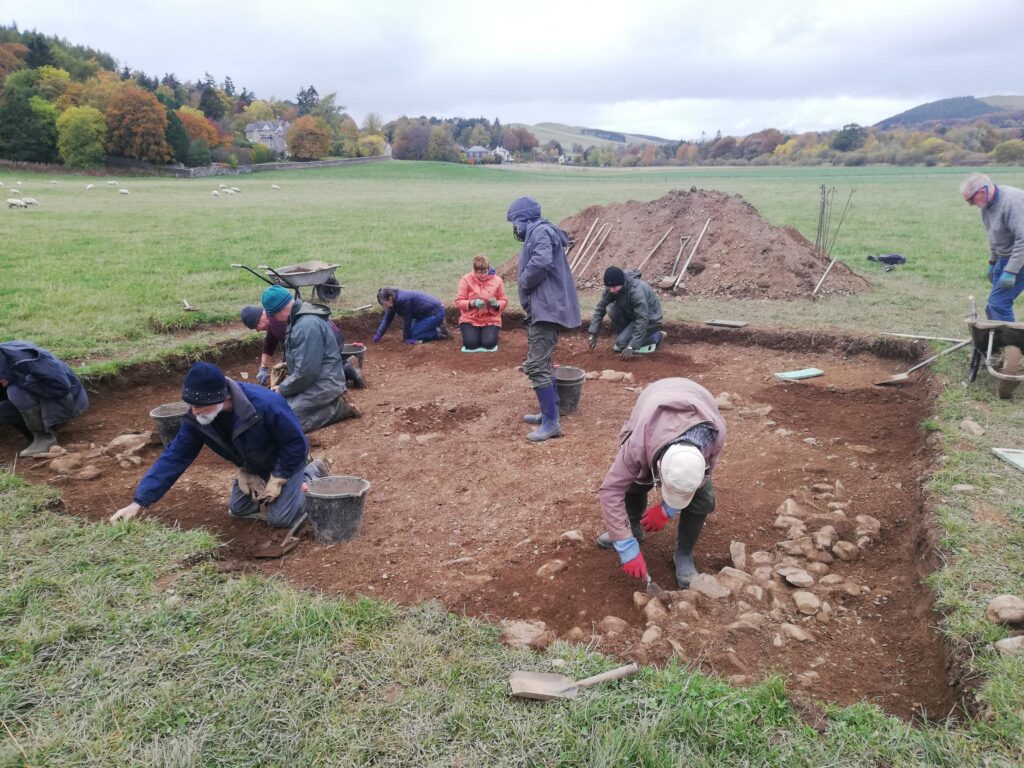
Excavation of the one of the Thirlestane Round Barrows (© GUARD Archaeology)
Do Archaeologists in Scotland Try to Find the Relatives of the Deceased?
Generally, no. Finding living relatives of deceased individuals from the past without accompanying records is almost impossible. But in exceptional circumstances, such as in historic burial grounds when individuals of known identity are excavated (and evidence such as church records or coffin plates with names, survive), archaeologists can and do work with a local council’s Bereavement Services to ensure appropriate mitigation for exhumation where necessary.
For example, archaeological work in advance of the Trams to Newhaven project in Edinburgh encountered part of a medieval parish cemetery on Constitution Street where the last burial dated to around AD 1650 (over 370 years ago) and no historical records of the identities of the cemetery’s inhabitants survive. In theory, some of those deceased may have decedents still living nearby but finding them would be impossible without aDNA sampling of the whole of the area’s population.
On the other hand, a project to install a lift access to the undercroft at St John the Evangelist Church on Princes Street in Edinburgh required the excavation and reburial of the remains of known individuals within a 19th century family burial lair dating from AD 1826. This was undertaken with discussions with the church who had good burial records of the individuals affected by the works. In the end, they couldn’t find any surviving direct relatives and the remains were exhumed, recorded and reburied on site in discussion with the church.
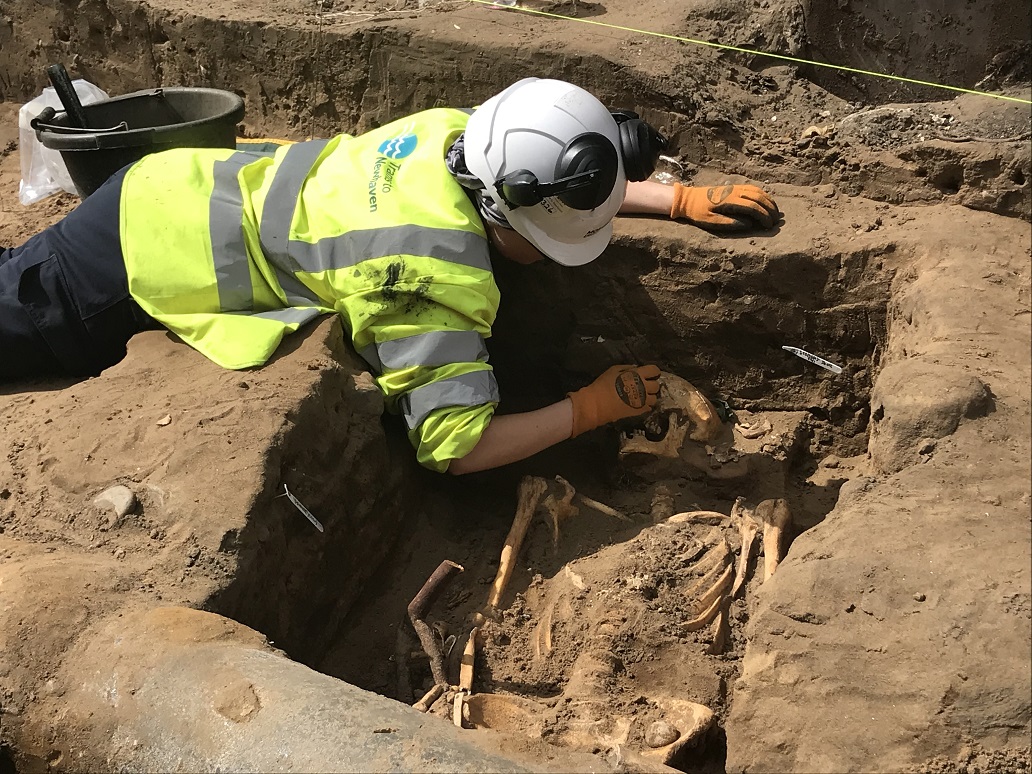
Excavation of medieval South Leith Parish Graveyard during construction of Edinburgh Tram to Newhaven 2020 (© The City of Edinburgh Council)
What Happens to Human Remains After They’re Found in Scotland?
Although the UK has good ethical standards (professional guidelines), legal protections for human remains are scant. They can’t be owned, but they can be legally damaged or destroyed without recording. Plus, human remains discovered or collected centuries ago can be legally sold at private auction, though there are organisations who are campaigning to stop this practice.
The decision of whether to excavate and remove human remains, rather than avoid or cover them over depends on the extent of the risk to them—whether they will be disturbed (or potentially disturbed) through planned or future works—and their research value for understanding our past.
In Scotland, the reburial of human remains of archaeological interest is not generally practiced, and most excavated human remains are retained in collecting institutions such as museums.
Why Don’t Archaeologists in Scotland Rebury All Human Remains?
There are a few reasons why archaeologists don’t rebury all human remains they come across. This is partly due to their research potential – they retain them because as archaeological techniques improve, they can undertake more research on the remains which could allow for further insight into the past.
But if they did decide to rebury human remains which have been through the archaeological process – how should they rebury them? Attitudes towards the dead in the past differed from those of today. Excarnation (removing flesh and organs), the disarticulation of bones, disinterment (removing human remains from their resting place) and repeated use of the same burial place are all known to have occurred in the past, and these are only small glimpses of complex funerary rites which are lost to us.
In the 21st century, archaeologists consider it vitally important to treat human remains with the respect owed to the remains of a once-living person, especially when the disturbance of their remains is unexpected or unavoidable (for example, by coastal erosion). In doing so, they must also acknowledge that we do not know what people in the past would’ve considered to be appropriate.
People today may have differing views on whether or not the careful scientific excavation and curation of human remains is more ethical than reburial, depending on their own cultural practices and background. However, notions of single interment and resting in eternity in the same location are relatively recent and not universally accepted across different cultures even today. We need to be careful not to impose our own preconceptions on the remains of past peoples.
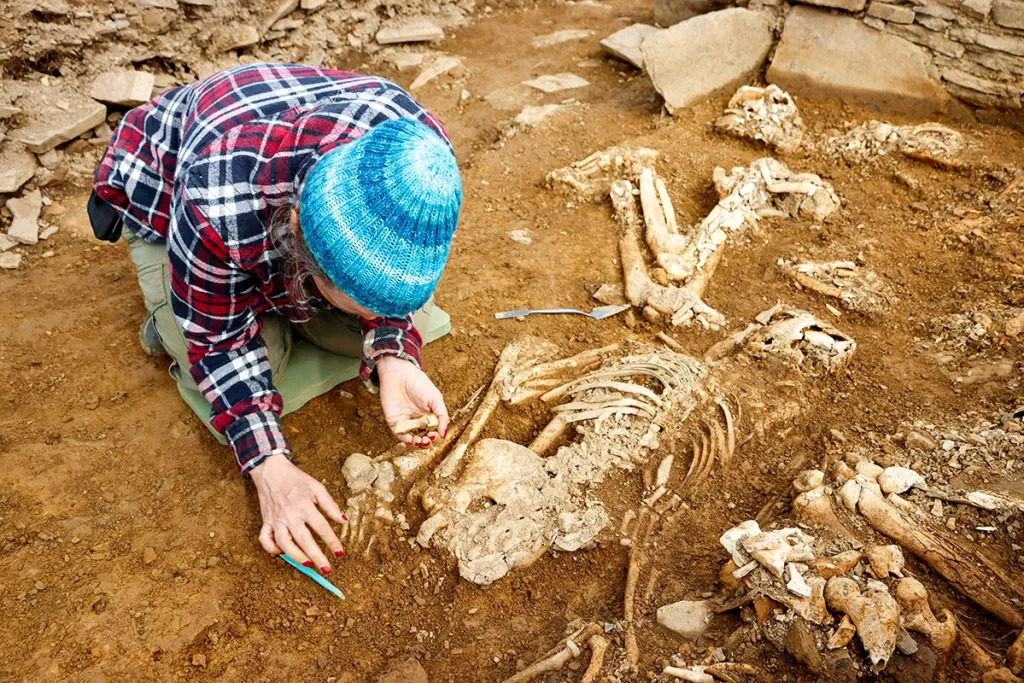
Articulated Neolithic burials in the south cell of Blomuir passage grave under excavation in 2023 (© National Museums Scotland)
As scientific analysis is constantly developing, so is the ability to care for and learn from the people who went before us. Institutions which care for large collections of human remains have specialist facilities and high standards of ethical care, and those collections retain the potential to tell us much about the past and the future.
These individuals can help us to understand how people lived, died and were remembered in Scotland over millennia and their remains can be used to study health, disease, population movement, climate impacts and many other things which can help to tackle challenges to today’s population.
Indeed, for people from the past whose remains were excavated and taken to a museum or university for further study, their story continues. Find out what happens to human remains that are curated in collections in this article.
By Kirsty Owen FSAScot, Deputy Head of Archaeology at Historic Environment Scotland; Bruce Mann FSAScot, Senior Historic Environment Officer at Aberdeenshire Council and Chair of ALGAO: Scotland; John Lawson FSAScot, Archaeology Officer at The City of Edinburgh Council; Jane Matheson, Bereavement Services Operational Manager at The City of Edinburgh Council; Dr Jess Thompson FSAScot, Curator of Osteoarchaeology at National Museums Scotland; and Dr Matt Knight FSAScot, Senior Curator of Prehistory at National Museums Scotland.
Header Image: Overview of Blomuir Neolithic passage grave (© National Museums Scotland)
