What Can Archaeology Tell Us About Prehistoric Migration in Scotland?
Migration has been a hot topic in archaeology since its beginnings.
Antiquarians and archaeologists of the 19th and 20th centuries often interpreted changes in the archaeological record as representing invasions of new people with new cultural traditions who wholly replaced previous groups.
In other words, whenever a new style of ceramic vessel appeared, it was assumed that new groups of people had arrived and brought a different technology or culture, a way of thinking that is sometimes summed up as ‘pots equal people’.
These interpretations became tied up with ideas around cultural and ethnic superiority in the context of European colonialism. For example, the prevailing belief at the time was that the ‘invaders’ who arrived in what is now Scotland during the Neolithic period over 4,500 years ago (2500 BC) brought farming and ‘civilised’ the hunter-gatherers who were already living there, presumably by violence as that’s how Europe was mainly colonising other places at the time. Concepts such as these were eventually co-opted as part of Nazi ideologies about the predestined superiority of a Germanic ‘race’.
After World War II, archaeologists became understandably suspicious of explanations of archaeological change that were underpinned by migration or invasion and developed well-reasoned critiques of these earlier theories about invasions (also known as ‘invasion neuroses’).
The problem with studying migration in the archaeological record is that material traces of societies can only ever be proxies of human movement. Just because a pot moved great distances doesn’t mean that people did. It may have been traded or gifted and passed between dozens of people who never moved more than 10 miles away from where they were born.
It’s also problematic because material remains such as pots generally relate to people’s social identities (or their perceived social identities) rather than their biological identities (the actual biological relationships that humans had with each other).
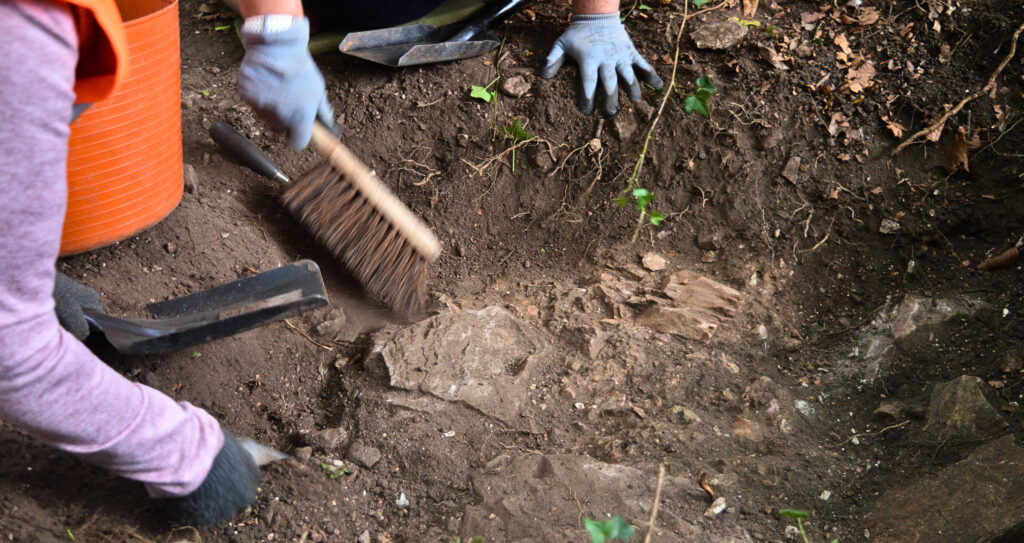
Excavation (Image credit: Sally Pentecost FSAScot)
ARCHAEOLOGICAL EVIDENCE OF MIGRATION
This situation has changed in the last few decades thanks to new scientific methods, firstly through the development of stable isotope techniques. This uses signatures of diet and childhood geology locked up in human bone and tooth enamel to identify if people had moved across large distances over their lifetime.
The situation then progressed again at the end of the 00s which saw the development of Next Generation DNA Sequencing (NGS) technology which was a catalyst for reliable sequencing of vast amounts of DNA from ancient human skeletons. The scale of sequencing facilitated by NGS has meant that ancient DNA laboratories have been able to analyse the whole genetic ancestry of over ten thousand ancient humans from all over the world, dating back tens of thousands of years.
The big advantage of whole ancestry analysis is that it doesn’t just tell us about the ancestry of a single individual but also a representative sample of their genetic ancestors, the remains of most of whom are unlikely to have survived into the archaeological record.
This means that the analysis of a whole ancestry in a few ancient individuals can be used to measure the influence of migrations (in this context meaning people moving from one place to another and having children) on their broader ancestral population and to understand whether changes in the archaeological record (such as new styles of pots, for example) were associated with significant movements of people.
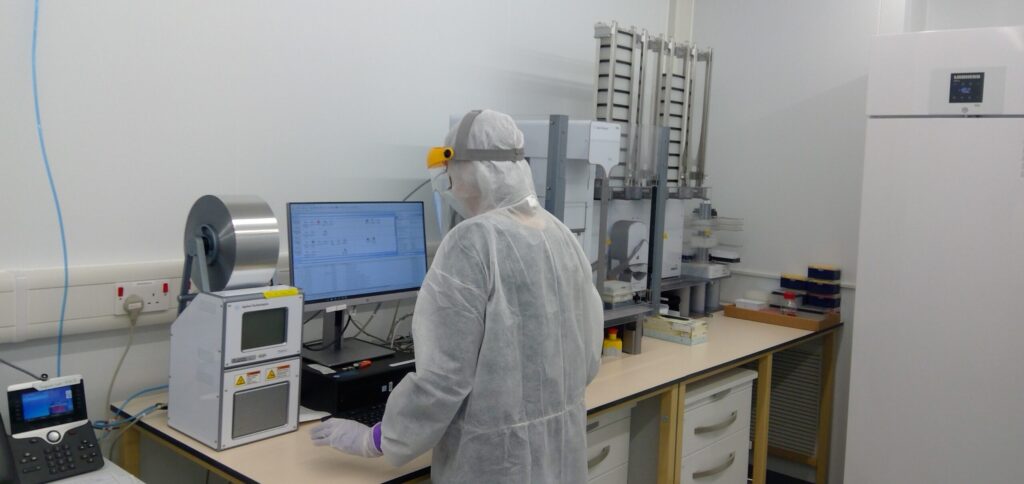
The clean room in the ancient genomics laboratory at the Francis Crick Institute (Credit: Kyriaki Anastasiadou)
THE HISTORY OF MIGRATION IN SCOTLAND
These kinds of genome-wide studies of ancient DNA (meaning that they’re studying information from across the entire set of DNA instructions found in a cell) have found that there’s hardly any population on Earth that hasn’t been affected by migration and mixing of populations, and Britain (including Scotland) is no exception.
From 18,000 BC (around the end of the last Ice Age over 20,000 years ago) to 43 AD (at the time of the Roman invasion into southern Britain around 2,000 years ago), there were at least four large-scale shifts in the ancestry of people in Britain as a result of migration:
– 12,500 to 12,000 BC (around 14,500 years ago) in the Late Upper Palaeolithic
– 4000 to 3500 BC (around 6,000 years ago) in the Early Neolithic
– 2500 to 2000 BC (around 4,500 years ago), at the beginning of the Chalcolithic (Copper Age)-Bronze Age
– And 1000 to 800 BC (around 2,800 years ago), in the Late Bronze Age, although these migrations only had a minor genetic impact in Scotland
Each of these periods of migration was accompanied by substantial changes in the archaeological record indicating shifts in lifestyle, technology, ritual, belief and possibly also language.
But this doesn’t mean we should revert to outdated ideas about prehistoric invasions.
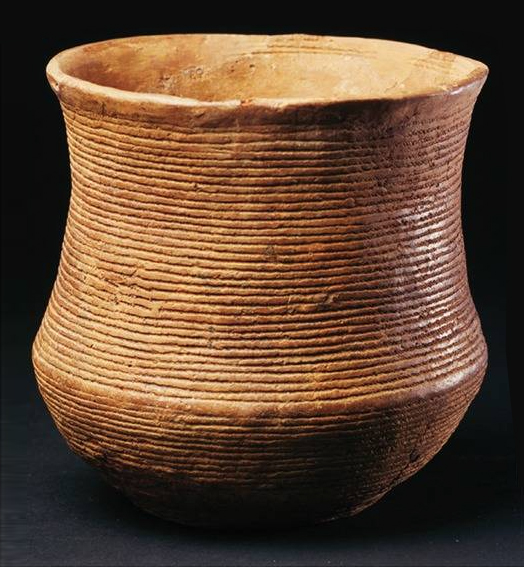
‘All-Over-Cord’ Beaker from Bathgate in West Lothian (Image credit: National Museums Scotland, CC BY-SA 4.0 <https://creativecommons.org/licenses/by-sa/4.0>, via Wikimedia Commons)
THE MYTH OF ‘PREHISTORIC INVASIONS’
In the first instance, our modern understanding of terms like ‘invasion’ and ‘conquest’ are likely to be anachronistic (belonging to a different time period) when applied to the distant worlds of prehistory.
But also, while ancient DNA can provide evidence that groups of people moved and had children, it has less to say about the scale and tempo of migration, as well as how genetic change happened after groups of migrants began to arrive.
The term ‘population replacement’, which is often used by geneticists to describe large-scale genetic change, is sometimes incorrectly assumed to mean “a rapid displacement of one population by another, involving violence or catastrophe”.
But genetic change happens because one group of people carrying certain ancestries has more descendants than a group carrying different ancestries.
Intergroup violence could be a factor in this kind of change but so could intergroup differences in a range of other factors related to demographics, health, economy, subsistence and fertility. Assessing the extent to which any of these factors contributed to genetic change in the past can’t be done using genetics alone and requires careful appraisal of all the available evidence through archaeological research.
In Britain (including Scotland), there’s a distinct lack of compelling evidence that any major period of ancestry change was exceptionally violent (such as large-scale massacres at one point in time across Britain), and so we must consider a range of possible explanations.
DNA strands (Image credit: geralt, CC0, via Wikimedia Commons)
GENETIC CHANGE IN PREHISTORIC SCOTLAND
While these centuries-long episodes of migration and ancestry identified in prehistoric Britain (including Scotland) all resulted in large-scale genetic change, they were different in nature.
For instance, around 14,000 years ago in the Upper Palaeolithic (c.12000 BC) sea levels were lower than today, and present-day Britain formed part of the European continent’s northwestern peninsula. Britain may have only been seasonally occupied by groups of hunter-fisher-gatherers and so evidence for genetic change may reflect different groups of people gradually expanding into largely uninhabited parts of Britain as ecosystems changed over hundreds to thousands of years.
Migrations into Scotland between 2500 and 2000 BC (around 4,000 years ago) at the beginning of the Chalcolithic-Early Bronze Age have popularly been discussed in terms of invasion and conquest by violent hordes of young men. In other parts of Europe, similar interpretations have been argued to be supported by genetic evidence showing changes in paternal lineages which outstrip changes in whole ancestry, suggesting that males primarily drove migration and genetic change.
However, the shift in whole ancestry and paternal lineages in Chalcolithic-Early Bronze Age Scotland is roughly equal, meaning that both males and females had to have moved and settled together at the same time.
In Orkney during the same period, we see a substantial shift in whole ancestry with smaller changes in paternal lineages, which would suggest that Orkney was conquered by female armies from mainland Britain under the same assumptions of ‘invasion’. While we can’t rule this out, it seems more likely that simple models of invasion and conquest are inadequate.
There are also other examples of migration and genetic change across prehistoric Britain and Europe where a simple ‘invasion’ model doesn’t explain the evidence. Instead, it’s more likely that a whole spectrum of regionally variable social, environmental and political factors were involved.
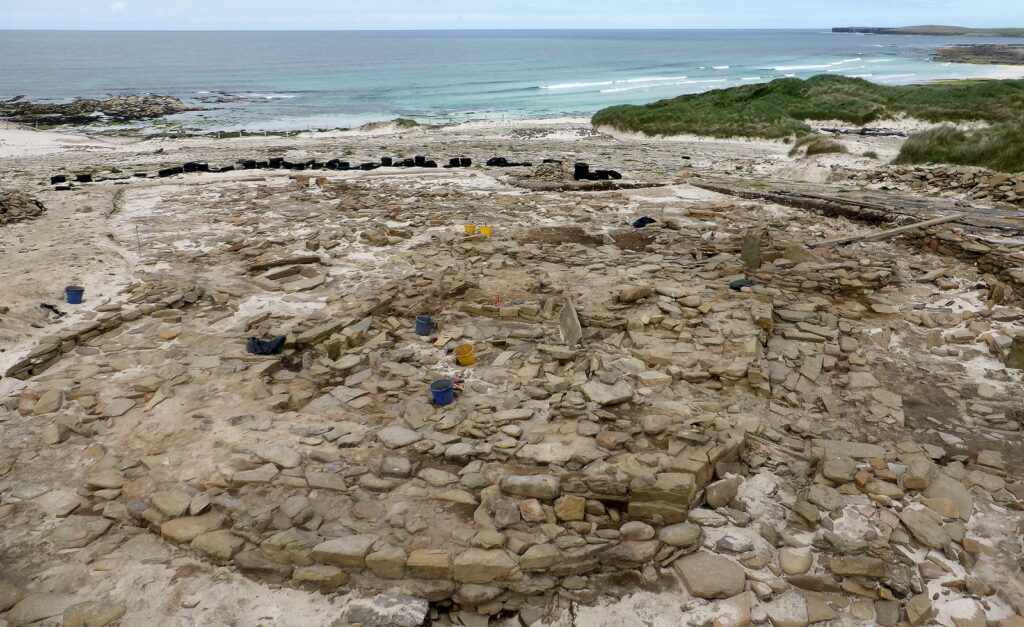
Links of Noltland excavation in Orkney (Image © Sandy Gerrard (cc-by-sa/2.0))
Ancient DNA continues to provide extraordinary evidence of human movement in the past and the wide-ranging influence these movements have had on life in Britain. However, we should be clear about what ancient DNA can and cannot say about past migration.
We can acknowledge that ancient DNA is providing fresh evidence for the influence of migration in the archaeological record while stressing that pots still don’t equal people, and our insights into the past will be richer for it.
Want to keep reading? Dig into Dr Booth’s article on the reliability of genetic ancestry testing.
By Dr Tom Booth, a Senior Laboratory Research Scientist in the ancient genomics laboratory at the Francis Crick Institute. Dr Booth is an archaeological scientist working on a Wellcome Trust-funded project which is sequencing the genomes of at least 1,000 people who lived in Britain over the last 6,000 years. The results will be used to investigate population change and natural selection in Britain over time.
Tweet
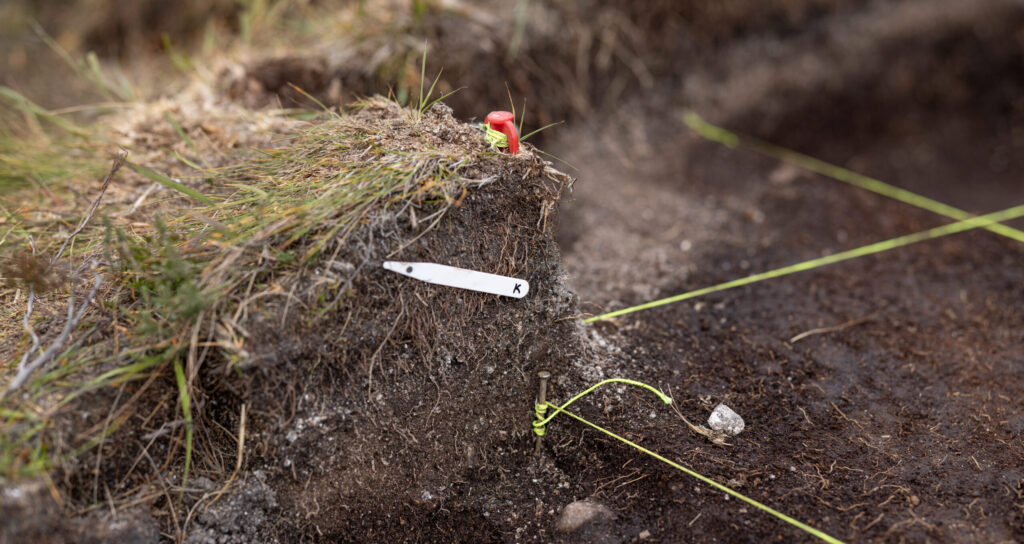
Header Image: Excavation in the Cairngorms (Image Copyright: Shahbaz Majeed 2023)
