Archaeologists and Game Designers Collaborate to Create “Basically the Best Book on the Picts Ever Written”

Carved in Stone: A Storyteller’s Guide to the Picts is an illustrated and comprehensive book for anyone interested in Scotland’s past, including those who play tabletop roleplaying games (TTRPGs).
Following a successful crowdfunding campaign in 2021 and four years of work by game designers, writers, archaeologists and a diverse group of artists, Carved in Stone is now available for purchase.
Carved in Stone is an illustrated guide to the world of the Picts, an early medieval Scottish society, in the late 7th century. Packed with information on the weather, languages, settlements, cuisine, fashion, medicine, skills and more, cutting-edge research is presented in over 160 pages with more than 350 historically informed illustrations.
The project was led by Brian Tyrrell of Stout Stoat Press, an Edinburgh-based games-and-book publisher, and ArchaeoPlays’ Dr Heather Christie FSAScot, an archaeologist, gamer and YouTuber, in partnership with Dig It!.
Why was Carved in Stone created?
Despite forming a major kingdom of early medieval Scotland, the Picts have a relatively one-dimensional image in popular culture, often portrayed as blue-tattooed barbarians.
Carved in Stone was designed to present the latest archaeological research about the Picts in a more accessible and engaging way which highlights that the Picts were like any human society: complicated.
They responded to, built on, and contributed to the cultures around them, were internationally connected, were intricately skilled artists, held a mixture of religious beliefs, and went out of their way to accommodate disabled members of society. More evidence is found every year that suggests they could have been farmers, hunters, blacksmiths, monks, artisans, members of the warbands of kings, and every possible profession of the early medieval period.
With regards to a Pictish tattooing tradition, the authors of Carved in Stone believe that evidence is inconclusive. Although the Picts certainly had the artistic capabilities, tattooing does not show up in any of their stone carvings. Furthermore, while some blue pigments such as woad or copper were available, they would have known that these were unsafe for human use.
The authors propose that tattoos of varying colours were as common for the Picts as they are today; a few people had many, some people had one or two, and most had none.
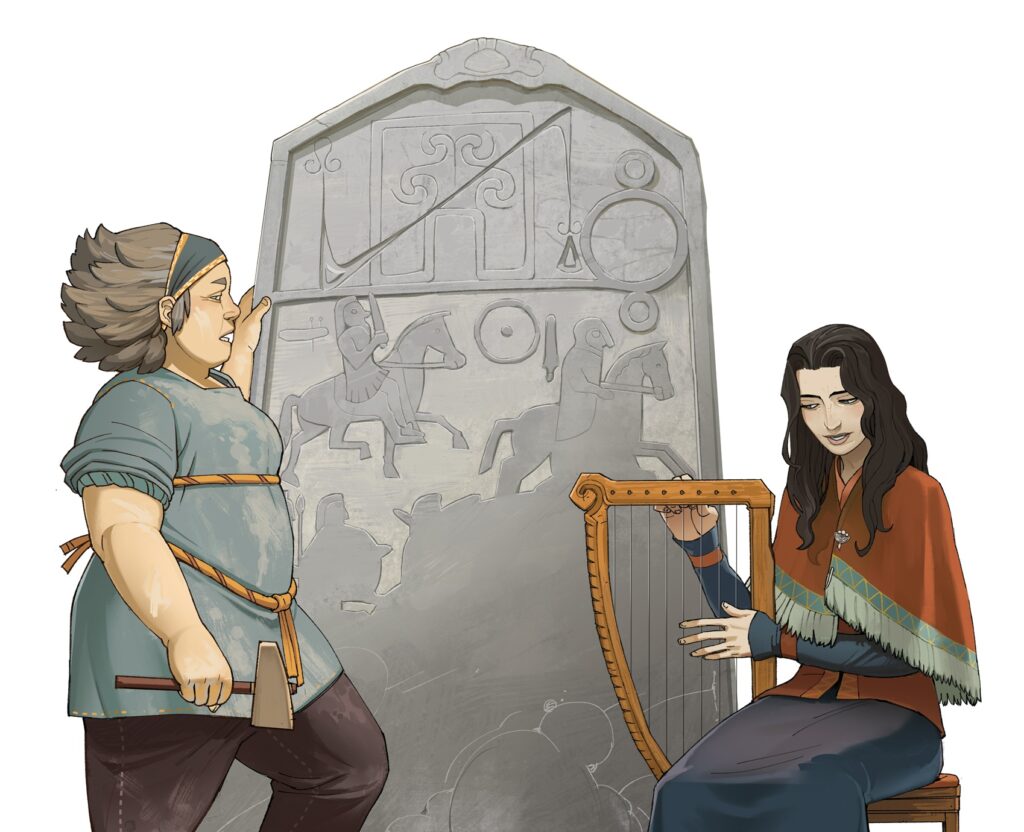
A stonemason and bard in a scene from the section about ‘Your Protector, King Bridei mac Beli’ in Carved in Stone (Image Credit: Nathaniel Santore gyrium.neocities.org)
Who is Carved in Stone for?
Carved in Stone can be enjoyed by anyone aged 14+ with an interest in Scotland’s past. It can also be used by those who already play TTRPGs to build adventures where players explore the landscape, meet the Picts and their neighbours, and create their own stories.
Who were the Picts?
The Picts were descended from Iron Age tribes, whom the Romans called the Caledonii (among other names). The ancestors of these tribes arrived in the lands of modern-day Scotland less than 3,000 years ago.
The Pictish people formed a series of smaller kingdoms, many of which are thought to have unified in the late 7th century to form a single kingdom. Though their kingdom’s name is currently lost, modern academics refer to it as Pictland.
Evidence suggests that the heart of the Pictish kingdom was in present-day Moray and Aberdeenshire. However, it also stretched down to the Firth of Forth and across from the Isle of Skye to Shetland. Anyone who arrived and settled in Pictish lands throughout this chapter of their civilisation was generally considered Pictish.
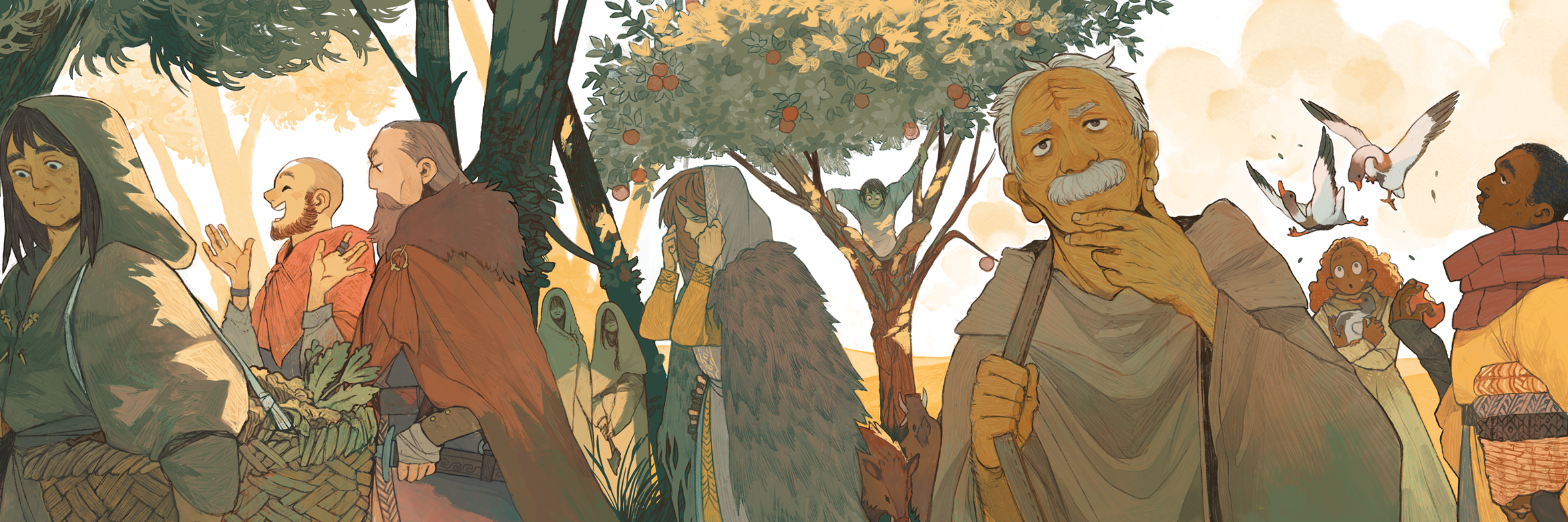
A scene from the ‘People You Meet’ section of Carved in Stone (Image Credit: VER artistver.carrd.co)
What is a TTRPG?
Tabletop roleplaying games, or TTRPGs, are collaborative storytelling games where players use their imagination to invent characters, tackle problems, and immerse themselves in adventures within a world of their choosing.
One of the most famous examples of a TTRPG is Dungeons & Dragons, which appeared in the hit TV show Stranger Things.
Carved in Stone presents the key facts and latest theories about the Picts which can be used to shape TTRPG adventures. For example, information on Pictland’s key fortresses, the people you might meet travelling from one place to the next, what you could eat at a feast, and what the local bard would be singing about.
Praise for Carved in Stone
Carved in Stone has already been applauded by experts, including Dr. Adrián Maldonado, Project Curator at National Museums Scotland, and Prof. Katherine Forsyth FSAScot, Professor of Celtic Studies at the University of Glasgow.
Dr. Maldonado said:
“It’s basically the best book on the Picts ever written. By starting from Scotland’s environment, and incorporating lessons from archaeology, history and art, this brings the Picts to life more effectively than any other depiction I’ve yet seen.”
Prof. Forsyth said:
“Such a lot of thought and care has gone into this painstaking recreation of what it was like to live in Scotland in the seventh century. The result is a fresh perspective which is wonderfully creative yet grounded in thorough research and accessible in our age. The Picts emerge from the shadows and step forward in technicolour. This will inspire readers to bring them to life in their imagination and in their games.”
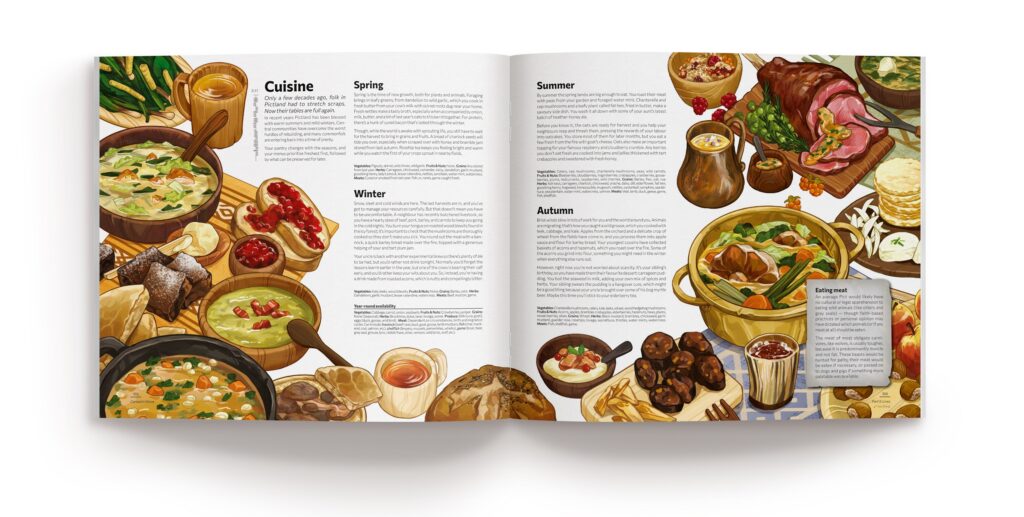
Part of the ‘Cuisine’ section in Carved in Stone (Image Credit: Ilsa Zhang)
Dr. Jeff Sanders FSAScot, Head of Outreach at the Society of Antiquaries of Scotland, said:
“There have been so many exciting archaeological discoveries about the Picts in recent years and we wanted to find a way to really bring these stories to life. So we spoke to Stout Stoat Press about designing a setting for a tabletop roleplaying game where people could actually use this information to play as a Pict. But to do justice to their diversity of cultures, languages and social life, they ended up creating a book that far exceeded our original plan, effectively producing a sweeping guide which captures early medieval Pictish life in its rich entirety.”
Dr. Susan O’Connor, Head of Grants at Historic Environment Scotland, said:
“While evidence of Pictish life still surrounds us today, not much is known about the way they actually lived, and what’s easily accessible often doesn’t reflect the complexity of their society. We are delighted that Carved in Stone will be an accessible and engaging resource to explore this fascinating period, and welcome Dig It!’s continued work to bring Scotland’s past to life in novel and inclusive ways.”
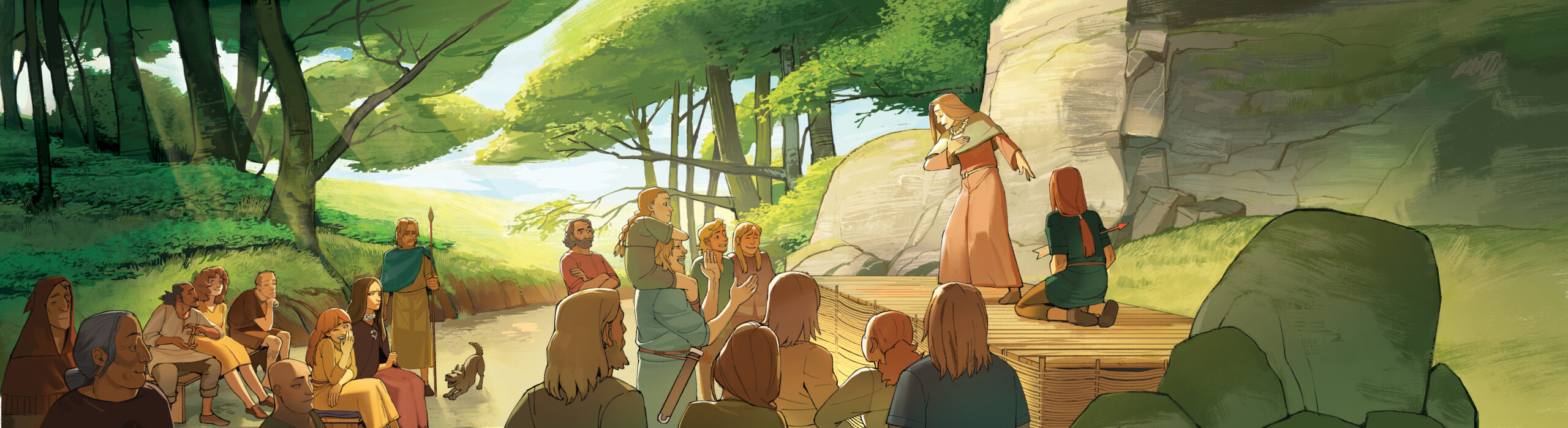
Bards’ performance from the ‘Hierarchy and Power’ section of Carved in Stone (Image Credit: Nathaniel Santore gyrium.neocities.org)
Stout Stoat Press’ Brian Tyrrell said:
“When I was first approached by Dig It! we initially planned to make a very short adventure for folks to play along. But every step of development unearthed new questions, and revealed yet more gaps in the Pictish narrative. Each inquiry added another page, another illustration, another footnote. What started as a quest for a lost sword has grown into a comprehensive cultural digest, one that invites you to muck in and explore the past. This is unlike any project I’ve worked on before, and it’s a triumph to see it come together.”
ArchaeoPlays’ Dr. Heather Christie FSAScot said:
“For many archaeologists, our favourite moments are when the past suddenly feels like it’s reaching out to say ‘hello’. Holding a Bronze Age piece of pottery that still has the potter’s thumbprints on it or carefully excavating an Iron Age hearthstone worn smooth by hands and feet. For Carved in Stone, we wanted readers to be immersed in late 7th century Pictland, to feel as if they could wander around and say ‘hello’ to the folks on the page. It’s easy to fall into the trap of thinking they’re so different from us, but we’re all human. Most of us have the same general goals, and at the end of the day, Pictish or not, we all have to figure out what we’re doing for dinner.”
Carved in Stone is available from the Stout Stoat Press website. The creators will also be delivering a free public lecture on 11 December 2025 in Edinburgh and online.
Carved in Stone was produced in partnership with the Dig It! project, which is coordinated by the Society of Antiquaries of Scotland (Charity No SC010440) and primarily funded by Historic Environment Scotland. Carved in Stone was sponsored by Forestry and Land Scotland, the University of Glasgow and Interface.
Header Image: A Pictish hillfort from the ‘Settlements’ section of Carved in Stone (Image Credit: Anine Bösenberg anineillustration.com)
