The Archaeobotany of Scotland: The Importance of Plants and Puffballs in Iron Age Medicine
Plants were hugely important to past populations, who used them to produce food, fodder, fuel, building materials, bedding, dyes, textiles, flavourings, beverages, alcohol, medicine and more. Archaeobotany enables us to study this rich relationship between these humans and the plant resources that were part of their daily lives.
Why is archaeobotany important?
Studying plants that have been uncovered at archaeological sites reveals so much information about the people that lived and worked in these past communities. For example, the types of plants that are present tell us what past populations ate, what materials they gathered for building and fuel, the status of the site, if they were rich or poor, if they had access to luxury and imported items, what medicines they used and what activities took place within their settlements.
The plants used by a community also give us an insight into the cultural development of their society. For example, if their choices of plants were guided by necessity or by cultural preference.
How past populations used plants to sustain their communities has even influenced our existing relationship with our environment today.
The study of archaeological plant assemblages allows us to better understand how past humans influenced, either deliberately or accidentally, the landscapes in which they lived and worked. As people moved from place to place, their choices helped to shape the environment where they settled. The development of crop husbandry (farming) and woodland management, and the introduction of new plant species to Scotland as people imported and traded goods, led to noticeable changes in the environment which continue to shape the places that we live in today.
But to unlock this information, we need to find plant remains which have been preserved so they can become part of the archaeological record instead of decomposing and disappearing forever.
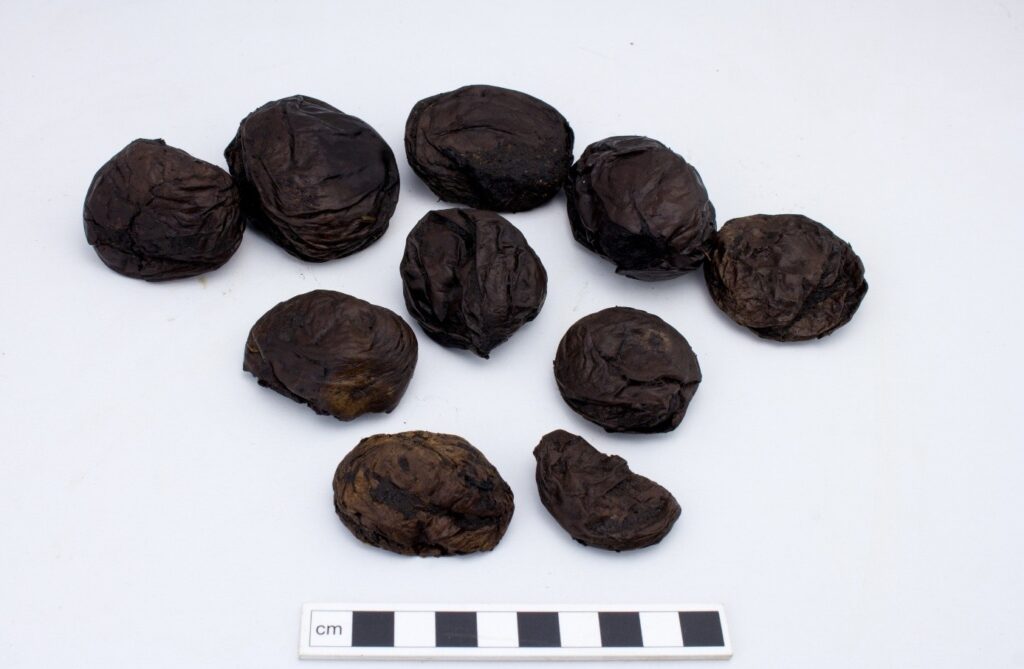
Iron Age puffballs from Black Loch of Myrton in Dumfries & Galloway (Image credit: AOC Archaeology)
How are plants from the past preserved?
The most common method in Scotland by which plant material has been preserved is by exposure to heat (carbonisation). This is where plants are burnt during activities such as food processing and cooking, or during an accidental fire.
Exposure to heat, especially at very high temperatures, is destructive, so only the sturdiest plants typically survive this process. This means that Scottish carbonised plant assemblages are usually dominated by cereals and nuts. The species we find most often are oat (Avena sp.), barley (Hordeum sp.), rye (Secale sp.), wheat (Triticum sp.) and hazelnut (Corylus avellana L.) shells.
-
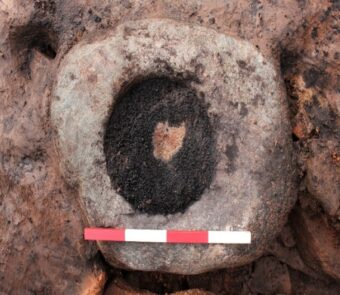
- Examples of carbonised barley grain burnt in situ in a knocking stone at the Iron Age Clachtoll Broch (Image credit: AOC Archaeology)
-
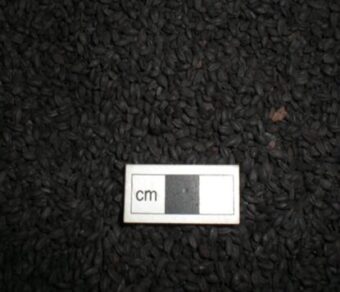
- Close up of the charred barley grain from the knocking stone when Clachtoll Broch burnt down (Image credit: AOC Archaeology)
The other main method of preservation is where plants have been left long term in wet environments (anaerobic conditions) which prevents them from decaying. This method is less destructive than carbonisation so fragile plant remains, including building materials, flooring, bedding, vegetables, fruits, dyes, textiles and medicines, are much more likely to survive in a waterlogged assemblage.
Plants, once carbonised or waterlogged, are able to survive for thousands of years within archaeological sites, just waiting to tell us their story.
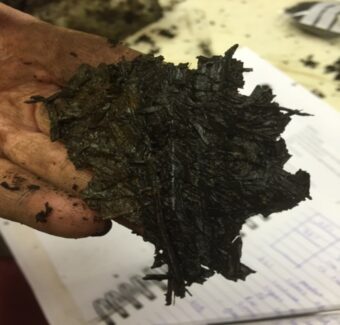
2,000-year-old waterlogged floor surface from Black Loch, their equivalent of carpet (Image credit: AOC Archaeology)
What has archaeobotany helped uncover in Scotland?
Many of the archaeobotanical remains uncovered in Scotland from the prehistoric to the post-medieval periods are preserved through carbonisation, including the finds from the Iron Age Clachtoll Broch in Ayssnt in the Highlands which was excavated by AOC Archaeology. This means that most of the plant assemblages we study are dominated by burnt food remains, such as cereal and hazelnut shells.
When we do have an opportunity to analyse waterlogged plant assemblages, they’re usually more varied. This makes it possible to identify a much wider range of plants used for multiple purposes, including medicine. This is a much rarer find in Scottish archaeobotany.
The excavation at Black Loch of Myrton in Dumfries & Galloway uncovered six Iron Age roundhouses and a midden (rubbish heap) which were all waterlogged. At this settlement, there was evidence that a large variety of plants were used for food, construction, and fuel. There was also evidence that plants and puffballs were likely used for medicine. These finds seem to have been part of an Iron Age first aid kit used to treat the people who lived and worked at this 2,000-year-old wetland village.
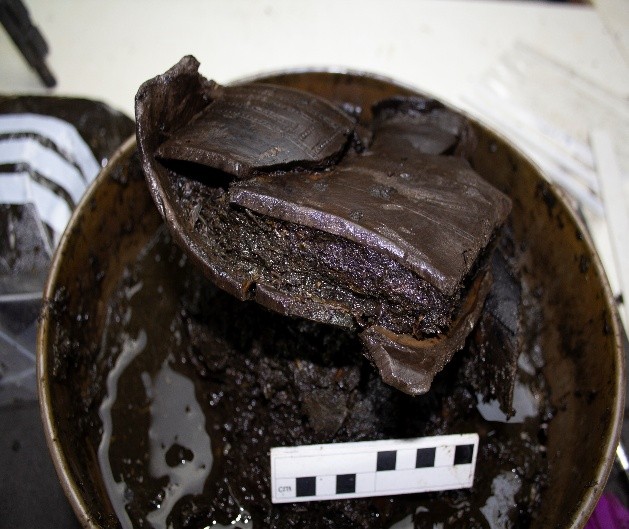
A wooden bowl found in the Black Loch midden filled with willow leaves (Image credit: AOC Archaeology)
Willow Bark and Leaves
In the midden at Black Loch, a wooden bowl containing a large number of willow (Salix sp.) leaves was uncovered. Willow bark and leaves contain salicin which is similar to aspirin. The bark and leaves from this tree have long been known to effectively treat many ailments including pain, fevers, sore joints and arthritis.
At Black Loch, the leaves could have been easily collected and made into tea and poultices. Historically they have also been added to bedding to help draw out pain and reduce the fevers of the people who slept on them. There are a number of advantages of using the leaves over bark. The leaves would be easier to transport and there would be little damage to the tree, meaning the population would have continued access to this valuable medicine.
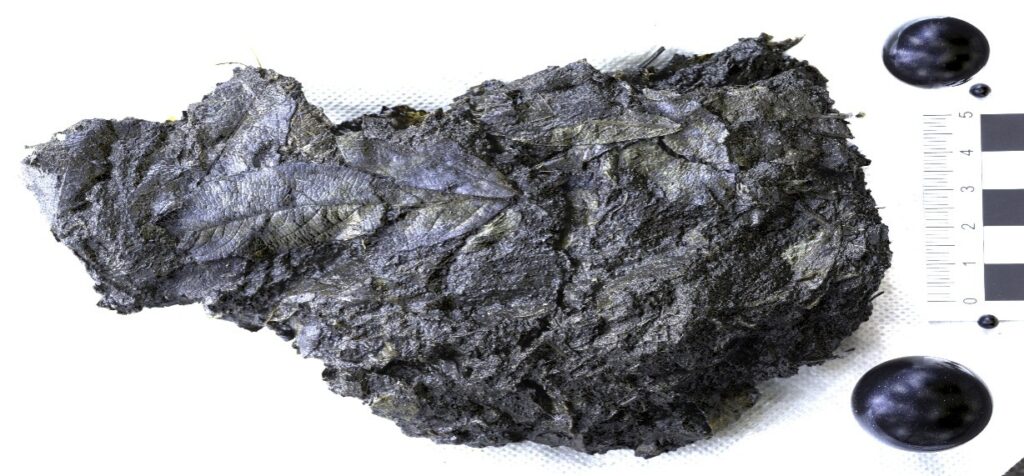
Willow leaves trapped in sediment from a bowl from Black Loch (Image credit: AOC Archaeology)
Puffballs
The second potential medicine found at Black Loch was a type of fungi known as puffballs (26 brown puffballs (Bovista nigrescens) and a single deceiving bovist (Bovista aestivalis)). Unlike mushrooms, puffballs don’t have a cap with spore bearing gills or stems. Instead, their spores are produced inside a round pouch-like fruiting body.
Why do we think they were medicinal? Well, it’s very easy to separate immature puffballs (which are edible) from mature puffballs (which are inedible) – as they mature, puffballs become noticeably discoloured with an unpleasant smell and texture, and may cause food poisoning if eaten – and these ones were all mature.*
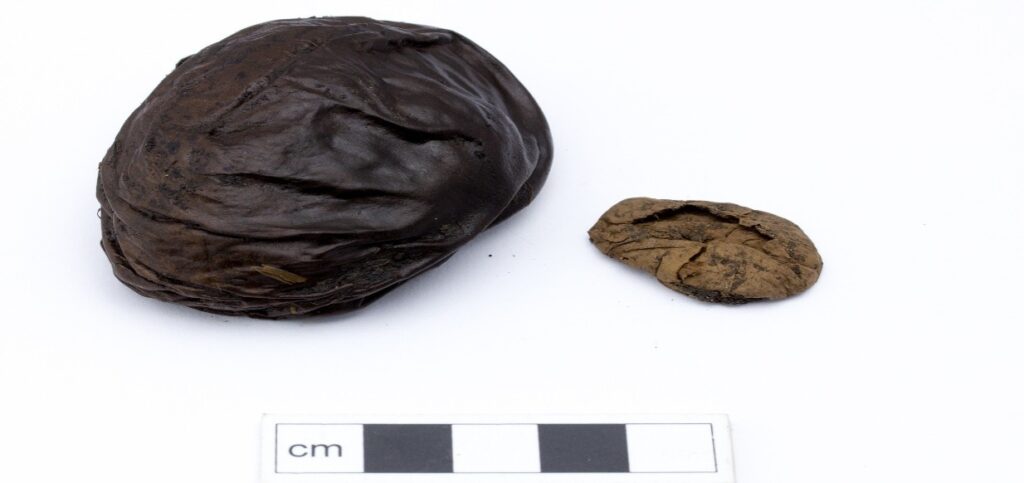
The larger puffball is a brown puffball, and the much smaller one is a deceiving bovist (Image credit: AOC Archaeology)
If these puffballs had been collected for food, then they would’ve been disposed of as they were no longer edible. The people living in these structures were quite house proud and it’s unlikely that they’d leave spoiled food in their homes.
Many cultures throughout the world from the prehistoric period onwards have also used puffballs as fire starters, for smoking bees to obtain honey and for their supposed ritual and hallucinogenic properties. However, none of the puffballs at Black Loch had been charred, indicating that they hadn’t been used for starting fires, nor is there any evidence they were used for any other purpose.
This brings us back to their medicinal properties. Once matured, puffball spores have also been used to help stop bleeding, treat skin disorders and promote healing. The puffballs at Black Loch were concentrated within a cache (hidden collection) in structure three, which was believed to have been a workshop. This meant that the opportunity for becoming hurt by cutting or burning yourself when working in this location would’ve been very high, so it looks like the people who worked in structure three deliberately stored the puffballs in this area for when they became injured and needed an Iron Age plaster.
Waterlogged puffballs have also been recovered at Cults Loch in Dumfries & Galloway and at Hyndford Quarry in South Lanarkshire, where again they were all found to be mature so were no longer edible. This repeat pattern of collecting and storing mature puffballs at many Scottish Iron Age sites is an excellent sign that fungi were deliberately gathered from the wild for their medical properties.
While they may also have been eaten when immature and used to start fires, these are all activities that would’ve permanently removed all trace of them from the archaeobotanical record, so we can’t know for sure.
-
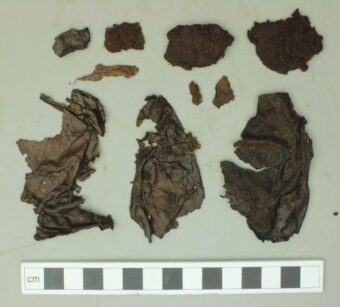
- Puffball fragments from Hyndford Quarry (Image credit: AOC Archaeology)
-
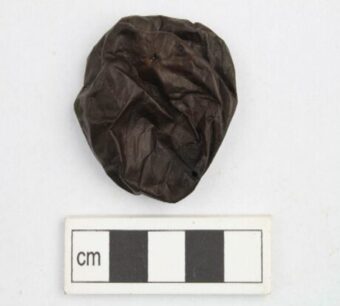
- The puffball from Cults Loch Crannog (Image credit: AOC Archaeology)
The willow leaves and puffballs are of huge interest in Scottish archaeobotany as such strong evidence of plants and fungi being used for medicine so rarely survives. This gives us an excellent opportunity to better understand how the people living in these Iron Age communities 2,000 years ago coped with ailments and injuries which would’ve impacted their health as they went about their daily life and work activities.
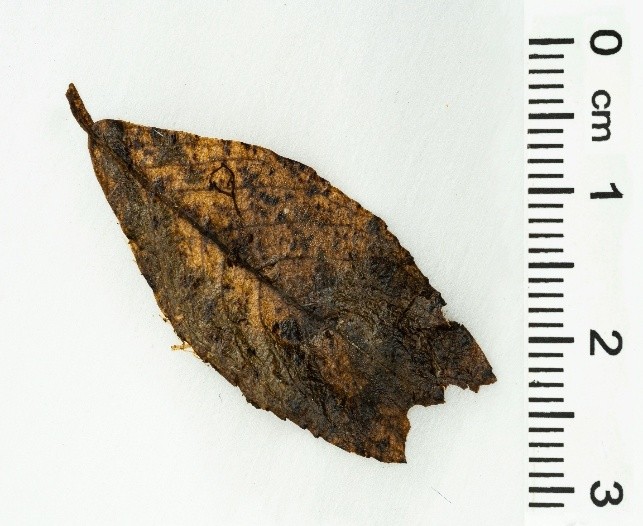
A willow leaf from the wooden bowl at Black Loch (Image credit: AOC Archaeology)
If you want to know more about AOC Archaeology’s work, visit their InSitu website, watch AOC TV or follow them on Facebook or Instagram. You can also keep reading about the sites mentioned by exploring the references below.
By Jackaline Robertson, environmental specialist at AOC Archaeology. Jack studies archaeobotanical and archaeozoological assemblages from across Britain dating from the prehistoric to the post-medieval period. A very special thank you to Professor Roy Watling MBE for sharing his love and knowledge of puffballs. With thanks to Dr Anne Crone FSAScot, Dr Graeme Cavers and Historic Environment Scotland (HES) for their work at Cults Loch and Black Loch and Katie O’Connel, Dr Paula Milburn FSAScot and Breedon Group for their work at Hyndford Quarry.
*Foraging for wild mushrooms carries inherent risks. Never consume any wild mushroom unless you’re 100% certain of its identity and safety, verified by an experienced expert.
References
Barber, J, et al. 2022. Clachtoll: An Iron Age Broch Settlement in Assynt, North-West Scotland. Edited by Cavers, G 1st ed., Oxbow Books. https://doi.org/10.2307/jj.5699284
Cavers, G and Crone A. 2018. A Lake Dwelling in its Landscape: Iron Age Settlement at Cults Loch, Castle Kennedy, Dumfries & Galloway. Oxbow Books.
Crone, A, Cavers, G, Allison, E, Davies, K, Hamilton, D, Henderson, A, Mackay, H, McLaren, D, Robertson, J, Roy, L & Whitehouse, N. 2018 ‘Nasty, brutish and short?; the life cycle of an Iron Age roundhouse at Black Loch of Myrton, SW Scotland’, Journal of Wetland Archaeology 18.2, 138 – 62. https://doi.org/10.1080/14732971.2019.1576413
Mackay, H, Davies, K L, Robertson, J, Roy, L, Bull, I D, Whitehouse, N J, Crone, A, Cavers, G, McCormick, F, Brown, A G, Henderson, A C G 2020 ‘Characterising life in settlements and structures: Incorporating faecal lipid biomarkers within a multiproxy case study of a wetland village’, J Archaeol Sci 121. https://doi.org/10.1016/j.jas.2020.105202
Crone, A 2024 ‘The view from the North; wetland settlement in Scotland and the Black Loch of Myrton’, in Knight, M, Ballantyne, R, Cooper, A, Gibson, D & Robinson Zeki, I 2024 The Must Farm Pile-dwelling Settlement Volume 1. Landscape, architecture and occupation (CAU Must Farm/Flag Fen Basin Depth & Time series (Vol II)), 246 – 254. Cambridge: McDonald Institute for Archaeological Research. https://www.repository.cam.ac.uk/handle/1810/365351
Crone, A, & Cavers, G 2026 Black Loch of Myrton. The life and times of an Iron Age wetland settlement in southwest Scotland. Sidestone Press. https://doi.org/10.59641/c3f4z5a1b2
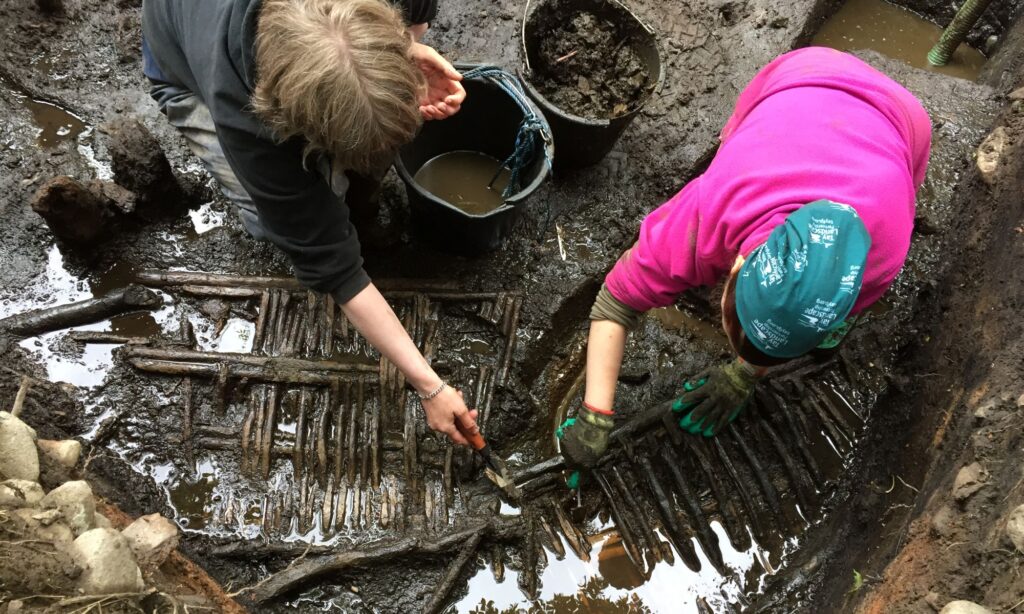
Header Image: Archaeologists uncovering hurdle screens at Black Loch (Image credit: AOC Archaeology)
