Archaeology at Edinburgh Castle: Our Greatest and Least Understood Royal Fortress
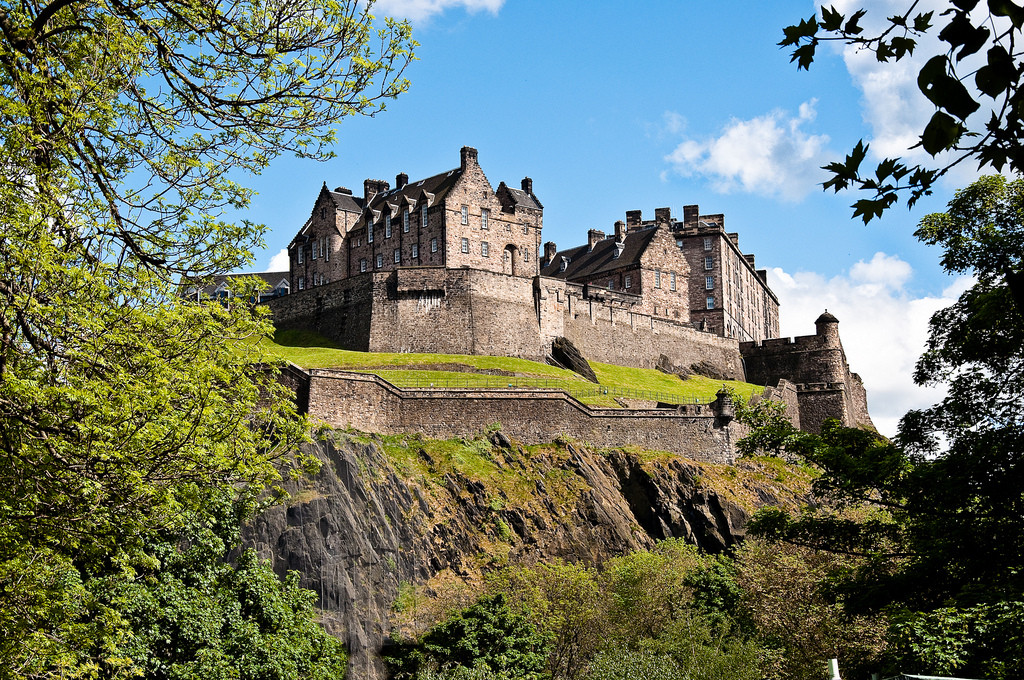
Attracting almost two million visitors a year, Edinburgh Castle is one of the oldest fortified places in Europe. A place of safety and of royal government, it embodies the strength and power of the kings and queens of Scotland throughout medieval times. It’s an image of Scotland familiar around the world, but for archaeologists the castle stands for much more – a prehistoric fort and a royal fortress central to the history of Edinburgh and Scotland.
Centuries of military use has obscured much of the remains of the original castle, but archaeological investigation has been extremely successful in revealing tantalising evidence of the site’s medieval past.
Uncovering a King’s Lost Tower
The first major investigation at the castle took place in 1912 when architect W T Oldrieve FSAScot explored the cellars under the palace, which at that time were used as the army’s canteen. The castle today is fronted by the familiar bulk of the Half Moon Battery, built in the late 1500s, but Oldrieve worked out that parts of a great lost royal residence might still exist below and behind this.
Oldrieve broke through the pavement of the Half Moon Battery into a partly infilled void and was immediately confronted with the outer face of the lost tower of King David II. Known simply as ‘David’s Tower’, the structure was commenced in 1367 under King David II, son of King Robert Bruce, and became a principle royal lodging. It is also considered to be the prototype tower-house; the tower-house became the common form of lordly and defensive fortified residence throughout Scotland – David’s Tower was the first, and was copied for more than 200 years.
The tower still bore the dramatic scars from its final days under fatal bombardment when English guns had been shipped up and brought to bear on the castle. This resulted in the rapid conclusion of the ‘Lang Siege’ of 1571-73, when the castle was held by forces loyal to the exiled Scottish monarch, Mary, Queen of Scots. David’s Tower, aggressively fronting the castle, suffered catastrophic damage and collapsed.
At a depth of five metres, Oldrieve came down onto the vault over a chamber, broke through this, and was amazed to be confronted by the worn steps and doorway of the original front entrance to the tower (see image below).
He discovered that its massive broken walls, almost three metres in thickness, still rise 12 metres in height above its rocky base, being barely covered by the paving above, utilised as a foundation from which to hang the castle’s Half Moon Battery over 200 years later. It’s incredible to think that a building of such importance had been hidden for so long.
Oldrieve quickly published his results in the Proceedings of the Society of Antiquaries of Scotland in 1914, and visitors today can experience something of this mighty tower thanks to Oldrieve’s questing mind.
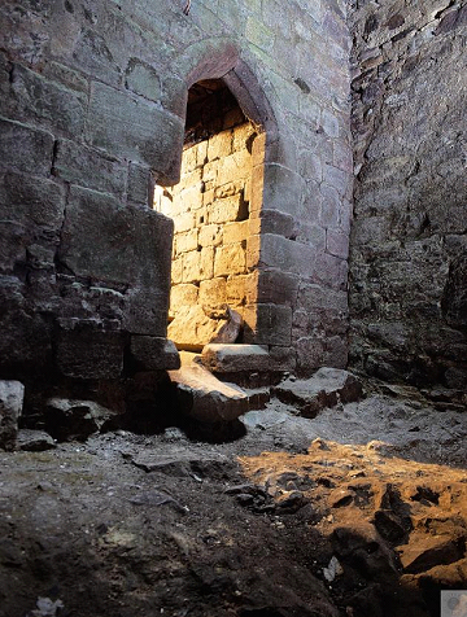
The front entrance to David’s Tower c1370 as rediscovered by Oldrieve in 1912 (© HES)
A Tunnel to the Past
From 1987-89, a major campaign of excavations took place ahead of the construction of a new vehicle tunnel beneath the castle, and multiple other associated works.
Despite some saying that the team wouldn’t find anything, in just two years archaeologists had discovered evidence of:
– Roman Iron Age huts (from the 1st-2nd centuries AD, around 1,800-1,900 years old)
– An early medieval midden (a domestic midden accumulated over dismantled Roman Iron Age structures which was radiocarbon dated to around AD 449-598. The team also found a decorated bone/antler comb of Anglian or Pictish form 7th – 10th century, along with a fire steel (strike-a-light) which could be 7th – 9th century)
– The road to the back postern (entrance) where the body of St Margaret had been smuggled out in AD 1093 to be taken to Dunfermline Abbey for burial
– The smithy used when Edward III of England rebuilt the castle during his AD 1335 invasion of Scotland – Robert the Bruce had ordered the castle’s destruction in AD 1314 to prevent the English occupying it
– A pit where all the castle dogs had been killed and buried, possibly during an epidemic likely to be mid 17th century which could coincide with a number of sieges at this time, including the Cromwellian siege of 1650 (dogs were known to be culled in times of plague due to being seen as a carrier of disease, but they could also just have been a drain on resources during a siege)
– A hitherto unknown cemetery where the dead of the garrison were buried in the Glorious Revolution siege of AD 1689
This was in addition to defences of every period and evidence which doubled the age of the castle back to the late Bronze Age (as far back as c. 900 BCE, almost 3,000 years ago).
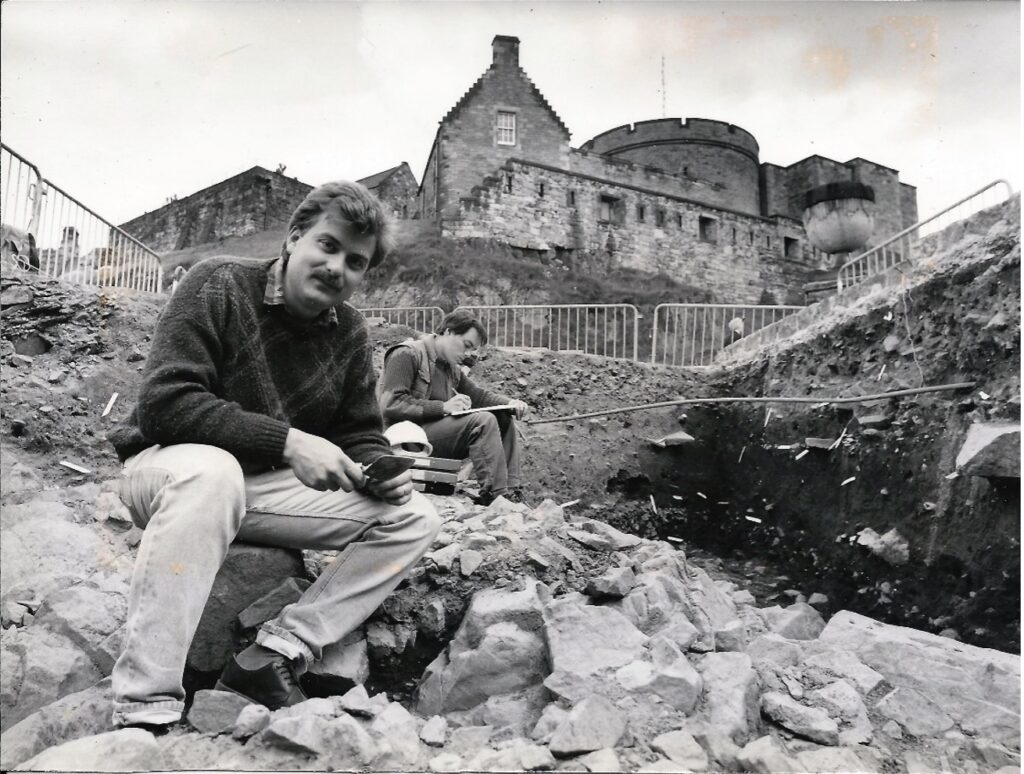
The author sitting on the 11th-century road leading down to the postern gate, found in the 1988 tunnel excavations (© Historic Environment Scotland)
Under the Esplanade
In 2010 another major investigation took place when the Royal Edinburgh Military Tattoo (which takes place on the esplanade, the open area in front of the castle) commissioned the construction of a new grandstand.
This involved some major works on the esplanade for the 326 piled foundations, so CFA Archaeology Ltd were contracted to monitor the works. As well as tracing the development of the area, they hoped to locate a spur built in AD 1548. This was an angle-pointed artillery bastion that housed cannon, while its shape and form was effective at countering incoming fire.
Military science was changing across Europe in the 16th century, responding to the increasing effective use of siege artillery. At this time Scotland was without a monarch, but the Dowager Queen Marie de Guise (the French mother of the infant Mary, Queen of Scots) had a direct line to France for military support. And so the new defence at Edinburgh Castle was funded by the French monarch and constructed by a leading Italian military engineer.
The spur was demolished in AD 1650 but the team knew what the feature looked like from historical drawings and suspected that it took up a lot of the ground which is now the Esplanade. They were thrilled when they located the deeply buried pointed nose of the spur towards the town-end of the esplanade.
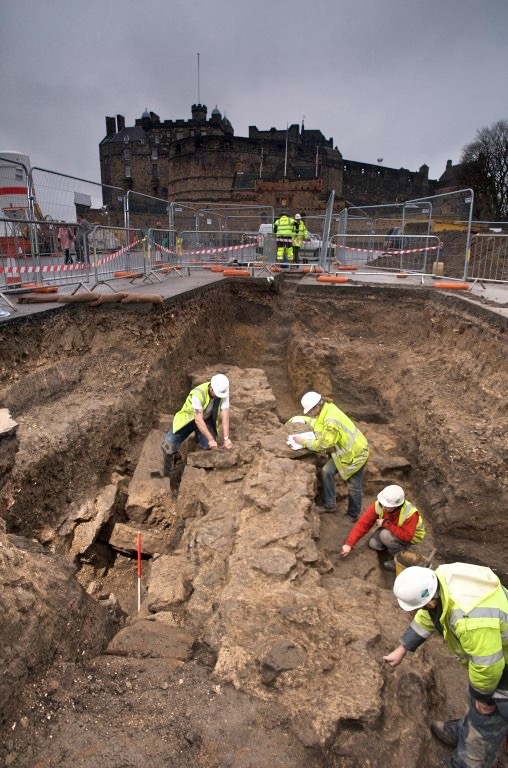
Nose of the 1548 artillery Spur discovered during Tattoo stand works in 2010 (© Historic Environment Scotland)
Archaeology at the Castle Today
The unsung heroes of archaeology at the castle are Gordon Ewart HonFSAScot and his team from Kirkdale Archaeology, who diligently worked away in the castle on-and-off for years, whenever works needed archaeological monitoring. Gordon, his team, and the late Dennis Gallagher FSAScot, developed a tremendous breadth of knowledge, fortunately published in 2014 in a book, Fortress of the Kingdom, available to purchase online.
Today, archaeological works are routinely undertaken by HES’ contractor, AOC Archaeology and overseen by HES’ archaeology team. They carry out any monitoring, survey and recording or other archaeological mitigation that might be needed alongside conservation work or new developments.
Most recently, HES’ experts have been delving into the hidden histories of key locations around the castle that are often overlooked, with a view to enhancing the on-site interpretation. They’ve recently funded new research into the Military Prison and the individuals associated with it, and have plans to survey and investigate military era graffiti across the site.
New understandings on the castle have been summarised in their latest guidebook, also available to buy online.
Aerial photograph of Edinburgh Castle (© Historic Environment Scotland)
By Peter Yeoman FSAScot. Peter is an archaeologist and cultural historian who has directed major excavations projects, notably at Edinburgh Castle and on the Isle of May, while also writing a number of books, major excavation reports and guide books. He has a special expertise in the archaeology of pilgrimage.
Through the 1990’s he was Council Archaeologist for Fife. Peter then joined Historic Scotland where he was responsible for developing archaeology and research across the estate of properties in care. He led research programmes which underpinned major permanent exhibitions at James V’s Renaissance Palace within Stirling Castle, at Whithorn Priory, St Vigeans Pictish stones, Iona Abbey, and at Edinburgh Castle.
Ready to learn more? Dig deeper into the castle’s history in this recording of the Society of Antiquaries of Scotland’s free public lecture – The Lost Royal Lodgings of Edinburgh Castle and the Birthplace of Great Britain – by Peter Yeoman FSAScot on 15 January 2026.
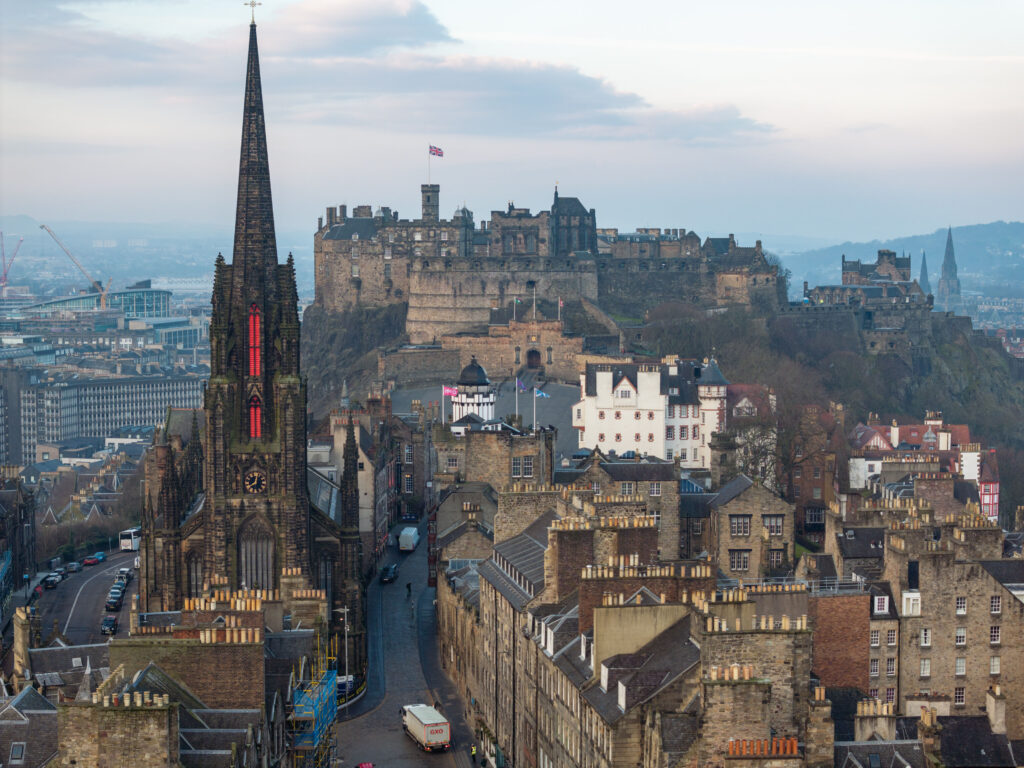
Header Image: Edinburgh Castle (© Craig Cormack via Flickr, CC BY 2.0)
