Death and Ritual in Prehistoric Scotland: Exploring the Archaeology of Moray’s Sea Caves

In an enigmatic sea cave in north-east Scotland, the remains of mummified bodies and rare artefacts reveal Moray’s ancient burial practices.
What Are the Covesea Caves?
The Covesea (pronounced Cow-see) Caves are a series of sandstone caves located on the south shore of the Moray Firth, between Burghead and Lossiemouth in north-east Scotland. The best known is the Sculptor’s Cave, which takes its name from the Pictish carvings on its entrance walls.
The Sculptor’s Cave has been used for a variety of purposes for thousands of years, from funerary rites in the Bronze Age and Iron Age to a possible store for smuggler’s loot, suggested by a curse carved into the wall in the 1690s.
In prehistoric times, caves appear to have been considered as liminal spaces caught between worlds. The Covesea Caves are notoriously difficult to reach, and over 2,800 years ago in the Bronze Age, access was cut off by two inland lochs to the south. Because of this, people may have travelled to the cave by boat, emphasising the symbolic journey between the world of the living and the world of the dead.

(© Visit Moray Speyside / Visualising Scotland)
When Was the Sculptor’s Cave Excavated?
Over the last 100 years, excavation at the Sculptor’s Cave has offered a glimpse into the symbolic and ritual lives of Moray’s prehistoric inhabitants. It was first excavated in 1928-30 by Sylvia Benton, who returned in 1979 for an excavation led by Ian and Alexandra Shepherd and traversed the scaffolding down to the caves at 90 years old.
Benton’s original excavation found Late Bronze Age metalwork, Roman Iron Age pins, coins and pot sherds as well as more than 1,600 disarticulated human bones (bones that are separated and no longer attached to one other). Only seven of these bones survive in the Sculptor’s Cave archive today and all are from the upper neck. At least six of these have evidence for cut marks, suggesting that these individuals were decapitated.
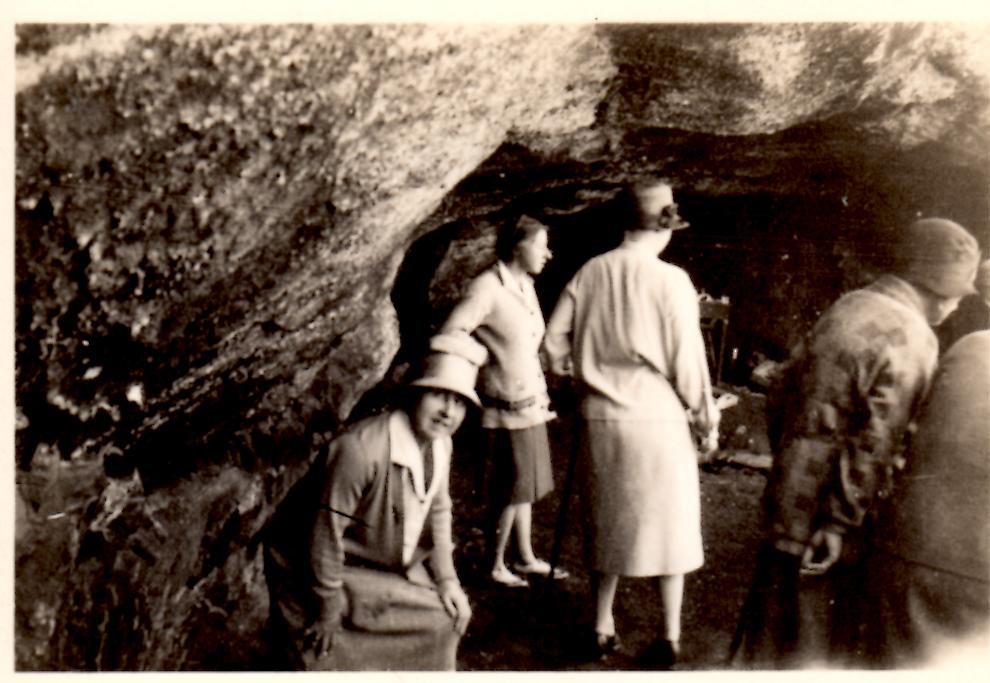
The Sculptor’s Cave under excavation in the late 1920s (Credit: Sculptor’s Cave archive)
The 1979 excavation also uncovered disarticulated human bones, mostly belonging to juveniles (children aged 15 and under), with one skull showing evidence of post-mortem processing (processing of the body after death), as well as evidence of timber structures in the entrance passages.
More recently, the Covesea Caves Project used terrestrial laser scanning at the Sculptor’s Cave to create a full 3D model of the site, as well as structured light scanning to record the carved Pictish symbols. This technique used light at different angles to bring out additional features such as extra fins on the leaping salmon symbol. This data was then used to create a virtual animated site tour which you can watch on Elgin Museum’s YouTube channel.
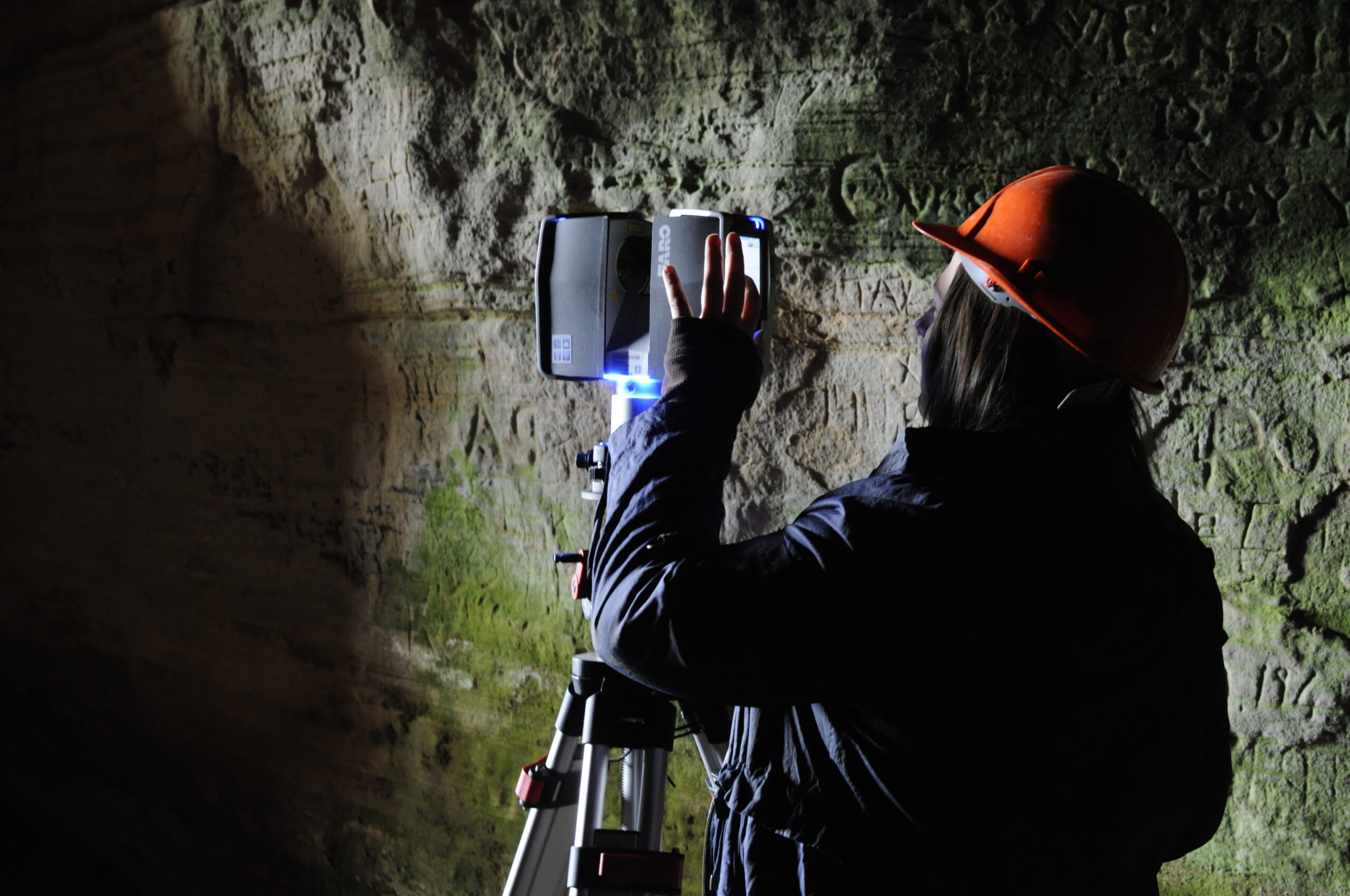
Rachael Kershaw Conducting Terrestrial Laser Scanning inside the Sculptor’s Cave (Credit: Leanne Demay)
What Have Archaeologists Found in the Sculptor’s Cave?
The Covesea Caves Project determined that there had been around 1,500 years of continuous activity at the Sculptor’s Cave, which can be divided into three main phases with the first and last phases characterised by funerary activity.
The earlier phase dates to the Late Bronze Age from 1100 – 800 BC (around 3,100 to 2,800 years ago) with artefacts including rare and high-value metalwork such as gold-covered hair rings.
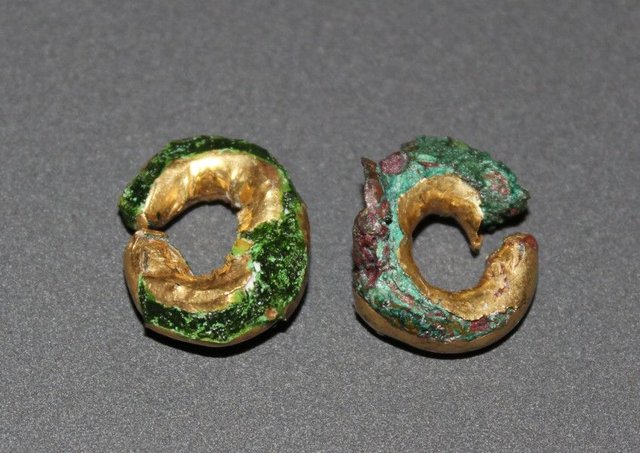
Two of the gold-covered hair rings from the Sculptor’s Cave (© Elgin Museum)
The second phase dates to the pre-Roman Iron Age from 800 BC – 100 AD (around 2,800 to 1,900 years ago) which showed that people were repeatedly visiting the cave and preparing food in the entrance chamber. During this period, a dog was also buried in the cave’s west passage.
The final phase dates to the Roman Iron Age between the 1st and 4th centuries AD (around 2,000 to 1,600 years ago) with artefacts including Samian ware (mass-produced, red-glazed pottery), glass beads, a padlock and key, a spoon handle bearing a Latin inscription, and even tweezers and nail cleaners. There were also 220 coins buried in the cave around 1,650 years ago in AD 364, the most northerly coin hoard from this date ever found in the UK. 14 are original Roman coins and the rest are copies made by local people, with several having been pierced to be worn like jewellery.

Coins from the Sculptor’s Cave (The Excavation of the Sculptor’s Cave, Covesea, Morayshire, by Sylvia Benton, PSAS, vol. 65, 1931)
The Late Bronze Age and Roman Iron Age activity was also represented by the human bones found in the cave. A total of 1,750 bones have been recovered from the site over the years. These were disarticulated, mixed together and spread across the whole cave interior, but experts were able to work out that they were from at least 32 individuals– making this one of the largest later prehistoric collections of human remains in Scotland.
But since archaeologists didn’t find any whole skeletons or signs of grave goods, what kinds of funerary activity were taking place in the cave?
What Rituals Were Performed in the Sculptor’s Cave?
In 1979, the Shepherds mostly excavated Late Bronze Age children and infants from the cave entrance, whilst between 1928 and 1930, Benton mostly excavated Roman Iron Age adults and young people (15-25 years old) from the cave interior.
The Late Bronze Age juveniles were mostly represented by bones from the head, pelvis, breastbone and shoulder blades, but very few bones from the spine, ribs, hands and feet. However, almost the exact opposite was the case with the adult bones from the Roman Iron Age. These mostly consisted of bones from the spine, ribs, hands and feet, with very few bones from the head, pelvis, breastbone or shoulder blades.
This suggests that two vastly different funerary rites were happening in the Sculptor’s Cave.
The Late Bronze Age Activity
Most people in prehistoric Britain are assumed to have undergone excarnation after they died, a process which removed the flesh and separated the bones by natural or artificial means. The sites of these rituals are virtually unknown because they don’t leave any trace.
Small bones of the hands and feet are most likely to become detached and lost early on in this process, so the lack of these kinds of bones in the Late Bronze Age juveniles from the Sculptor’s Cave suggests that they may have been excarnated off-site. Their remains may have then been brought to the cave to be deposited, either as body parts, defleshed bones or “mummy bundles” (bundles of articulated bones and possibly preserved skin, wrapped in cloth and adorned with ornaments).
You might have come across reports that a line of children’s heads was displayed at the entrance to the Sculptor’s Cave, but more recent analysis has changed our understanding of what likely happened at the site. Due to the presence of many fragments of bones from the head, as well as the gold-covered hair rings and evidence for decapitation, it was initially thought that funerary activity in the Late Bronze Age involved preparing the heads of children, adorning them with finery such as the gold-covered hair rings, and displaying them on a wooden structure at the cave entrance.
However, it is now clear that the evidence for decapitation dates to the Roman Iron Age over 1,000 years later, and post-excavation analysis has since shown that some of the bones were from other parts of the body, not just the head. So, while it still appears that the majority of the Late Bronze Age bones did belong to children, it’s probably more likely that adorned ‘mummy bundles’ were being processed and displayed on the timber racking, not just heads.
The pre-Roman Iron Age finds of pot sherds and evidence of preparing and cooking food may have been later offerings for these displayed mummified bodies, and the dog may have been buried to symbolically guard their remains.
The Roman Iron Age Activity
The opposite seems to have happened over 1,000 years later in the Roman Iron Age. Freshly dead bodies were being laid out in the cave for excarnation, which could make the Sculptor’s Cave the first primary excarnation site ever found in the UK.
The evidence of jewellery from this period showed that these bodies were also adorned with finery but rather than being displayed in the cave, it’s thought that certain recognisable elements of the body, like the head, were then removed and taken away, perhaps by loved ones to be displayed in the home.
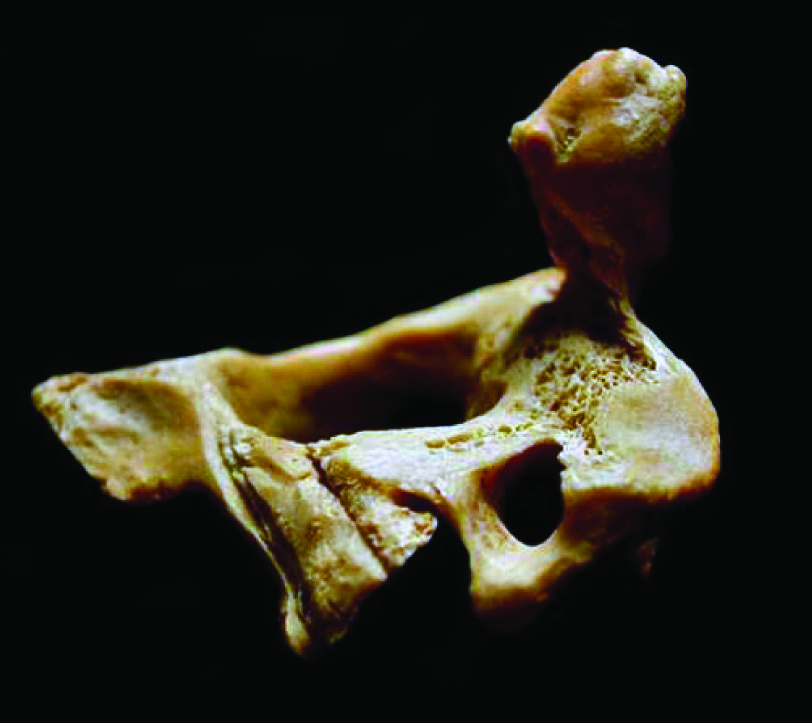
Cut-marked neck vertebra from the Sculptor’s Cave (Credit: Rick Schulting)
In 2007, archaeologists re-examined the seven bones found by Benton’s team which showed signs of decapitation. Their analysis revealed that the bones belong to this period of funerary activity and not to the Late Bronze Age, as previously thought. What’s more, the decapitating blow appears to have been delivered from behind as the victim knelt with their chin pressed tightly into their chest. Decapitation is common in Roman funerary rites, but this always occurred from the front to an already-dead body, whereas these bones suggest that decapitation was the cause of death for these individuals.
This act appears to have been performed inside the cave during the 3rd century AD and represents the decapitation of at least nine people (evidenced by the seven surviving bones plus two more which were recorded but are now sadly lost from the archive). Who were these individuals, who killed them and why? And was the hoard of Roman coins buried in the cave around 100 years later connected to this event?
Closing this Chapter of the Sculptor’s Cave: The Pictish Symbols
At the end of the Roman Iron Age around 1,600 years ago, funerary activity seems to have stopped in the Sculptor’s Cave. It was a few centuries later that the Picts carved symbols onto the cave walls – an unusual act, as most of their symbols are found on standing stones.
The markings – which give the Sculptor’s Cave its name – are found only in the twin entrance passages and not deeper inside the cave. They include classic early Pictish symbols found across the country, including a fish, a “V” shape and a crescent.
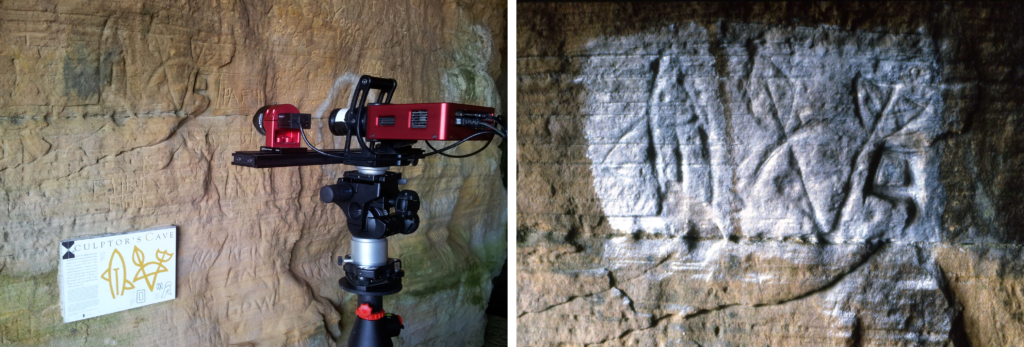
Left: Structured light scanning of the Pictish carvings in the East Passage of the Sculptor’s Cave (Credit: Covesea Caves Project). Right: Pictish carvings in the East Passage of the Sculptor’s Cave, as photographed in 1979 (Credit: Sculptor’s Cave archive)
What these symbols mean has been debated for centuries, but the latest research suggests that they could represent two-part personal names, like modern first names and surnames. The traditional date for these symbols is the 6th century AD, but recent analysis of similar symbols elsewhere suggests that those at the Sculptor’s Cave could have been created much closer to the decapitation event, perhaps only a century or so later.
Could this mean that the Pictish symbols at the Sculptor’s Cave represent the symbolic closing of a pagan ritual space by a newly Christianised community? Or perhaps the memorialisation of known named individuals who suffered a violent death?
Sueno’s Stone, a huge carved Pictish slab made of Covesea stone standing around 15 miles from the caves, could give us more clues. Created sometime around the 9th or 10th centuries AD (some 500 – 800 years after the execution event), one panel depicts prisoners awaiting decapitation by individuals holding swords. The heads of the victims are laid out in front of a motif which has been thought to symbolise a broch (stone tower) or a bell. But could the motif actually be the mouth of a cave set into cliffs? And if so, could the stone be commemorating the decapitation event inside the Sculptor’s Cave in the 3rd century AD?
The Story Continues
The Sculptor’s Cave has captivated archaeologists so much over the years that the site has traditionally been looked at in isolation. However, collections of human bone and artefacts in Elgin Museum and the National Museum of Scotland suggest that other caves along this stretch of the Moray coast also contain evidence of human activity. In 2014, the Covesea Caves Project was set up to examine the archaeology of this coastal landscape as a whole.
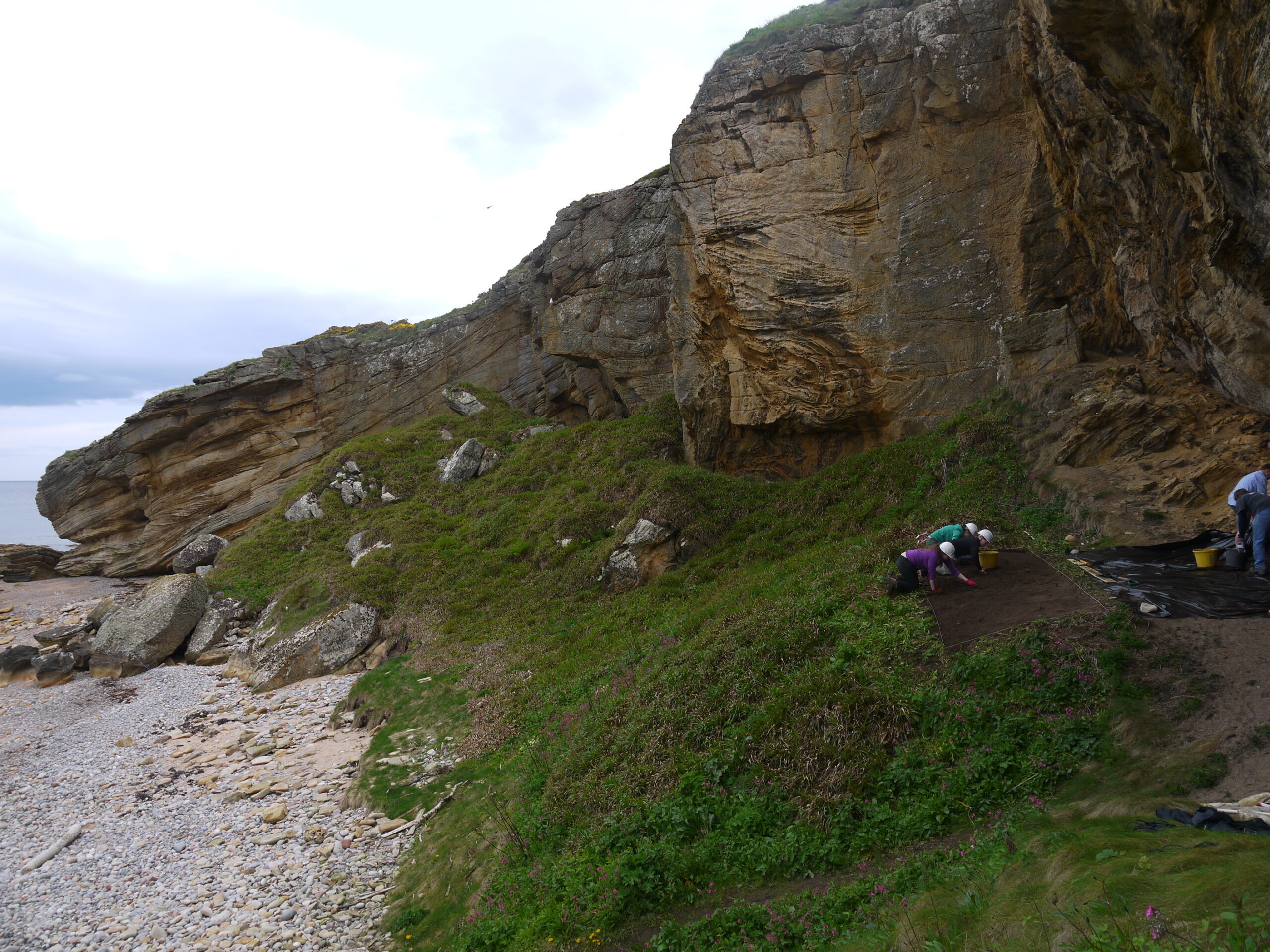
University of Bradford undergraduates excavating Sylvia Benton’s spoil heap in 2014 (Credit: Lindsey Büster)
As well as bringing together the archive of work on the Sculptor’s Cave from the 1920s and 1970s, the team travelled back to Moray to carry out more excavations at Covesea Cave 2, in the bay immediately west of the Sculptor’s Cave. Over several excavations in the 2010s, they found 50 human teeth and almost 300 human bones at the site, some of which display evidence of post-mortem processing.
The team also found soft tissue preserved on some of the 3,000-year-old bones from the Late Bronze Age, which gives us a better understanding of some of the possible evidence missing from the Sculptor’s Cave. It could explain why human intervention was necessary on the juveniles brought to the site – the sandy, salty cave environment meant that the bodies wouldn’t deflesh on their own and so some post-mortem processing may have been considered necessary to ensure that excarnation was successfully completed.
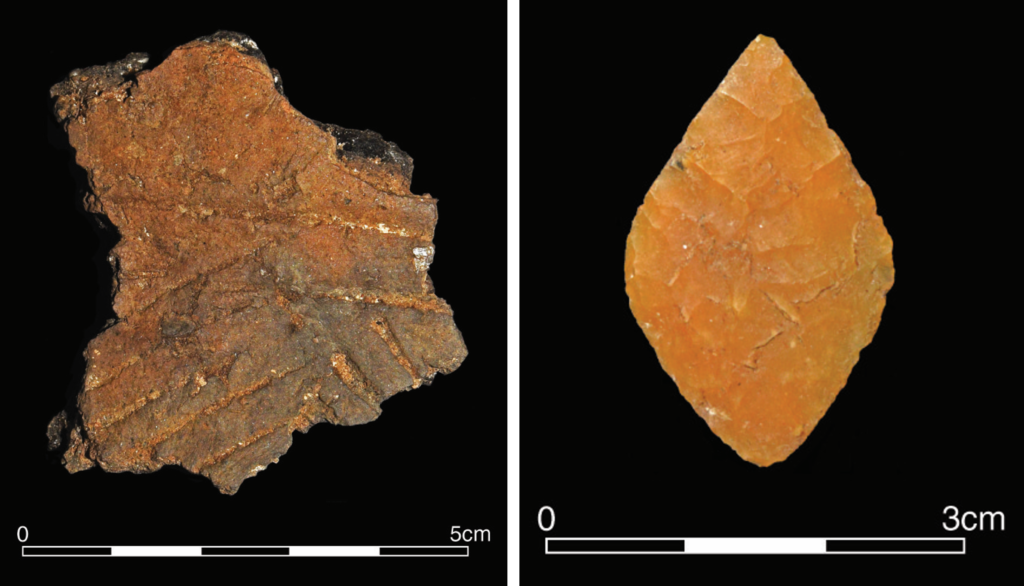
Left: Early Bronze Age pot sherd from Covesea Cave 2 excavations (Credit: Lindsey Büster). Right: Neolithic leaf-shaped flint arrowhead from Covesea Cave 2 excavations (Credit: Lindsey Büster)
Towards the rear of Covesea Cave 2, the archaeologists also found a much earlier human tooth and juvenile skull fragment which dated to the early Neolithic period (around 6,000-5,300 years ago) as well as a leaf-shaped arrowhead from around the same time. This opens up more questions about who was using the caves at this time, and why. The investigation continues!
Want to keep exploring? Head over to the Visit Moray Speyside website for inspiration and dig deeper into the Covesea Caves in the Darkness Visible e-book, available free online.
Have the Covesea Caves piqued your curiosity? Dig into the story in Darkness Visible: The Sculptor’s Cave, Covesea, from the Bronze Age to the Picts, winner of the Saltire Society Research Book of the Year Award 2022, which is available to read free online and to purchase in the Society of Antiquaries of Scotland’s online shop.
Published by the Society of Antiquaries of Scotland (who coordinate Dig It!), the book was written by Professor Ian Armit, Chair in Archaeology at the University of York and Dr Lindsey Büster, a Research Associate at the University of York and Lecturer in Prehistoric Archaeology at Canterbury Christ Church University. For more information, you can also watch the recorded lecture on the book on YouTube.
Header Image: (©Visit Moray Speyside / Visualising Scotland)