Industrial Archaeology: Unearthing Scotland’s ‘Iron Burgh’
Half-hidden in a natural amphitheatre right in the centre of Coatbridge lies one of the most significant places in modern Scottish history.
Here you can see the remains of Scotland’s only excavated Victorian ironworks in the heart of a preserved industrial landscape. In the mid-1800s Coatbridge was epicentre of an industry that propelled the country into the modern age.
“Oot-ower the auld brig, up to sweet Simmerlee,
Sweet, said ye? – hech, whaur? – for nae sweetness I see;
Big lums spewin’ reek an’ red lowe on the air,
Steam snorin’, an squeelin’, an’ whiles muckle mair!”
– Janet Hamilton (1795-1873), from ‘A Wheen Aul’ Memories’
The History of the Summerlee Iron Works in Coatbridge
High corn prices after the Napoleonic Wars had given landowners and farmers the money to exploit local coal reserves. Demand driven by the growing city of Glasgow had already led to the opening in 1793 of the Monkland Canal which connected the mineral-rich Monklands to the expanding city.
The Summerlee Iron Works was one of the first of a new generation of factories producing pig iron using the ‘Hot Blast Process’ in which pre-heated air was forced into a blast furnace. This was more efficient than using cold air and enabled the plentiful local ‘black band’ ironstone, previously considered useless, to be used.
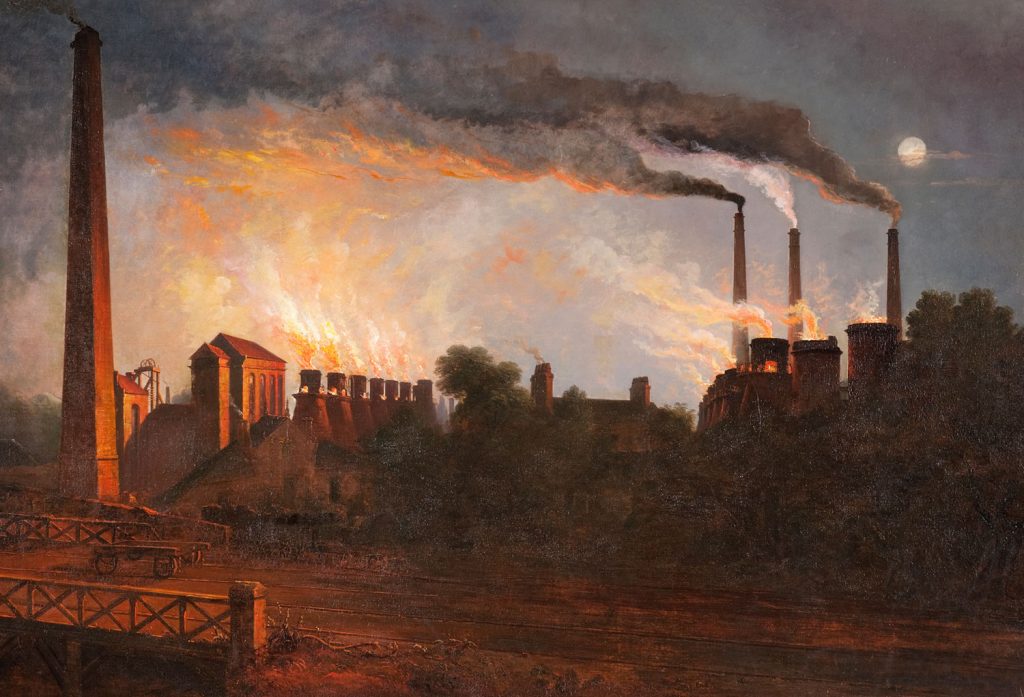
‘Gartsherrie by Night’ by C R Stanley, 1853. This large-scale painting shows Scotland’s biggest ironworks, next door to Summerlee, at its greatest extent with 16 furnaces.
By 1850 the Coatbridge area, known as the ‘Iron Burgh’ had nearly half of Scotland’s blast furnaces. This growing urban centre drew in newcomers from the Highlands, Ireland, England and Wales.
It was a boom that couldn’t last as nearby mineral reserves were exhausted and the new steel industry of the 1870s passed Coatbridge by.
Most of the Iron Burgh’s furnaces were extinguished after the First World War. Summerlee shut its gates in 1933 and was demolished five years later. The furnaces and other structures remained buried under metres of rubble for half a century.
![[IMAGE 4: Excavators illustrating the depth of debris that had covered the remains of the ironworks, around 1986.]](https://www.digitscotland.com/wp-content/uploads/2020/04/IMAGE-4.jpg)
Excavators illustrating the depth of debris that had covered the remains of the ironworks, around 1986.
In the 1980s work began to build a museum at Summerlee. Hundreds were drafted in to help excavate the ironworks over several years before the museum opened in 1988. Then in 1999 and 2000 more targeted archaeology was carried out, along with a topographic survey of the site.
Pigs and Sows
Summerlee was a pig iron works, meaning it made cast iron. Not fancy, decorative ironwork, just long ingots of iron called ‘pigs’, so-called because when cast in parallel rows they resembled piglets suckling at a sow.
![[IMAGE 5: A bar of pig iron found at Summerlee.]](https://www.digitscotland.com/wp-content/uploads/2020/04/IMAGE-5-1024x156.jpg)
A bar of pig iron found at Summerlee.
The blast furnace which was used to make the pig iron was an iron-covered structure some 20 metres tall and lined inside with firebricks. Ironstone, coal and limestone were ‘charged’ into the top of the furnace while hot air was forced through the molten mixture. Until the late 1800s the tops of the furnaces were open so flames and fumes spilled out. All that survive of the Summerlee furnaces are the hearths but two still have visible tap holes for releasing the molten iron.
The newly-cast pigs were then broken apart manually. This had to be done while the iron was still hot so the workers wore wooden-soled clogs such as this pair found during the excavations.
![[IMAGE 11: These clogs were found on the ironworks site. They have a wooden sole with a leather upper.]](https://www.digitscotland.com/wp-content/uploads/2020/04/IMAGE-11-1024x569.jpg)
These clogs were found on the ironworks site. They have a wooden sole with a leather upper.
Future Digs?
The iron works was constructed on two distinct levels divided by the ‘furnace bank’, the wall of which can still be seen today.
On the higher ground was the infrastructure to bring in the raw materials, a sprawling area of railway sidings, reservoirs, workshops and offices.
The lower level, or ‘fore side’ was where the iron was made and where the hot blast was generated. Eight furnaces and associated hot blast stoves stood in a row immediately below the furnace bank. At either end was an engine house containing a beam engine to drive the hot blast.
Between the line of furnaces and the canal were casting beds where the molten iron flowed into sand moulds and solidified in the open air. These have yet to be excavated.
![[IMAGE 14: Excavation plan of one of the Summerlee furnaces showing the circular hearth surrounded by rectangular supports for the outer structure of the furnace.]](https://www.digitscotland.com/wp-content/uploads/2020/04/IMAGE-14.jpg)
Excavation plan of one of the Summerlee furnaces showing the circular hearth surrounded by rectangular supports for the outer structure of the furnace.
Summerlee Today
Today the remains of the ironworks lie in quiet parkland in Summerlee Museum of Scottish Industrial Life, a far cry from the noisy industrial scene of a century ago. The site may be ruinous but it is as important to Scotland’s story as any castle or stately home. Here enormous wealth was forged and a community of disparate cultures melded together like iron ore, limestone and coal.
If you’d like to know more about the museum, you can find them on Twitter (@SummerleeMuseum and @NL_Heritage), follow them on Facebook, or dig into the collections.
By Justin Parkes, Industrial History Curator for North Lanarkshire’s museums since 2008.
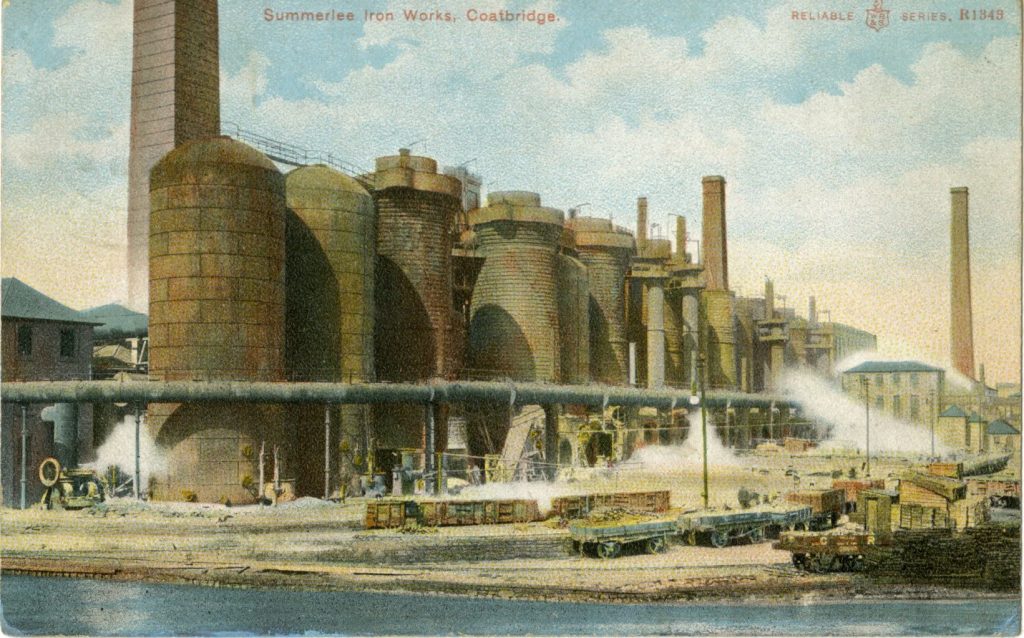
Header Image: The Summerlee Iron Works, seen in a picture postcard from the early 1900s. In the foreground you can see the Gartsherrie Branch of the Monkland Canal.

This article was produced as part of Scotland Digs Digital. In the summer of 2020, we shone a spotlight on Scottish archaeology with the Scotland Digs Digital campaign which brought together online and offline events, as well as live updates from across the country for everyone to enjoy.
