‘Many Pits They Dug’: The Archaeology of Robert the Bruce (English)
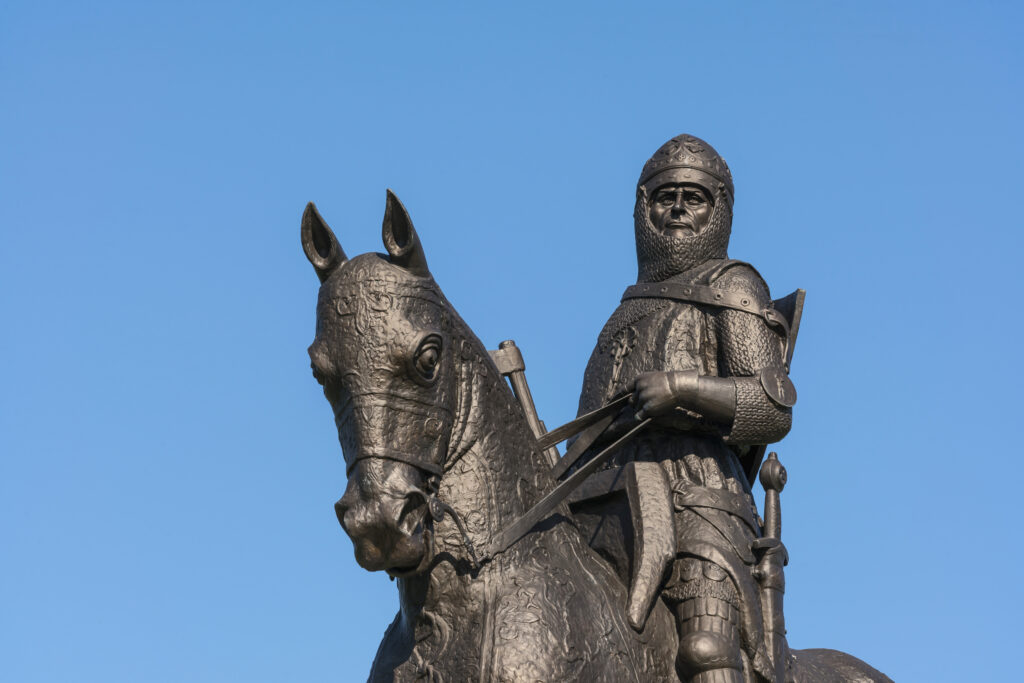
King Robert I of Scotland – Robert the Bruce as most of us know him – is undoubtedly one of Scotland’s most celebrated monarchs. Much of what we know about his life and reign comes to us through written sources, but archaeology has also furnished us with several artefacts that offer a tangible link with Scotland’s hero-king.
A TOMB FIT FOR A KING
Perhaps the most dramatic archaeological discovery associated with Bruce was the unexpected unearthing of a body believed to be Bruce’s during building work at Dunfermline Abbey in 1818.
As early as 1314, Bruce had expressed a desire to be buried at Dunfermline with ‘our royal predecessors’, as he put it. Seven previous Scottish monarchs had been buried at the abbey, including St Margaret, whose shrine attracted pilgrims from across Europe.
To that end, Bruce paid for an ornate tomb to be made for himself and his queen, made from white marble shipped from Italy with a slab of black Frosterley marble from northern England beneath it. Sadly, the tomb was smashed during the Scottish Reformation, but several fragments of the expensive Italian marble have survived – some of which are now on display at the National Museum of Scotland in Edinburgh. In 2017, specialists digitally recreated Bruce’s tomb and you can read all about it in this case study on the ScARF website.
It is not entirely clear whether the body found in 1818 was Bruce’s, but the coffin also contained cloth of gold – now also on display at the National Museum of Scotland – that the body may once have been wrapped in. The body was examined by Alexander Munro, Professor of Anatomy at the University of Edinburgh, and briefly displayed to the public before being reinterred in 1819.
Before it was reburied however a cast was made of the skull, and replicas of this cast have since entered the collections of several museums around Scotland. This has been the basis of several facial reconstructions of the king, with the most recent being undertaken in 2016 using the cast belonging to The Hunterian in Glasgow.

Fragments believed to be from Bruce’s tomb at Dunfermline Abbey. Dunfermline became something of a mausoleum for the Bruce family in the years after King Robert’s death, with his nephew and brother-in-law also choosing to be buried there
THE HEART OF THE MATTER
Following his death in June 1329, Bruce’s body was buried at Dunfermline but his heart was removed and – after a brief but eventful trip to Spain – was buried at Melrose Abbey in the Scottish Borders.
While this practice was often frowned upon by the Church (Bruce had to get permission from the Pope before doing it), it appealed to Bruce because it would mean that prayers and masses would be said for his soul by the religious communities of both Melrose and Dunfermline, which would decrease the time he would have to spend in Purgatory for all of the sins he had committed during his lifetime.
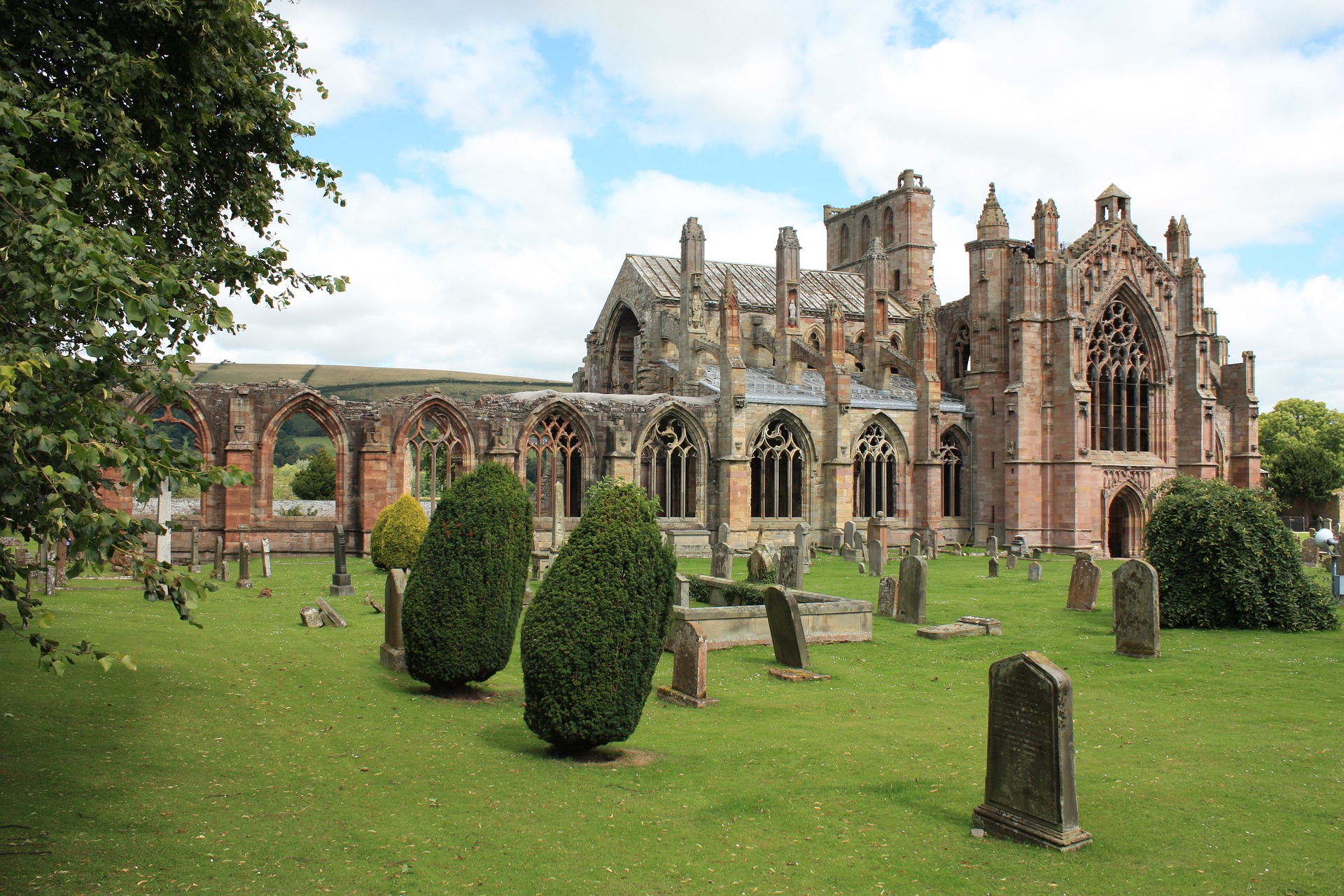
(Image by Bret Fischer from Pixabay)
But Melrose’s position close to the border gave it added significance. This was a region that Bruce had fought hard to recover from the English, and his decision to have his heart buried there symbolically emphasised his expectation that his successors would retain control of that area.
In 1921, the Office of Works discovered a conical casket, roughly ten inches long, beneath the Chapter House floor at Melrose. They quietly reburied it, but in 1996 an archaeological team working for Historic Scotland (now Historic Environment Scotland) rediscovered the casket.
As with the body discovered at Dunfermline, we do not know for certain whether or not this contained Bruce’s heart. It would certainly seem to be a heart burial and in 1998 it was reburied again beneath a memorial stone dedicated to the king.
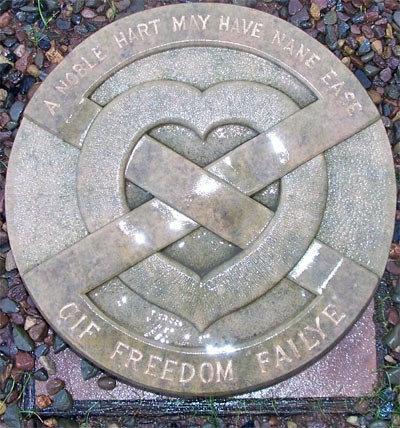
The modern memorial stone beneath which Bruce’s heart is believed to be buried. Bits of Bruce were buried at no less than three separate sites around Scotland: his heart at Melrose, his body at Dunfermline, and his entrails at Cardross near Dumbarton, where he had built for himself a luxurious manor house. (© Otter via Wikimedia Commons CC BY-SA 3.0)]
CLUES FROM THE BATTLE OF BANNOCKBURN
The most recent archaeological discoveries associated with Bruce came in the build-up to the 700th anniversary of his most significant military victory at the Battle of Bannockburn. In anticipation of the anniversary celebrations in 2014, a team of archaeologists undertook a systematic survey of the area where we think the battle was fought.
The likelihood of much material being recovered was relatively low, for a number of reasons. Firstly, we would expect anything that could have been reused to have been taken from the battlefield by the victorious Scots. Furthermore, much of the fighting took place in the space between two shallow slow-moving streams, on ground that would be expected to badly corrode any metal objects buried there.
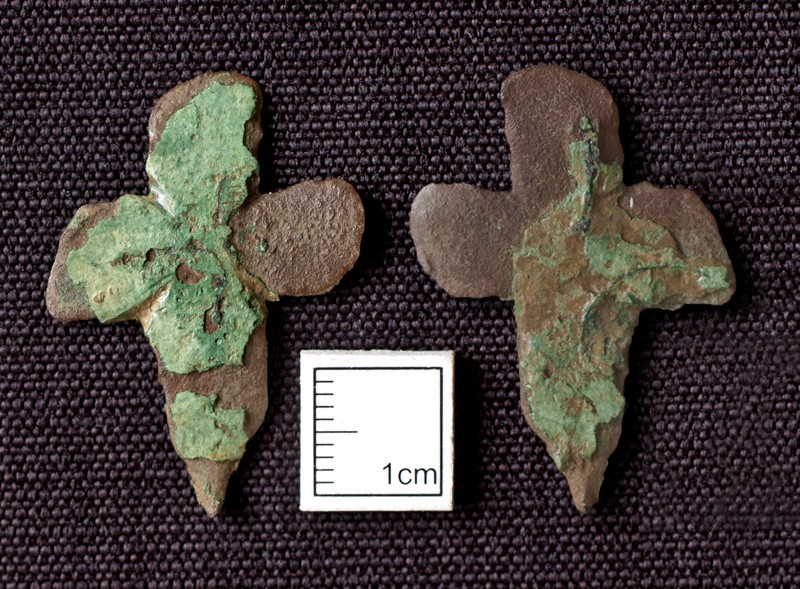
A cross-shaped pendant found in 2014 on the likely site of the Battle of Bannockburn. This would once have hung from the harness of a horse to show the wealth and piety of the man who owned it (© GUARD Archaeology Ltd.)
Nevertheless, three objects were recovered that may have been left behind following the battle. These were a piece of a spur, a piece of a stirrup, and a small copper alloy cross pendant featuring traces of blue enamel.
All of these appear to be early fourteenth-century, were clearly prestige items and were found close to the Bannock Burn itself. They may have been lost by an Englishman while crossing the burn in preparation to camp on the evening of the first day of the battle, or by some poor soul fleeing for his life towards the end of the second day.
These three objects represent the best archaeological evidence we have to confirm what the relevant narrative sources seem to be telling us about where Bruce’s most notable victory occurred.
Ready to explore more battlefield archaeology? Dig into the archaeology of burials on Scotland’s battlefields.
BY DR CALLUM WATSON, EARLY CAREER RESEARCHER IN LATE MEDIEVAL SCOTTISH POLITICS, SOCIETY AND WARFARE. BATTLE COORDINATOR AT THE BATTLE OF BANNOCKBURN VISITOR CENTRE. BLOG POSTS AT ‘KNIGHT OF THE TWO L’S’. JOIN THE CONVERSATION WITH @VIVSTAN211240 ON TWITTER
Header Image: (© VisitScotland / Kenny Lam)
