Queering Archaeology: Vikings in Scotland (English)

Of all historical groupings of people, the Vikings are perhaps the most celebrated as a prime example of ‘real men’. The iconography of the Vikings and Norse mythology has become an adornment for masculinity, worn as tattoos by bodybuilders and etched into the armour of buff superheroes.
The stories you hear are of fierce hotblooded warrior men, of violence and pillage. This notion can make it hard for us to look at the 8th to 11th centuries in Scotland without a strong cisgender and heterosexual bias. It can be a challenge to see the roles of gender nonconforming people, to pull apart the understanding of gender, sex and identity as they really were for the people who we now call Vikings.
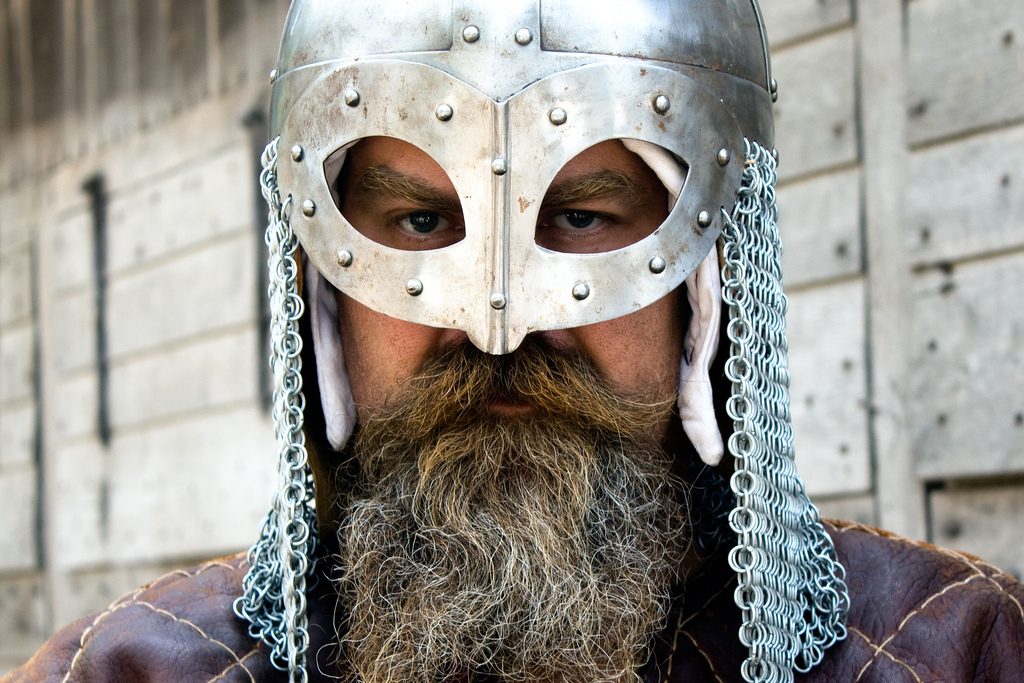
(Hans Splinter via Flickr at https://bit.ly/2LBMO6u, CC BY-ND 2.0)
History is a living, growing, imperfect thing, but one thing that we know for certain about the past is that LGBTQ+ (lesbian, gay, bisexual, transgender and queer) people have always existed. In every place and every time, people who today might define as any of the many queer identities were every bit as alive, present and vibrant as we are today. The issue is in the telling and how the world of yesterday has been framed for an audience of straight cis-gendered white men.
Understanding Grave Goods
In the past, academic writing has made assumptions about gender roles in Viking society. For example, the joint burial of two individuals discovered at Ballinaby in Islay in the Inner Hebrides in 1878 was at the time interpreted as the burial of a man and woman. This was before genetic testing, and therefore based solely on the grave goods found buried with the bodies and the idea that Viking men were warriors, while women were housekeepers.
One of the bodies was buried with a spear, sword, shield, axes and blacksmith’s tools, while the other was found with various items of jewellery including two tortoise shell brooches, now in the National Museum of Scotland in Edinburgh. As a result, an article in the Proceedings of the Society of Antiquaries of Scotland states: “It is evident from the nature of the two groups of objects thus associated with the two skeletons, that No. I. was the grave of a man, and No. II. that of a woman.”

Oval Bowl-shaped Brooch found in the grave No. 2 at Ballinaby, PSAS Vol. 14 (1879)
Similarly, the Port an Eilein Mhòir ship burial in Ardnamurchan in the Highlands was presumed to be that of a male warrior based on lack of jewellery and the huge axehead that was found buried with the body.
However, it’s important to remember that grave goods may not necessarily have belonged to the person they were buried with. They may have been family heirlooms, or offerings made by mourners at the grave side. For example, we know of cases where a child has been found buried with huge weapons which they would never have been able to lift while alive.
Archaeologists lifting the axehead from the Port an Eilein Mhòir ship burial in Ardnamurchan (Via Wikipedia at https://bit.ly/2ByQQXA)
A Warrior from Sweden
But in cases where it is plausible that weaponry belonged to a buried individual, we should consider that that person may have been a woman. Indeed, whilst it’s clear that Viking societies were aggressively patriarchal, there is also significant evidence for a more fluid understanding of gender roles.
A Viking warrior from Birka in Sweden for example, was found in 1878 surrounded by weapons and the spoils of war. This skeleton was tested over 100 years later and found to be that of a person with XX chromosomes, which means that today they would have been recorded as female at birth. Experts now think that this person “lived as a professional warrior and was buried in a martial environment as an individual of rank.”
DNA analysis showed the body was biologically female
This caused controversy as the grave had long been considered a high-status warrior burial. Read a fantastic summary of debate following the 2017 article https://t.co/cLHQnAcF51
(/Tancredi Valeri via @CambridgeCore) pic.twitter.com/RI3pDlmcwW
— trowelblazers (@trowelblazers) February 26, 2019
Unfortunately, there appears to be no data yet on whether the individual in the Port an Eilein Mhòir burial has been tested to determine their biological sex. What the Birka burial tells us is that in the absence of this information we cannot jump to conclusions about the gender identity of the individual in the Port an Eilein Mhòir grave based on heteronormative assumptions about gender in the past (which was the case in the 19th-century interpretation of the Ballinaby burial).
Reimagining Viking Society
We know that the gender identity of a person in the Norse period was often tied to their role in Viking society, not just the biology they were born with. Someone assigned male at birth might practice ‘seiðr’, a particular kind of religious divination and magic associated with women and through this gain a kind of gender fluidity.
Similarly, unmarried women might become landowners and inherit property; These ‘Baugrygr’ or ‘Ringkvinna’ would be the head of the family occupying a traditionally masculine role in Viking society. At the very least, men and women in Viking society could break from traditional constructs of male and female roles and it is possible that we are talking about people who would today identify as transgender or nonbinary.

A Viking Boat Burial (Image Credit: John Haylett via Wikimedia Commons at http://bit.ly/2xQ5bxd, CC BY 3.0)
Queer theory is an important part of archaeology and can help us understand the complexity and diversity of past societies. Passing a queer eye over historical ‘fact’ does not mean flipping everything on its head for the sake of seeming ‘fair’. Instead it takes the idea that heteronormative assumptions made about peoples in the past can oversimplify the truth, and therefore need to be challenged or at least questioned.
We know that queer people have always existed, gender identity is a complex and shifting thing, and human sexuality is a spectrum of possibilities. Applying this knowledge to the past can only bring us closer to telling the real stories of the people of Scotland hundreds, and even thousands or years ago.
Want to keep reading? Dig into Who Were the Vikings?.
By Sacha Coward, who has worked with collections, heritage sites and museums for over 10 years. His background is in evolutionary anthropology and he is passionate about exploring human culture and history through an inclusive lens. Sacha is a regular LGBT History Month speaker, a freelance queer historian, and an escape room designer.
Glossary
-
Cisgender – a term used to describe people whose gender identity aligns with those typically associated with the sex they were recorded as at birth
-
Heterosexual – someone who is attracted to a person of the opposite sex
-
Gender-nonconforming – people who do not follow other people’s ideas or stereotypes about how they should look or act based on the female or male sex they were assigned at birth
-
Transgender – an umbrella term describing a person whose sense of personal identity and gender does not correspond with their birth sex
-
Queer – an umbrella term for sexual and gender minorities who are not heterosexual or are not cisgender
-
Gender Expression is how a person behaves, appears, or presents oneself with regards to societal expectations
-
Heteronormative – a world view that promotes heterosexuality as the normal or preferred sexual orientation
-
Nonbinary – someone who does not identify as a man or a woman, or solely as one of those two genders
Featured Image: Viking arms and armour (Helgi Halldórsson via WikiCommons at http://bit.ly/3nSmylb, CC BY-SA 2.0)
Le taic bho Bhòrd na Gàidhlig