Shell Beads, Glass Bangles and Hogback Stones: 10 Highlights from the Scottish Archaeological Research Framework
Scotland boasts over 12,000 years of human history and much of what we know about the people comes from the remains they left behind. But how to get to grips with twelve millennia of archaeology? The Scottish Archaeological Research Framework (ScARF) is here to help.
What is ScARF?
The ScARF is an online resource, launched in 2012, which provides an overview of everything we know (and would like to know) about archaeology in Scotland.
-
- (©ScARF)
-
- (©ScARF)
Why was ScARF created?
Hundreds of top experts worked together to create a series of reports that tell us about every period of Scotland’s past and importantly, lots of ideas (research questions) for the future. Instead of creating a book, it was decided to share the framework as a website (and free downloadable PDFs) so this fabulous resource could be free to access and available for anyone with an interest in Scotland’s history and archaeology.
Visitors to the ScARF website can find events and exciting archaeological research news from around the country. Readers can also scroll through thousands of years of prehistory and history sorted into seven time periods covering the Palaeolithic & Mesolithic and Neolithic, Bronze Age, Iron Age, Roman, Early Medieval, and Modern.
What Can I Find on ScARF?
1. Carved Stone Objects
These mysterious objects were found during the excavation of the Neolithic (stone age) village of Skara Brae in Orkney. They’re around 5,000 years old, but what were they used for? Take a look and see what you think.

Three pointed object, Skara Brae (© National Museums Scotland via https://bit.ly/3kdi4UB)
2. Mesolithic Shell Beads
Archaeology is rubbish… no really, it often is. We find out lots about past people from the everyday waste (midden material) they leave behind. These beads come from a Mesolithic (hunting and gathering period) shell midden in Oronsay in the Inner Hebrides. They are at least 5,500 years old and represent the earliest jewellery found in Scotland.

Oronsay beads from a midden (© SCRAN/National Museums Scotland via https://bit.ly/3pcycsZ)
3. Jet Objects of the Bronze Age
Around 4,000 years ago, beautiful jewellery was made from jet (black fossilised wood – a bit like coal) which was shaped, polished to a high shine and sometimes decorated with patterns. During this time, jet was a popular material for making a variety of decorative objects like necklaces, bracelets, buttons and belt rings and these have been found with Bronze Age burials all over the country.
4. Roman Brooches
For almost four centuries, Scotland was at the edge of the mighty Roman Empire and archaeologists have discovered Roman artefacts all the way up to Shetland. These brooches were discovered at a large hillfort occupied by powerful Iron Age people in East Lothian around 2,000 years ago. Objects such as this help us explore relations between the Romans and the Iron Age societies of Scotland during this exciting period.
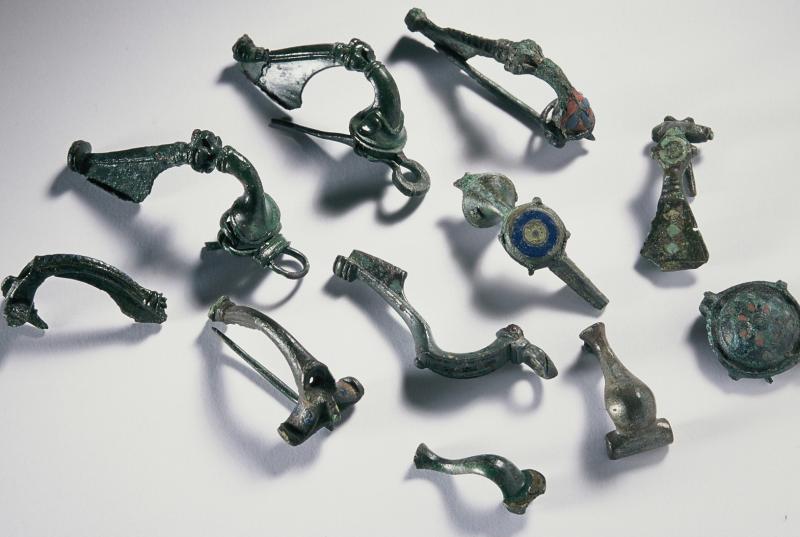
Roman brooches from the Iron Age hillfort of Traprain Law (© National Museums Scotland via https://bit.ly/3lv6VA1)
5. Hogback Stones
Around 1,000 years ago, parts of Scotland were settled by Vikings and archaeologists have found lots of evidence of settlements and burials. In the later Norse period, a distinct type of carved stone, known as ‘hogbacks’, were used as grave markers. There are five ‘hogback’ stones in the Govan collection in Glasgow. These gigantic carved stones marked the graves of very important people during this period and might have been shaped to look like Viking halls.

Hogback stone from Govan (© Northlight Heritage via https://bit.ly/38vE0Iq)
6. Iron Age Glass Bangles
Around 2,000 years ago, Iron Age people in Scotland wore colourful glass beads, and fragments of glass bangles have been found on several Iron Age sites in the Roman period. Lots of new materials were introduced during the Iron Age and colourful glass objects may have been an important accessory used by people to decorate themselves and express identity.
7. The Lewis Chess Pieces
Interested in science? These (sometimes scary looking!) chess pieces were carved from walrus ivory around 900 years ago before being discovered on the Isle of Lewis in the Outer Hebrides – but where did they come from? ScARF’s science framework has more information about the different types of analysis that can be applied to all sorts of artefacts. This can help us understand where the raw materials to make objects came from, how the objects were used, and how they can be preserved for the future.
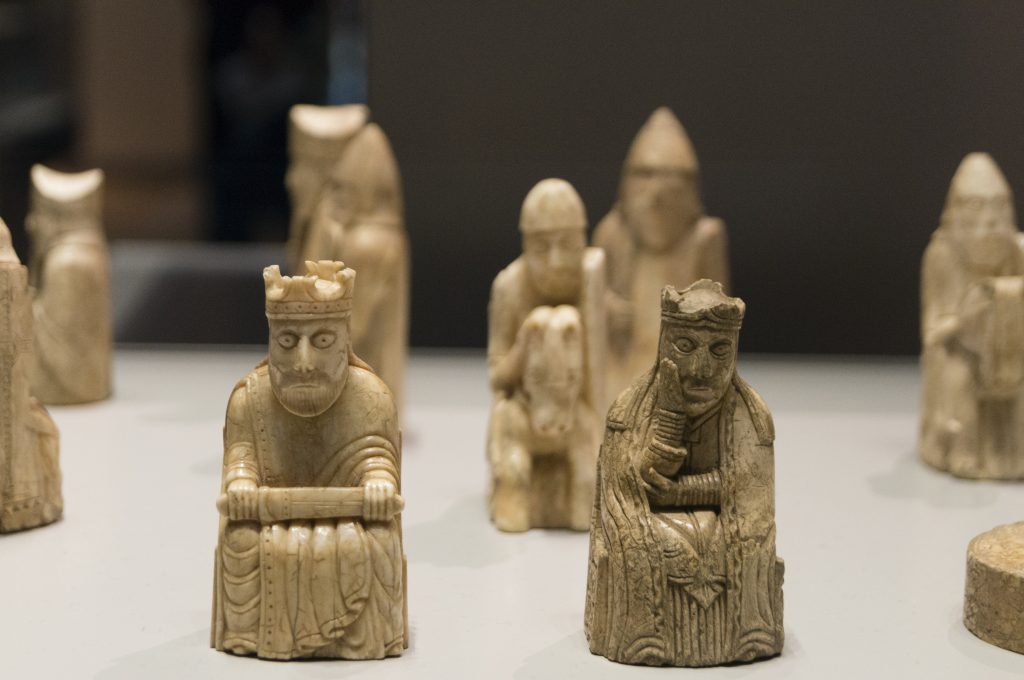
Lewis Chess Pieces (Image Credit: Jagoba Barron via Flickr, CC BY-SA 2.0)
8. The Tomb of Robert the Bruce
Around 700 years ago, one of Scotland’s most famous kings, Robert the Bruce, was buried in Dunfermline Abbey in Fife. His grave was marked with an elaborate monument, later destroyed and thought to be lost forever – until several pieces of gilded white marble were discovered during excavations in the graveyard.
Specialists have digitally recreated Bruce’s tomb and you can read all about it in a case study on the website. If you love carved stones, you’ll be excited to hear there’s a whole part of the ScARF website dedicated to them! From prehistoric carved stones to modern market crosses- the carved stone framework outlines what we know about carved stones in Scotland to date.
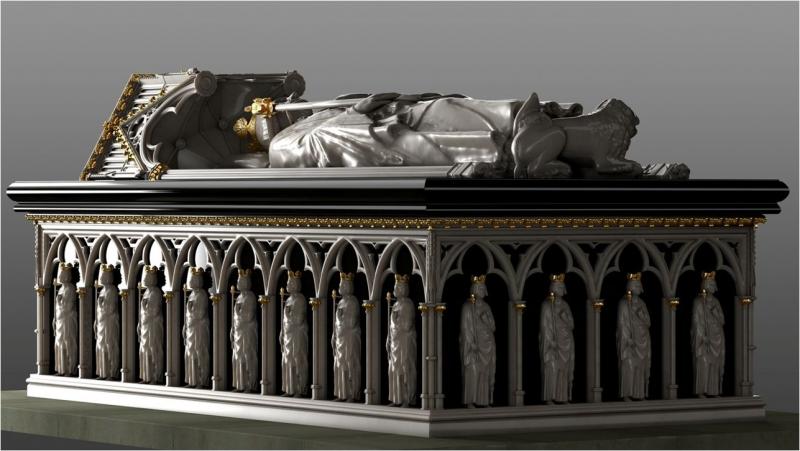
Digital reconstruction of how Bruce’s tomb may have appeared (© The Centre for Digital Documentation and Visualisation via https://bit.ly/2IqqxGS)
9. An Invitation to the opening of the Forth Bridge (1890)
Archaeology of the past, present and future? This invitation was sent to guests in 1890 to mark the official opening of the Forth Bridge. The bridge across the Firth of Forth in the east of Scotland is now a UNESCO World Heritage Site and has been described as a ‘masterpiece of creative genius’. It was built during the fast-moving industrious and revolutionising period known as the Long Nineteenth Century. During this time, Scotland was a world-leader in the creation of new technology and scientific techniques.
10. Prehistoric Rock Art
Mysterious prehistoric rock art can be found all over Scotland, and Argyll and Bute is home to almost 20% of known examples. The website even has a feature which will enable you to find out more about the carved stones in the area and how members of the community across the country are helping us to understand more about the past.
Of course, these are just some of the team’s favourites. Why not have a browse through the website and choose your own?
