Six Amazing Artefacts In Scotland’s Museums
Scotland is home to hundreds museums, ranging from record-breaking national organisations to buildings with one room run entirely by volunteers – and you’ll find fascinating stories in each and every one of them:
1) Walrus Ivory Knife Handle
Where: Perth Museum and Galleries
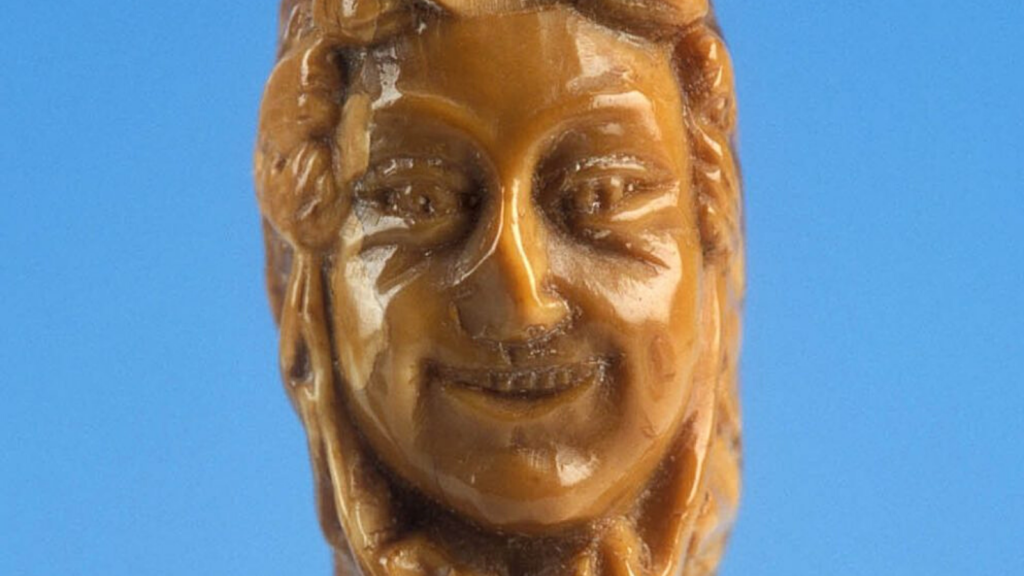
This unique 14th-century knife handle was found in 1977 during excavations on Perth’s High Street. It shows a hooded face carved in fine detail and intricately carved leaves being held to either side of the hood.
According to the Museum, it probably represents someone enjoying May-time festivities, which often included the gathering of seasonal greenery. Sounds like medieval Perth knew how to throw a good party.
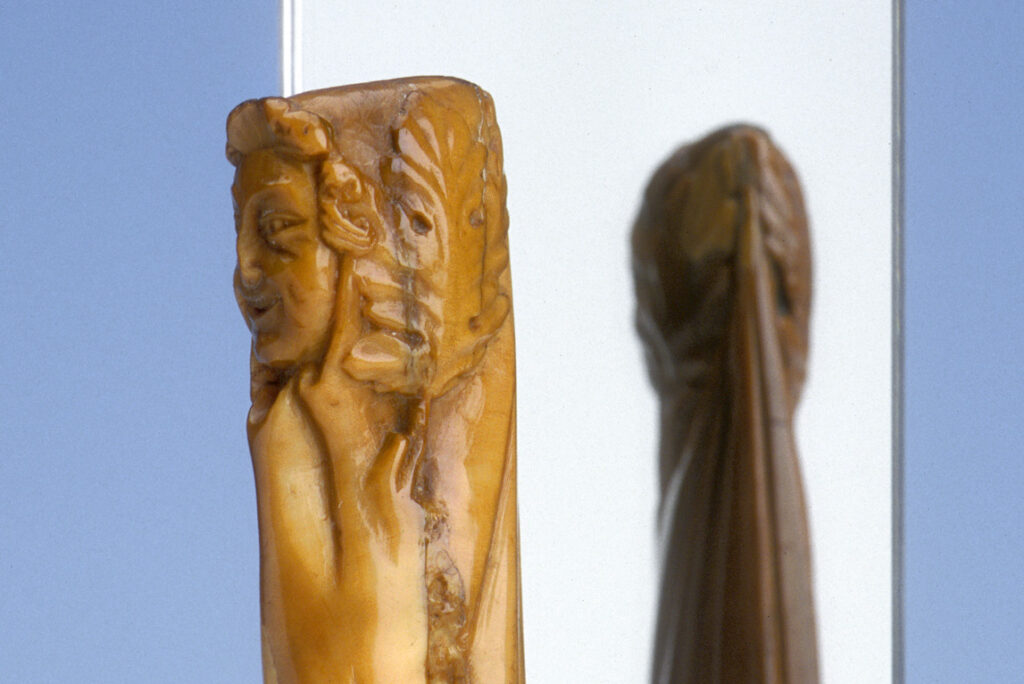
Walrus Ivory Handle – copyright Perth Museum and Art Gallery
2) Rheingulden coin
Where: Shetland Museum & Archives
This small coin played a big part in Shetland’s history. In 1469, Princess Margrethe of Denmark married King James III of Scotland. The Danish king was short of money for her dowry, so he pawned Orkney to the Scots for 50,000 Rheingolden (Florins of the Rhein) and Shetland for 8,000, with the understanding that if Denmark paid the money they would get the islands back.
The Danes tried many times during the next 200 years to get Orkney and Shetland back but always failed, so the islands became part of Scotland.
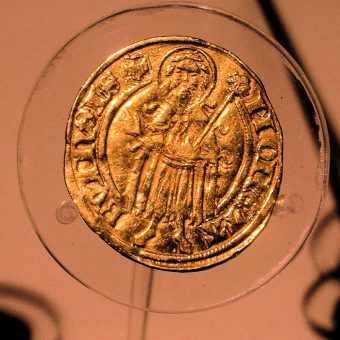
Image courtesy of Shetland Museum & Archives
3) Scar Dragon Plaque
Where: Orkney Museum
In 1991, coastal erosion unearthed a Viking burial on a beach on Sandy. Racing against time, archaeologists found a small rowing boat, human remains (a man in his thirties, a child and an elderly woman at the centre) and two dragons – in the form of a whalebone plaque.
With a smooth surface and flat base, theories regarding its function have ranged from “ancient ironing board” to “food platter” at high status feasts. The true story behind these individuals, their burial and the plaque has yet to be solved.
Day 1. The Scar plaque. A whalebone linen smoother from a 10thC Viking boat burial. #AdventCalendar #Orkney pic.twitter.com/LnZvLcmYqj
— Orkney Museums (@OrkneyMuseums) 1 December 2016
4) The Hostage Stone
Where: Bute Museum, Argyll & Bute
This piece of slate depicts a scene carved somewhere between 800 to 1,100 AD in which an ecclesiastical figure is being taken hostage by a chainmail-clad Viking. The poor monk is being led to a Viking ship with oars ready to row him away.
It was almost certainly sketched by a child who was drawing something they had either imagined occurring or had seen first-hand, which would have been a common enough scene at the time. According to the Museum, this little sketch is of such importance that it’s frequently requested on loan by other museums (including a high-status gig in Denmark at the Viking Ship Museum in 2014).
5) Three Cervical (Neck) Vertebrae from Sculptor’s Cave
Where: Elgin Museum, Moray
When classical archaeologist Sylvia Benton entered this dark cave in 1928, she encountered a floor “strewn with human bones”. During the subsequent excavations, she recovered around 1,800 of them. These three bones – with cut-marks indicative of decapitation – illustrate the practice of beheadings in the Iron Age (around 240 AD).
Further examination uncovered additional bones, including several mandibles from juveniles, which may indicate the display of severed heads at the entrance. The difficult and dangerous site is located near the base of impressive cliffs and can’t be accessed at high tide, which may have made it a highly appropriate location for the undertaking of ritual practices. A visit to the museum is a much safer option.
6) Inscribed Distance Slab of the Twentieth Legion
Where: The Hunterian, Glasgow
Turf ramparts, ditches and stone forts once marked the most northerly border in the Roman Empire. Scotland’s Antonine Wall was carved out of the landscape from coast to coast, and traces can still be found in modern parks, suburbs and cemeteries almost 2,000 years later.
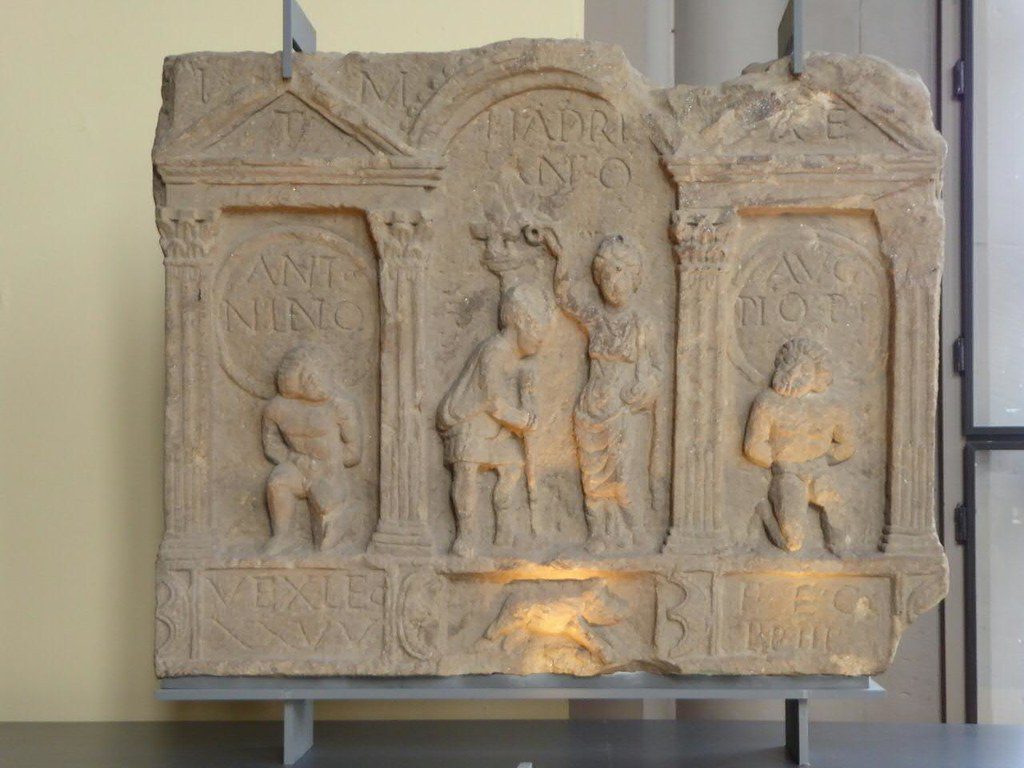
Distance slabs were used to record lengths or ‘distances’ of the wall completed by each legion, while celebrating the Roman military victories that preceded the construction of the Antonine Wall as a form of propaganda – also known as “gloating”.
According to the Museum, this sandstone distance slab from Hutcheson Hill in Bearsden symbolises Roman victory over the Caledonian tribes (who are shown in defeat). The central female figure is probably Britannia – the female personification of Britain – who congratulates the Roman troops on their success. Only eighteen slabs survive and all but two are in The Hunterian’s collections.
If you’re feeling inspired by these finds, visit our Events & Digs page to find your next event.
Header: Walrus Ivory Handle – copyright Perth Museum and Art Gallery
