The Archaeology of Scotland’s Natural Larder: Red Deer

Animal bones hold a wealth of information that can tell us about the past, including past economies, agricultural and dairying practices, what the local landscape was like, whether a species was introduced or became extinct, what people ate, where they ate and when. These bones tell us about the relationships between people and animals and is a field of archaeology known as zooarchaeology.
The cultural and economic importance of wild species in Scotland’s past is the focus of my PhD research, and I’m exploring the relationship between people and arguably the most iconic animal in Scotland, red deer.

Excavation of cattle and deer bones from Structure 10 at the Ness of Brodgar in 2024 (Credit: Kath Page)
The archaeology of red deer in Scotland
Red deer (Cervus elaphus) and Roe deer (Capreolus capreolus) are the only two species of deer that are native to Scotland. This article will be focusing on red deer which is the basis of my PhD research. We know from excavations at the Bones Caves at Creag nan Umah in Sutherland in the Highlands, that red deer were present 25,000 years ago in what is now Scotland before becoming extinct during the last Ice Age.*
However, excavations at Mesolithic sites such as Rubha Port na t-Seilich on Ìle (Islay) in Na h-Eileanan A-Staigh (the Inner Hebrides) show that by 9000BC, red deer had migrated back to Scotland from Southern England (see here, vol. 14 (2013), p.51). At this time, sheep or goats and cattle had not yet been introduced from Southern Britain, so red deer and wild boar would’ve been the only large prey animals available for people to hunt.

Stag sitting in the woods in the Strath of Kildonan (Credit: Kath Page)
How long have people eaten red deer in Scotland?
Evidence from Germany suggests that people were hunting and eating venison as far back as 120,000 years ago. However, the earliest evidence we have in Scotland (so far) is from Mesolithic sites (dating from around 12,800 to 6,100 years ago) along the west coast, where meat-bearing bones have been found in shell middens (heaps or deposits) such as Cnoc Coig on Orasa (Oronsay) in Na h-Eileanan A-Staigh and at Sand, near Applecross in the Highlands.
At Cnoc Coig, the midden contained red deer bones, wild boar and shellfish such as cockles and limpets, and suggested that seasonal hunting activities occurred at the site. The cave was excavated in 1891 by Joseph Anderson (see pp.299-300) who described finding harpoons and spears made of red deer bone in amongst the food debris – hunting tools made from the bones of the very animals they were hunting!

Mesolithic red deer bone harpoon from Arisaig (© West Highland Museum)
Where did people eat red deer in Scotland?
Evidence from Mesolithic sites shows that seasonal hunting activities took place across Scotland and that people were eating venison, processing hides and manufacturing bone and antler tools in temporary camps, rock shelters and caves.
From around 4000BC (6,000 years ago) onwards, during the Neolithic period, cattle and sheep or goats were brought into Scotland. These animals formed the basis of the prehistoric agricultural economy, but red deer and venison remained important.
In Orkney, excavations of burial cairns across the archipelago appears to suggest that venison consumption was an important part of mortuary ritual (activities related to the treatment of the dead). On the island of Rousay, tombs such as the Knowe of Yarso, Knowe of Ramsay and Rowiegar have some of the earliest dated red deer remains found in Orkney, which were “numerous” and “abundant” (see p.415).
The red deer bones in these tombs were marrow cracked, burnt and fragmented, and their remains outnumbered those of domesticated animals. Whilst there is some evidence for consumption of venison in settlement sites such as Skara Brae, this is more limited. This has led to the suggestion that venison consumption was controlled and reserved for special occasions during the Orcadian Neolithic.
The association between venison consumption and specialised feasting seems to have continued throughout Scottish prehistory. At the site of The Cairns broch in South Ronaldsay in Orkney, feasting deposits excavated from the West Room appear to be associated with special events in the Iron Age (which was around 2,800 years to 1,600 years ago). Site director Martin Carruthers FSAScot thinks that this was possibly to celebrate the completion of crafting and metal working.
Similar deposits were found at the metal working site of Mine Howe where conspicuous consumption – the extravagant feasting of venison, pork, lamb, beef and wildfowl on a lavish scale – appears to have taken place to commemorate certain crafting and metal working activities. The ditch surrounding the site’s “well” was also found to contain selectively and purposely placed feasting deposits of red deer that showed evidence of butchery marks and marrow extraction.**

Marrow cracked and burnt red deer bones from the Neolithic cairn of the Knowe of Yarso, Rousay (Credit: Prof Ingrid Mainland FSAScot)
What else were red deer used for?
Red deer were important, not just for food, but for their skin to make hides for clothing and shelter. Their bones and antler were used to make tools such as picks, points and harpoons, and their bones, antler and teeth were used for adornment. These materials were turned into beads and toggles that were worn on clothing or as necklaces and bracelets.
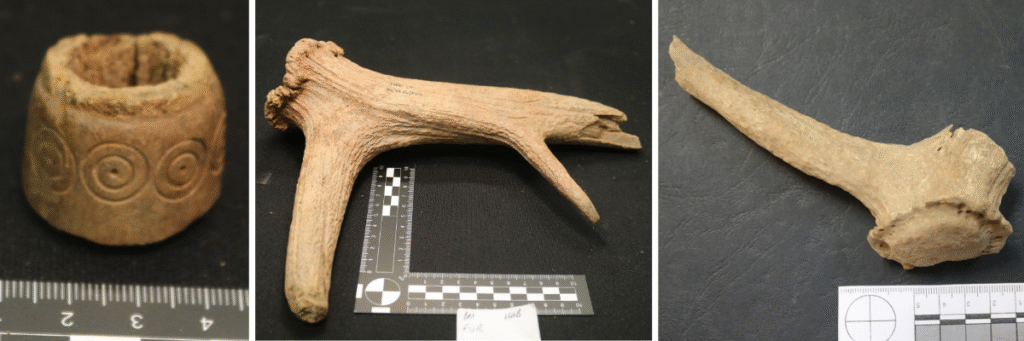
Decorated antler bead from Mine Howe, antler pick from Broxmouth and an antler hammer from Mine Howe (Images by Kath Page FSAScot, courtesy of National Museums Scotland)
There’s also evidence to suggest that people in prehistory considered red deer to hold some kind of power. The shedding and regrowth of antlers is likely to explain why red deer are linked with fertility, renewal and mortuary ritual and why venison appears to have been eaten to commemorate the birth or foundation of structures, objects and people, and their death or decommissioning (taken out of use). Evidence of this can be seen particularly in Iron Age deposits, especially at broch sites such as Applecross broch in the Highlands and The Cairns and Howe in Orkney.
However, a different practice involving red deer bodies occurred in Orkney towards the end of the Neolithic. Unprocessed “heaps” of complete red deer skeletons have been found at the settlement sites of the Ness of Brodgar and the Point of Buckquoy on the Orkney Mainland, and at the Links of Noltland in Westray. Whilst this practice might evidence the conspicuous non-consumption of venison or decommissioning deposits to commemorate the end of the life of these settlements, the unusual and unique nature of these deposits suggests they represent something different.
These heaps may have been a response to the societal upheaval that occurred in Orkney at this time. Archaeological evidence shows that during the Chalcolithic, the transition period between the Neolithic and the Bronze Age, people and practices migrated from Europe across Scotland. The unprocessed red deer deposits could be interpreted as a final attempt by local communities to stabilise their world by harnessing the associative power of red deer, the complete nature of their bodies may suggest that their restorative power was strongest if they were deposited whole.
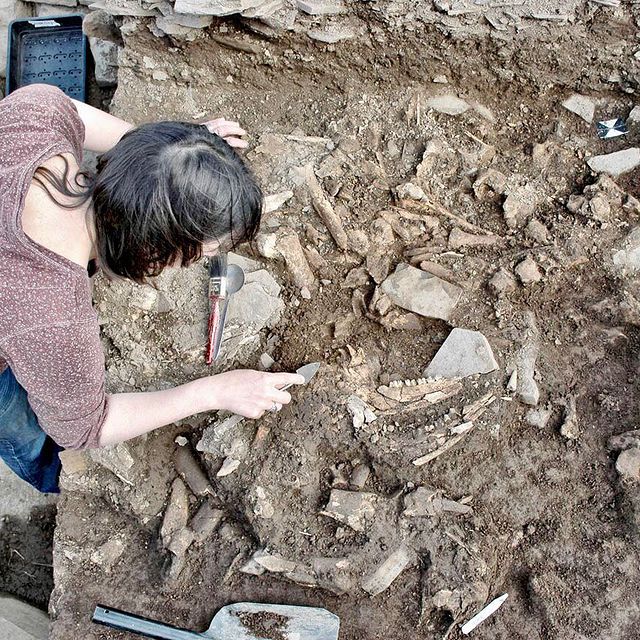
Excavating the red deer and cattle deposit at Structure 10 at the Ness of Brodgar. Image courtesy of Nick Card FSAScot and Prof Ingrid Mainland FSAScot)
How have people managed red deer in the past?
The archaeological evidence from prehistoric sites across Scotland suggests that red deer held a special or different significance to people in the past compared to domesticated species.
Whilst cattle and sheep or goat account for the majority of bones found across prehistoric sites, red deer dominate deposits that are considered special or purposeful. The introduction of red deer to the Northern and Western Isles much later than the introduction of domesticated animals may suggest that red deer were valued for more than just their meat, skins and bones. The exploitation of antler is another explanation for its associated symbolism linked to fertility and renewal.
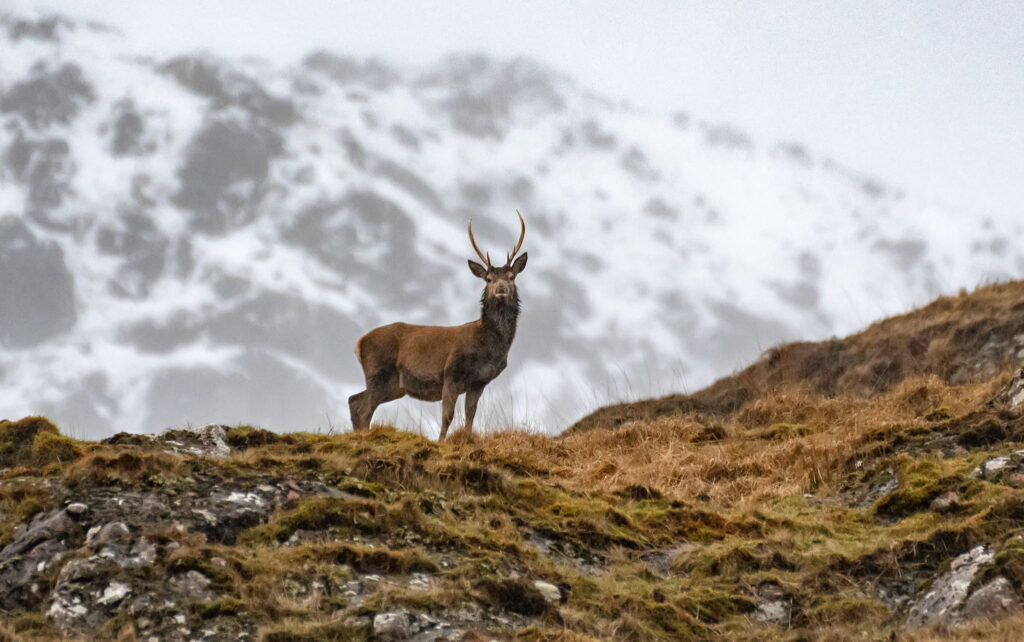
Deer at Ardnamurchan (© Caroline Legg via Flickr, CC BY 2.0)
It’s been proposed that in the past red deer were managed, herded and corralled (much like moorland sheep today) to ensure a ready supply of antler and venison. Scientific techniques such as isotopic analysis have provided some evidence to support this theory. One study (see p.474) analysed the tooth enamel of sheep and deer from the Ness of Brodgar and found that the carbon, nitrogen and sulphur signatures from these animals suggested that whilst sheep were free roaming and had access to seaweed as part of their diet, deer did not.
This may suggest that deer were corralled in some way and kept from accessing the coastal fringes of the islands. As a result, they would’ve required subsistence feeding, especially over the winter. This may be further evidence that red deer had an elevated significance and value. Or perhaps it was just a way to stop the deer from swimming away? This is one area that I’m exploring further in my research.
How can archaeology inform our current relationship with red deer?
Understanding how people lived with and exploited species in the past can help us understand our contemporary relationships between people and animals. We’ve seen that the Scottish archaeological record suggests that red deer were seen as different to domesticated animals due their economic and cultural value. Similarly, red deer are valued today as an economic, cultural and recreational resource.
There’s a growing body of scientific evidence showing that in prehistory, some red deer populations had restricted access to parts of the landscape and required supplementary foddering. This is the same for contemporary wild deer today. Miles of deer fencing criss-crosses the countryside and overgrazing means that subsistence feeding is needed in the winter months. The impact that people have had on red deer since the Mesolithic leads us to questions whether red deer were considered truly wild in prehistory and whether they are truly wild now.
The archaeological deposits of red deer lead us to think that in the past, people believed that red deer had associative powers related to cycles of birth, death and renewal. These beliefs have perpetuated within folklore, fairy tales and literature. Even today, red deer have become the embodiment of the Scottish Highlands, in part thanks to the romantic reimaging of Scotland during the 17th and 18th centuries. This idea that red deer are somehow different to other animals, that they are majestic and wild, means our current relationship with them can be complex and problematic, especially in relation to venison consumption and population control.

The Monarch of the Glen by Sir Edwin Landseer (1802 – 1873), via National Galleries Scotland.
Tourists visit Scotland each year to see red deer. The current large population numbers almost guarantee a sighting in most areas, but their numbers mean that deer vehicle collisions are increasing, and concerns continue about the impact of overgrazing by deer.
Like Scotland’s previous residents, our current relationship with deer is often contradictory. The movement of red deer to the Scottish islands and their extinction from Orkney is a reminder of our how the changing relationships between humans and animals affects the delicate balance of nature. We need to better understand the historical reasons why society views some animals as having worth, and others as worthless, and how and why this changes over time. This is an important contribution that zooarchaeology can bring to the debate on the Scottish deer problem.
By Kath Page FSAScot, who’s in her third year of an SGSAH-funded PhD at the Archaeology Institute UHI Orkney. Kath’s project, “The Deer Turn: An Archaeological Case Study Approach to Reimagining Dualistic Ontologies of Human-red Deer Relationships in Scottish Prehistory”, explores the changing economic and cultural relationships between people and deer in the past and how understanding this can help inform our current relationship with red deer. Contact Kath for more information or check out her research on Bluesky at @orkat3.bsky.social.
If you’d like to keep reading, dive into the Dig It! articles on shellfish and seaweed.
* Stanton, D.W., Mulville, J.A. and Bruford, M.W., 2016. Colonization of the Scottish islands via long-distance Neolithic transport of red deer (Cervus elaphus). Proceedings of the Royal Society B: Biological Sciences, 283 (1828), p.20160095.
** Mainland, I., forthcoming
Header Image: Red Deer Stag (© Mehmet Karatay via WikiCommons, CC BY-SA 3.0)
