Cells and Souvenirs: What Can Archaeology Reveal About the Saints of Scotland?
Whether you’re driving over the Queensferry Crossing road bridge or playing a round of golf in the town of Saint Andrews, the impact of saints in Scotland can still be seen across the country.
Despite their fame, there’s still a lot to learn about these people and the cult that grew around them – which is where archaeology comes in.
Saint Columba’s Cell
Colum Cille (St Columba) is credited with founding the monastery on Iona after arriving in 563 AD and bringing Christianity to Scotland from Ireland. 100 years after his death, Columba’s successor wrote the saint’s biography where he referred to his ‘cell’ on a rocky hillock within the monastery.
In 2017, archaeologists from the University of Glasgow announced that they’d come “as close as any archaeologist has come to excavating a structure built during the time of St Columba” when they uncovered evidence that a wooden hut traditionally associated with the saint (excavated 60 years ago) dated to his lifetime.
Carbon dating proved that samples of hazel charcoal from the excavation of a simple wattle and timber structure on the island dated back to when he lived and worked at the monastery. This may be the hut where he prayed and studied.
Archaeologists say they have identified the remains of the cell of St Columba on the Scottish island of Iona https://t.co/Zfia0gPoqx pic.twitter.com/Q8Ne0BFlhb
— BBC Scotland News (@BBCScotlandNews) 11 July 2017
Saint Andrew’s Souvenirs
Unlike the other saints on this list, Saint Andrew never visited Scotland (although his bones may have made a trip from Greece as relics). It’s likely that the Scots treated him as their patron saint in practice long before he officially became the patron saint when independence was declared with the signing of the Declaration of Arbroath in 1320. The ancient town of Cill Rìmhinn (St Andrews) was named after him and the flag of Scotland – the Saltire – was chosen in honour of him, as he was crucified on an x-shaped cross (according to tradition).
In medieval Scotland, pilgrims travelled to sites which housed a saint’s relics and many of them collected badges as souvenirs. This 14th-century pilgrim’s badge mould was found in the churchyard of old St Andrew’s Church in North Berwick. It would have been used to create badges such as the one found in Fife.
Saint Moluag’s Monastery?
Moluag was an important figure to the kings of Dál Riata and the Picts when their kingdoms merged, so it’s been argued that he was the first patron saint of Scotland. According to tradition, he came to Scotland from Ireland in the 6th century to promote Christianity and founded a monastery on Lios Mòr (Lismore). Some versions of the story pit Moluag against Columba in a race to the island, with Moluag cutting off one of his fingers and throwing it ashore in order to be the first one to touch the island.
Despite his influence and potential willingness to chop off his own extremities, we don’t have any physical evidence that he visited the isle – only fragments from an early medieval cross-slab or cross-shaft (a much later find) which indicate that there was a religious community on the island at that time.
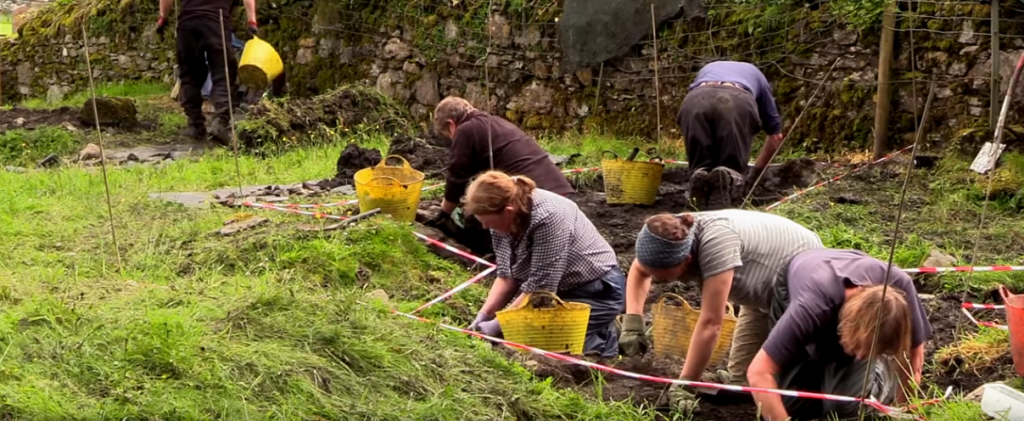
In 2019, it was announced that a community dig led by Clare Ellis of Argyll Archaeology on behalf of the Kirk Session and Lismore Historical Society had unearthed another piece of the puzzle. They’d excavated a cemetery and dated one of the burials to the 7th century, bringing us a bit closer to Moluag’s period. Furthermore, the enclosing wall of the cemetery (another indication of a religious community) may be even older. Since enclosing walls are associated with churches, this might indicate that an earlier church or monastery is somewhere nearby.
These finds are almost at the right period and they may be an indication of an earlier site. Could this be the burial ground for Moluag’s original monastery?
Saint Margaret’s Shoulder Bone
Margaret was born in Hungary and became Queen of Scotland when she married King Malcolm III in 1070. Known for being pious and charitable, she established a crossing point on the Firth of Forth for pilgrims on their way to St Andrew’s Cathedral: the “Queen’s Ferry”.
After her death, she was made a saint by the pope and her remains were treated as relics. Mary Queen of Scots was a fan – she asked for her head to be sent to her at Edinburgh Castle to assist her in childbirth.
In 2019, Margaret made headlines when one of her shoulder bones was removed from its display case in a Dunfermline church. Thankfully, this wasn’t the work of a thief. An archaeology student named Lauren Gill (working alongside the parish priest) was hoping to discover more about her lifestyle and use 3D scans to produce an exact replica that people could get their hands on.
If you’d like to keep digging into the past, visit our Events & Digs page to find an activity near you.
Header image: Community dig on Lismore
