Tombs, Battlements, Bark and Underpasses: Your Guide to the Archaeology of Graffiti in Scotland
‘Graffiti is like a mirror, we should be able to look at it and see our hopes, desires and fears reflected in it.’ – Anonymous, 2020
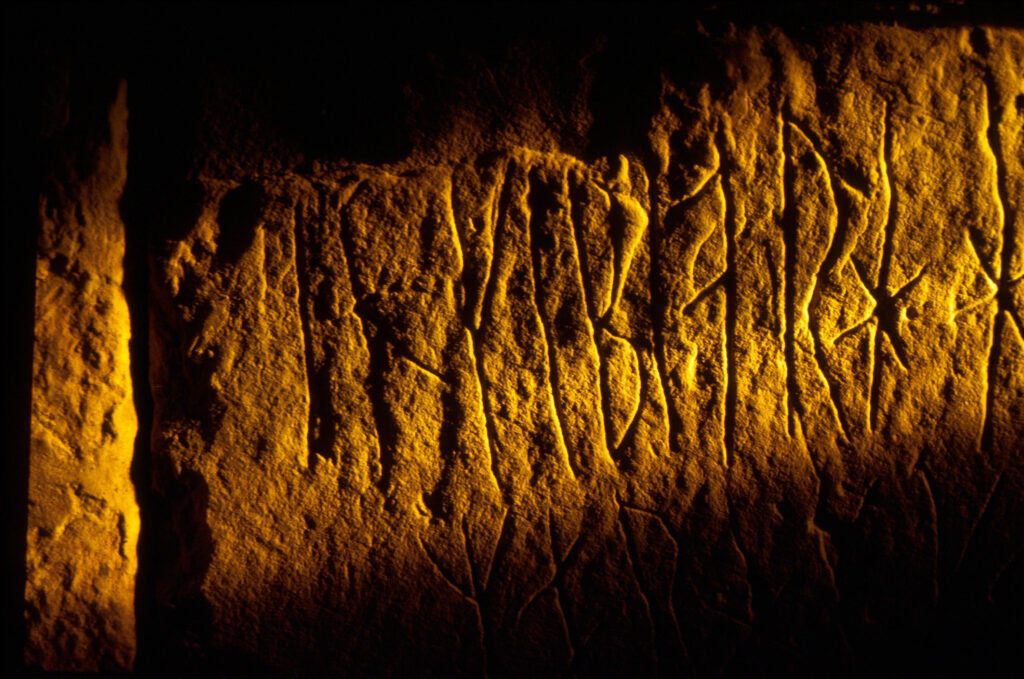
On a snowy December day in 1153, Norse visitors to Orkney left messages carved on the walls of Maes Howe. They used the inside of the Neolithic tomb to write about their experiences, sign their names and leave messages about their lives. Some of what they wrote was very rude and not repeatable here!
But our interest in these and other historical carvings left on the walls of tombs, castle battlements, etched in tree bark and sprayed on 1970s underpasses suggest that we are fascinated with these fleeting messages from past lives. Luckily for us, the runes (that’s what they are called) didn’t get cleaned off Maes Howe’s walls, even though they are not as old as the 4,000-year-old tomb and were carved by people who had broken in to shelter from the snowstorm.

Maes Howe Runic Inscriptions & Graffiti.
So, how do we feel about the range of graffiti that we can find today? From vast street art images on tower blocks to tags on bins, murals on underpasses and chalking in parks; our world is covered in messages, some colourful and plain to see, others hidden away to be uncovered like archaeology.
Graffiti Artists and Archaeologists
Some archaeologists are now using their skills gained in exploring prehistory and more recent periods to explore the world we live in today, along with the people that are creating what will be tomorrow’s archaeology – and one crucial aspect of this involves learning with those people who already have knowledge of what we are studying. So, archaeologists have been working with graffiti artists to discover first-hand how they navigate their landscapes and use walls as their canvases, similarly to the Norse in Maes Howe.

Laundry block. Detail of tag by Smug.
We have learnt so much about their art, the craft that goes into their work, the archives they create in their sketchbooks known as blackbooks, and the intangible aspects of their heritage. Here a graffiti writer explains a tag and why creating one and choosing where to place it can become a carefully planned project:
‘A tag, the simplest form of modern graffiti, is a writer’s alter-ego, a name usually chosen from a combination of favourable letters making up a word that means something to the person writing it. This form of graffiti first emerged in the USA during the 1960s and has quickly spread to the rest of the world. The tag style lies at the foundation of graffiti and is considered the first skill that a graffiti writer must master.
Being the fastest way of ‘getting up’ (getting more recognition among the graffiti scene), tagging forms the essence of graffiti or what can also be called ‘graffiti bombing’. In order to be a well-respected graffiti writer, you have to be a good bomber that has accomplished (painted) various spots in the city while showing unique style and pushing the boundaries of what can be done and achieved, over and over again.
It is not a static form of art, a writer is always looking for better spots, planning their next move, making up new colour schemes and always ‘fighting the buff’ (cleaning and removal)! So the most important skills that a writer must learn are resilience and perseverance, it is the constant desire to see your name anywhere you go around the city especially at new spots that no other writer has reached, and that is what feeds graffiti and allows it to progress and develop’.
By working with graffiti writers, we can begin to uncover their heritage and understand the unfolding history to their art. They spend a very long time crafting their tags which sometimes never leave their blackbooks. Other times, they will go on to tag walls and develop their tags into a throw up (extended versions of their tags) which apply different colours and – if they have really developed their skill set – they may work on masterpieces, which are their tags with expanded letters, stylish backgrounds and complex letterforms.

View of a throw up.
Graffiti Throughout Scottish History
But back to the history lesson; it turns out that the modern-day tag, which originated in New York and Philadelphia in the 1960s, has much deeper roots. We can follow the act of leaving signatures, marks, messages and meanings across the landscape and back in time to the World Wars, when millions of people were displaced and sent to countries around the world where some of them left messages for us to discover.
Before this, we see the names of families evicted from their homes during the mid-19th century carved on church windows in the Highlands and images of ships carved on sea cliffs that may commemorate the sinking of vessels around Scotland’s coastline.
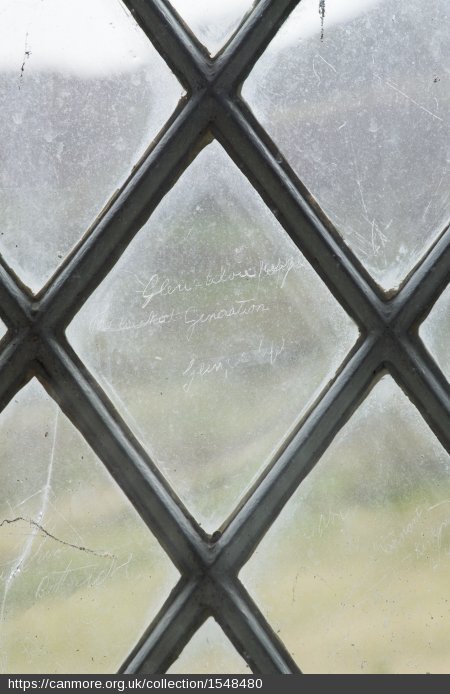
East window. Detail of writing etched on glass. (Image reversed for legibility.) ‘Glencalvie people the wicked generation Glencalvie’
Further back in time, we are lucky enough to find early carved crosses which indicate the spread of Christianity to Scotland. Occasionally archaeologists turn up finds such as those from the Early Historic monastery on the island of Inchmarnock, which date to the around AD 600. They discovered stone fragment with words, human figures, games, ships and names like ‘Ernan’ carved into their surfaces, which give an incredible insight into the history of life on the island over 1,400 years ago.
This is where it gets interesting: if we can follow the art of leaving a name carved on a stone over 1,400 years ago, what graffiti might have been created before that? Is the prehistoric rock art that is found across Scotland and North-West Europe part of a long tradition of ‘signing’ the landscape?
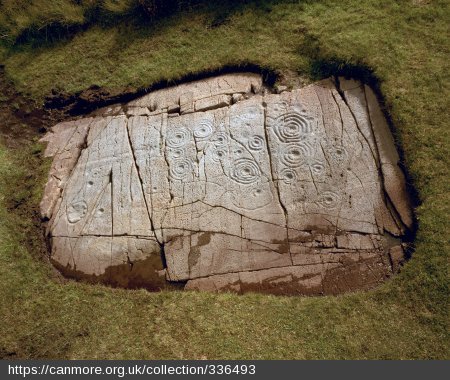
View of cup and ring marked rock, Cairnbaan.
Reading the Graffiti Landscape
So, the next time you see a tag or a throwie, remember that the hand that crafted it is one in a long line of writers who left their marks for someone to see; artists who have worked hard to develop their craft and persevere despite their transgressions.
Perhaps we should read their art as providing a free splash of colour in a dull world where public space is being sold to private corporations for profit and control? Maybe graffiti is one of the few remaining signs of freedom in a world that is increasingly designed to observe and control our every move?
Wherever you stand on the matter, their art deserves a reading and – through archaeology – some consideration before buffing. Maybe now as you read the graffiti landscape, you will be able to understand a bit more about the meanings behind the messages and appreciate this free art.
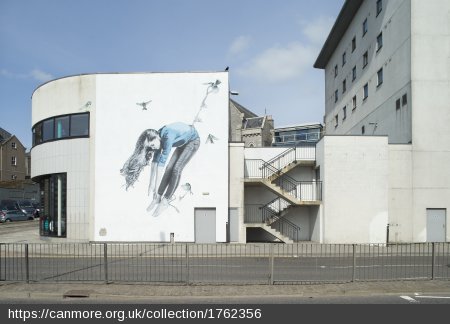
General view of street art by artists SNIK, from east.
If you are interested in discovering more about graffiti, archaeology and graffiti archaeology, why not check out the GRAFFITI REVIEW, Graffiti Archaeology, Canmore or Instagram, or take a look at a recent article about alternative heritages: ‘The filth and the fury: 6 Denmark Street (London) and the Sex Pistols’.
By Alex Hale, Senior Archaeology Researcher at Historic Environment Scotland
Header Image: © VisitScotland / Paul Tomkins
