Footsteps in the Dark: Your Guide to Caves and Cave Use in Scotland

Caves have always fascinated humankind and present one of the most enduring natural features in the wider landscapes of Scotland. [NOTE: Article contains images of human remains]
With a history passing back into obscurity, caves are liminal, transitional and otherworldly places where the natural and supernatural worlds mingle, imbuing such sites with greater mystery, expressed outwardly in a rich corpus of legend and folklore.
With their use extending back into the Ice Age thousands of years ago, caves have formed sites of natural deposition, of human occupation, burial, ritual and artistic activities. The deposits found in caves provide rare time capsules of cultural and scientific information and as such, they’re renowned for their contribution to archaeology throughout much of the world.
In a European context, Scotland has been fortunate to share in this very important category of scientific and heritage asset. And, in line with investigations in caves sites elsewhere in Europe, it is apparent that some of these sites were used over extensive periods of time.
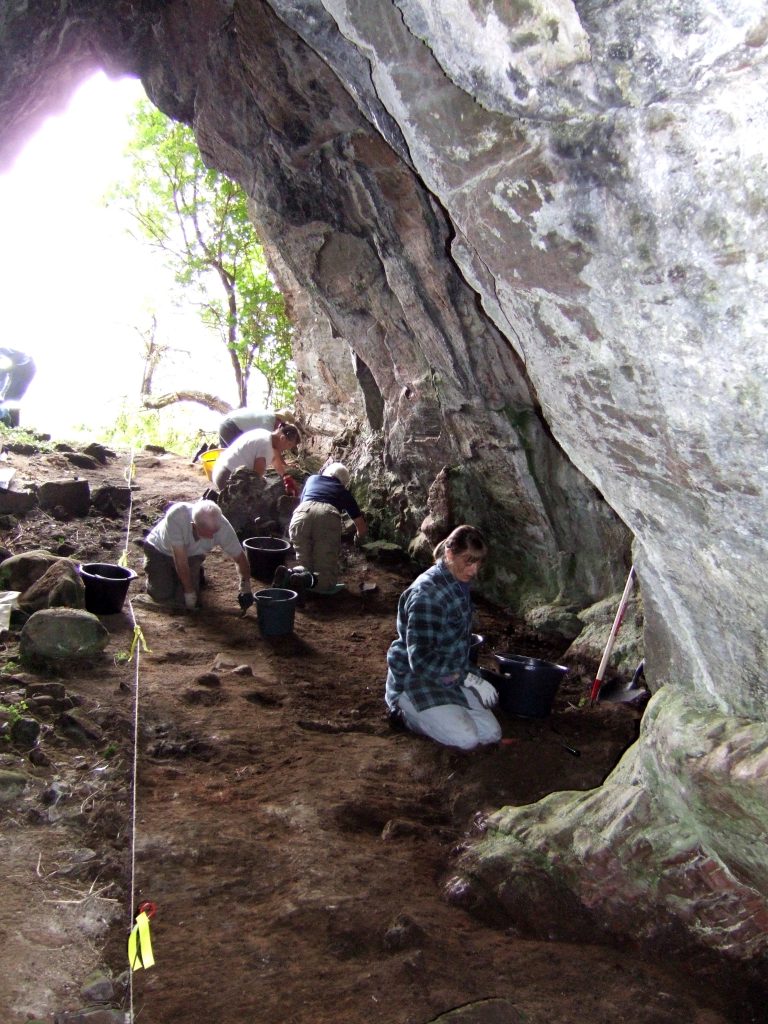
Excavations in Caird’s Cave, Rosemarkie (Image Credit: Rosemarkie Caves Project)
Caves and cave archaeology in Scotland
The history of cave archaeology in Scotland can be traced back to the later stages of the nineteenth century when a few prominent scientists began to explore these underground spaces and their deposits as part of broader geological, palaeontological and antiquarian research agendas, including the great debate over the antiquity of mankind in the country.
Excavations at the caves at Creag nan Uamh near Inchnadamph, Sutherland in 1885 recovered Lateglacial fauna including reindeer antlers and Arctic lemmings, while more recent investigations have found the remains of wild horse, reindeer and brown bears, which have been radiocarbon dated to around 12,000 years ago. Unfortunately, no archaeological evidence as yet come to light to suggest a human presence at Creag nan Uamh during this period.
However, a new analysis of a flint and stone assemblage of artefacts excavated at Kilmelfort Cave in Argyll in 196l suggests a human occupation at the site during the Late Glacial Interstadial 12,000 years ago, providing the first substantive evidence for the presence of Late Upper Palaeolithic hunters in caves on the west coast of Scotland.
Cave function
A pattern for cave use and function which seems to hold throughout the world (including Scotland) suggests that they were initially used as temporary shelters by mobile hunters and gatherers, as they moved over large distances through the landscape.
Later periods evidence a wider range of use, including what we might more confidently attribute to ‘ritual’ purposes, such as burial in caves during the Neolithic and Bronze Age over 4,000 years ago. While there is less evidence of the use of caves for burial during the Iron Age (around 3,000 years ago), several recently excavated sites have demonstrated the continuing significance of caves from this period for depositing the dead; a function that continued into the medieval period (which began around 1,100 years ago).
Due to the often-disturbed character of cave deposits and data from earlier, poorly recorded excavations, it is difficult to attribute other discrete forms of activity during their use. Artefacts and features recovered from caves display a very wide range of types indicating that they were used for an expanding range of activities including their use as domestic spaces comprising temporary homes and shelter for hunter-gatherers, farmers and pastoralists (who kept livestock); but also as workshops, for storage, and as hideaways.
Recent excavations undertaken at the Rosemarkie Caves, on an t-Eilean Dubh (the Black Isle) near Inbhir Nis (Inverness), have revealed evidence for metalworking in three former sea caves located within the same small headland, dating to the Early Medieval period between the 5th-8th centuries AD.
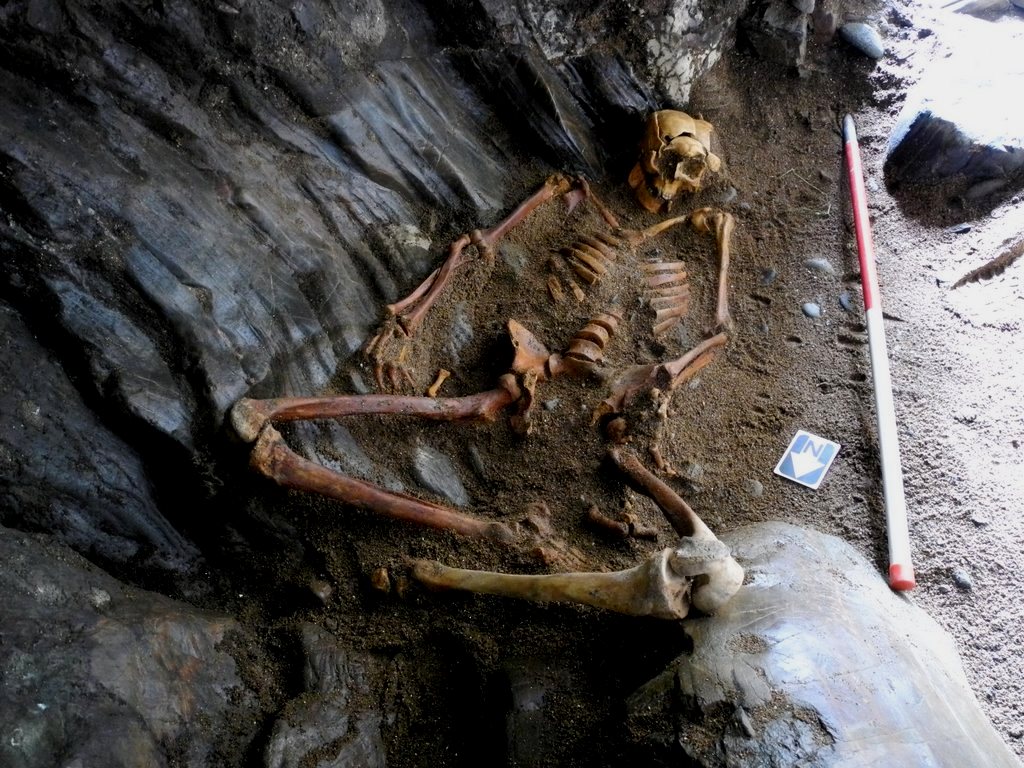
Early Medieval inhumation at Learnie Cave 2B, Rosemarkie. This individual had been brutally killed using several well-aimed blows to the head – potentially a punishment killing, after which he was laid out in the back of the cave accompanied by the butchered remains of at least eight cattle, one horse and several large fish including cod and plaice. These may have been feasting residues or offerings placed over the man’s body. A large (23kgs) beach cobble had been placed between and over his legs, resulting in their unusual position in the grave, while smaller stones had been placed over his arms and chest. This may have comprised what we call a ‘deviant’ burial, where the stones had been used to stop the spirit of the individual rising from the grave! (Image Credit: Rosemarkie Caves Project)
Darker aspects of cave use
However, it is now thought that many caves, especially during prehistory, were used for rituals involving the preparation and display of human remains and the structured deposition of material culture and food residues including wild and domesticated animals. These were clearly performative acts and the recurrent use of caves as the arenas for such performances tells us much about their role in the cosmology (a branch of astronomy) of later prehistoric communities.
Excavations at Sculptor’s Cave in Moray and High Pasture Cave on An t-Eilean Sgitheanach (the Isle of Skye) have both provided evidence for the display and deposition of human remains. At Sculptor’s Cave, the discovery of cranial (skull) elements around the entrance of the cave suggested to the archaeologists that heads had been mounted there during the Late Bronze Age, while a number of individuals appear to have been beheaded over 1,600 years ago during the Roman Iron Age and their remains deposited in the cave, indicating the use of the cave for such practices over a significant period of time.
During the excavations at High Pasture Cave, selected bones and teeth of adults and children were found in the cave along with the remains of animals and a wide range of artefacts including ceramics, bone, antler and stone tools between 800-300 BC. However, the most important set of human remains had been deposited at the site at the time of its final closure (c.100-200 AD), when the stone staircase accessing the natural cave below was backfilled with stones and sediment. In the top of the stairwell, the remains of an adult woman had been laid out along with the remains of her unborn child. They were accompanied by the remains of a third individual, a child that had died around birth, a very young dog and a young piglet. It is probable that other Scottish caves displaying similar forms of evidence await identification through a re-analysis of materials recovered from earlier excavations.
Early medieval illumination
Several caves across Scotland have been identified with Pictish and Early Christian images and symbols, most of which were initially investigated during the later stages of the nineteenth century.
Comprising old sea caves, especially around the Fife, Ayrshire and Galloway coastlines, and on the island of Bute, these sites include caves at East Wemyss, which contained Pictish symbols and associated occupation deposits such as stone and bone tools, the residues from fires and the remains of food they were cooking in the fires.
Many other caves have been found in the south-west of Scotland that have potential associations with the church, including their use as corpachs, temporary resting places for the dead during their final journeys by boat for burial on off-shore islands, including Oronsay and Iona in Na h-Eileanan a-staigh (the Inner Hebrides). Some of these sites also boasted graffiti carved into the cave walls including crosses and other inscriptions.
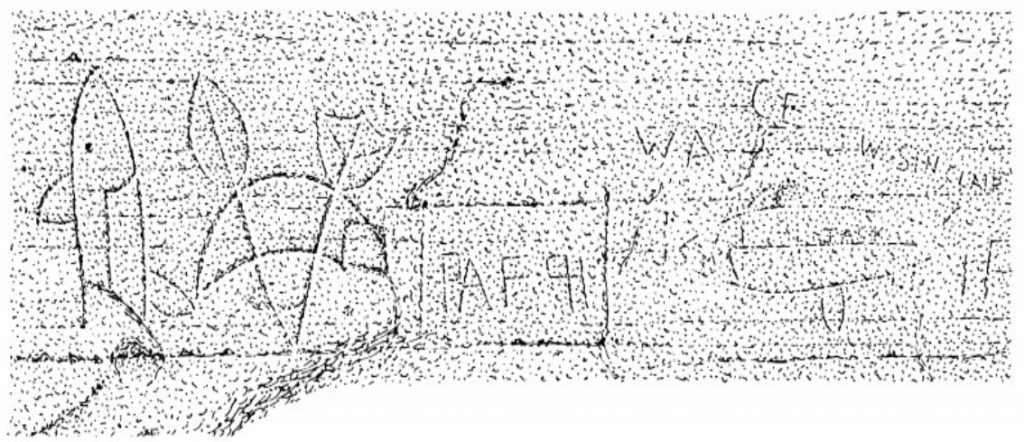
Pictish carvings at Sculptor’s Cave, Moray (Image: HES Canmore)
Caves and cave archaeology – the future
Future work to investigate the use of caves and other elements of the subterranean realm in Scotland offers great research potential and opportunities including the integration of caves within broader archaeological landscapes on a local and regional level.
Caves, along with other types of natural locations, are often ill-defined and overlooked in the archaeological record, but are important evidence of landscape utilisation and were part of the way societies perceived and understood their world.
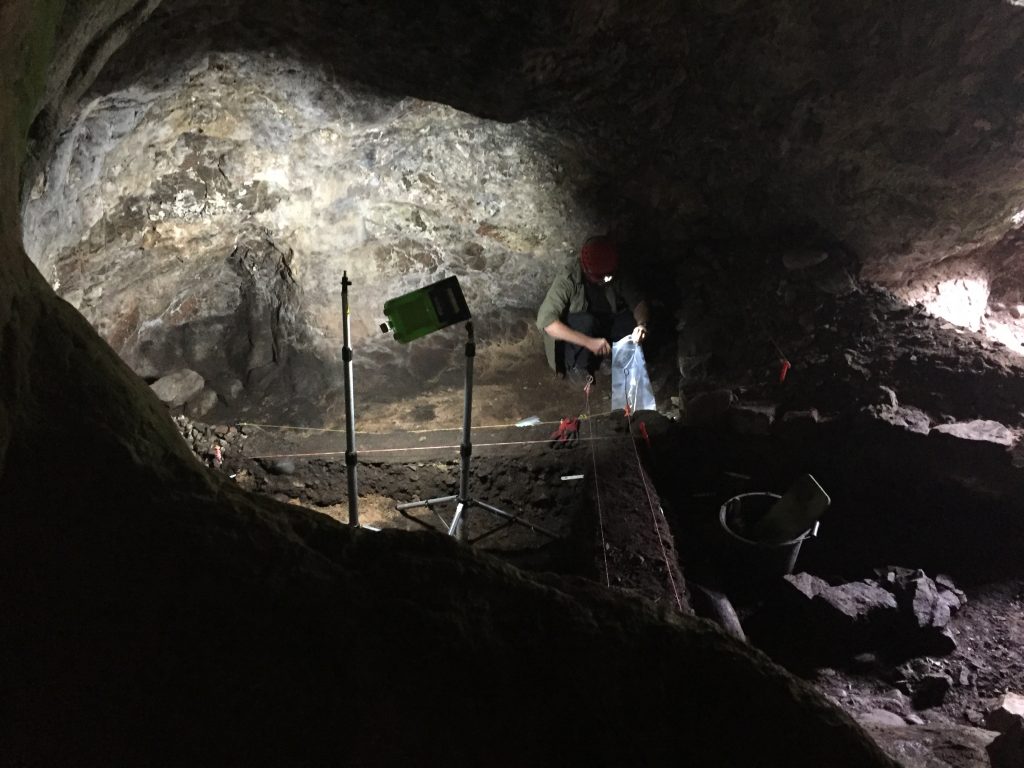
Excavations in Learnie 1A Cave, Rosemarkie (Image Credit: Rosemarkie Caves Project)
Context is vital in helping us to understand these types of site and caves and their archaeological assemblages (group of artefacts) would seem to be prime targets for this avenue of research. A wealth of uninterrogated data has been deposited in museum archives, which needs to be researched and reassessed in the light of developing theory and new methodologies.
The aesthetic and natural history values of caves are well established and appreciated, but archaeological caves are difficult to characterise and control within existing cultural resource management frameworks. The archaeological significance of a cave site is normally recognised only at the point when cave deposits and their contents are intrusively and destructively investigated, and most caves in Scotland have never been visited by a professional archaeologist. Speleologists (someone who studies caves) and people visiting caves therefore play a pivotal role in their discovery and the archaeological deposits they may contain.
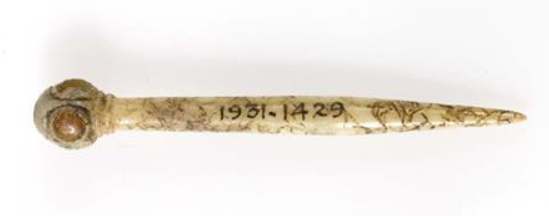
Amber-inlaid bone pin of Early Medieval date from Caird’s Cave, Rosemarkie (Image © National Museums Scotland)
It is also important that we do not investigate caves in isolation. Along with other types of underground structures including souterrains (underground structures), caves should be seen as a part of a much wider cultural and symbolic landscape. Likewise, the investigation of cave sites should not be confined to their interiors and entrances.
Excavations carried out at High Pasture Cave in An t-Eilean Sgitheanach uncovered archaeological deposits and features outside the cave including hearths and midden deposits, along with a sequence of stone-built stairwells that provided access to the natural cave below.
The archaeological potential of caves in Scotland is increasingly being recognised, while the number of caves of archaeological significance is growing, developing our knowledge regarding how they were used and perceived by communities in the past, from the first human colonisation of the country by hunter-gatherers, through to the 21st century urban dweller.
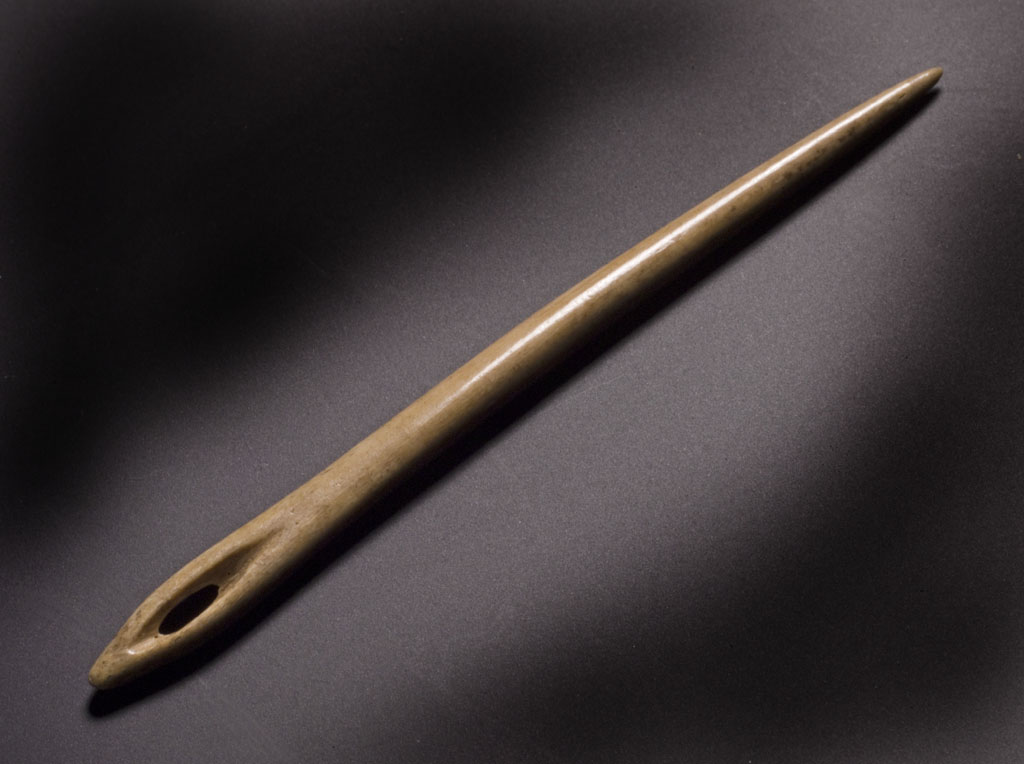
Bone needle from High Pasture Cave, An t-Eilean Sgitheanach (Image Credit: High Pasture Cave Project)
If you’re feeling inspired, find out what’s happening with the Covesea Caves Project.
By Steven Birch, a freelance archaeologist working in the Highlands of Scotland and is co-director of the High Pasture Cave Project. Steven graduated in 2005 from the University of Aberdeen with an MA in Scottish Archaeology and his broad research interests include Scottish prehistory, with a particular focus on the use and function of cave and rockshelter sites. Recent excavations have included the Fiskavaig rockshelter in An t-Eilean Sgitheanach and a number of old sea caves on the Black Isle as archaeological supervisor to the Rosemarkie Caves Project.
Header Image: Main stream passage, High Pasture Cave, An t-Eilean Sgitheanach (Image Credit: High Pasture Cave Project)
