Top Seven Scottish Archaeology Models on Sketchfab
Take these 3D models for a spin to explore the best of Scottish history in 3D!
What is Sketchfab?
Sketchfab is an online platform in which anyone with access to the internet can upload, view, and share 3D models. It’s used a lot by artists and gamers, but there is a steadily growing community of cultural heritage professionals and enthusiasts alike creating 3D content to explore.
Here are seven brilliant models in no particular order to get you started:
Digging deeper – Ness of Brodgar
The first model to highlight is a trench from the excavation at the Ness of Brodgar in Orkney at the end of the 2018 season. This massive Neolithic complex beneath the Ness, halfway between the Standing Stones of Stenness and the Ring of Brodgar, was revealed by a geophysical survey in 2002 after being buried for more than 4,000 years.
By creating models of different phases of the excavation, archaeologists can examine details of the site from a variety of angles, and compare how the site has changed over time.
Modelling the past – Cambuskennenth Abbey
Now to think a little outside the box: this is a digital reconstruction of Cambuskenneth Abbey in Stirling by 3D artist Bob Marshall which shows what the abbey could have looked like in 1383.
Though the bell tower is the only surviving part of the original site – with only hints of its surrounding foundations left (unearthed by excavations in 1864) – Marshall brings the abbey to virtual life on this platform.
Museums in 3D – Lewis Chess Pieces
It’s not only archaeological sites which have been scanned and shared on Sketchfab! National Museums Scotland has uploaded many items from its collections.
Here is a particularly good-looking example in the Lewis chess set, medieval gaming pieces made over 700 years ago which were found on a beach on Leòdhas (the Isle of Lewis) in Na h-Eileanan Siar (the Outer Hebrides) in 1831. Not many people can say they’ve looked at the underside of a Lewis chess piece! Give them a spin.
Below the scenes – Edinburgh Castle’s Fore Well
Its depths hidden to visitors, the Fore Well at Edinburgh Castle is one of its oldest architectural features. Many archaeological finds have been recovered from the well over the years, including a complete cannonball, a brass button thought to be from a military uniform and a halfpenny dated 1795.
Digitally documented by the team at Historic Environment Scotland (HES), the 700-year-old structure can be visualised in a whole new way on Sketchfab. Check out the well through the ghostly grounds of the castle.
(Top tip: If you have access to VR equipment in your home, you can even take a virtual walk around!)
Artefacts: near, far, wherever they are – Carved Stone Balls
Access to 3D models can bring objects from across the world to your virtual fingertips. Here is an example of a mysterious Neolithic carved stone ball which was produced over 4,000 years ago and found at Hillhead in Orkney in the late 19th century.
Over 400 examples of these balls are known, with over 90% having been found in north-east Scotland, although we still don’t know why they were made or how they were used.
Dr Hugo Anderson-Whymark has scanned many of them so you can compare these artefacts from varying locations side-by-side.
AR to the rescue – Maiden Stone
Sketchfab has a variety of ways to explore models, including virtual and augmented reality.
This is the Maiden Stone, a beautiful Pictish cross slab in Aberdeenshire carved around 1,300 years ago. In order to protect it from harsh weather, it’s placed within a large box in the winter months. Though effective in shielding the monument, it also does a good job of making sure no one visiting can see it!
To combat this, HES has added a QR code linking to the Sketchfab model so that you can use AR to explore the monument with your phone.
Listen up! – Mousa Broch
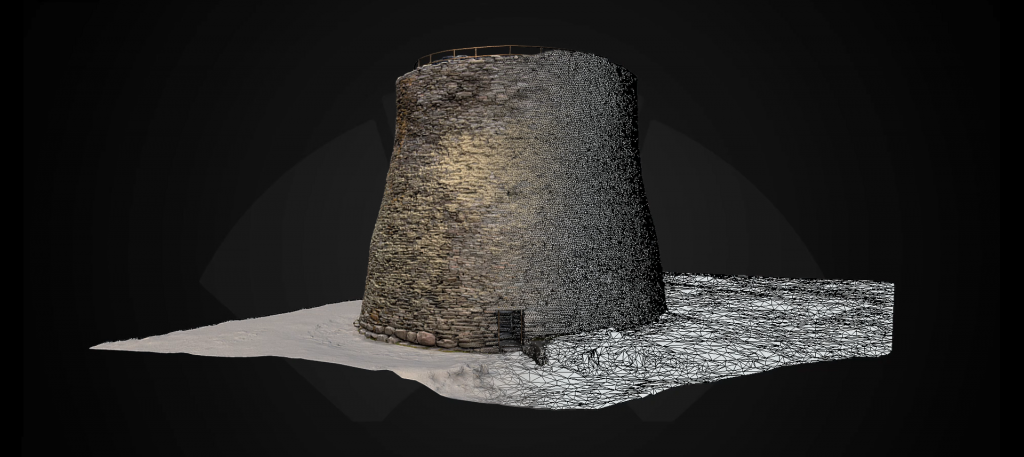
One of the most powerful tools in evoking a sense of place is sound. This is a model of Mousa Broch, an excellently preserved Iron Age drystone roundhouse off the coast of Shetland which was thought to have been constructed over 2,300 years ago.
Today, the ancient dwelling houses a colony of storm petrels, who bring the site to life at twilight. Listen to their sounds mingling with the waves on the shore as you zoom in and around the building.
Sketchfab is a brilliant tool in telling different stories not only for Scottish archaeology but the wider cultural heritage sector as a whole. This is a platform that can bring heritage to your virtual fingertips.
If you’re interested in keeping up with the latest in heritage on Sketchfab, Thomas Flynn, their head of Cultural Heritage and History, showcases a weekly collection of models on his page. Happy exploring!
By Sophia Mirashrafi, a Digital Project Officer at Historic Environment Scotland (HES) on the Digital Innovation Team, jointly funded by the National Trust for Scotland to digitally document the Hill House. She holds an MA in Medieval History and Archaeology from the University of St Andrews and an MSc in Digital Heritage from the University of York. Over on Twitter, she releases a new model from HES’s collection every Friday as a part of the #SketchfabFriday campaign.
This article was produced as part of Scotland Digs Digital. In the summer of 2020, we shone a spotlight on Scottish archaeology with the Scotland Digs Digital campaign which brought together online and offline events, as well as live updates from across the country for everyone to enjoy.
