Climate Change and Scotland’s Heritage: What You Need to Know

“But we could really use some global warming up in Scotland, right?!”
If this was your response to the title of this article, don’t worry – most people offer this line when they see the words “climate change” and “Scotland” in the same sentence.
Sadly, “global warming” was a major mis-branding of the global catastrophe that is climate change. For many parts of the world climate change has meant weather changes well beyond rising temperatures. Here in Scotland, we have indeed seen a 1°C temperature rise since the 1960s, but that has been accompanied by an average 20% increase in rainfall. That’s right, climate change has made the country wetter, and continues to do so. So when your granny told you it never rained this much when she was a girl, she was probably right.

Image credit: David Harkin, Climate Change Scientist at Historic Environment Scotland
So, climate change means a trend towards warmer wetter winters and hotter drier summers. But what does that mean for our heritage: for places like castles, stone circles, and even buried artefacts and features that are yet to be discovered? Well, it means we’re going to have to work even harder to hold onto them: climate change is one of the biggest challenges facing archaeologists and heritage professionals in the 21st century.
“Should I be worried about climate change in Scotland?”
While this may all seem a bit daunting, we’re fortunate enough to have many organisations and communities around the country doing amazing work to look after our archaeological sites in the face of a changing climate. Pro-active action, protection and research will all help to protect our heritage against this threat for future generations.
Taking Action on Climate Change
The Ring of Brodgar is one of Scotland’s largest Neolithic henge monuments, and lies at the centre of a 5,500-year-old ritual landscape, today known as the Heart of Neolithic Orkney World Heritage Site. Understandably, people flock from all around the world to see this incredible site and experience the landscape.
Although this is good news for the Orcadian tourist industry, wetter summers combined with increasingly high footfall led to serious, damaging erosion around the standing stones. Not only did this threaten the site itself, it was doing unknown amounts of damage to buried archaeological features and artefacts in the area.
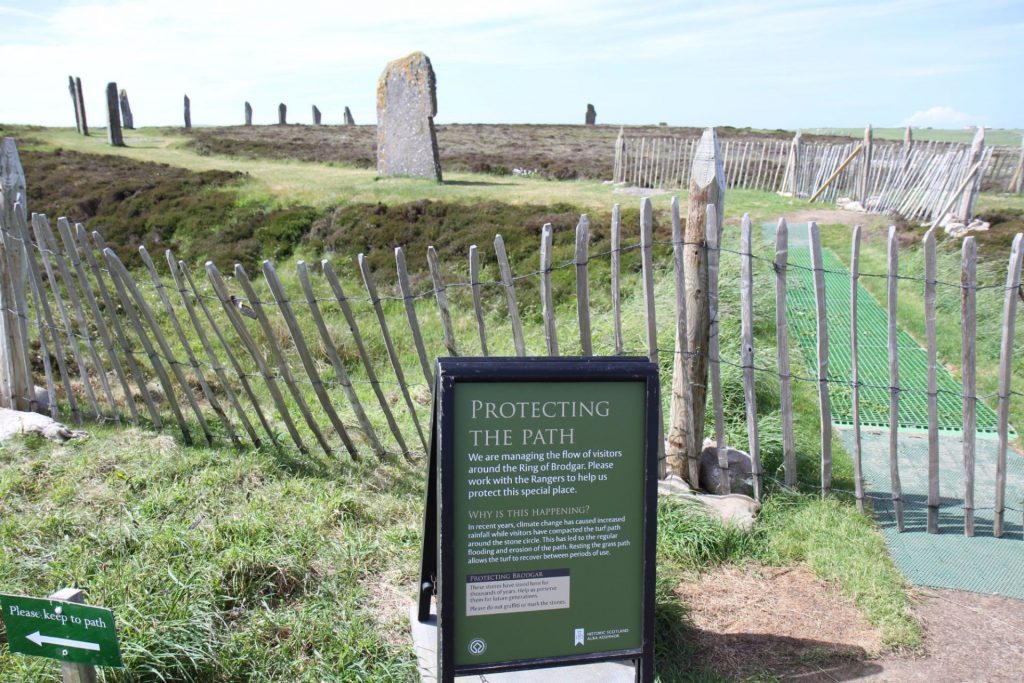
Tourists were kept informed about the reasons for the closure and the problem of climate change with these handy signs (Image Credit: Learning from Loss project)
The solution? The Historic Environment Scotland Ranger Service at the Ring of Brodgar decided to close off the inner part of the ring for a season to allow the paths to regenerate. Now the team carefully monitor footfall and erosion at the site (using aerial images as well as digitally scanned data) and tourists are encouraged to stick to the paths to help with this problem (you can learn more about this important work here).
Protecting Scotland’s Heritage Sites
Increased storminess and rising sea levels are endangering coastal heritage sites, of which this island nation has many. In the past, the coastline could create a defensible position, making for a strong place to build a fortress, like Tantallon Castle in East Lothian.
In other instances, communities originally built far inland, but changing coastlines mean that sites are nearer the sea today. This is true of Skara Brae – the oldest domestic settlement in Scotland – which was originally built about a mile inland.
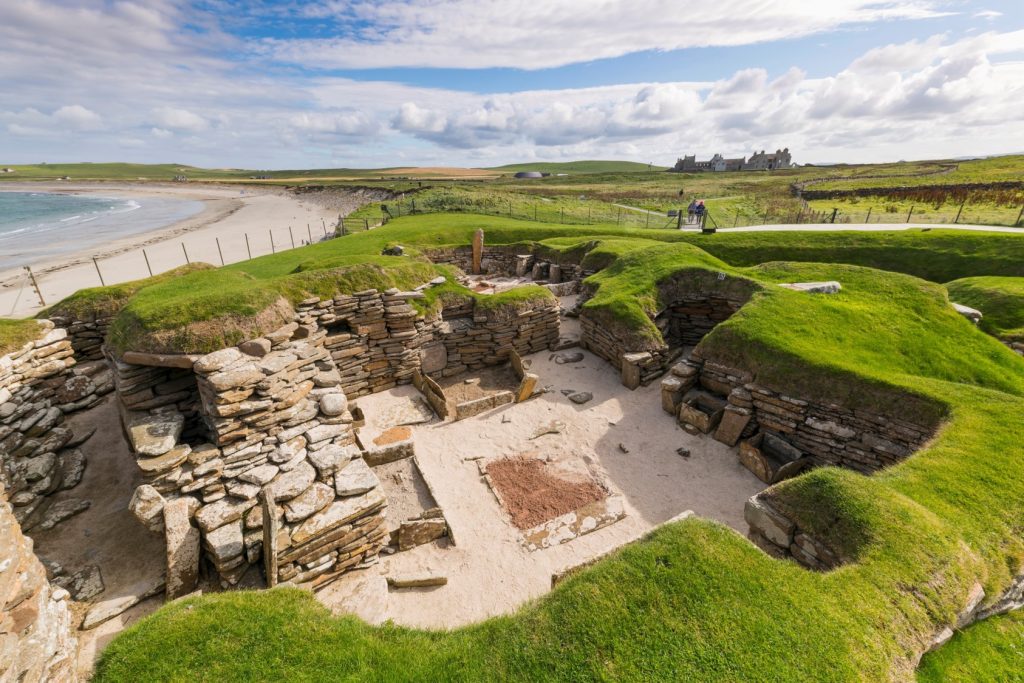
Skara Brae (Image Credit: © VisitScotland / Kenny Lam)
The 5,000-year-old structures at Skara Brae now lie directly on the cliff edge, having originally been uncovered by a storm back in 1850. A sea wall has been protecting the site for nearly 100 years but even with this in place, parts of the site have been damaged by the brutal storms which batter the northern isles through the winter months.
What’s more, drone footage shows that the cliff face at the edges of the sea wall are suffering increased erosion, as waves are deflected from the hard wall to the softer stone around it. Walls like this one (and at Midhowe Broch on Rousay, pictured below) are doing a wonderful job to protect many settlements, brochs, castles and duns (keep an eye out for one next time you find yourself at a coastal site – you might be surprised by how many are out there!), but they won’t suit all of our coastal sites.
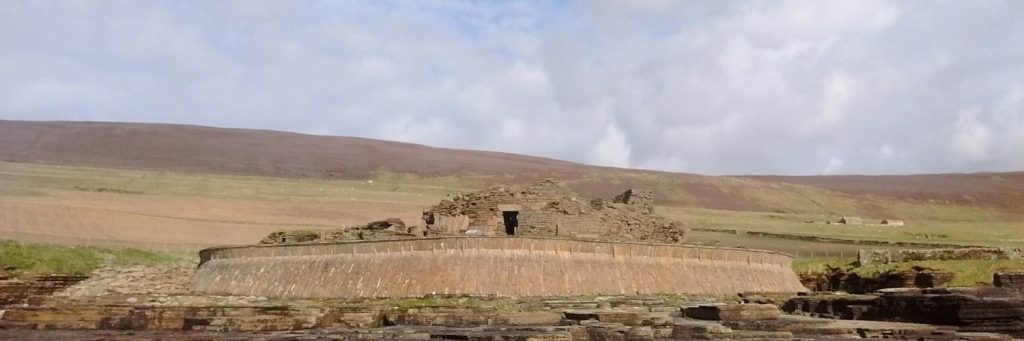
Sea wall protecting Midhowe Broch on Rousay (Image Credit: Hannah Genders-Boyd)
Researching the Effects of Climate Change
Research and monitoring are also valuable tools in our current response to climate change because many of the processes by which archaeological sites are damaged are not yet fully understood. The SCAPE trust brings together researchers from the University of St Andrews and volunteer Citizen Scientists from all walks of life to monitor Scotland’s coastlines. We know that sea levels are rising, we’re seeing increased storminess, and coastal sites are being affected by changing aeolian erosion (also known as wind), but exactly what effects this is having, and where, is still not clear.
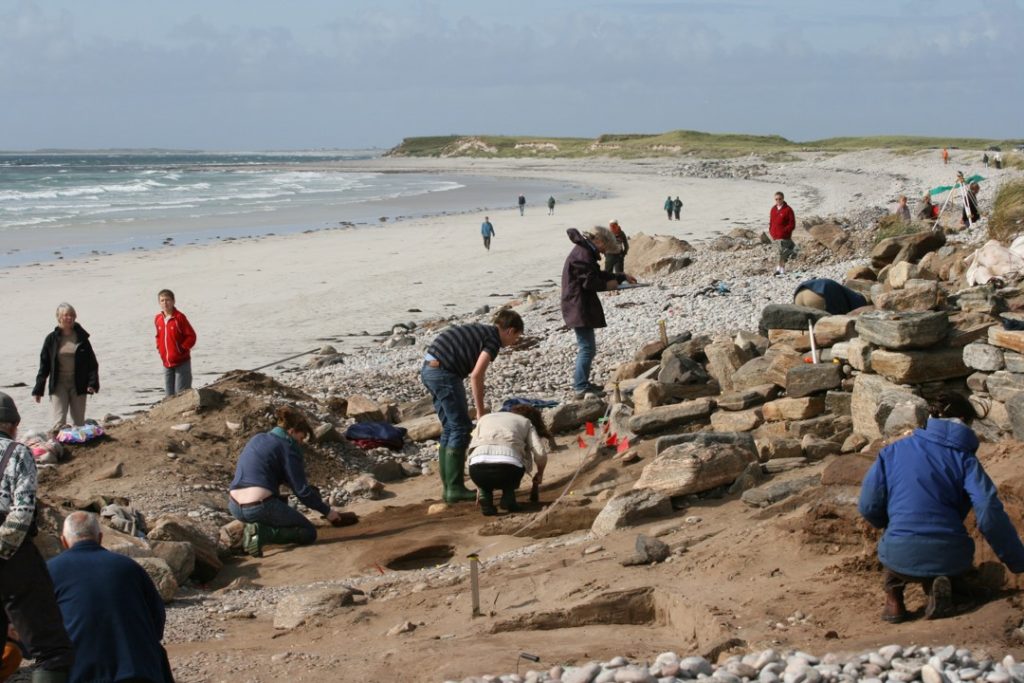
Archaeologists and volunteers working to record the Iron Age site of Baile Sear, Uibhist a Tuath, Na h-Eileanan Siar (North Uist, Western Isles) (Image Credit: Scotland’s Coastal Heritage At Risk Project)
For this reason, volunteers undertake condition surveys of sites on the coast to check for any changes. Many hands make light work, and between them the SCAPE team monitor hundreds of sites around Scotland’s coast, from which we can understand how soon sites are likely to face damaging levels of erosion. Other methods for monitoring changes in coastal erosion have come from Scottish Government-funded projects like Dynamic Coast and include drone surveys, map comparisons, and using GPS to map out the changing coastline.
Climate change is bad news for Scotland, and for the world, but the hard work and exciting innovation that it has initiated around the country is really inspiring. In many ways, this global catastrophe presents some interesting opportunities to better understand archaeological sites and has sparked some major investments of time and funds.
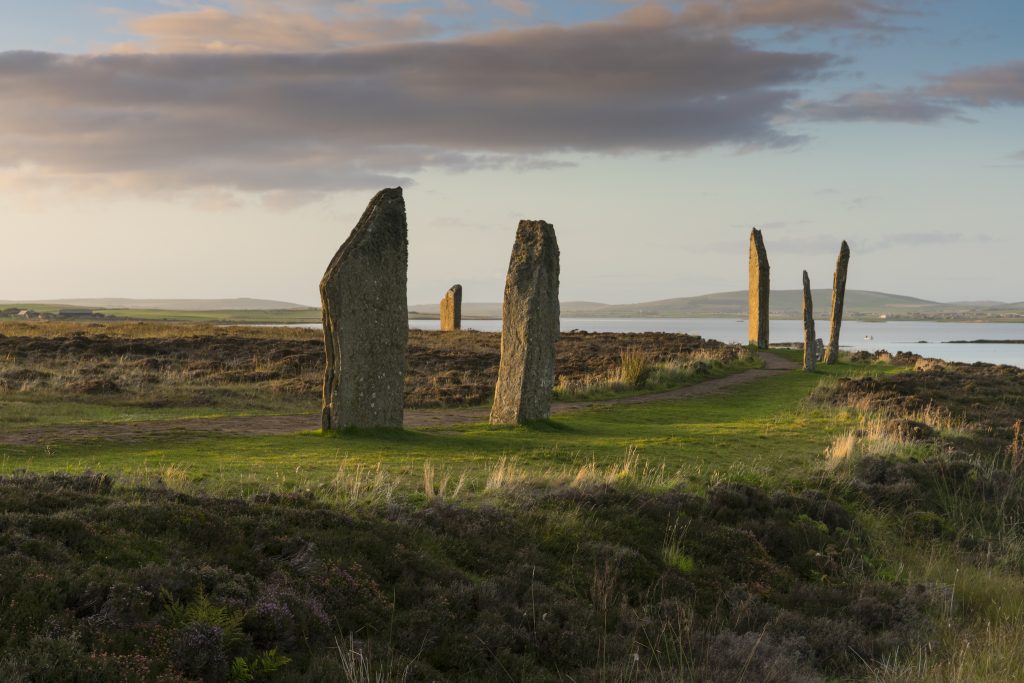
The Ring of Brodgar in the Heart of Neolithic Orkney (Image Credit: © VisitScotland / Kenny Lam)
So where do you fit into all of this? Well, if you’re a coast-dweller and keen to get out and about, you could help monitor sites with SCAPE. Also, we can all be mindful of where we’re putting our feet when visiting sites – and finally (and it’s a biggie) we can cut our carbon emissions.
Right now, reducing our carbon footprint is one of the most powerful actions we can take to help protect our archaeological sites, and all the rich heritage that we love so much. Next time you hop on your bicycle to go to the shops, rather than getting in the car, you will be supporting the future of Scotland’s heritage.
Sites around the country will thank you for it – as will future generations who get the opportunity to enjoy them as we have done.
If you’d like to know more about what Historic Environment Scotland are doing in response to climate change, check out their Action Plan and their handy guide to climate change impact.
By Hannah Genders-Boyd, an archaeologist rooted in climate activism. Since researching historic responses to natural disasters during her undergraduate degree at The University of Edinburgh, Hannah has moved into a diverse career, from climate heritage with Historic Environment Scotland, to grassroots activism with XR, engaging with the commercial archaeology sector and sustainable tourism along the way. She recently completed a research masters in palaeoecology at the University of Highlands and Islands, Orkney.
Header Image: © VisitScotland / Colin Keldie
