“A Long Love Affair” with Bearsden Roman Fort: the Story of an Excavation

In the summer of 1973, I began a long love affair with the Roman fort on the Antonine Wall at Bearsden when I undertook an exploratory excavation in advance of building work.
The first season was planned to last four weeks but as we found the fort’s bath-house it was extended to seven. The press conference about the East Dunbartonshire discovery led to an influx of something like 2,000 visitors over the final weekend: Bearsden was on the map.
As building work on the site was delayed I was able to return for several summers to examine more of the fort and its annexe.
However, by the end of ten seasons we had achieved our aims: a plan of the fort and part of the annexe; an understanding of the history; locating a civil settlement outside the fort; and an appreciation of the environmental background.
What did Roman Soldiers Eat on the Antonine Wall?
There is no doubt in my mind that if asked to choose the paramount aspect of the investigation it would be the botanical evidence. The examination of samples from across the site was undertaken by the late Camilla and Jim Dickson.
In particular, they analysed the sewage from the latrine which had accumulated in the outer east ditch, revealing the nature of the soldiers’ diet. Emmer and spelt wheat were identified (to which we can add durum wheat from residue analysis of pottery), barley, lentil, horse bean, linseed, fig (seeds pictured below), dill, coriander and opium poppy, some imported from the continent.
Items gathered locally included celery, turnip, radish, common mallow, bilberry, strawberry, blackberry, raspberry, hazel nuts and purging flax. To these foodstuffs we can add olive oil, wine and fish-based products brought to the fort in large jars. The soldiers certainly had a varied diet.
But on top of the acquisition of this knowledge was the biochemical analysis undertaken by Brian Knights. He was able to demonstrate that the vegetarian part of the diet was more important than the meat element. We know that Roman soldiers ate meat, but hitherto we had not known what part it played in the soldiers’ diet.
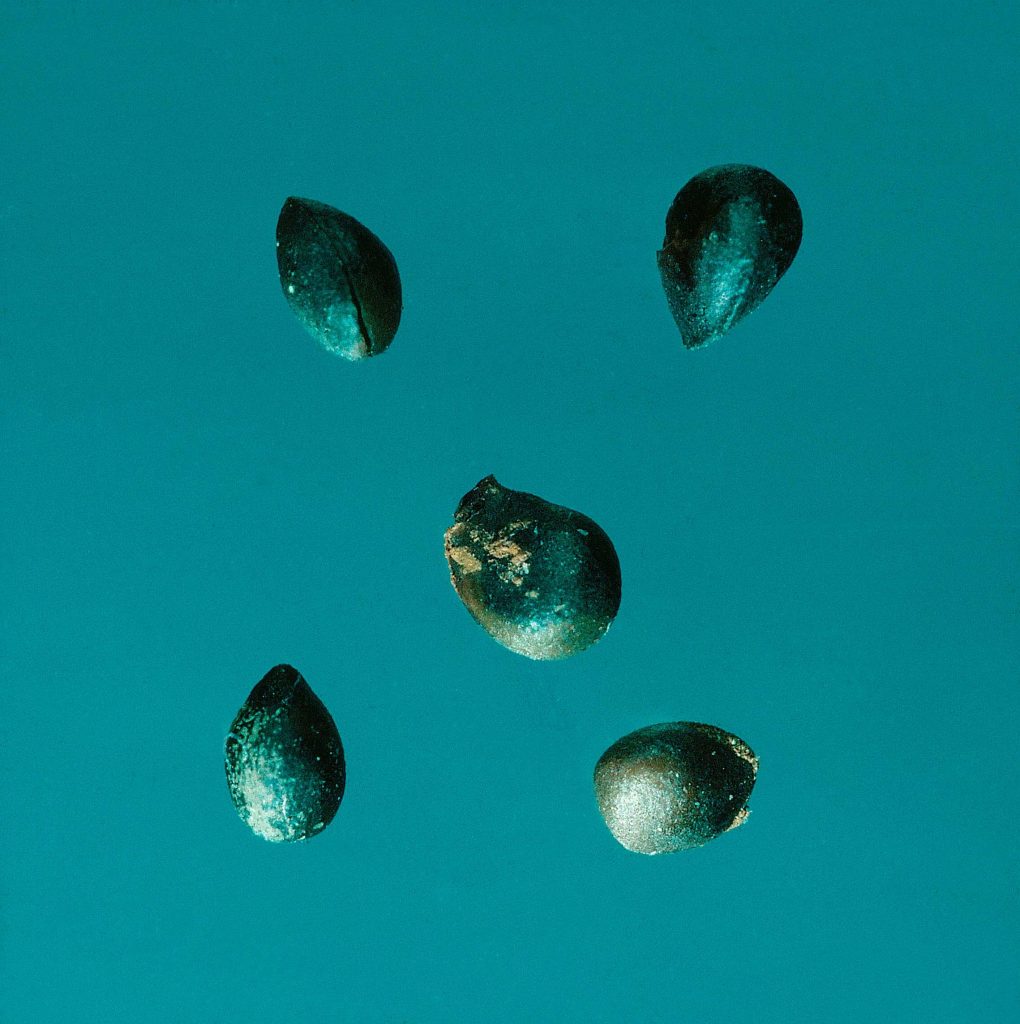
Fig seeds found in the sewage; the figs would have been imported from the continent (Copyright: Historic Environment Scotland)
Cooking at Bearsden
We were fortunate to be able to investigate nearly the whole of two barrack-blocks in the fort. When Denis Gallagher came to plot the distribution of pottery throughout these two buildings it became clear that nearly every room produced some fragments of mixing bowls, cooking pots and bowls, but no plates.
It would appear that the soldiers prepared, cooked and ate their food – with their fingers – in their barrack rooms. Some cooked their food on braziers in a tradition found in north Africa where we know that soldiers from the Antonine Wall served; seemingly some brought back these styles of cooking.
In working on the distribution of pottery in the fort, I took advice from Rikke Giles who had written a book about the subject [1]. One of the points she made was that fragments of jars tend to be found on roads within forts because they were used to carry water and food from the granaries and were dropped on the way to the barrack-block; this was exactly the pattern at Bearsden.
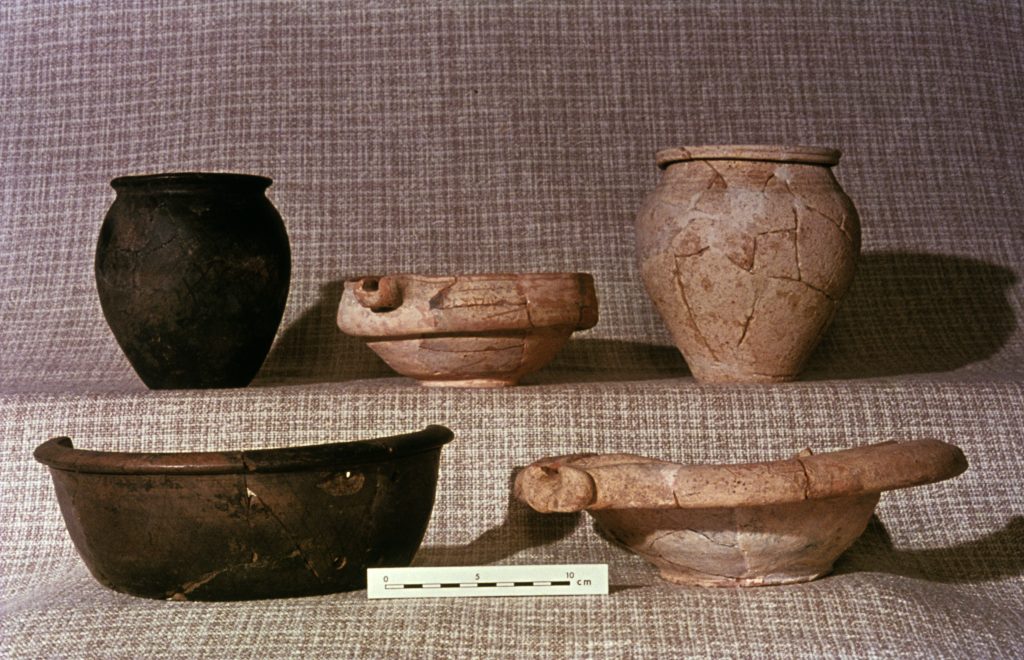
These pottery vessels illustrate life in the barrack room. The jar top right would have been used for carrying grain or water to the barrack, the mixing bowls (made locally by Sarrius) for preparing food, the pot top left for cooking and the bowl bottom left for eating from (Copyright: Historic Environment Scotland)
Puzzling Pottery
One of the puzzles was the distribution of pottery in the bath-house. There were fragments of only two cups but sherds representing as many as eight bowls.
What were the bowls used for? Quaffing large quantities of wine or beer? As chamber pots, bearing in mind that the latrine was outside the building? Or for holding nibbles? The latter won the day for me when I realised that we had found fragments of nuts and strawberries in the building.
A Pest Problem
The soldiers in the fort at Bearsden shared their environment with a variety of insects. Grain beetles were found in both the west and east ditches as well as within one of the barrack-blocks. Aquatic beetles lived in a hollow in the fort while others feasted on rotting hay. The soldiers had worms, both whipworm and roundworm. A single example of a human flea was recovered.
Did Romans use sponges as toilet roll?
Another aspect of hygiene had far-reaching implications. It is assumed that Roman soldiers used sponges to clean themselves in the latrine. This is based on very little documentary evidence.
At Bearsden, we found moss in the latrine and were lucky to be working with Jim Dickson, an international expert on mosses. It seems that this was what was used by the soldiers at Bearsden to clean themselves.

An artists’ impression of the interior of the latrine showing the soldiers using moss to clean themselves (Drawn by Michael J. Moore)
Abandoning the Fort
The fort at Bearsden had a short life, perhaps a generation, and then the soldiers packed up and left. The items which they left behind were of poor quality, so they clearly took the useful material with them. The fort rampart was slighted and, it would appear, its timber breastwork burnt. The soldiers marched out never to return. 1,800 years later the bath-house and latrine at Bearsden were included in the Frontiers of the Roman Empire World Heritage Site.
If you would like to visit, they are on Roman Road in Bearsden (a few metres east of Bearsden Cross) and are free and open year-round. Want to know more? Click here to read the full excavation report, ‘Bearsden: A Roman Fort on the Antonine Wall’, which is available to download for free thanks to the Society of Antiquaries of Scotland‘s commitment to open access.
By David J. Breeze, a past president of the Society. He excavated Bearsden while an inspector of ancient monuments. He subsequently led the team which made the Antonine Wall a World Heritage Site.
[1] Roman Soldiers and the Roman Army, BAR BS 562, 2012
Header Image: The bath-house looking south-west with the latrine in the shadow to the left and part of the earlier bath-house to the right. The soldiers entered the changing room at the far end of the building and progressed to the hot room in the left foreground. (Copyright: Historic Environment Scotland)

This article was produced as part of Scotland Digs Digital. In the summer of 2020, we shone a spotlight on Scottish archaeology with the Scotland Digs Digital campaign which brought together online and offline events, as well as live updates from across the country for everyone to enjoy.
