What is Radiocarbon Dating?

It’s a very exciting feeling when you unearth your first artefact, one which anybody who has uncovered a find will know well. You could be holding something – a bowl, a bead, or a brooch, perhaps – which has not been seen for hundreds, or even thousands of years. But how do we find out just how old an artefact is? There are various methods which can help us work out a date, and one important technique in an archaeologist’s toolkit is radiocarbon dating.
Brooches and Bones
Over 2,000 years ago, brooches were the height of fashion in Scotland. Today they help tell us more about the Iron Age people who wore them. Brooches are often all that survives from the dress of an Iron Age person and since the early 20th century, they have been used to estimate how old a burial or site is.

Iron Age brooches from Pocklington (Image courtesy of MAP Archaeology – © Sophia Adams)
To date a brooch we look at its shape, style and design, as well as the way it has been made and the type of metal it’s made from. But now, at the University of Glasgow, we are researching how to improve this traditional technique using a method called radiocarbon dating.
What is Radiocarbon Dating?
Radiocarbon dating (also referred to as carbon dating or carbon-14 dating) is a method for determining the age of an object which contains organic material by using the properties of radiocarbon, a radioactive isotope of carbon. Archaeologists often use this method to date organic remains (e.g. human or animal bone). It has been in use for 70 years and in that time the method has been improved immensely. We now only need a very small sample of bone to achieve a radiocarbon age accurate to about 50 years.
Using radiocarbon dating, we can analyse bones found alongside brooches in Iron Age graves to work out how old they really are. There are four main stages that require careful consideration:
-
Choosing the best sample
-
Taking and preparing the sample
-
The serious science
-
Interpreting the results
1. Choosing the Best Sample
Unburnt human and animal bones, and charred plant remains are the most common materials sampled for radiocarbon dating. For this project we are focussing on bone that has been buried at the same time as the brooch. We use the collagen (a structural protein) in the bone to identify when the person or animal died. During life, the collagen in nearly all of our bones is continuously replenished with carbon from the food we eat, and a very small proportion of that carbon is the radioactive isotope form, 14C.
At death, the body stops producing new collagen, so no new 14C is incorporated into the bones. The 14C starts to decay at a known rate. The ratio between the remaining 14C within the sample and the stable isotopes of carbon: 12C and 13C (which do not decay) allows us to work out how long it has been since the human or animal died.

A small section of bone is taken as a sample (© Sophia Adams)
When considering the date a brooch was deposited, we want to get the most accurate results and so we must date the ‘newest’ collagen at the time of death, in a bone that was buried very soon after the human or animal died, and which remained undisturbed until careful excavation. Ribs provide great samples because collagen turnover is more frequent than in other types of bone. Single jaw bones (mandibles) and skulls (without a skeleton) don’t make for ideal samples as there is a greater risk that they were not buried soon after death.
2. Taking and Preparing the Sample
We remove a 2g sample from the bone (usually by cutting with a diamond-edged circular blade) and put it in a clean labelled bag. The bone is further cleaned in the pre-treatment lab then bathed in weak acid until it demineralises: the sample becomes rubbery (like the texture of squid rings).
-
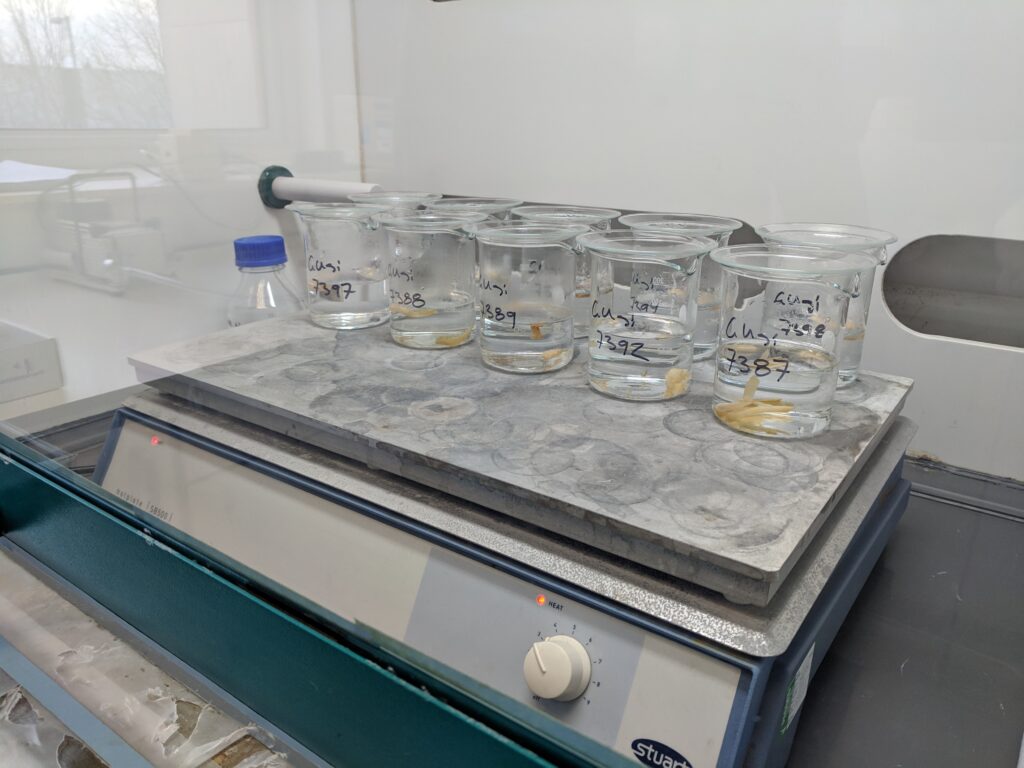
- The samples are heated on a hot plate in ultrapure water (© Sophia Adams)
-
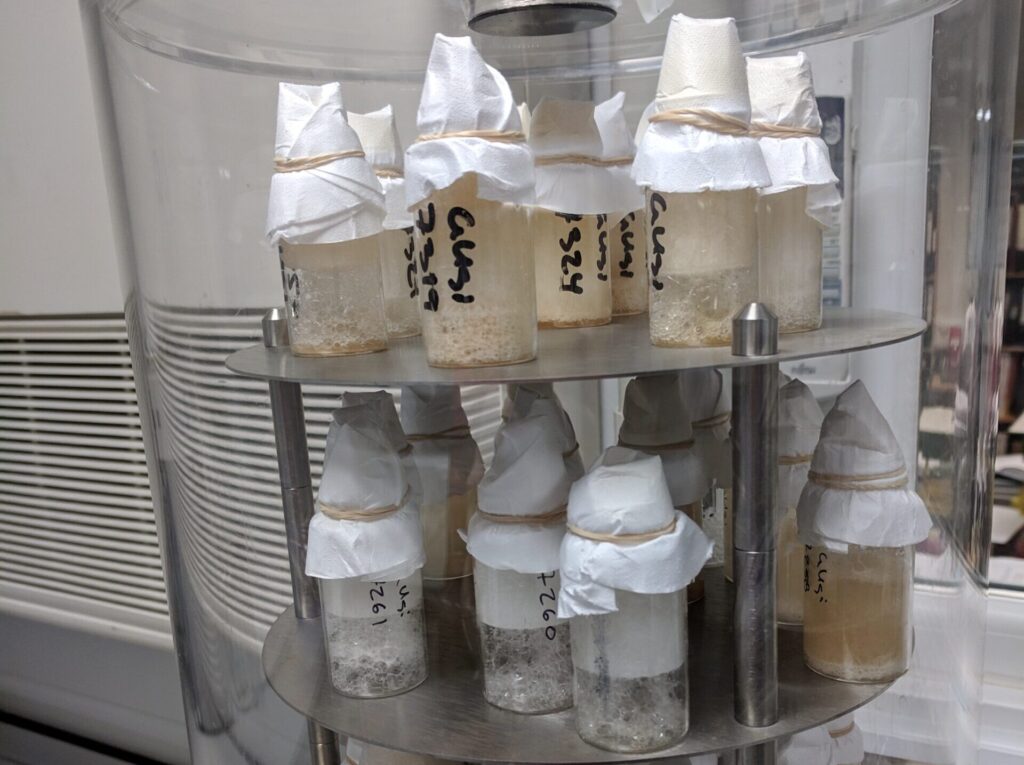
- The samples are freeze-dried (© Sophia Adams)
It is then slowly heated in ultrapure water until it has dissolved, leaving a clear liquid sample of dissolved collagen which is filtered, reduced in volume and freeze-dried. The final result at this stage looks like a little piece of candy floss.
3. Serious Science: Turning the Sample into Graphite
A tiny 15–20mg piece of the freeze-dried sample is carefully placed into ready-prepared quartz tubes; after a series of heating (combustion) and purifying processes, we are left with tiny fragments of graphite-coated iron, ready to be put through the Accelerator Mass Spectrometer (AMS), a massive machine housed in its own building.

The Graphitisation Lab at SUERC (© Sophia Adams)
This machine directly measures the carbon-14 isotope (14C) content of the sample relative to the known abundances of carbon-12 and carbon-13 isotopes present in the sample. The number of carbon atoms present in the sample are counted and the proportion of the isotopes is used to calculate the radiocarbon age. See here for further information on how the calculations are carried out.
4. Interpreting the Results
The AMS produces results where the radiocarbon age of the sample is given in years before present (which actually means 1950, when the technique was first developed). Because the amount of 14C in the atmosphere is not stable and has changed over time, the radiocarbon determination is not in calendar years. To obtain a calendar date, the radiocarbon date needs to be calibrated against an internationally-agreed curve. For a period up to about 13,000 years ago this curve is based on radiocarbon dates, from multiple labs around the world, made on dendrochronologically-dated tree rings.
The river Teviot is giving up her secrets, amazing day’s sampling on Fri of oak branders of an early bridge, 4 new dendro samples taken for me by @RFMacKintosh & Steph of @WAScotland abetted by ADHS @BorderArch Richard & Geoff. Sub-samples today by @HamishDarrah #SESOD #HESfunded pic.twitter.com/XxphPQQyaY
— Dr Coralie Mills (@Dendrochronicle) August 3, 2020
Dendrochronology is based on the variable annual growth of specific tree species which produce patterns in the width of the growth rings; these allow us to align cross-sections of trees with overlapping periods of growth to create a sequence over thousands of years. The combination of two sets of probabilities–the uncalibrated radiocarbon age and the calibration curve–result in complex probability distributions for the dates. Fortunately, we have computer programs to carry out this work for us.
While the average uncalibrated radiocarbon age will have a margin of error usually between 100 to 140 years (the average 1-sigma measurement error is 25 to 35 years), the final calibration can cover a range of 100 to 400 years as the calibration curve is full of wiggles, plateaus and steep sections that impact the final calibrated precision.
Back to Our Brooches
By finding as many examples as possible of brooches in Britain alongside material that can be radiocarbon dated, we can create a series of dates for specific types of brooch. Eventually, we will carry out statistical modelling on these dates to narrow down when they were made, used and buried. This, in turn, will assist us in dating archaeological sites where brooches are the only dateable items found.
This might sound like an enormous task but the numbers of suitable samples are not so high. After two years, Derek Hamilton and I (at SUERC, University of Glasgow) have managed to obtain samples for 250 brooches from England and Scotland, and 28 from France for comparison. We hope to share the results with you soon.
Bonus Fact: Did you know we have scientific glassblowers at our labs? Much of the glassware used in the labs is produced for us in-house
-
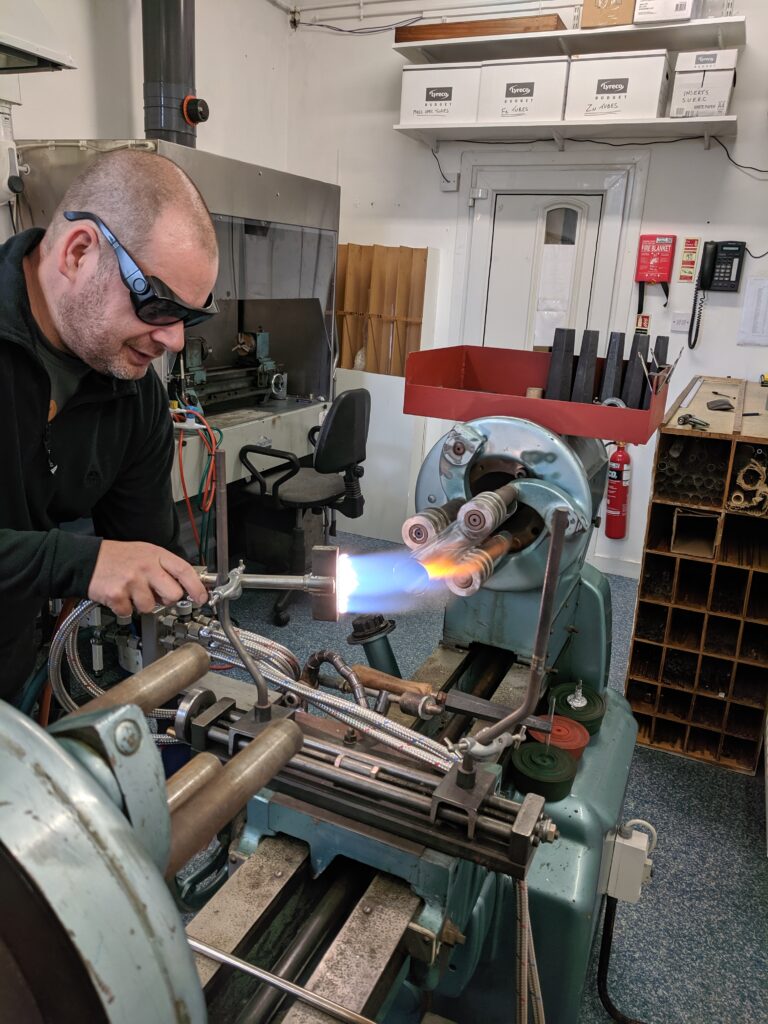
- A scientific glassblower at work (© Sophia Adams)
-

- Much of the glassware at SUERC is made in-house (© Sophia Adams)
Hungry for more? Click here for a longer summary of the radiocarbon dating process or email Sophia at sophia.adams@glasgow.ac.uk for more information.
By Dr Sophia Adams, a Research Associate with the University of Glasgow based at the Scottish Universities Environmental Research Centre (SUERC) and is working on the ‘Setting Artefacts Free’ project, funded by The Leverhulme Trust.
Featured Image: A demineralised bone is rinsed with ultra pure water before heating (© Sophia Adams)

This article was produced as part of Scotland Digs Digital. In the summer of 2020, we shone a spotlight on Scottish archaeology with the Scotland Digs Digital campaign which brought together online and offline events, as well as live updates from across the country for everyone to enjoy.
