The Best of Scottish Archaeology on Canmore

Behind every photograph or drawing in the Historic Environment Scotland (HES) Archive there is a story, an excitement, an experience, a discovery, a memory, a voice.
As the online catalogue to Scotland’s archaeology, buildings, industrial and maritime heritage, Canmore is where you can begin to explore records of some of Scotland’s best archaeological gems. With the ability to delve into the images greatly improved with a new zoom function, now is a great time to explore six of my favourite items (click on the photos below to be taken to their Canmore page).
Early Christianity in Print in Earra-Ghàidheal (Argyll)
Photography has played such an important part in documenting our historic environment and there are numerous examples of ancient monuments, buildings and sites that have been captured in print and provide a valuable insight into what places were like through the 19th century when it was a developing art. Unlike today when we can easily take hundreds of digital images, many early photographers felt they had had a successful day when they were able to take and develop six photos.
James B Mackenzie (1833-1920) was a minister and keen amateur photographer. There are several of his albums, photographic prints and glass plate negatives in the HES Archive, dating from c1860 onwards including historic buildings and early mediaeval sculpture.
This example is a delightful view of the medieval chapel at Keills in Earra-Ghàidheal (Argyll), which likely dates from the second half of the 12th century. You can also see the Keills Cross which is around 1,200 years old. The carved stone monument depicts various scenes from the bible, such as St Michael vanquishing the dragon or serpent, and hints at the early spread of Christianity in Earra-Ghàidheal.
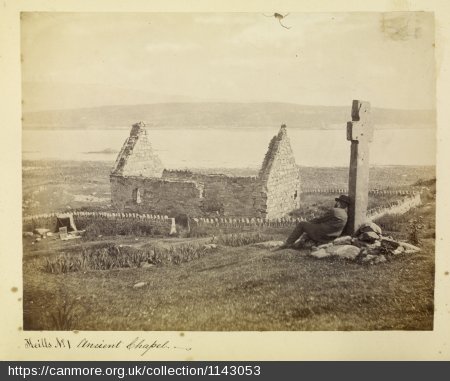
Your eye is automatically drawn to the man reclining at the base of the cross but if you look to the left, you can see Mackenzie’s photographic tent where he will have developed his glass negative that would later result in this print.
An Ancient Coffin in Siorrachd Inbhir Àir (Ayrshire)
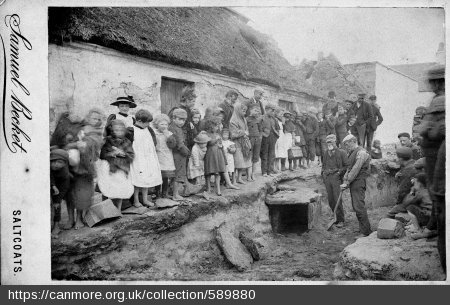
Excitement always comes with the discovery of a cist – an ancient coffin or burial chamber – and it would be no different in 1895 when this prehistoric grave was uncovered during building work at Baile Steaphain (Stevenston) in Siorrachd Inbhir Àir (Ayrshire). The discovery was captured in this photograph by Samuel Becket and is an important visual record of what was uncovered.
The Bronze Age cist contained a food vessel and a stone ‘club’ which are now in the North Ayrshire Heritage Centre in Saltcoats along with two other ‘clubs’ which were apparently found near the cist.
But I am fascinated by the people – there is a natural curiosity on their faces. What did they make of the Bronze Age burial cist; did they see the pottery vessel and stone tool found inside?
A Pictish Stone in Na h-Eileanan Siar (the Outer Hebrides)
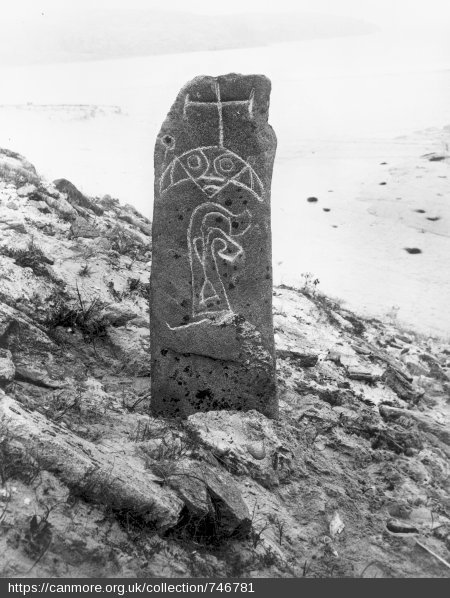
There is always more to discover about the past and you should never assume that you have the full story. This is a photograph by Erskine Beveridge, Vice President of the Society of Antiquaries 1915-18 and prolific amateur photographer. The catalogue entry for this Pictish stone on the island of Pabaigh (Pabbay) includes the words ‘symbols have been outlined in chalk’ – but have they?
The discovery of a diary by Beveridge reveals that he was on a yachting holiday in 1895 visiting several of the Scottish islands. He had clearly heard of the Pictish stone on Pabaigh and may have actually set off on the voyage to find it. A prehistoric midden (rubbish heap) was once nearby, as well as an Early Christian burial ground and medieval chapel. Several weathered slabs with Christian crosses and earlier pagan markings survive here, including the Pabbay Stone dating from the 6th century.
This is the only Pictish symbol stone still to be seen in Na h-Eileanan Siar and one of only five in the entire Hebrides. It is marked with a V-rod, lunar crescent and flower (a lily?) and a crude cross has been added over it at some later date, possibly coinciding with its move to this site as a grave marker.
In the diary entry for 23 September, Beveridge describes arriving at the island and his search for the stone, finding it lying flat by the churchyard with its markings badly eroded. But in order to get the best photograph he placed it into an upright position and outlined the symbols not with chalk but with ‘bits of human bone’!
A Record of Weaving in Aonghas (Angus)
Scotland has a rich heritage of textile production and before large scale manufacturing, weavers worked from their cottages in communities across the country.
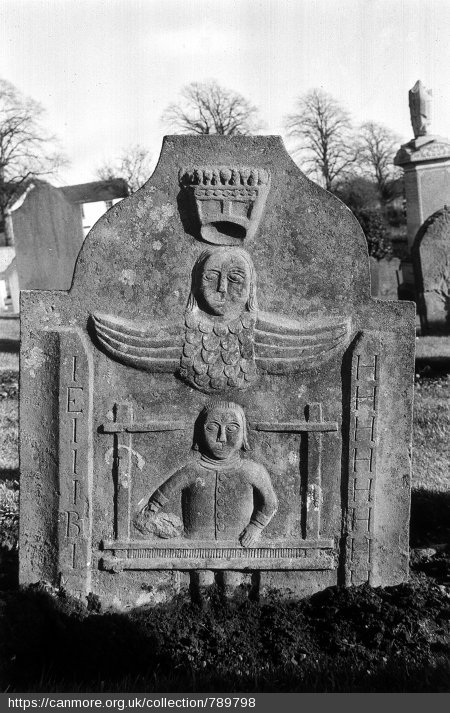
This gravestone from Kirkton of Monikie in Aonghas (Angus) dates to 1778 and depicts a weaver at work at his loom, the shuttle in his right hand. It is a tangible reminder of pre-industrial age manufacturing before the invention of large-scale mills. But it also reflects the skill of the stone mason and if you zoom into the image you can see some of the fine detail of the warp on the loom and the weaver himself. It is one of a number of fine 18th-century stones in the graveyard commemorating weavers and their families.
This photograph is just one of thousands of images and inscriptions of 17th and 18th century gravestones captured by Betty Willsher through the 1970s and 80s. What had started as an interest in folk art carvings soon became a full-time labour of love in retirement as she traversed Scotland’s graveyards, and indeed further afield to England, Wales and the USA.
It is one of a number of collections that have come from the activities of an inspirational individual who has documented one aspect of our past and generously gifted their research for the benefit of others.
Stones Carved for Kings in Glaschu (Glasgow)
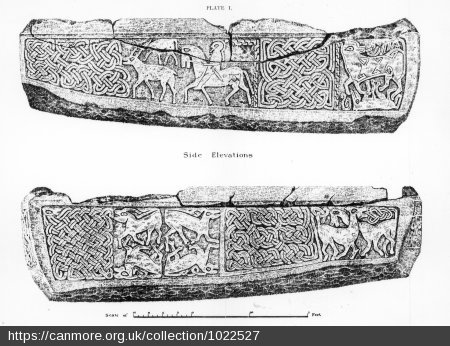
The sarcophagus at Govan Old Parish Church is a remarkable monument, one of over 30 early medieval sculptured stones preserved in the church. Found in 1855 during grave-digging in the graveyard, the sarcophagus was carved sometimes in the 9th to 11th centuries to commemorate the power of those who ruled the Kingdom of Strathclyde.
Created from a block of local sandstone and some 2m in length, intricate carvings of animals and symbols adorn the sides of the sarcophagus beautifully depicted in this drawing by Ian G Scott in 1999. Ian was the first professionally trained illustrator in the Royal Commission on the Ancient and Historical Monuments of Scotland (RCAHMS) and went on to transform the standard of survey drawings. This was especially the case for recording Scotland’s carved stones, as he developed a stippled modelling technique to accurately capture the details of any sculptured surface (as seen here).
Retirement from RCAHMS saw Ian travelling the length and breadth of Scotland continuing to develop a detailed understanding of early medieval sculpture through his drawings and generously making sure that his work was accessible to all in the archive at HES. A fitting legacy to Ian who died in November 2020.
A Lost Broch in Orkney
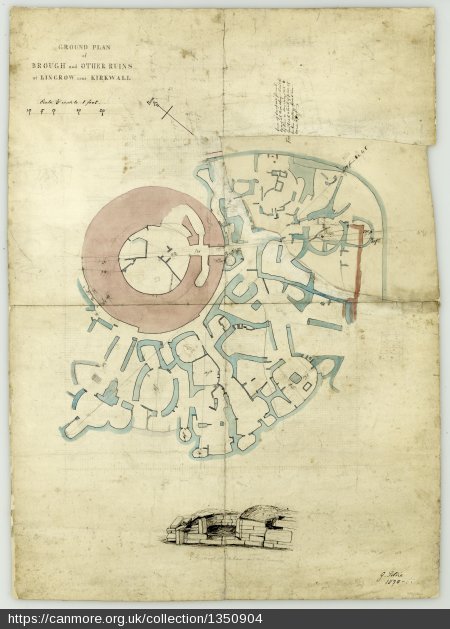
Sadly, the Broch of Lingro in Orkney no longer survives but it must have been an impressive complex of buildings when excavated by George Petrie, Sherriff Clerk of Orkney in 1870.
Inside he found a wealth of artefacts including a large number of querns (a simple stone hand mill for grinding corn), quartz pebbles used as strike-a-lights to make a fire, a stone lamp, bone pins, needles and long-handled combs ornamented with design of St. Andrew’s Cross, spindle-whorls, a clay mould for casting bronze pins with open circular heads, bone playing dice, pottery, charred barley, several Roman coins, and many tools made from red-deer horn.
Petrie produced a range of detailed drawings and sketches to illustrate what he had uncovered but died before being able to produce a published account of his discoveries. Fortunately, his papers were gifted to the Society of Antiquaries of Scotland (and are now in the care of HES) as they represent the only record of this extensive site which was completely destroyed in 1981.
BY LESLEY FERGUSON, HEAD OF ARCHIVES AT HISTORIC ENVIRONMENT SCOTLAND. LESLEY HAS WORKED WITH SCOTLAND’S HERITAGE ARCHIVES SINCE THE 1980’s (PREVIOUSLY IN RCAHMS) AND HAS PARTICULAR RESEARCH INTERESTS IN EARLY PHOTOGRAPHY AND ANTIQUARIANS.
Header Image: Keills Chapel Of St Charmaig, Knapdale, Argyll (© VisitScotland / Paul Tomkins)
