Treasures in the Dirt: Why Archaeology is About More than Precious Metals
Who doesn’t love reading about newly-discovered ancient treasures – dazzling gold or silver, perhaps studded with precious gems? These headline-grabbing objects instantly spark the imagination and conjure up images of ancient royalty bedecked in finery.
But the problem is that precious metals tell only an idealised story of the great and the good (the “1%” of their time). What about the lives of the other 99%? Archaeologists want to tell their story as well!
For an archaeologist, treasure can be broken, repaired and waste goods, as they tell us a lot more about how people lived in the past. Likewise, tiny things like pollen and micro-fossils can help us see the landscapes of the past.
“Making good use of the things that we find
Things that the everyday folks leave behind”
– Wombles, The Wombling Song
What’s hidden in the midden?
A nosy parker rummaging around in your rubbish bin would soon discover what (and how) you eat and drink, as well as what medicines and toiletries you may use. Archaeologists call mounds of rubbish, especially food waste, middens. Waste food, broken containers and even poo (archaeologists call them coprolites) can tell us what life was like in the past.
Excavations at Advocate’s Close in the centre of Edinburgh, for example, revealed middens of animal and fish bones, broken pottery, and worn-out leather goods. The changes in how and what was being dumped illustrated how post-medieval Edinburgh was becoming an important city with increases in imported luxury goods and an awareness of the health risks such rubbish dumps could cause in an urban setting.
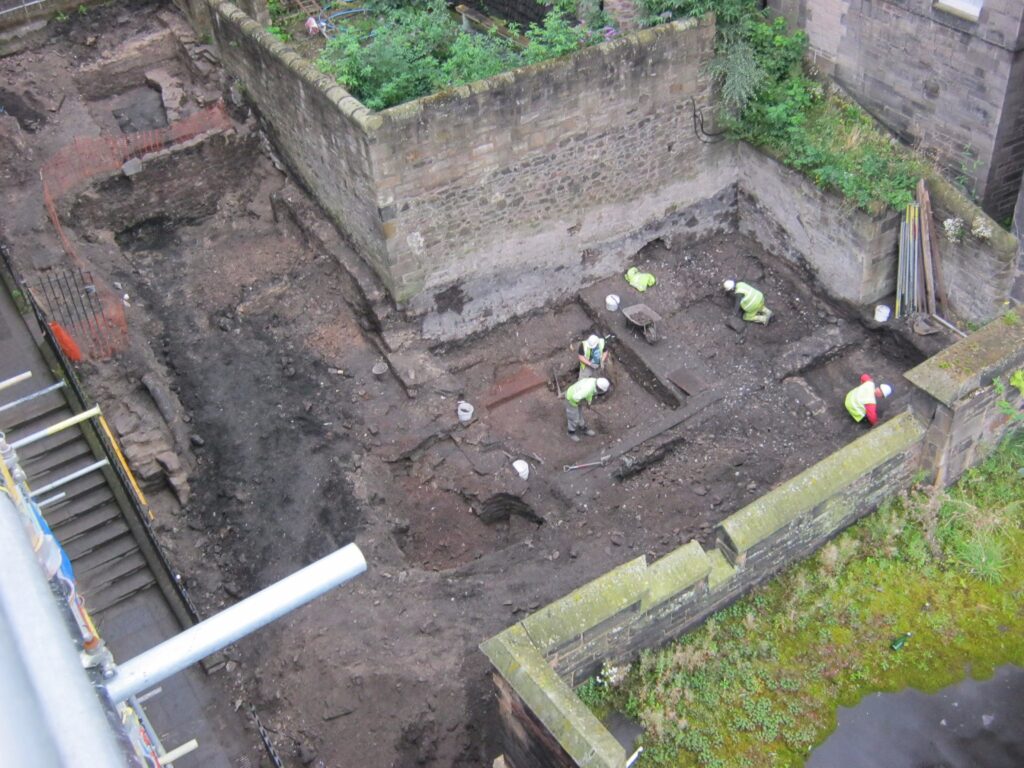
Advocate’s Close excavation (Image Credit: AOC Archaeology Group)
Poor sanitation and decidedly dodgy diets meant that internal parasites abounded in the past, so examining the, ahem, ‘end’ result of what people consumed can tell a lot about health and longevity in the past. Combined with evidence from middens, microscopic analysis of poo can paint a vivid picture of how even the wealthiest lived – and died.
Lack of hygiene and poor cooking could kill – osteoarchaeologists could find no trace of Robert Bruce’s supposed leprosy, but we do know from literature of the time that his personal physician warned against eating eels, which can be toxic if not cooked properly, and this may well be what killed him.
Very ancient middens sometimes tell stranger stories. Over 5,000 years ago, people in Mesolithic Scotland consumed a lot of fish. We know this because of great heaps of shells at sites like Oronsay and An Cruinn-leum in Applecross in the Highlands. Yet by the time the first farmers and cairn (stone mound) builders were settling in Scotland, fish was firmly off the menu. Archaeologists are still working on trying to find out why!
Bugs and bogs
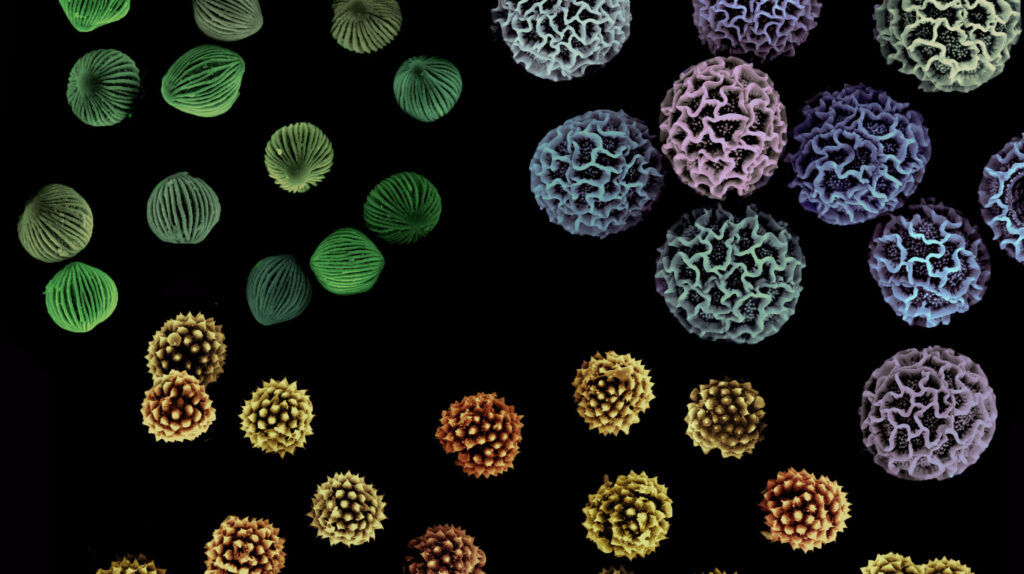
The next time a spring wind blows flower pollen in your face and you sneeze, think of where that pollen may end up. If it lands in a peat bog, it becomes a page of history, preserved in the peat. Archaeologists take cores from bogs and examine the layers of plant material. After some science jiggery-pokery, palynologists (people who study pollen) can identify the plants and trees which were in the area, resulting in a reconstruction of ancient landscape.
Were the fields nearby full of wheat and meadow flowers with grazing animals?
A forest of great dark-leafed oaks with all sorts of wild creatures in it? Orkney was once like that.
Was it cold and dreich? Or was it mild with the air full of buzzing insects? Little ‘midge’ flies, or chironomids, buzzing around bogs fall into the peat when they die and are good climate indicators as they hatch only at certain temperatures. If they are present as micro-fossils, we can even give a weather forecast (post-cast?) for the past. That re-imagined scene can bring a long-vanished landscape to life; one in which people of the past were working, making, hunting, eating, and drinking.
Bugs, bones, pollen, poo, broken plates, lost shoes, and rusty metal rarely make the front page. But these broken, discarded and often mucky everyday things somehow survived through centuries and contain the low-down dirty truths of life in the past. They are time travel in a test tube, tiny things with huge stories to tell – some sad, some satisfyingly happy. But most of all, they tell the stories of how despite everything, humans made it to the 21st century.
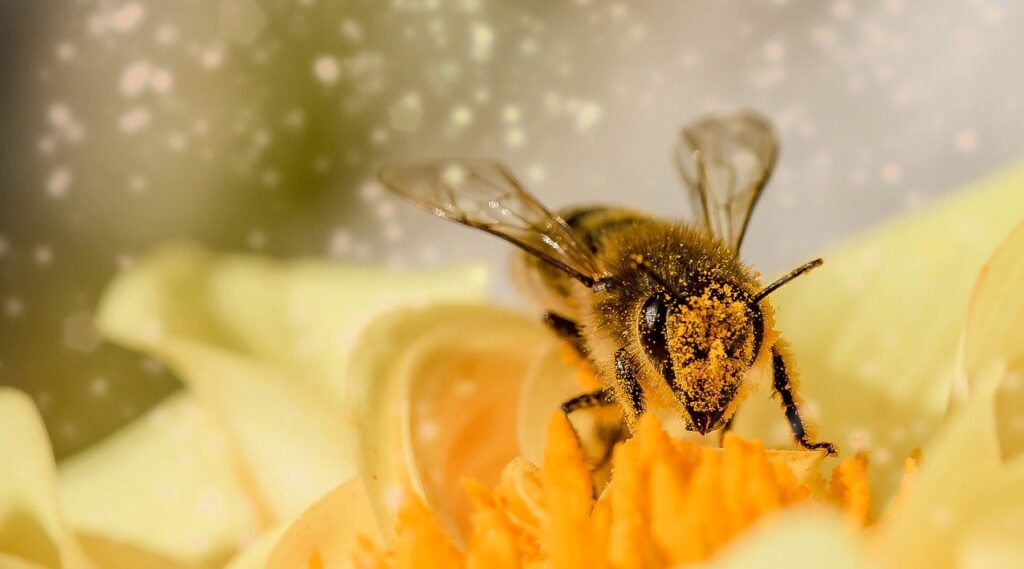
Image by Myriams-Fotos from Pixabay
If you’d like to keep exploring, check out Dogs, not Dinos! The Truth About Zooarchaeology.
By Dr Rena Maguire, Curatorial Archaeologist in Historic Environment Division and Research Fellow in QUB Belfast, specialising in north-western Late Iron Age material culture and later prehistoric equitation. MSc in environmental archaeology. Editor EXARC Journal. Join the conversation with @justrena on Twitter.
Further Reading:
Finlay, N., Cerón-Carrasco, R., Housley, R., Huggett, J., Jardine, W.G., Ramsay, S., Smith, C., Wright, D., Augley, J. and Wright, P.J., 2019, December. ‘Calling Time on Oronsay: Revising Settlement Models Around the Mesolithic–Neolithic Transition in Western Scotland, New Evidence from Port Lobh, Colonsay’. Proceedings of the Prehistoric Society 85, pp. 83-114.
Penman, M. 2014. Robert the Bruce: King of the Scots. New Haven: Yale University Press
Richards, M.P. and Schulting, R.J., 2006. Touch not the fish: the Mesolithic-Neolithic change of diet and its significance. Antiquity, 80(308), pp.444-456.
(Header Image Credit: Three Species Pollen Grains – Asja Radja, CC BY 4.0 <https://creativecommons.org/licenses/by/4.0>, via Wikimedia Commons)
