A Load of Old Rubbish? What Middens Can Reveal About Scotland’s Past

What can rubbish tell us about the history of Scotland? Actually, rather a lot! Middens contain material remains from many years ago and can reveal information about the people who lived in Scotland over the last 10,000 years. What’s more, some middens in Scotland have been found to contain unusual finds…
[NOTE: Article contains images of human remains]
What is a Midden?
Middens are essentially old rubbish dumps; they are primarily made up of domestic waste and some were created over numerous generations. They can contain a host of artefacts (objects made by human beings) and ecofacts (natural objects used by humans which people haven’t altered e.g. animal bones left from dinner) that can tell archaeologists more about human occupation in the past.

Iron Age Midden Material (© Shetland Museum & Archives)
Some of the First Peoples in Scotland
We don’t know all that much of how the first people who hunted, fished and gathered plants in Mesolithic Scotland saw the world. Over 6,000 years ago, communities moved around a lot, likely using water as an important method of transport. Due to the nature of their mobile lives, and the huge amount of time that has passed since they were around, there is relatively little evidence of structures that have been dated to the Mesolithic (or Middle Stone Age) in Scotland.
Middens, like the 9,500-year-old one at Druimvargie in An t-Òban (Oban) on the west coast of Scotland, are one of the few surviving substantial features from this period. Like many other ancient middens by the sea, it contains huge quantities of sea shells and other marine waste materials, which tells us about how people lived at this time, including what they ate.
Were you told as a youngster to ‘clean that bedroom, it’s a midden’? We’re here to reassure you that archaeologically speaking, excavating a midden can be quite rewarding! See: waste from Cnoc Sligeach on Oronsay revealing clues on Mesolithic life ➡️ https://t.co/JSkL8oYEoN pic.twitter.com/Ed92kK4h2w
— Historic Environment Scotland (@HistEnvScot) December 19, 2019
On the island of Orasa (Oronsay) in Na h-Eileanan A-Staigh (the Inner Hebrides), the primary type of fish identified in five middens was a species known as saithe – a type of pollock. By examining the size of the saithe ear bones, archaeologists have been able to establish during which season the fish were caught at each site.
Interestingly, the five middens examined across Orasa appear to have been occupied at different times of year. As a result, experts believe that either there was one population of people living on the island who moved from place to place throughout the year, or that foragers from the mainland travelled across to Orasa and camped at specific places in different seasons.

Oronsay west end, cc-by-sa/2.0 – © Ian Taylor – geograph.org.uk/more.php?id=5800939
Medieval Middens
Middens don’t just reveal information about prehistory, they also tell us about life in medieval Scotland. In 2009, a waterlogged midden was found in Stirling town centre and was identified as being over 600 to 800 years old through radiocarbon dating and the presence of medieval pottery.
By the early 13th century, Stirling was a royal residence with the right to have merchants’ guilds and to hold weekly markets, which made the town a buzzing industrial and urban centre.
In particular, it’s thought that Stirling may have acted as a giant slaughterhouse, processing hides, meat and bone which then provided the raw materials for other industrial and manufacturing activities. The midden found in 2009 contained animal bones, leather, wood offcuts and industrial waste, hinting at the city’s medieval industrial past.

The medieval belt buckle found in Perth (© David Bowler, Alder Archaeology Ltd)
Similarly, a 2008 dig at Kirkgate in Perth uncovered a medieval street with a well-preserved midden rich in leather, bone, wood and pottery which was also well over 600 years old. Curiously, it was separated by thin gravel layers which archaeologists believe may be evidence of a kind of early street resurfacing. A 13th-century decorated belt buckle (now in Perth Museum and Art Gallery) and a medieval barrel lock were also discovered at the site.
The remains of ancient food and medieval industry are fantastic evidence, but perhaps aren’t very surprising finds for a midden. But this is not all that’s been unearthed from Scotland’s middens…
Human Remains at Mine Howe
Mine Howe is a 2,000-year-old chambered cairn in Orkney consisting of an underground chamber in a large, earthen mound. It’s generally agreed that Mine Howe probably had a ritual or religious purpose – perhaps as a symbolic entry to the underworld, or a place to commune with the spirits of the earth. The chamber is surrounded by a massive ditch that may have marked a boundary between sacred and common ground. Evidence of Iron Age metal-working and an associated midden were also found close to the entrance of the underground chamber.
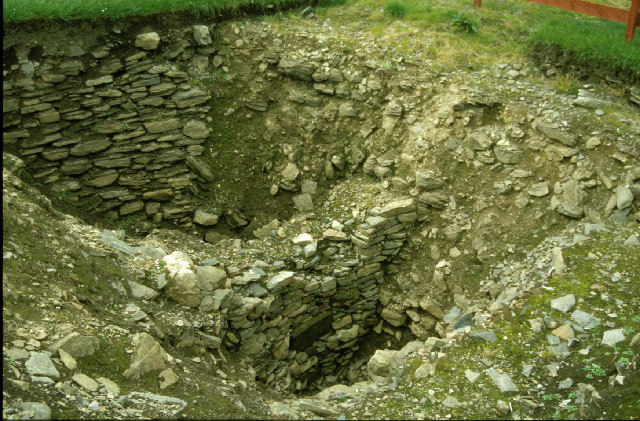
Excavation of the earthwork adjacent to the main shaft (© Peter Ward, CC BY-SA 2.0, at geograph.org.uk/photo/91366)
In 2005, archaeologists investigating the ditch around the chamber lifted a small flagstone to find the top of a human skull. The skull was part of the skeletal remains of a 25–35-year-old male who was buried in a shallow grave around 2,000 years ago (100BC to 100AD) which was barely large enough to contain his body. The skull was badly crushed by large stone slabs that were used to cover the burial. Forensic testing revealed that the individual had met a violent end with a number of traumatic wounds found on the bones which suggest that he was attacked with swords as well as a spear or arrows.
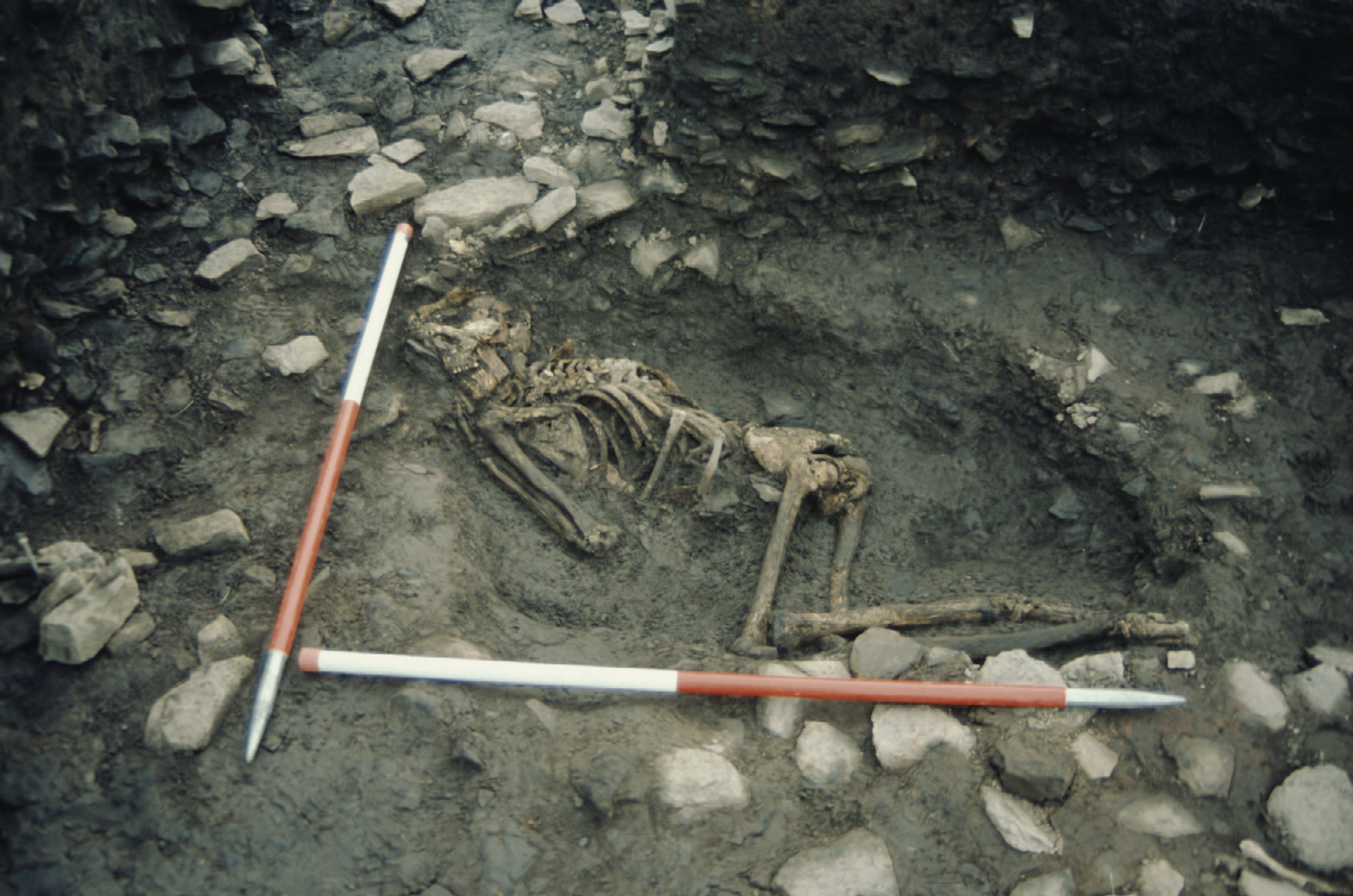
Mine Howe human remains (© ORCA UHI Archaeology Institute)
While the ill-fitting grave suggests the burial may have been somewhat of a rushed job, the body was still ‘formally’ buried in a pit dug into the midden at Mine Howe, with slabs covering the skeleton (not unceremoniously dumped onto the rubbish heap). It’s been suggested that the individual may have been killed as a sacrifice and buried at Mine Howe as an offering to the gods of the underworld.
Not Just a Load of Old Garbage?
Experts believe that middens may have served multiple purposes at once. In prehistoric times, they may have been created as boundary markers between different territories. Or perhaps, since occasional human toe or finger bones have appeared at midden sites, they may have been places where bodies were prepared for burial or where rituals around death were practiced.
At sites like the Cnoc Coig shell midden (also on Orasa), for example, archaeologists have found bones from human hands buried alongside those from seal flippers. Seals play an important role in Scottish folklore and myth, like the stories of selkies, and it’s tempting to see a prehistoric precursor existing thousands of years ago. Could we be seeing something of how Mesolithic people saw the world through these middens?
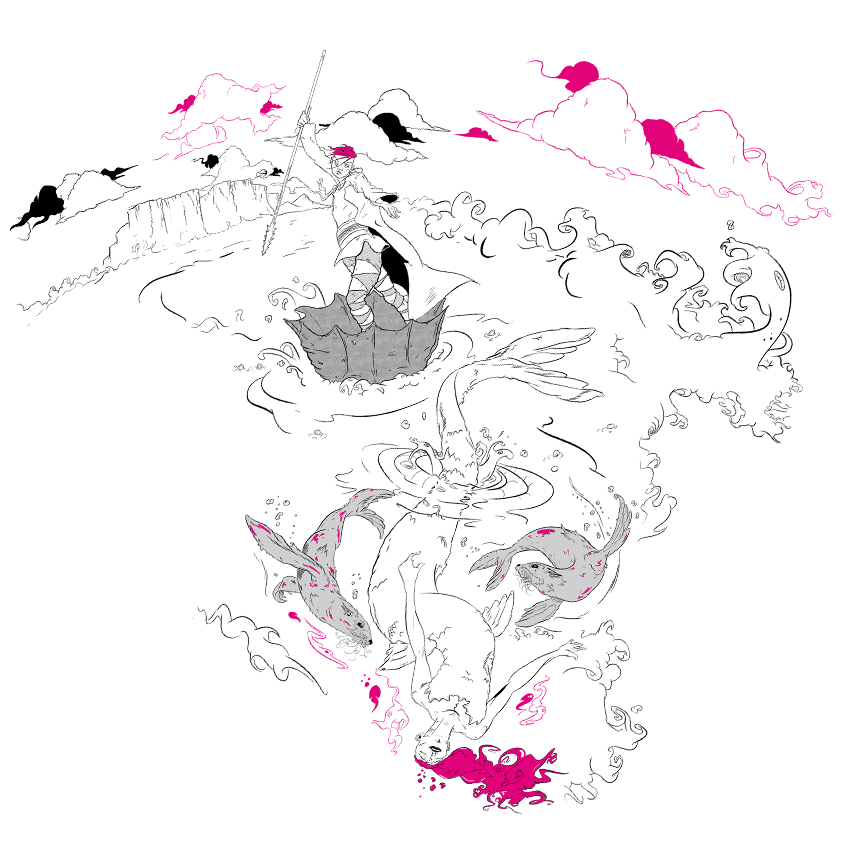
Mesolithic Scotland reimagined by artist John Felix for Dig It! 2017 (© John Felix)
We may no longer use middens as the prehistoric and medieval peoples of Scotland once did, but the word ‘midden’ is very much in use in the Scots language, indeed we still create mounds of refuse in landfill sites today. What might archaeologists of the future determine about our lives from the rubbish we leave behind in these modern mega-middens?
If you’d like to keep reading, discover more examples of why archaeology is about more than precious metals.
Header Image: Midden remains from Morton Farm, Tentsmuir, Fife (© National Museums Scotland)
