Top Five Mesolithic Discoveries in Scotland
Before humans adopted farming around 6,000 years ago, they lived as mobile hunter-gatherer-fishers. As the name suggests, these people lived off wild natural resources such as animals, nuts, and berries. When the thick glaciers of the last Ice Age began to melt across northern Europe around 12,000 years ago, groups of hunter-gatherer-fishers migrated over from mainland Europe and became the first people to inhabit what we today call Scotland. This period is referred to as the “Mesolithic” by archaeologists.
The evidence from the Scottish Mesolithic is sparse in comparison to later time periods because much of the artefacts once owned by the hunter-gatherer-fishers will have decayed over thousands of years. However, you may be surprised to read how much we can still learn about the lives of Mesolithic peoples through the material remains which have survived. Below are my top five archaeological discoveries to get you acquainted with some of the very first humans in Scotland.
Prehistoric Diets: Orasa Shell Middens

Oronsay beads from a midden (© SCRAN/National Museums Scotland via https://bit.ly/3pcycsZ)
Perhaps best described as prehistoric rubbish dumps, Mesolithic shell middens are excellent for archaeological study as the shells create the right chemical conditions for preservation of organic materials that would otherwise easily decay in the acidic soils of Scotland. Though found in several coastal locations, the largest shell middens known were first excavated more than a hundred years ago on the small island of Orasa (Oronsay) in Na h-Eileanan A-Staigh (the Inner Hebrides).
These middens contained a variety of domestic waste which provides us with a window into the resourcefulness of Mesolithic peoples. Besides shells from limpets, oysters, and scallops, the Orasa middens contained bones from mammals, fish, and birds, suggesting that their diet was varied and very dependent on marine resources, although it has been suggested that the limpets found were probably used as fishing bait rather than human food as they are very tough to chew! Also found were various tools made of bone and antler that included a harpoon used for fishing.
The Staosnaig Hazelnut Shells

Charred hazel nuts, © Wessex Archaeology, flickr, CC BY-NC-SA 2.0
Another fascinating find that tells us about how Mesolithic peoples in Scotland survived are the hundreds of thousands of charred hazelnut shells recovered at Staosnaig on the neighbouring island of Colbhasa (Colonsay), also in Na h-Eileanan A-Staigh. This discovery dates to around 9,000 years ago and shows that the first humans in Scotland also foraged extensively for plant foods in woodland areas, as a group of hunter-gatherer-fishers seem to have collected an enormous number of hazelnuts before roasting them in pits.
Charring the hazelnuts in this way would likely have been more than an attempt at adding a nice, toasty flavour to them – it was probably also a way to make them easier to bring on the next journey as the kernels could be ground into a paste, therefore taking up less room in the pot or bag that was used to carry them.
Warren Field: The Beginning of Time?
Though the hunter-gatherer-fishers of Mesolithic Scotland did not leave behind great stone monuments or mounds like their Neolithic successors, we should not see them as unimpressive or less clever – on the contrary, they were sophisticated human beings who observed the world around them in great detail. One archaeological discovery which demonstrates this is the unique site of Warren Field in Aberdeenshire, which may be the location of a lunar calendar.
First discovered in an aerial photograph, the site has been found to contain twelve pits that are aligned with the phases of the moon and would therefore have helped Mesolithic peoples to create a concept of time. This find is extraordinary as it would constitute the earliest lunar calendar known in the world – 5,000 years older than those previously known from Mesopotamia in the region we today call Iraq!
The Orkney Microliths: A Strong Mesolithic Presence

Microliths from Stronsay, Orkney © Hugo Anderson-Whymark
One of the most common archaeological findings from this period are microliths that are typically found in scatters on Mesolithic sites. These artefacts are tiny tools of thin flint that would have been incredibly sharp and therefore excellent for making very fine cuts and incisions, which have led archaeologists to suggest that they may have been used as arrow tips, drill bits, inserts for sickles, or even as tattooing needles!*
They are also very useful to archaeologists as they are unique to this period in Scotland and can therefore be used to distinguish a site as Mesolithic, as well as offer a clue about how big the presence of hunter-gatherer-fishers in the area would have been. For example, the discovery of thousands of flint tools, including microliths, on Orkney confirmed that large numbers of hunter-gatherer-fishers moved across the island as early as 8,000 years ago, long before it was settled by the more well-known Picts and Vikings.
Mesolithic Hikers? Hunter-gatherer-fishers in the Cairngorm Mountains

© University of Aberdeen and the Upper Dee Tributaries Project
Most Mesolithic sites that we know of in Scotland are located in lowlands and along coastlines. Recent exciting discoveries made in the Cairngorms, however, have shown that Mesolithic hunter-gatherer-fishers were no strangers to hiking and that they explored mountainous inland areas, too. In 2021, archaeologists working at the site of Chest of Dee, uncovered evidence in the form of firepits with traces of charcoal in them and large amounts of stone tools. There was no sign of any permanent structures, which would suggest that these are the remains of seasonal camps, where the hunter-gatherer-fishers resided temporarily as they hunted and foraged before moving along.
We therefore have lots of Mesolithic evidence in Scotland that reveal to us the lifeways of the first humans here, and more remains to be found. The recent discoveries in the Cairngorm mountains, for example, are encouraging for finding new Mesolithic sites in upland regions. Perhaps the most exciting discovery that continues to elude archaeologists in Scotland is a Mesolithic burial – finding one would be extraordinary and would greatly add to our understanding of Mesolithic Scotland.
Ready to dig into more from Scotland’s islands? Check out our island archaeological guides.
By Livia Dyring, a Senior Honours Archaeology student at the University of Glasgow. Livia blogs about archaeology and related topics at Follow the Stones.
* Wild Harvesters: The First People in Scotland by Bill Finlayson, Second Edition, 2005 (Birlinn Ltd; pages 34-35).
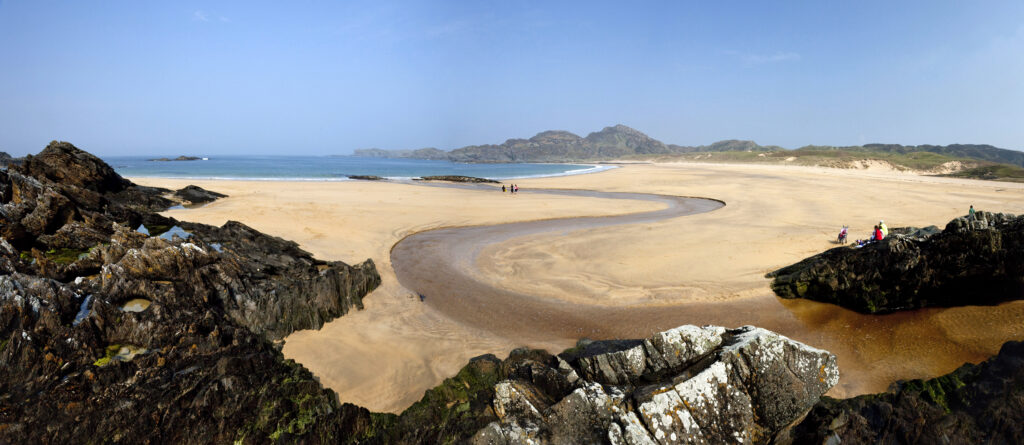
Header Image: Kiloran Bay, Isle of Colonsay, Inner Hebrides (© Paul Tomkins / VisitScotland)
