The remains of Kings and Saints in Dumfries and Galloway
A quiet county with a not-so-quiet history – the following stories behind these seven sites in Dumfries and Galloway might just surprise you.
Falling out with the neighbours at Gilnockie Tower
500 years ago, the lands to the north and south of the Scottish-English border formed a dangerous frontier between two warring nations. ‘Borderers’ were robbed and killed by armies from both sides, crops were burned and properties destroyed.
In order to survive, Borderers resorted to living by their own rules; this attitude was to be the making of the ‘border reivers’ – lawless gangs from all walks of life who plundered livestock, kidnapped, raised fires and murdered.
Gilnockie Tower (also known as Hollows Tower) stands as a stark reminder of these times. A pele tower (a type of fortified tower or keep) built in the 1500s, it was reputedly the home of reiver Johnnie Armstrong. Studies of the tower’s architecture over the years show how every detail was built with defence in mind. At four storeys high, the tower is topped with a parapet enabling a watchful eye over the surrounding territory. A stone slab also marks the spot of a beacon where a signalling fire would be lit at the first sight of incoming raiders on the horizon.
Surveys of the building have also managed to reveal the remains of prehistory in its structure – a stone placed as the floor-slab in one of the doorways has prehistoric artwork carved into it that dates back some 4,000 to 6,000 years. Appearing to have been deliberately placed here as part of the build, it shows that the builders still had appreciation for a bit of artistic flavour amidst their fortifications.
Standing your ground at Caerlaverock Castle
It took the full force of Edward I of England’s army over 24 hours to break through the defences of Caerlaverock Castle in the year 1300, to find only Lady Maxwell and just 60 men holding it.
Caerlaverock Castle was built in the 1270s, and was for nearly 400 years, a home, a prison, a refuge and a target for many. A final 13-week siege in 1640 saw this come to an end, but all have left their traces.
Artefacts recovered from the site represent all aspects of medieval life – jugs to hold their drinks, axeheads for cutting their wood and padlocks to keep trespassers out (or prisoners in). There’s even a nit comb; not just for meticulous grooming, the comb features a heart decoration and might actually be a love token – a heartwarming glimpse into what romance looked like in the medieval period.
Caerlaverock is shaped like a triangle, has its own moat and is even surrounded by a nature reserve hiding the site of an earlier castle dating to 1229 round the back. Research has shown that it was likely a wave of extraordinary storms that caused them to relocate to the current location.
There are few castles that stir the imagination quite like Caerlaverock and you’ll find it hard to leave without pretending to breach its walls one last time.
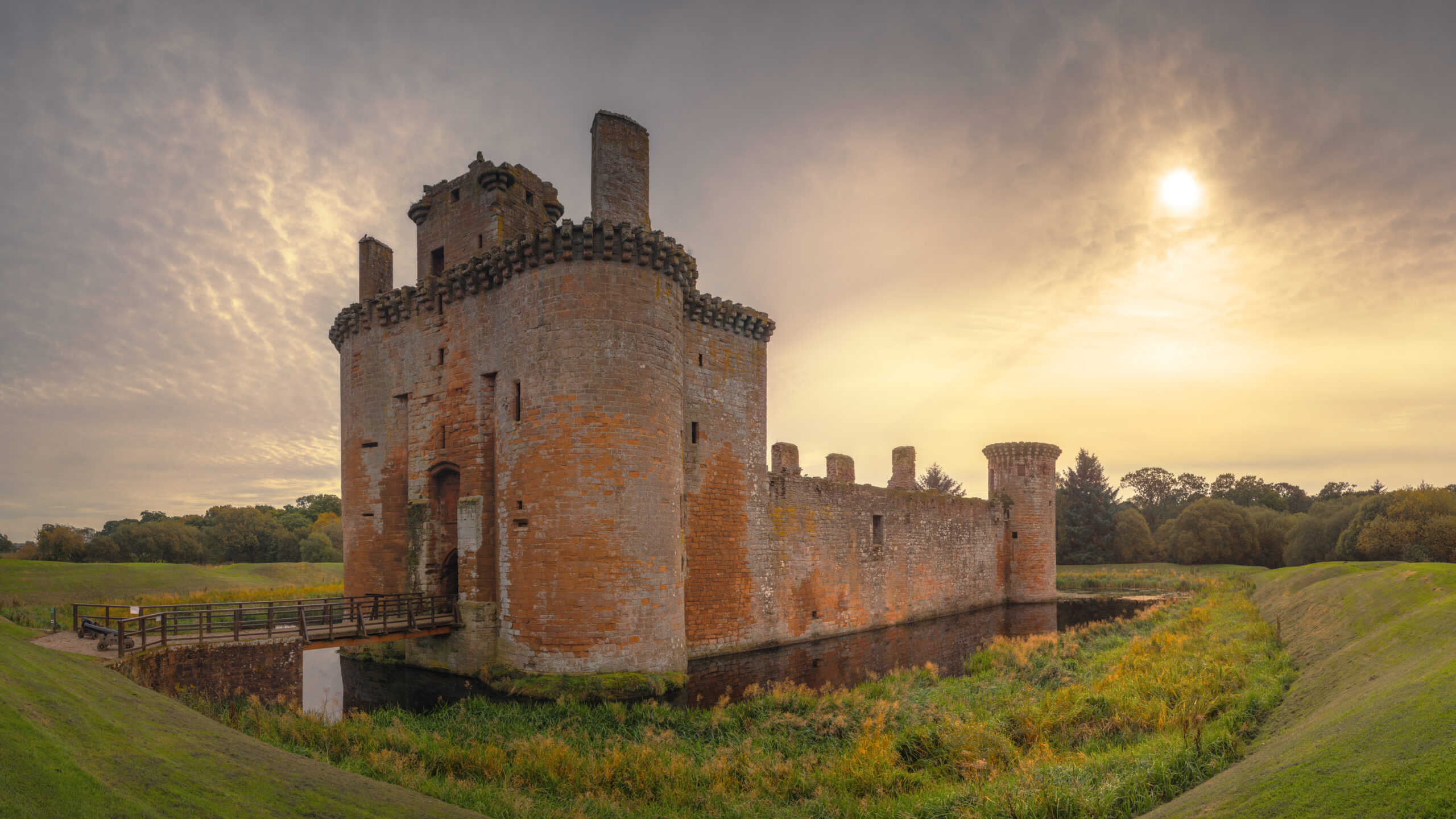
Caerlaverock Castle situated near the town of Dumfries (© VisitScotland / Damian Shields)
Following in the footsteps of a saint to Whithorn
By the 8th century AD, Christianity had spread to become the main religion in Scotland, and it all began at Whithorn.
Around AD 400, St Ninian became bishop at Whithorn, Scotland’s first Christian community where large quantities of coloured glass show trade links as far as the Mediterranean. It was also in this area that Ninian, Scotland’s first saint, was laid to rest.
For the next 1,000 years, Whithorn was to become one of the most important religious sites in the country and thousands of pilgrims would line the roads of Galloway to seek out the healing of St Ninian’s shrine.
Today you can see the ruins of the 12th century priory and Scotland’s earliest Christian monument – the 1,500-year-old Latinus Stone. But below ground sits centuries of archaeology, burials and artefacts which reflect the rich history of this ‘Cradle of Christianity’.
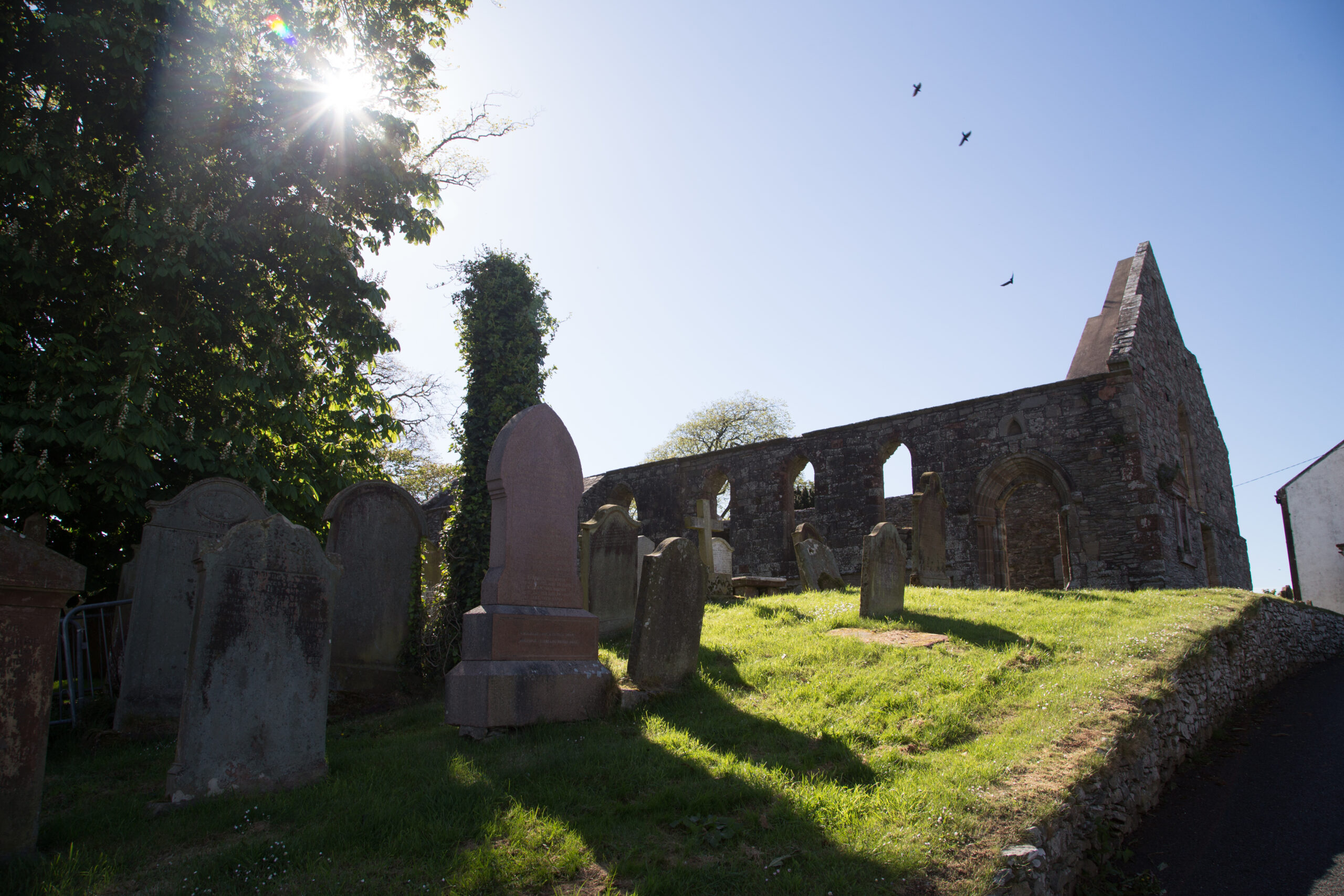
Whithorn Priory (Tom Parnell via Flickr at https://bit.ly/3wLKSdy, CC BY-SA 2.0)
Settling down for the night in Castle Haven
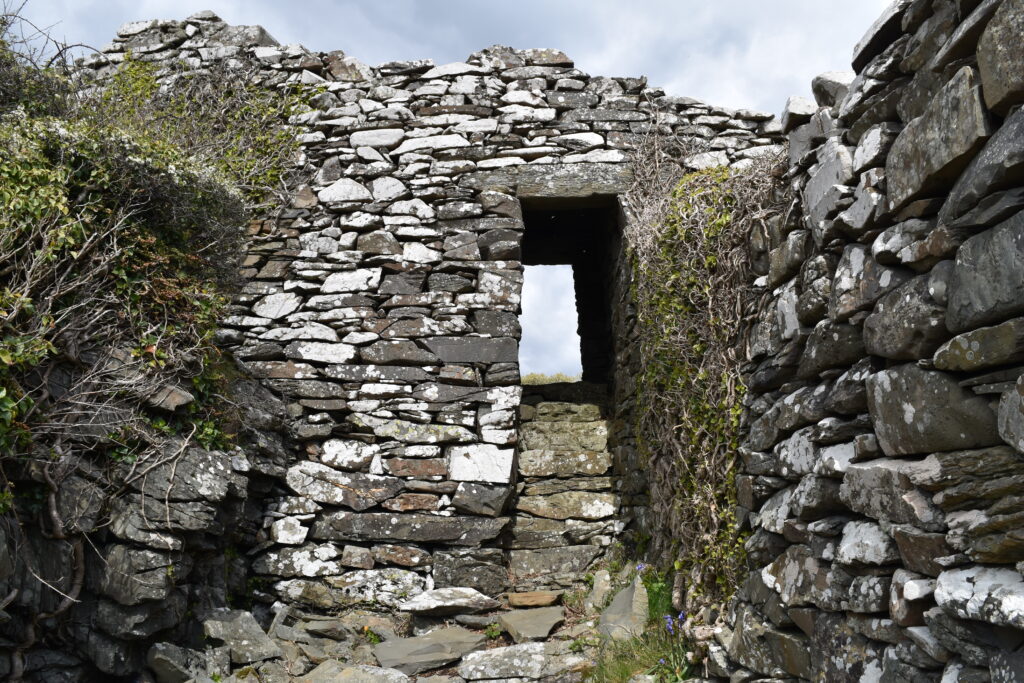
Nestled at the side of a bay along the Galloway coast, and looking like something out of the Secret Garden, sits Castle Haven in the parish of Borgue.
Much older than the castles of Caerlaverock’s time, this D-shaped ruin dates back some 2,000 years to the Iron Age. It’s a galleried dun, a type of fortified homestead with thick hollow walls containing cavities or ‘galleries’, and is an unusual find in this part of the country.
Even more unusual, the dun’s walls were heightened in 1905 by the landowner but thankfully they appear to have faithfully followed its outline.
A drystone structure which displays considerable architectural skill, Castle Haven has also revealed its archaeological clout through its artefacts; bronze spiral finger rings, glass and amber beads, and even a fragment of chain mail recovered during the restoration works mark it as a site of some importance. Some of the finds may even hint at another stage of occupation during the medieval period.
Mysteriously, the initial 1907 report on the works also mentions (almost in passing) that they found a human skeleton lying on the floor of the outer court which surrounds the dun. They say that it immediately crumbled with the exception of the bone of the ring finger, still wearing a heavy iron ring, and a number of teeth.
Not much more is made of this in later writings but it does suggest that Castle Haven still holds its secrets to this day.

Castle Haven (© Claire Williamson)
Releasing Hell at Burnswark
Seven hectares in size and 1,000 feet high, you’ll see Burnswark long before you reach it. By the time Iron Age settlers made it their home around 2,500 years ago there was already archaeology – a cairn (stony mound) marks the spot of a Bronze Age burial which predated their arrival by several centuries.
When the Romans arrived at Burnswark in the 2nd century AD, it’s clear that they weren’t looking to make new friends. They surrounded the hillfort and built a camp to either side, the defences of which you can still see today.
In the southern camp, they built the ‘Three Brethen’ – three circular mounds on which the Romans positioned their ballistae (large powerful crossbows). They hit the hillfort with lead sling bullets, stone balls, arrows and bolts. Excavations have recovered around 700 bullets, while metal-detecting has identified a further 2,000, known to have hit their target mainly on the southern face of the hill. There is even evidence that the Romans were dabbling in psychological warfare – holes bored into some of the smaller lead bullets may have caused a whistling sound as they soared towards their target.
Watching time go by with the Twelve Apostles
Rather oddly, the stone circle known as the Twelve Apostles appears on TripAdvisor, and not everyone’s impressed. To be fair, they appear to be just stones in a field (and to add insult to injury, there’s only 11 of them).
But, as with all ancient sites, there is more than meets the eye. Stand at its centre and you’re standing in the largest stone circle on Scotland’s mainland. Built around 3,000 to 5,500 years ago, it’s second in size only to the Ring of Brodgar in Orkney.
Now look to the northeast, putting the entrance gate to your left. In the neighbouring fields, excavations have revealed the locations of two cursus monuments – large linear enclosures defined by a mix of posts, banks and ditches built for ceremonial or ritual practices. Each measured roughly the length of three football pitches and date back to the Neolithic, over 5,000 years ago.
Look back at the stones in front of you. Now picture them as part of a large ceremonial landscape revered across centuries. What events they’ve borne witness to is anyone’s guess – some stone circles reveal evidence relating to burial practices, while others appear to line up with the sun or the moon, but their exact purpose remains a mystery.
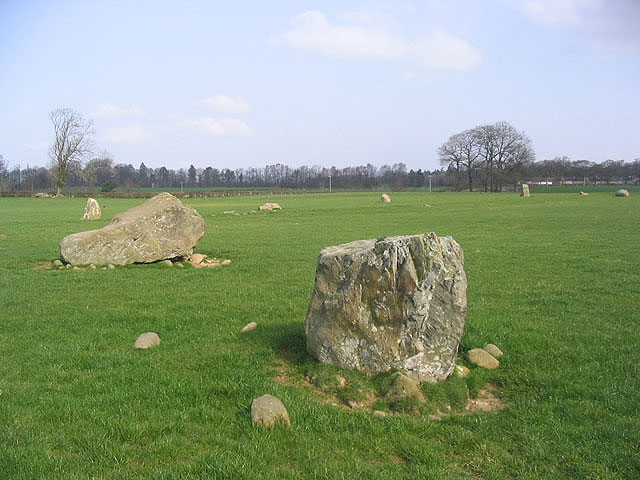
Twelve Apostles Stone Circle (© Walter Baxter via geograph.org.uk/p/385556, cc-by-sa/2.0)
Honouring the dead at the Cairn Holy Chambered Cairns
Up a wee farm track with views out to sea sit the Cairn Holy Chambered Cairns: the remains of two burial sites dating back between 5,000 to 6,000 years ago to the Neolithic, a time when communal tombs were all the rage.
It’s uncertain how many people were buried here but they were in use for centuries. The items buried alongside the dead include a jadeite axe imported all the way from the Alps.
Cairn Holy I is the more elaborate of the two. Stand in front of its stone façade and you’re standing in the tomb’s forecourt where fires burned in honour of the dead.
Not to be outdone though, Cairn Holy II holds its own legend as the burial site of Galdus, a mythical Scottish King who’s famed for fighting the Romans…

Cairn Holy Chambered Cairn (© Claire Williamson)
Whichever archaeological site you find yourself at, look to the stories and the people at its heart – no matter how old they are, there is still much to learn.
To discover more archaeological sites in Dumfries and Galloway (and anywhere in Scotland), check out Pastmap and you’ll find something that will surprise you.
By Claire Williamson, an archaeologist working in the commercial sector who wonders how history ever got a reputation for being boring
Header Image: Castle Haven (© Claire Williamson)