Recording, conservation and display: Episodes in the continuing life of a 3,000-year-old logboat from the River Tay

Ever wondered what happens to an artefact once it’s been discovered? Just like before it became buried, each find goes on its own journey once it’s above ground, and there can be numerous different outcomes for material remains from the past. Some are excavated and allocated to museums, some may be granted to their finder to keep, and sometimes artefacts are even left to remain where they were found.
One of the most exciting archaeological projects in Scotland in recent years – the discovery, excavation, conservation and display of the Carpow Logboat from Perth & Kinross – can give us an idea of some of the steps that may take place in an artefact’s journey.
Discovery
The logboat was first officially reported in 2001, by metal-detectorists who had been exploring the mudflats at Carpow, during a summer of exceptionally low river levels. An archaeological assessment, led by Perth & Kinross Heritage Trust, established that the protruding log was indeed a logboat that was 9m (or 30 ft) long. An initial sample taken for radiocarbon dating returned a date of circa 1000 BC, some 3,000 years ago.

The logboat exposed (© Courtesy Perth Museum & Art Gallery/Culture Perth & Kinross)
Excavation
For two years after the boat was discovered it was sandbagged and monitored to try and off-set any further deterioration of the exposed bow, while a recovery plan was drawn up. In 2006, the boat was excavated over a seven-day period in July and August, taking advantage of low river levels and the year’s lowest tides.
In a thrilling race against those tides, the boat and its associated environmental evidence (including hazel nut shells, peat and tree roundwood) were recorded in situ (meaning where it was found without moving it at all), and the boat, once fully exposed was floated downriver supported by three large, semi-submersed, plastic barrels.
At Newburgh quayside a lifting frame was slowly lowered into place and the boat raised to rapturous applause from the gathered crowd. It was carefully placed onto the back of a large flat-bed lorry and slowly driven down the motorway to Edinburgh, a supporting flotilla of vehicles behind.
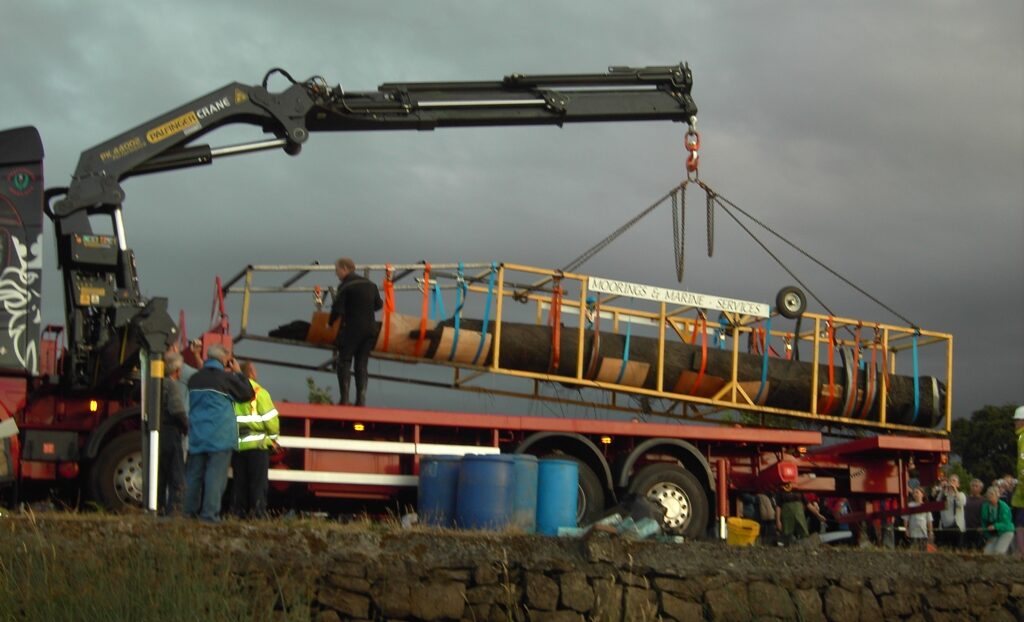
The boat being lifted from the river at Newburgh (© Courtesy Perth Museum & Art Gallery/Culture Perth & Kinross)
Conservation
The lorry took the boat to the National Museums of Scotland Conservation and Analytical Research Laboratory at Granton, Edinburgh. The boat remained there until 2011, initially resting on a supported, tarpaulin sheet with hoses to keep it wet.
To conserve the boat for the long-term, the collective decision was taken to partially impregnate it with PEG (polyethylene glycol) to replace water and give the structure integrity, and then freeze dry it, to shorten that process a little. But at that time, the only freeze drier large enough to take it as a single piece was in Tokyo, Japan – sadly, not a practical proposition.
Instead, the boat was cut into three pieces, each put into its own tank and submersed in a solution of PEG for impregnation, a three-year process.

The beginning and end phases of the boat’s conservation (© Courtesy Perth Museum & Art Gallery/Culture Perth & Kinross)
This was followed by several months of freeze-drying for each section, in the National Museum of Scotland freeze-dryer. This process removed a whopping 588 kg of water.
Differential distorting of the boat sections (where different bits of the boat warp at different rates) occurred when the boat was cut, releasing lots of pent-up tension in the wood and leading to twisting and cracking as it dried. The conservation team innovatively devised a method of correcting this that used flexible heating mats and an adjustable aluminium former (a piece of adjustable aluminium that applies pressure to the boat as it is heated so as to bend it back into shape). This allowed the team to mould the boat back close to its original shape.
Major cracks were then filled with epoxy resin (a particular form of adhesive based on epoxide polymers (organic compounds of oxygen and carbon atoms), before the three sections were then bolted to a stainless-steel frame for support.
Display
During the conservation process the boat was allocated to Perth Museum through Scottish Treasure Trove and a reward of £1,000 paid to the finders. In 2012 the boat was transported to Perth Museum for initial display in a temporary exhibition, The Carpow Bronze Age Logboat, which ran for 12 months. This introduced visitors to three key things: the Bronze Age and logboats, the human context of the logboat in the Lower Tay Valley, and the story of the boat’s discovery, excavation and conservation.
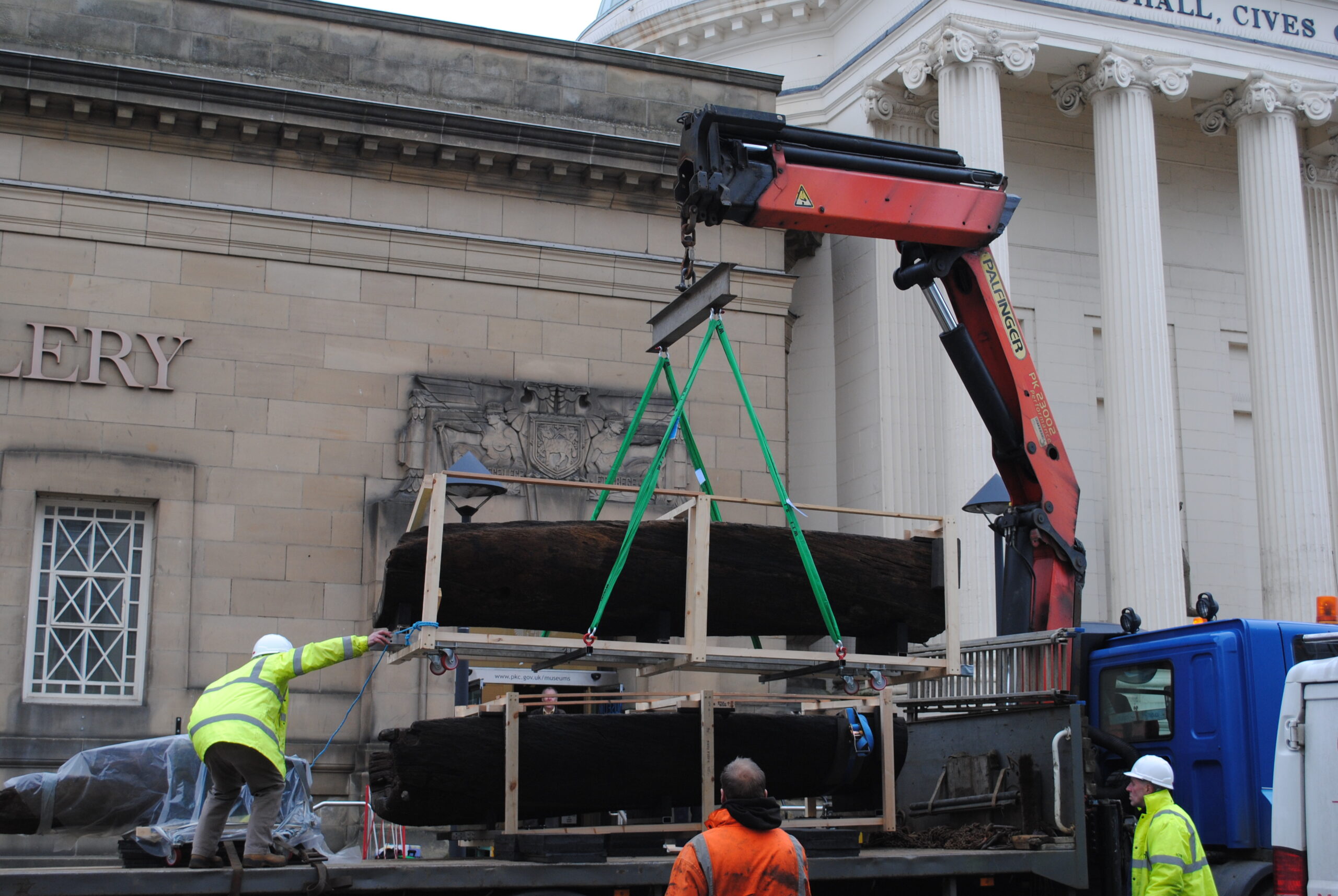
Delivering the boat to Perth museum (© Courtesy Perth Museum & Art Gallery/Culture Perth & Kinross)
Dramatically the exhibition showed, alongside the boat, for the first time anywhere, all the Bronze Age metalwork – including swords, axeheads and spearheads – found in the River Tay and now scattered across different museum collections.
The initial display was followed by a period of at the Glasgow Museums Resource Centre before a return to Perth Museum and display in a newly configured gallery of the area’s archaeology and history.
Now and in days to come
Currently underway is a project to transform the former Perth City Hall into a new museum for Perth and Kinross, telling some of the area’s rich archaeological and historical stories. One of the star objects in that new museum will be the Carpow logboat.
In August 2022, the boat returned to the National Museum of Scotland conservation centre for further reshaping work and crack repairs. The boat will then be installed in a new, atmospheric display evoking the Bronze Age riverine environment. We look forward to welcoming old friends and new ones who are keen to hear the boat’s song.

The logboat on display (© Courtesy Perth Museum & Art Gallery/Culture Perth & Kinross)
By Dr Mark A Hall. Dr Hall is an archaeologist and medievalist employed by Culture Perth & Kinross. Based at Perth Museum & Art Gallery, his Collections Officer role primarily means he looks after the archaeology collections. His main, current focus of attention is helping with the creation of the new displays for the new museum being developed in Perth, in the specially adapted former City Hall.
The logboat on display (© PaulT (Gunther Tschuch), via Wikimedia Commons, CC BY-SA 4.0)
Tweet
Further Reading:
– Strachan, M Hall and T. Skinner 2012 ‘The Carpow Bronze Age Logboat: Excavation, Conservation and Display’, in The International Journal of Nautical Archaeology 41.2, 390-422.
– David Strachan 2010 The Carpow Logboat: A Bronze Age Vessel Brought to Life. Perth: Perth & Kinross Heritage Trust.
– David Strachan (ed.) 2010 Carpow in Context: The Late Bronze age Logboat from the River Tay. Edinburgh: Society of Antiquaries of Scotland.
