Top 10 Artefacts from the Antonine Wall
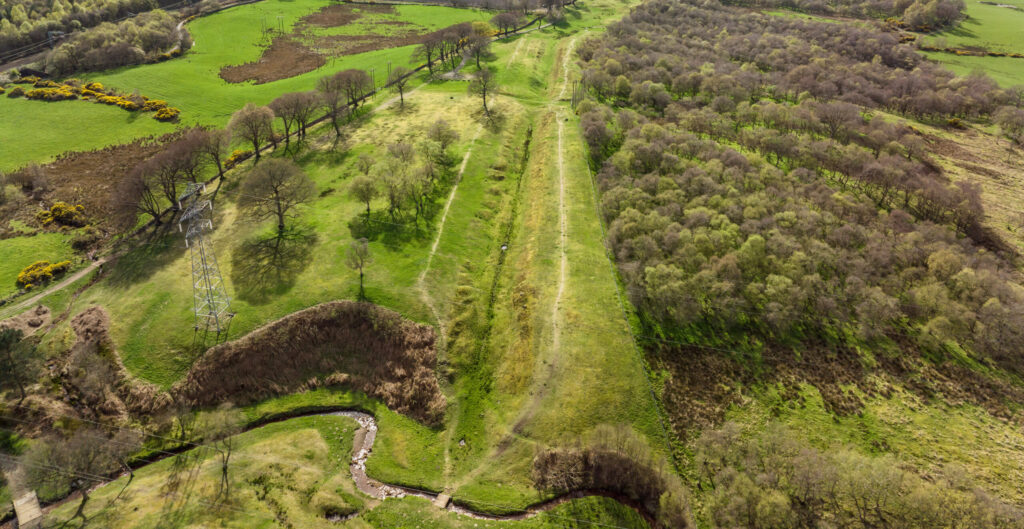
Stretching 62km from the Firth of Clyde to the Firth of Forth, remnants of the Antonine Wall include ramparts, steep ditches, forts and bathhouses, many of which are still visible today. Despite its short period of use by the Roman troops around 1,900 years ago (built in AD 142 and abandoned by AD 165), it’s left a lasting impression on the landscape and history of central Scotland.
To help us understand more about the Wall, a new research framework has been created by experts in Roman archaeology. Frontiers of the Roman Empire World Heritage Site: The Antonine Wall is the latest addition to the Scottish Archaeological Research Framework (ScARF). In addition to providing overviews of subjects and sets of useful and relevant research questions for everyone to use, the framework offers an insight into the archaeology of this incredible monument.
This includes thousands of artefacts which were left behind by the people who lived and worked on the Wall, such as these top picks from ScARF:
Box Flue Tile
This nearly intact box flue tile from Mumrills fort near Falkirk is an excellent example of the incredible technology employed by the Romans long before gas and electric heating were invented.
The open space in the centre of the tiles allowed hot air to travel along their floors and into the walls, heating the house or building efficiently. This is known as a hypocaust system. The incised lattice pattern is to provide a gripping surface for the wall plaster.
This tile was found close to the commanding officer’s house at the fort. The care taken to build long-lasting and well-heated structures is particularly astounding when you remember that the Wall was abandoned after only 20 years of use.
(Falkirk Community Trust 1975-040-002)
Relief Carving of Hercules
Hercules: gatekeeper of…Falkirk?
This well-preserved relief carving depicts a very recognisable figure from ancient mythology. Hercules was the son of Jupiter and Alcmene in Roman mythology, famous for his god-like strength and adventurous nature. He was used as a symbol of victory in the Roman Empire and statues to the god commemorating military triumphs were built as early as 305 BC (around 2,300 years ago).
This carving of Hercules was found in a back garden in the village of Laurieston near Falkirk in 1987. It’s made of local sandstone and was probably attached to a structure such as a shrine. The figure is done ‘in relief’, meaning it was carved directly into a background causing it to stick out from a flat surface like a 3D image. The hero is depicted with a beard, thick locks of hair and a muscular body. He is holding a club in his right hand, as if ready for battle.
(Falkirk Community Trust 2003-011-001)
Unguent Pot
This beautiful pot was found at a Cadder farm in Glasgow and was likely associated with the fort at Balmuildy. At only 12.5cm tall and 7cm wide, this small pot was used to hold unguent, which is a thick, oily substance applied to the skin, similar to an ointment or balm. It may have been used as a soothing treatment for wounds, burns or rashes.
Often depicted as a time of epic battles, artefacts like this offer an insight into the everyday lives of the occupants living along the Antonine Wall over 1,800 years ago.
(Hunterian Museum GLAHM F.1922.609)
Nymph Fountainhead
This sandstone fountainhead from Duntocher fort in West Dunbartonshire takes the form of a water nymph who holds a shell, from which water cascaded into a basin. It was found on or below the floor of the hypocaust room at an extramural bathhouse, meaning it was outside the boundaries of the fort. At 58cm tall, this is a large feature which would have created a decorative focal piece within the bathhouse, in addition to its practical purpose of pouring water into the fountain.
Since bathhouses play such an important role in Roman history and archaeology, this object being found on our doorstep highlights the significant presence of Roman ways of life and culture in Scotland during the occupation of the Antonine Wall.
(Hunterian Museum GLAHM F44)
Cheese Press
Another find from Balmuildy which illustrates an aspect of everyday life is this clay cheese press. The heavy centre piece would sit on top of the curds, with the excess liquid exiting through the small holes, leaving the finished cheese in the main bowl.
This small object (measuring 8cm high and 17cm in diameter) is well preserved, which makes it ideal for understanding the function and careful craftsmanship of this press and gives us an insight into the kind of foods being prepared and eaten by the people at this site.
(Hunterian Museum GLAHM F.1922.602)
Women and Children’s Shoes
Women and children are often overlooked in Roman history and archaeology. These extremely well-preserved shoes place them back in the narrative and highlight the fact that it was not just soldiers who lived in the forts, but also families and extended kin groups.
Both shoes are leather and were found in refuse pits at Bar Hill fort in Twechar in East Dunbartonshire. The adult shoe, measuring 23cm long, has detailed straps and foot-fitting moulded leather. The child’s shoe appears to be a similar design, measuring 15cm long, which would be a child’s size 7 today.
(Hunterian Museum GLAHM F.1936.123)
Dice Shaker
Evidence of games reminds us of the everyday lives of the Roman and local groups living in Scotland during this time.
This wooden box in the shape of a cylinder – also found at Bar Hill fort – was interpreted as a dice shaker. It has a stepped rim, presumably for attaching a lid.
(Hunterian Museum GLAHM F1936.104)
Gaming Board
More evidence of gaming was found at Bearsden in East Dunbartonshire in the form of a fragment of a stone gaming board.
It’s 16cm by 12cm and has a surviving pattern of 3x5cm cells. It was most likely used to play Ludus Latrunculi (translated as ‘the game of little robbers’ – the robbers being mercenaries or hired soldiers). Although it resembles chess or draughts, it’s generally accepted to be a game of military tactics. Counters would have been made from pieces of pottery, glass or small stones.
(Hunterian Museum GLAHM 138032)
Jar with Ashes
Rather than using a gravestone, it was common during the Roman period for the ashes of the poor to be buried with a wooden grave marker or kept in a jar like this one, which was found at Croy Hill fort in North Lanarkshire.
Remains such as these play a crucial role in our understanding of funerary practices during this period.
(Hunterian Museum GLAHM 138055)
Bronze Arm Purse
Roman coins are found abundantly across the UK, featuring the faces of emperors spanning the Roman period. However, it’s rare to find evidence of the purses that they were kept in.
This crescent-shaped arm purse (from the Latin ‘bursa’) was also found at Croy Hill and is crafted out of bronze. It would have been worn on the arm or wrist, and probably concealed under the carrier’s clothing.
(Hunterian Museum GLAHM 138042)
Feeling inspired by these artefacts? Dig into the framework on the ScARF website or visit the Antonine Wall where you’ll find museums, archaeological sites, Roman-themed playparks and more.
By Jennifer Allison FSAScot, Research Officer at the Society of Antiquaries of Scotland (who also coordinate Dig It!). ScARF is managed by the Society and grant funded by Historic Environment Scotland as a key part of its commitment to Scotland’s Archaeology Strategy.
Header Image: The Antonine Wall at Rough Castle © Rediscovering the Antonine Wall
