Magical Beliefs and Practices in Medieval and Early Modern Scotland: Why Does Archaeological Evidence Matter if We Have Written Records?

Written records contain a wealth of knowledge that help us better understand magical beliefs and practices in medieval (AD 400 to 1500) and early modern Scotland (1513 to mid-18th century).
So where does archaeology come into this area of study, and how can it be used with written records to enhance or challenge our current understanding?
What were Magical Beliefs and Practices?
Magic in medieval Scotland (approximately 1,600 to 500 years ago) – and in the context of medieval western Europe – had many facets. Religion, science, and magic weren’t considered distinct categories and what counted as magic could vary from person to person.
Broadly speaking, using magic meant accessing power and achieving outcomes usually beyond human control; this could include healing, protection, locating lost things, attracting good luck, influencing love, and seeing into the future.
Magical practice could include words, actions, and materials, and much of medieval magic drew from religious practices and concepts. For example, saint’s names were often used in spoken charms, and Christian symbols such as crosses sometimes featured on jewellery because they were considered both devotional and amuletic.

Medieval silver brooch (c.1300) with the inscription “IHESUS NAZARENUS” (Jesus of Nazareth), which was believed would protect the wearer from worldly harm (Image credit: Crown Copyright)
What Evidence Do We Have for Magical Beliefs and Practices?
When it comes to learning how magic was understood and practised by medieval people, we have a few key types of information to draw from: historical texts and archaeological evidence.
Historical texts are written evidence of the past that range from letters, wills, bills, and trade documents, to poetry, religious texts, and historical accounts. Following the Protestant Reformation in 1560, local church courts kept detailed records through which magical practice and belief have been identified. Records concerning witchcraft trials from the late 1500s to the 1700s (which include local church court records) have been studied extensively to learn more about magic at that time.
Archaeological evidence consists of material remains such as objects, buildings, human remains and environmental material (like seeds, pollen, and animal bones) which all help to build a more detailed, complete picture of how people navigated daily life.
Magical Carvings
Archaeological and historical sources often overlap when it comes to studying magic in historical periods (periods in which writing systems were in use) because drawing from one can help develop interpretations when evidence is scarce from the other. Archaeological evidence can alert us to magical practices and beliefs that aren’t recorded in writing, or that vary from magical practices described in written sources.
Take, for example, a fragmented flat piece of wood found in the silted-up harbour of Threave Castle, which was built in the mid- to late-1300s on an island in the middle of the River Dee between Kirkcudbright and Dumfries.
This piece of wood was 5cm long and came from a layer of silt dated to the late 1300s to mid-1400s. On one side it was carved with two five-pointed stars (also known as Solomon’s seal or pentacles), while the other side was carved with two simple crosses.
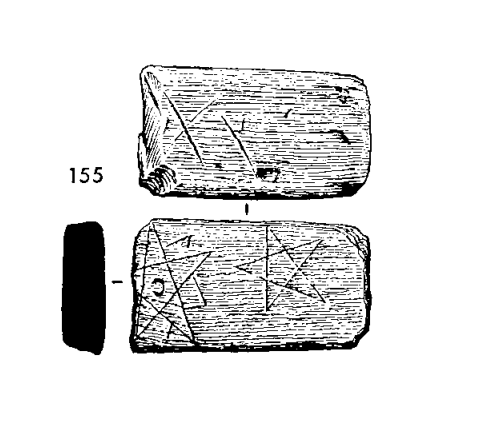
Illustration by John Barber (Good, G. L. and Tabraham, C. J. (1981). Excavations at Threave Castle, Galloway, 1974-78. Medieval Archaeology 25. Vol 25, pp. 90-140. https://doi.org/10.5284/1071656)
Five-pointed stars and crosses are known to have been carved on medieval and post-medieval pottery, walls, and other objects/surfaces in Northern Europe. It’s thought that this was done with magical intent, to harness the protective powers of the symbol, similar to how other Christian symbols and words were used in medieval devotional jewellery and in written charms.
Examples of such charms can be found in a 16th-17th century Scottish manuscript labelled as “GD188/25/1/3”. In this manuscript, the star features in love charms and fairy-summoning charms amongst other instructions for magical practice, showing how it was used for purposes other than protection. For one charm, it’s stated that in order for it to work, the star must be drawn in a certain order amongst the words.
A case of archaeological survival like the fragment of wood at Threave Castle demonstrates how powerful symbols might have made their way to formats and spaces beyond the written page. Scratching these symbols on the piece of wood may have been done to create a protective amulet, or it might have been part of a charm for other purposes (like those featured in the GD188/25/1/3 manuscript).
Given that the fragment was found in silted up layers of the castle’s harbour, we could theorise that it was either an accidental loss or perhaps ritually deposited in the river, which is something that has been recorded in watery sites such as wells, lakes, and rivers all over the British Isles and Europe dating back to prehistoric periods.

Threave Castle within the Threave Estate and Nature Reserve (© VisitScotland / Kenny Lam)
‘Elf Shots’ and ‘Thunderbolt Stones’
Another example of how archaeology provides insight into the facets of magic in medieval and early modern Scotland can be found in possible cases of ‘elf shot’ and ‘thunderbolt stones’.
Elf shot were believed to be weapons made and used by elves or fairies, causing illness when striking a person or animal. Thunderbolt stones were believed to fall from the sky when lightning struck, causing fire and other hazards.
Prehistoric stone tools were identified as elf shot and thunderbolts and sometimes employed as amulets for protection against those threats on the basis of ‘sympathetic magic’, a type of magic based on similarities between problems and cures or preventions.
For example, this arrowhead (header image) was adapted, possibly to be dipped in water for creating remedies, and this arrowhead (pictured below) may have been placed in a burial as a protective amulet.
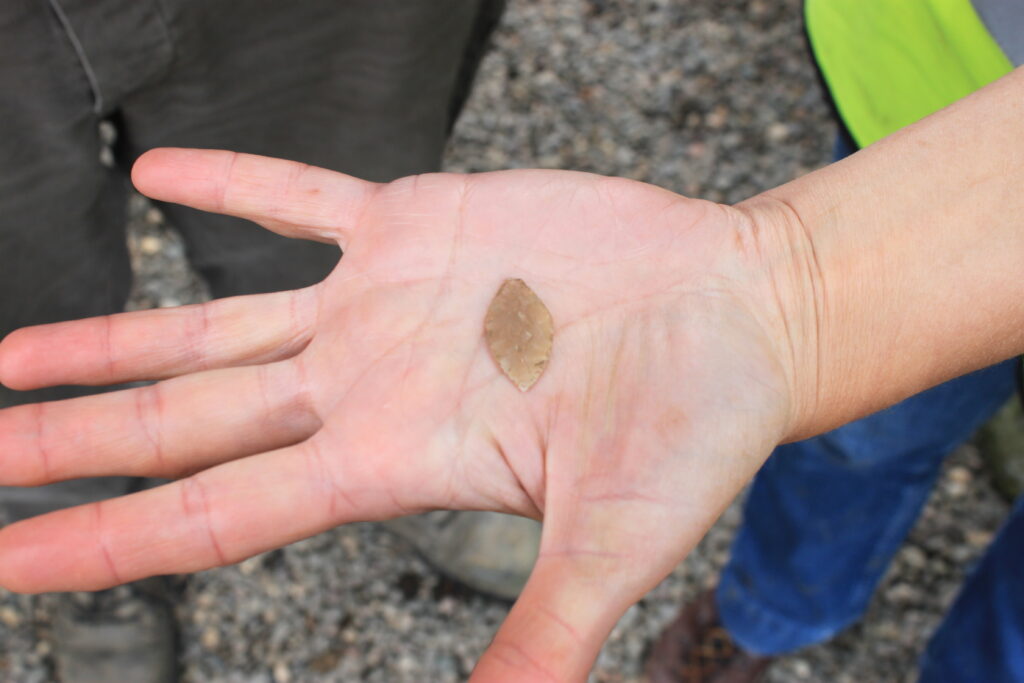
The Neolithic flint arrowhead, called ‘elf-shot’ in Medieval times, uncovered as part of the Kilwinning Community Archaeology Project with support from Historic Environment Scotland and the National Lottery Heritage Fund (© Rathmell Archaeology Ltd.)
The ways in which these objects were used varied from place to place and across time; archaeology offers us a glimpse into those adaptations and mindsets.
Excavations in Perth also unearthed a Bronze Age arrowhead estimated to be about 4,500 years old, found at the bottom of a posthole which would have been part of a large 12th– to 13th-century hall. The arrowhead measures 2.7cm across – about the same width as a fifty pence coin – and is 2cm long. It’s been suggested that it may have been placed within the building foundation as elf shot, extending its amuletic power to the hall’s occupants as well as the structure.
Like the five-pointed star inscription at Threave Castle, this archaeological evidence helps us expand that understanding and address questions concerning how magical beliefs were practiced and adapted.
The locations of the wooden fragment at Threave Castle and the arrowhead in the posthole at Perth make us think about how magic interacted with the places and spaces that people lived in, and how the processes behind the making and placing of things could be important factors in making magic work.

Barbed-and-tanged arrowhead (right) found in a posthole in Perth (Image courtesy of Culture Perth and Kinross Museums & Galleries)
Revealing Hidden Histories
These are things that can often be otherwise obscured or hidden, as written documentation of magic was often produced through the lens of a very narrow portion of society. While there are exceptions, those producing written records in the medieval period and well into the early modern period were usually men, in particular those who had access to education, reading and writing (so were often wealthy or members of the church, or both).
In this sense, archaeology provides further opportunities to explore how other groups in society – those who didn’t have access to formal education and literacy – engaged with magic. Archaeology can lift our understanding off the page, and bring experiences to the forefront that aren’t as easily accessible through written sources alone.

Charm consisting of a leaf-shaped flint arrowhead (© National Museums Scotland)
Want to keep reading? You can find more information about evidence for magical beliefs and practices through the charms collection held at National Museums Scotland.
By Abigail Ford. Abigail is a doctoral student at the School of Archaeology and Ancient History at the University of Leicester. She is researching archaeological evidence of magical practice in late medieval and early modern Scotland.
Header Image: Pendant found by a detectorist in Moray and allocated to Elgin Museum in 2022 (Image credit: Crown Copyright)
