Poisonous Wool, Silk Routes and Fast Fashion: Stories from Scotland’s Archaeological Textiles
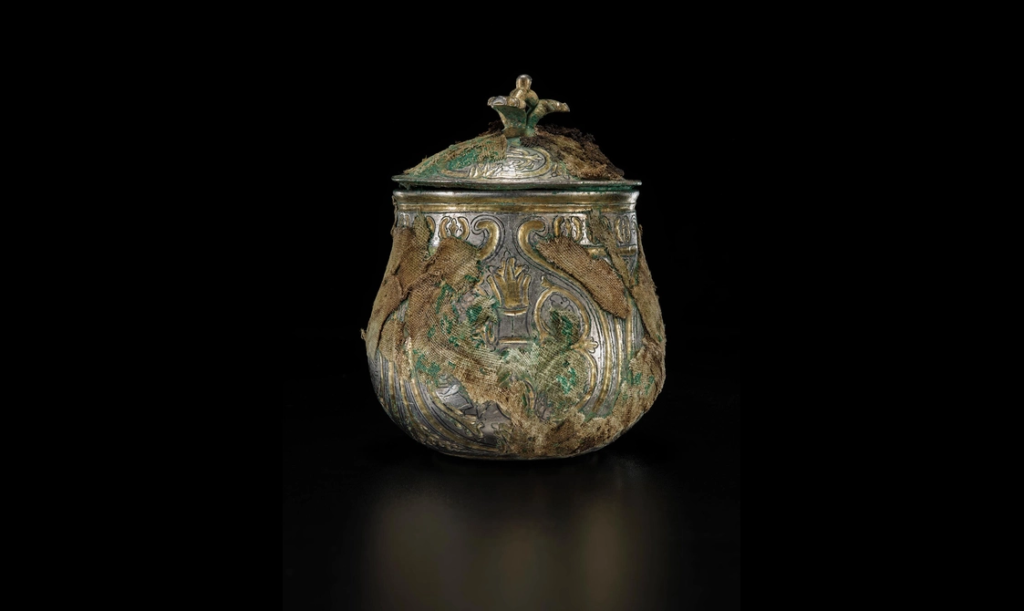
Due to Scotland’s temperate climate, textiles from the past are rare finds for archaeologists. But when conditions are just right and they’ve been preserved, they create a lot of excitement as they can offer many insights into the people who made and wore them.
What are “archaeological textiles”?
On a technical level, a textile is a fabric made from fibre woven on a loom. This involves several technologies. First, textiles are made from fibres like sheep’s wool, silk or linen. These raw materials are worked into yarns or threads (the two words can be used interchangeably) before they’re woven into textiles.
Textiles may be dyed, embroidered, cut and stitched and then used to make clothing, bags, ship’s sails and many other items. As archaeologists, we’re looking for traces of all these different stages of a textile to help us understand materials, people and society in the past.
They’re considered to be “archaeological textiles” when they’ve been uncovered through archaeological excavation. Although it’s worth noting that some textiles survive from the medieval period because they were looked after in church treasuries or stately homes. While these aren’t strictly archaeological textiles, they are early textiles and archaeologists consider them together with ones that have been found through excavation.
It’s important to note that it isn’t just the fabrics themselves that can tell us about textiles and the people who made them. Ceramic and stone spindle whorls (weights on a spindle used to twist thread) and loom weights (to hold warp threads under tension on a loom) survive on a variety of archaeological sites across Scotland. From the medieval period (which began approximately 1,600 years ago in AD 400), texts and pictures in manuscripts or carved on stones also reveal the style of garments and the people who wore them.

Dr Susanna Harris holding replica spindles with ceramic whorls (Image © University of Glasgow)
What type of archaeological textiles are found in Scotland?
Although archaeological textiles are rare finds in Scotland, our acidic soils do sometimes preserve natural fibres, especially wool. The transition from plant to wool fibres (the first textile revolution) occurred around 3,000 years ago in Scotland, as seen by wool textiles found in the hoards from St Andrews in Fife and Carnoustie in Angus.
In fact, we have some of the earliest wool textiles and garments in Britain thanks to the wet and mildly acidic soil at sites such as peat bogs and crannogs. These conditions deny the organisms that would normally break down textiles any opportunity to start the decomposition process.

Scanning electron microscope image of early wool fibres. Look closely to find the scales which identify them as wool fibres (Image Credit: Dr Susanna Harris)
Why do some archaeological textiles survive better than others in Scotland?
As well as preservation in peat and wet places, another common way in which textiles are preserved in Scotland is due to their proximity to metals.
When copper or iron corrosion comes in contact with textiles, like the ones in the Galloway Hoard, they become coated or impregnated with metal salts, a process called mineralisation. Copper turns the textiles green and also creates a poisonous environment, which protects them because they’re inhospitable to microbes that like to feed on them. This is what made the textiles available for subsequent research.
Ancient textiles are very fragile. If metal detectorists find traces of textiles when they dig up metal objects they should disturb the material as little as possible, cover it with soil for protection and contact the Treasure Trove Unit immediately who will organise archaeological specialists to assist in recovery. This is what happened with the Galloway Hoard.
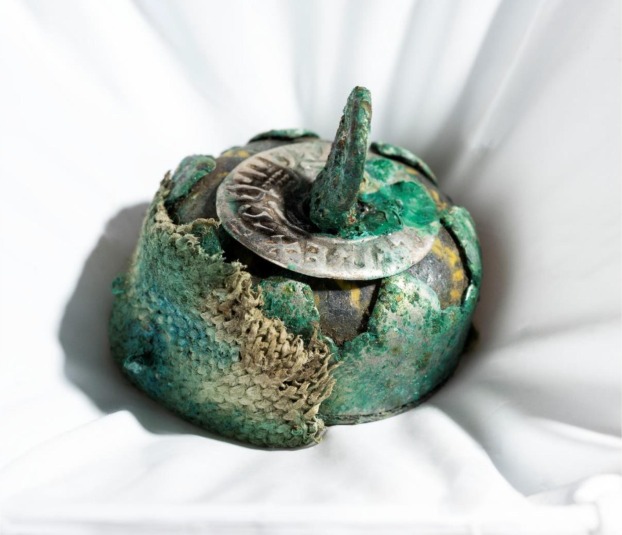
Mineral preserved textile on the metal casing of a composite glass bead pendant from the Galloway Hoard (Image © National Museums Scotland)
Can we learn anything from archaeological textiles found in Scotland?
When we discover archaeological textiles, we can uncover a range of stories about Scotland’s early inhabitants.
From a scientific perspective, textiles are organic materials and contain carbon. That means they can be radiocarbon dated, which is an important technique for dating archaeological finds.
We can also learn a lot from them because these and other organic materials were once the most personal of items and the most visible materials that filled daily lives in the past. Everybody needed clothing and people from all walks of life were defined by their choice, whether it was basic wool or imported silk. Professor Linda Hurcombe from the University of Exeter calls these organic materials the ‘Missing Majority’ because they were once very common, but now they’ve nearly all disappeared.
Working textiles and leather were two of the most important trades in the medieval period. They took many hours and people to produce, and some fabrics were even traded long distances. This means that they can also tell us a lot about Scotland’s medieval economy, including international trade.
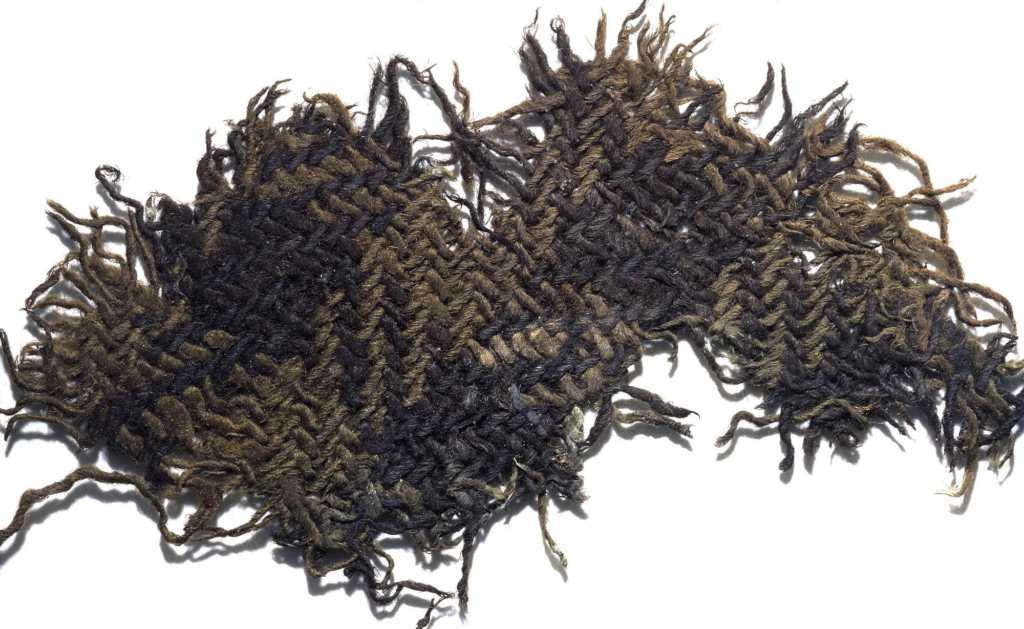
Tartan from Falkirk (Image © National Museums Scotland)
What are some of the most exciting archaeological textiles found in Scotland?
The earliest 2/1 twill textile (a type of weave like tweed) found in Scotland was excavated from Oakbank Crannog on Loch Tay; a radiocarbon date confirms it’s 2,400 years old.
Other famous examples include the earliest tartan in Scotland, which was found at Falkirk in the mouth of a pot containing Roman coins and is thought to be around 1,800 years old, and the Orkney Hood, a child’s fringed cape with a hood which is made from wool and was radiocarbon dated to between 1,400 and 1,750 years ago.
But one of the most thrilling recent discoveries in Scotland has to be the textiles of the Galloway Hoard, which dates to the ninth century (around 1,200 to 1,300 years ago), a period synonymous with the Vikings.
Due to the presence of copper, the perishable materials in the hoard have mineralised – and therefore – textiles, braids and leather are preserved. These were used to wrap and bundle items in groups, including a silver vessel from Iran and a rock crystal jar with gold filigree work. According to National Museums Scotland, this created “the opportunity to investigate the process of gathering and preparing a hoard like never before.”
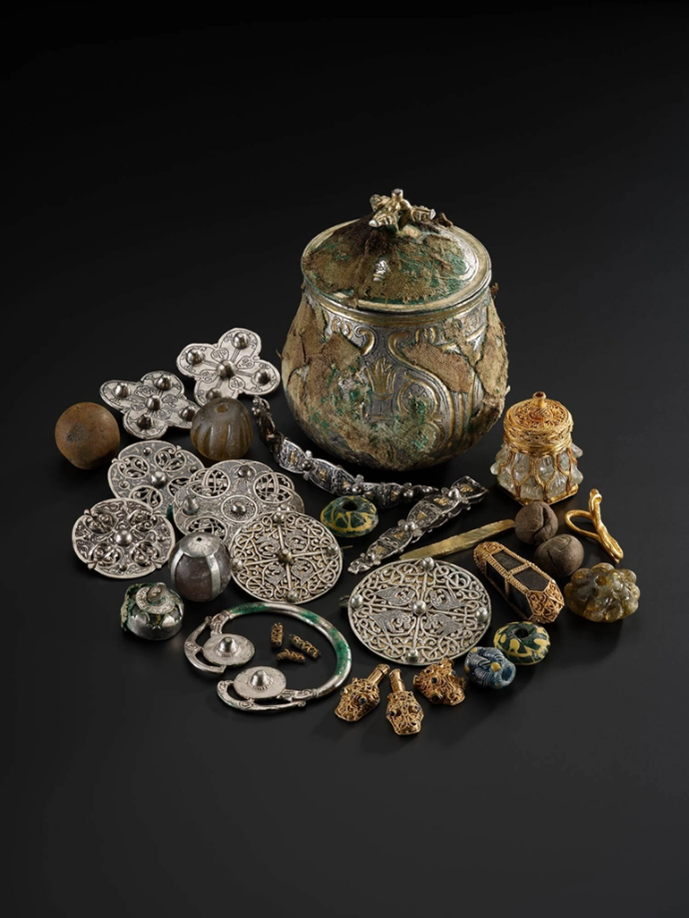
The Galloway Hoard with the silver vessel wrapped in plant fibre and wool textiles (Image © National Museums Scotland)
What makes the textiles from the Galloway Hoard so special?
The textiles from the Galloway Hoard are special because they shine a new light on the Viking Age.
It’s always easy to argue that durable objects like silver bullion (wealth in the form of coin, hacked silver and ingots) or gold were hoarded as stores of wealth because they have metal value. But in the Galloway Hoard, we can see that the metals and other durable items were placed in bundles and wrapped in quality fabrics. This suggests that, like metals, the textiles had value or that the textiles themselves could also be relics.
In particular, the Galloway Hoard silk textile has an exceptional story. It’s a valuable fabric called samite that was worn in the imperial courts of Byzantium (the ancient Greek city that would later become Constantinople and then modern-day Istanbul) and by the church leaders in Rome. Like the silver vessel, it came from a long way away – potentially as far as Central Asia. It was traded along the Silk Routes to reach the far west of Scotland and it’s incredible to think of the people and societies that contributed to this immense journey.
As well as being extraordinary for the period, the Galloway samite is fascinating in the history of the world. You may be surprised to know that the complex loom used to make the samite textile found in the Galloway Hoard is the distant ancestor of today’s computers.
In weaving, the vertical warp yarns are held stationary in tension on a loom while the horizontal weft is drawn through (inserted over and under) the warp thread. Where most textiles have one warp and weft, samite has two warps. These two warps and the way they were set up on the loom were used to create stunning patterns which were mechanically repeated across the fabric.
The patterns on these complex looms operate on a binary system with main warp shafts lifted up or down to control the colour pixels on the surface, while the binding warps are operated separately. The shafts were manually lifted until the invention of the Jacquard loom in the early 19th century. The Jacquard loom used reels of punch cards to operate the binary system, which inspired the first computers.
Can we learn any lessons about “fast fashion” from archaeological textiles?
Textiles of the earliest periods in Scotland’s history were made of natural fibres from plants and animals and most have decayed. Left outside or buried, textiles made from these fibres literally turn to dust!
When we buy fast fashion, we’re often purchasing clothing made from synthetic fibres like polyester and elastane. They derive from petroleum and are a type of plastic. When synthetic textiles deteriorate, they break down into micro plastics which are increasingly recognised as highly mobile and damaging pollutants. That’s quite a scary thought.
Today, innovative methods are being developed to recycle petroleum-based fabrics and make polyester from vegetable oil. But in the meantime, a way to try to break the textile pollution cycle is to reuse and recycle, just like Scotland’s former residents. The Orkney Hood, for example, was recycled from scraps of textile and fancy woven bands, and the Galloway Hoard silk wrapping was cut from a larger textile.
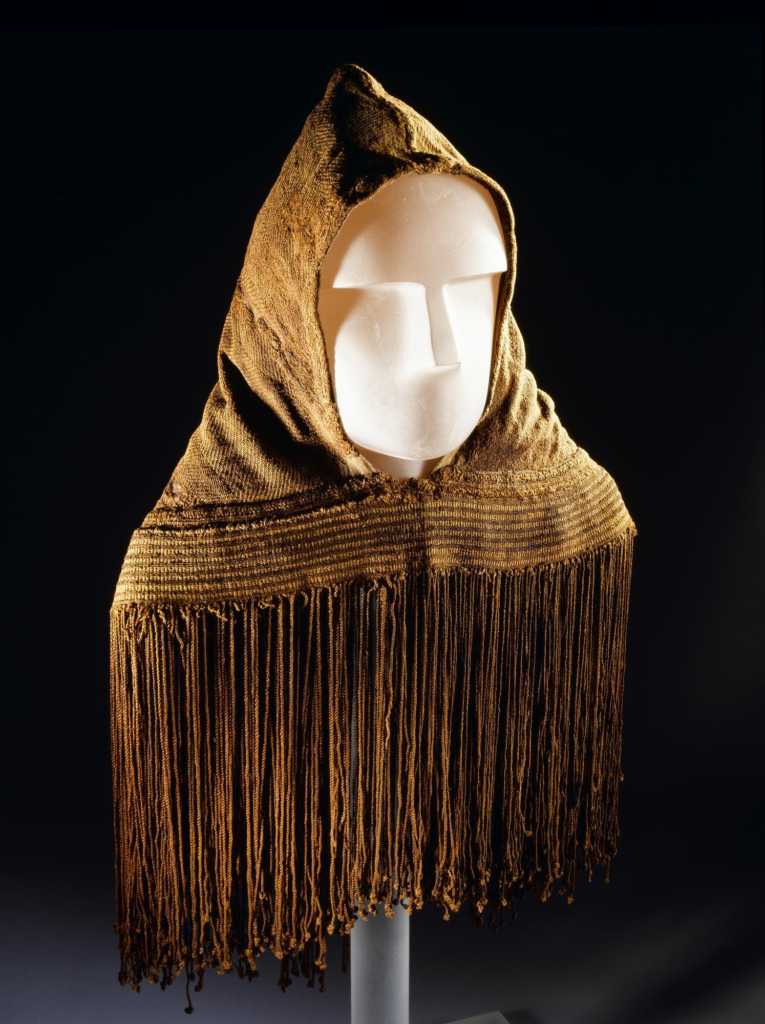
The Orkney Hood made from reused textiles and fancy woven bands (Image © National Museums Scotland)
Want to keep exploring archaeological textiles? Watch Dr Susanna Harris FSAScot’s lecture on ‘Fragile treasures: textiles of the Galloway Hoard’ on the Society of Antiquaries of Scotland’s YouTube channel.
You can also see the Orkney Hood and other early textiles on display at the National Museum of Scotland in Edinburgh, watch weaving on a warp-weighted loom at the Scottish Crannog Centre in Perthshire when the weaver’s hut is in operation (contact ahead for information), find out how to identify textiles in metal corrosion products in this free-to-download article, dive into an overview of Bronze Age textiles in Scotland with the Scottish Archaeological Research Framework (ScARF) or learn more about archaeological textiles in the Archaeological Textiles Review.
By Dr Susanna Harris PhD, FSAScot. Dr Harris is Senior Lecturer at the University of Glasgow and specialises in researching archaeological textiles. Dr Harris is co-investigator of the AHRC Project ‘Unwrapping the Galloway Hoard’ (Award Reference AH/T012218/1) leading the textile analysis in collaboration with National Museums Scotland. She is currently ‘Uncovering Scotland’s Earliest Textiles’ supported by a Royal Society of Edinburgh Personal Fellowship (RSE Reference Number: 3733).


Tweet
Header Image: The Galloway Hoard vessel wrapped in textiles (Image © National Museums Scotland)
