The Archaeology of Scotland’s Natural Larder: Seaweed
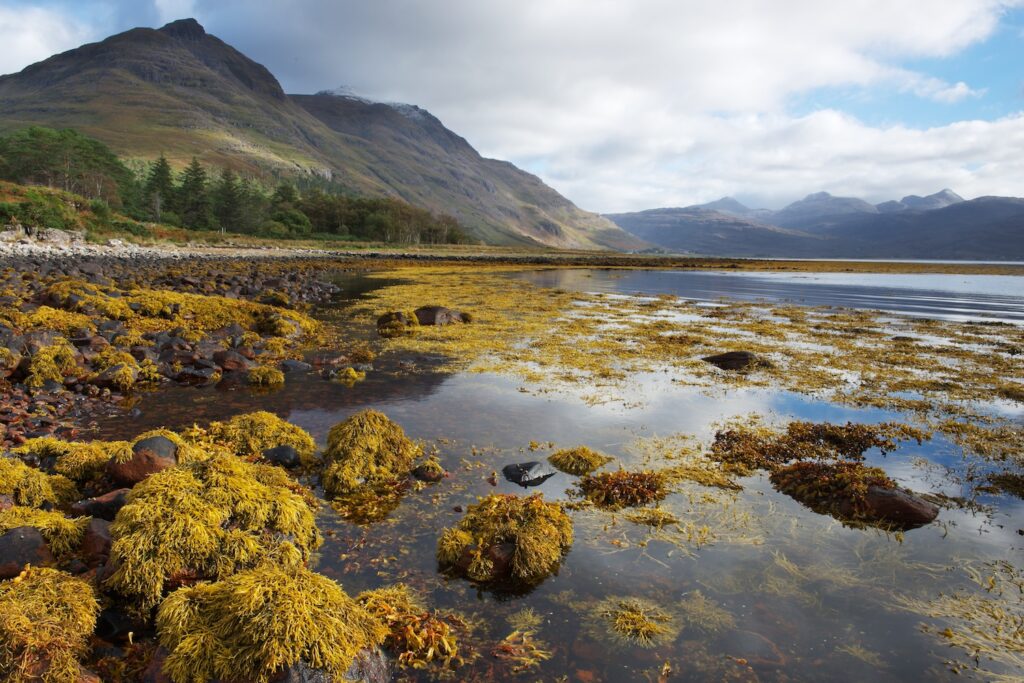
You probably already know about some of Scotland’s most famous dishes, such as haggis, neeps and tatties, but did you know that seaweed was once a popular traditional food too?
Thanks to historical documents, we’ve known for a long time that seaweed was part of many Scottish recipes, but with the development of new analytical methods in archaeological science, the use of seaweed has now been made visible in our distant past too.
Eating Seaweeds in Scotland
Over 400 different species of seaweeds have been identified on Scotland’s rocky shores. They include sea lettuce, dulse, laver, various types of kelp (e.g. tangle, badderlocks, oarweed), and wracks (e.g. bladder wrack, serrated wrack, spiral wrack).
The vast majority of these seaweeds can be eaten (with just one poisonous variety to watch out for), though some are tastier than others. Among the most popular are dulse and the laver species (Porphyra spp.). Laver is used to make Welsh laverbread, but also Japanese nori sheets (the seaweed on the outside of sushi rolls).
While foraging for seaweeds isn’t a widespread practice in Scotland today, several historical accounts show that they were commonly eaten in the Highlands 300 years ago. Seaweeds were eaten raw as salads, boiled and served with butter, included in thick oat broth, and made into a paste to spread on bannocks (traditional Scottish flatbread). In the 19th century, you could even buy dried seaweed from street vendors as a quick snack (particularly in Angus, Fife and Lothian).
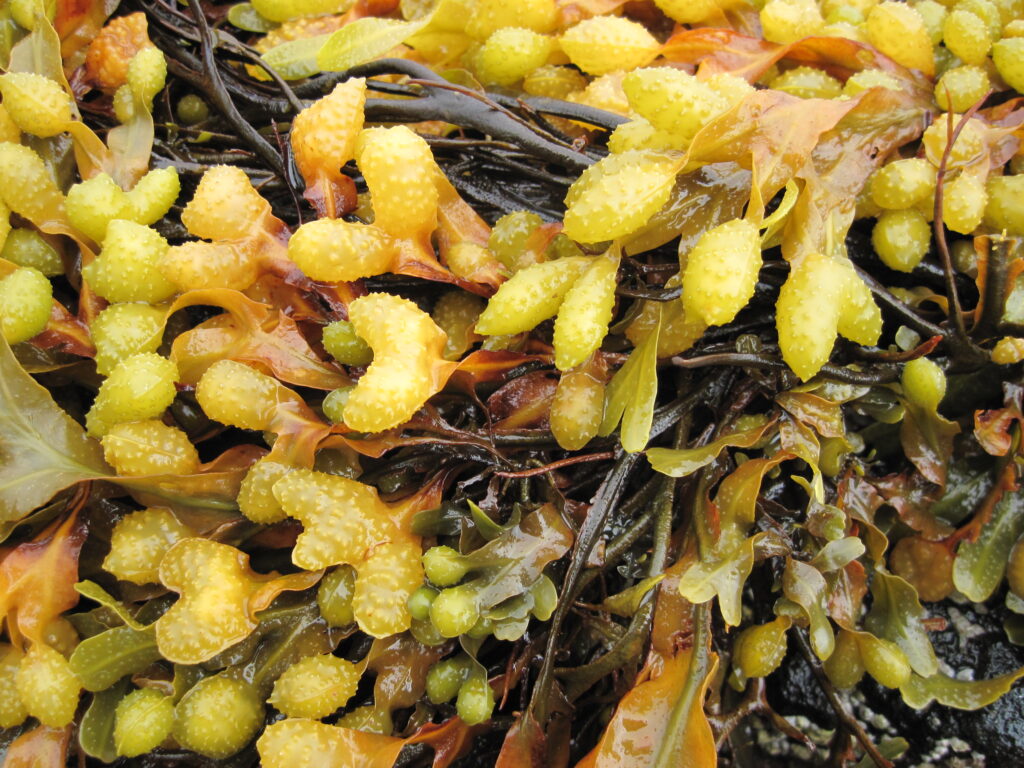
Spiral Wrack (Fucus spiralis) (© Haycutter via Flickr at https://www.flickr.com/photos/86933404@N00/6080695925/, CC BY-NC-ND 2.0)
How Can We Study Seaweed Use in the Distant Past?
It’s been difficult to study seaweed use in archaeological contexts, because seaweeds decompose very easily and quickly. This is also a problem for studying other plant foods in archaeology, which often only preserve through charring.
When crops like barley or lentils are preserved, it’s usually clear they were grown for use as food. In contrast, seaweeds can be used for many different purposes: as human and animal food, but also as fuel for fires*, as fertiliser**, as roofing and insulation material, as a dye, and even to make fishing lines. So the presence of seaweed at an archaeological site – a rare occurrence by itself – doesn’t directly indicate that seaweed was eaten.
Currently, the best archaeological method of identifying the use of seaweed as food lies in the analysis of hardened dental plaque. During life, dental plaque can entrap tiny bits of seaweed and their biochemical marker compounds (specific molecules that can be linked to seaweed). If the plaque isn’t cleaned off, it hardens and can preserve the trapped seaweed material for thousands of years.
Today, the plaque can be dissolved in a laboratory, and the trapped seaweed remains can be identified using a microscope. Dental plaque can also be analysed by mass spectrometry (a technique that identifies chemical compounds by measuring the mass of their molecules) to find out if it contains biochemical marker compounds characteristic of seaweed.
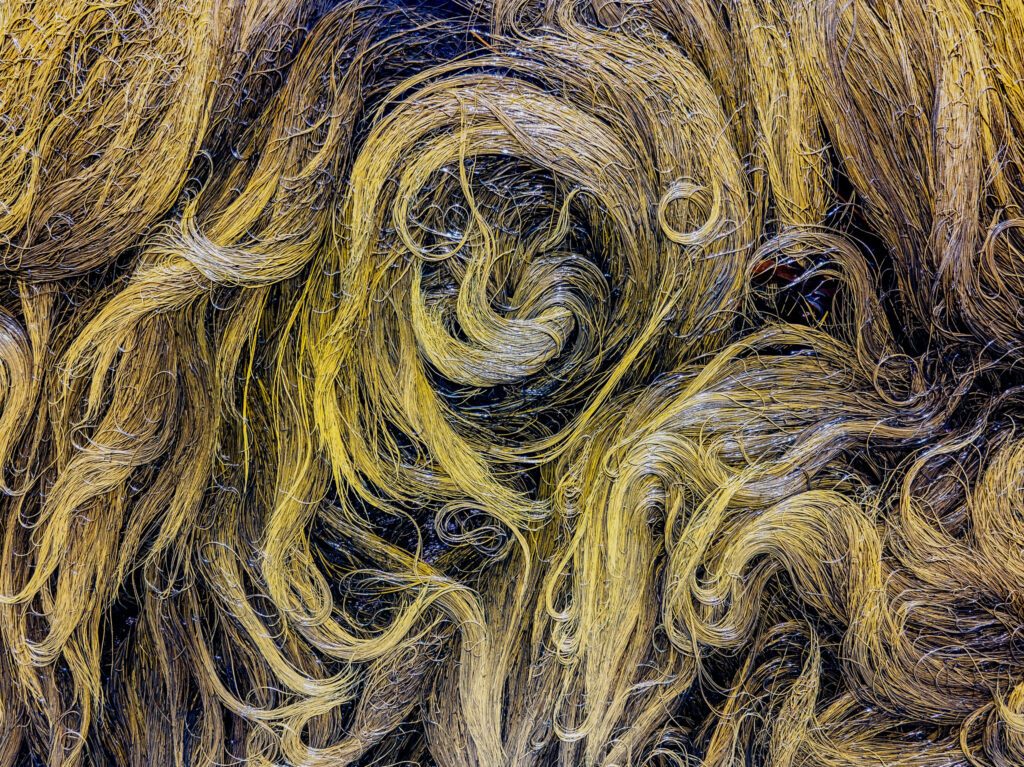
Mermaid’s Hair seaweed from Eilean nam Muc (Isle of Muck), Na h-Eileanan A-Staigh (Inner Hebrides) (© Siegfried Makedanz via Flickr at https://www.flickr.com/photos/simaron/, CC BY-NC 4.0)
What’s the Archaeological Evidence for Seaweed as Food in Scotland?
Analyses of hardened dental plaque have shown evidence of seaweed consumption in two teeth from Distillery Cave in Oban in Argyll & Bute and eight teeth from Isbister Chambered Cairn in Orkney. All of these are from the Neolithic (between 4,500 and 6,100 years ago). This shows that even when farming was introduced, people in Scotland were making use of naturally growing seaweed. Future studies of dental plaque will likely find much more evidence of seaweed consumption in this period and later eras.
Apart from dental plaque, the isotopic composition of tooth enamel can also reveal whether seaweed was eaten. This method works by measuring the ratios of carbon atoms of different weights (isotopes) in the enamel, which reflect the animal’s diet during the time the tooth was forming.
Isotopic analysis of over 100 Neolithic sheep teeth from Orkney, for example, showed that more than half of the analysed sheep ate seaweed. It seems that in Neolithic Orkney at least, seaweed was an important winter fodder when fields on land were exhausted. Today, sheep on North Ronaldsay are renowned for eating seaweed, and their meat is sold as a delicacy in restaurants in London.
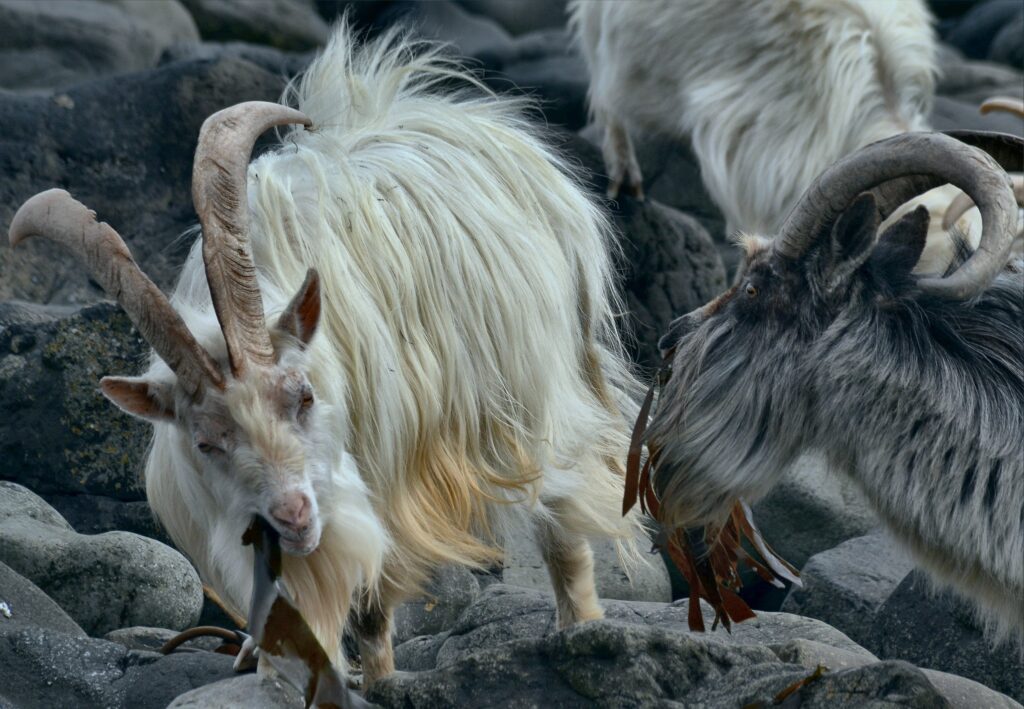
Feral Goats eating seaweed on Muile (Mull) in Argyll (© stuart anthony via Flickr at https://www.flickr.com/photos/stuant63/39488821560/, CC BY-NC-ND 2.0)
Benefits of Seaweed Consumption
In the early 18th century, the red seaweed dulse was used to treat headaches, constipation, and diarrhoea. Seaweed was also fed to animals to remedy stomach problems†. Present-day studies have shown that moderate seaweed intake can indeed improve human and animal gut health.
However, some seaweeds (particularly the Japanese seaweed hijiki) naturally contain high amounts of arsenic and iodine and so should be avoided. Care should be taken not to eat stranded seaweed from polluted areas, instead sticking to fresh harvests of the more palatable species from clean areas.
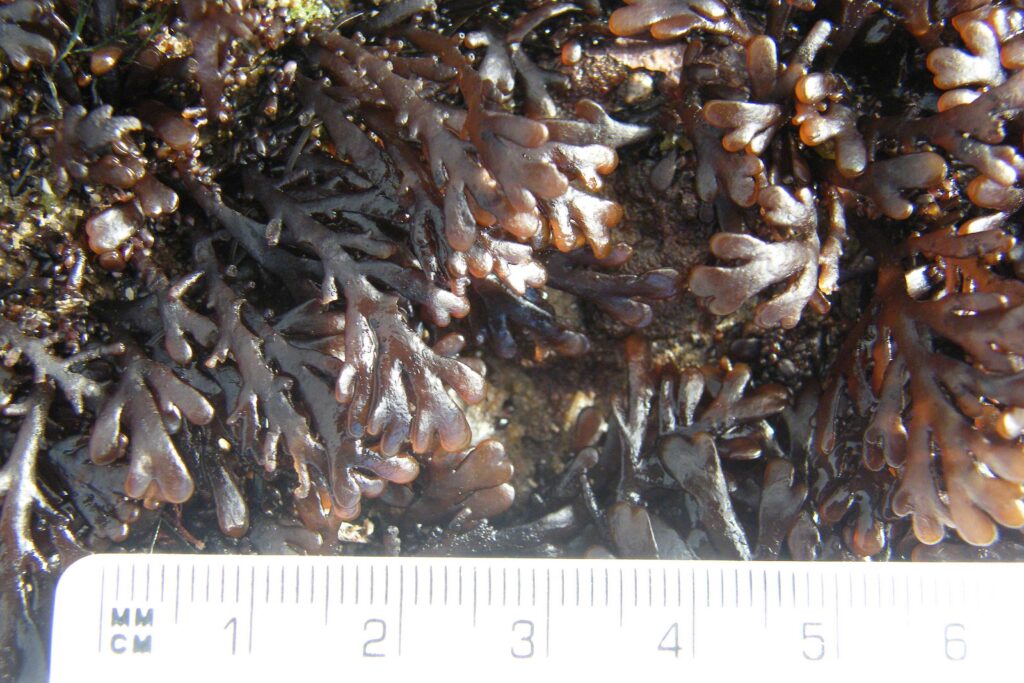
Osmundea (© Mike Hosken via WikiCommons at https://commons.wikimedia.org/wiki/File:Osmundea.JPG, CC BY-SA 3.0)
The Kelp Ash Industry
In the 18th century, a large industry sprang up in Na h-Eileanan Siar (the Outer Hebrides) and Orkney, and other parts of Scotland, involving the burning of seaweed and selling its ash. The type of seaweed used in this industry was kelp, large brown seaweeds that grow on underwater rocks from the low tide zone downwards all around Scotland’s coasts. The ash was used mainly to manufacture soap and glass. A large profit could be made, but the earnings were mainly kept by the landowners, rather than their tenants who were damaging their health by burning seaweed.
An abrupt end was put to the Scottish kelp ash industry when peace was made after the Napoleonic Wars (1803 – 1815) and cheaper ash could be bought from abroad. The remains of many kelp-burning pits, drystone walls for drying kelp, and abandoned crofts can still be seen on the rocky shorelines today.
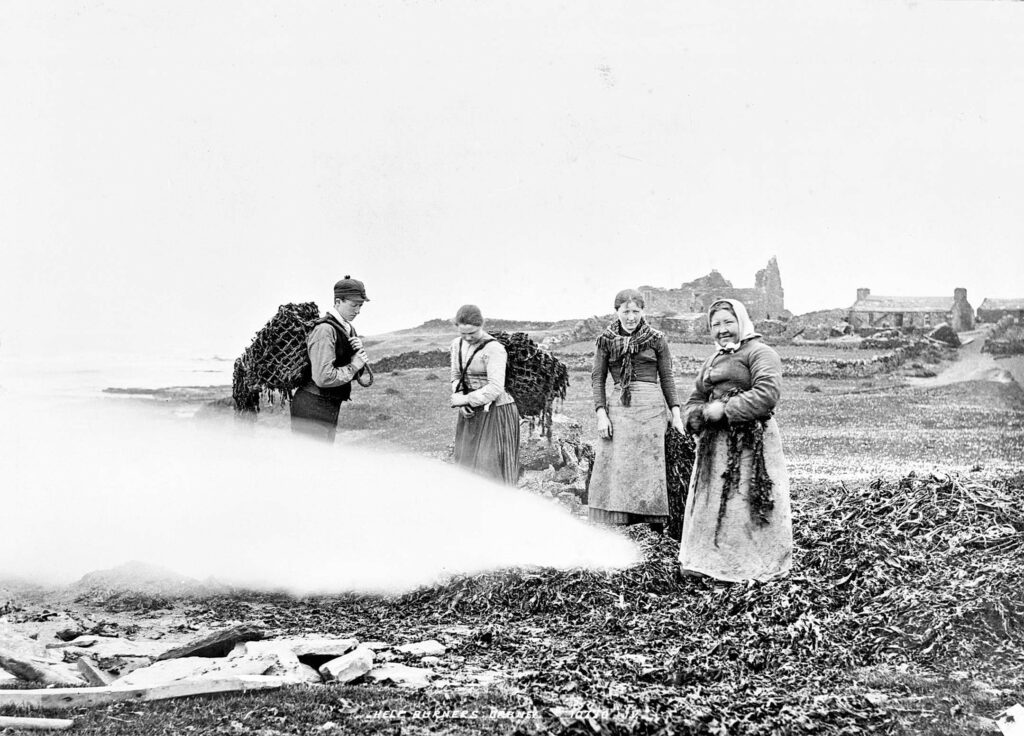
Kelp burning, Orkney c.1889 (From the Dr Isabel F. Grant collection gifted to Edinburgh Central Library, reproduced with kind permission from Highland Archive Centre)
Seaweed as Fertiliser
Seaweed was a very common fertiliser in coastal areas of Scotland from at least the 16th century, before the boom of industrial fertilisers in the 20th century. Unlike animal manure, seaweed was available even to the poorest crofters who didn’t have animals of their own. Even today, seaweed extract is sold as fertiliser, but seaweed collected directly from the shore can be just as effective.
Archaeologically, it’s very difficult to find evidence of the use of seaweed as a fertiliser. After its decay, it leaves little trace in the soil. Considering current knowledge of the earliest farmers, who have been shown to use animal manure as fertiliser, it’s reasonable to assume that seaweed was used as a fertiliser in Scotland from the Neolithic period onwards.
Seaweed in Modern Society
Seaweed grows wild naturally, without need of fertiliser or watering. Unlike some other natural resources, many seaweeds can also be harvested in winter, when crops grown on land are failing. Being naturally abundant, it’s no surprise that seaweeds have been used throughout the ages for varying purposes.
Today, seaweeds are important in Scottish industries as food additives (e.g. as a gelling agent in ice-cream), and in beauty products, and they’ll likely become even more important in the future (e.g. as part of bioplastics and biofuels).
Seaweed harvested in Scotland today is mostly wild-growing, and its careful harvest is sustainable. With rising demand, seaweed farms may also become common in Scotland, as they are in parts of Asia. As research into seaweed use in the past continues, archaeological evidence is reminding us to make use of local, sustainable food sources which are better for the environment.
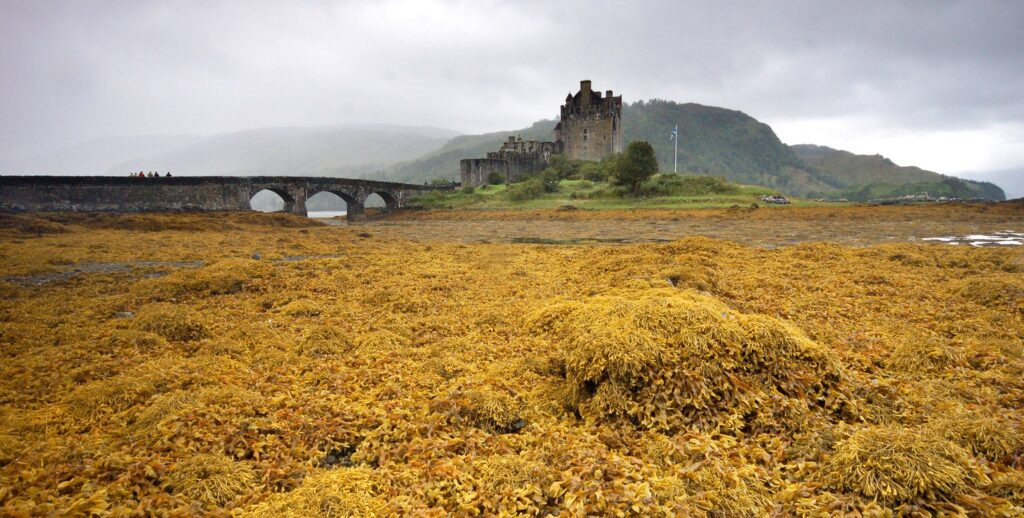
Eilean Donan Castle in the Highlands surrounded by seaweed (© Paul Stevenson via Flickr, at https://bit.ly/4sEsP6A, CC BY 2.0)
By Dr Magdalena Blanz, MChem, who was awarded a PhD by the Orkney Archaeology Institute (University of the Highlands and Islands) in 2020 for her research on seaweeds as food, fodder and fertiliser. Since then, Magdalena has specialised in reconstructing past people’s and animals’ diets using stable isotope ratio analyses, in addition to developing further methods of studying the use of seaweed in archaeological contexts.
* Berry, R.J. (1985). The Natural History of Orkney. London: Collins
** Fenton, Alexander. 1987. “Country Life in Scotland – Our Rural Past.”
† Fenton 1997 wrote that seaweed was fed as a remedy to inflamed stomachs of lambs that ate frosty grass in the Scottish Northern Isles (Fenton, Alexander. 1997. The Northern Isles: Orkney and Shetland. East Linton: Tuckwell Press).
Dig into articles on deer and shellfish to learn more about the archaeology of other Scottish natural resources.
Header Image: Seaweed at Loch Torridon (© Steve Schnabel via Flickr at https://www.flickr.com/photos/15572139@N07/10629312933/, CC BY-NC-ND 2.0)
