‘Not all Early Medieval Carved Stones are Created Equal’: A further assessment of the Conan Stone, a Class II Pictish Cross-slab
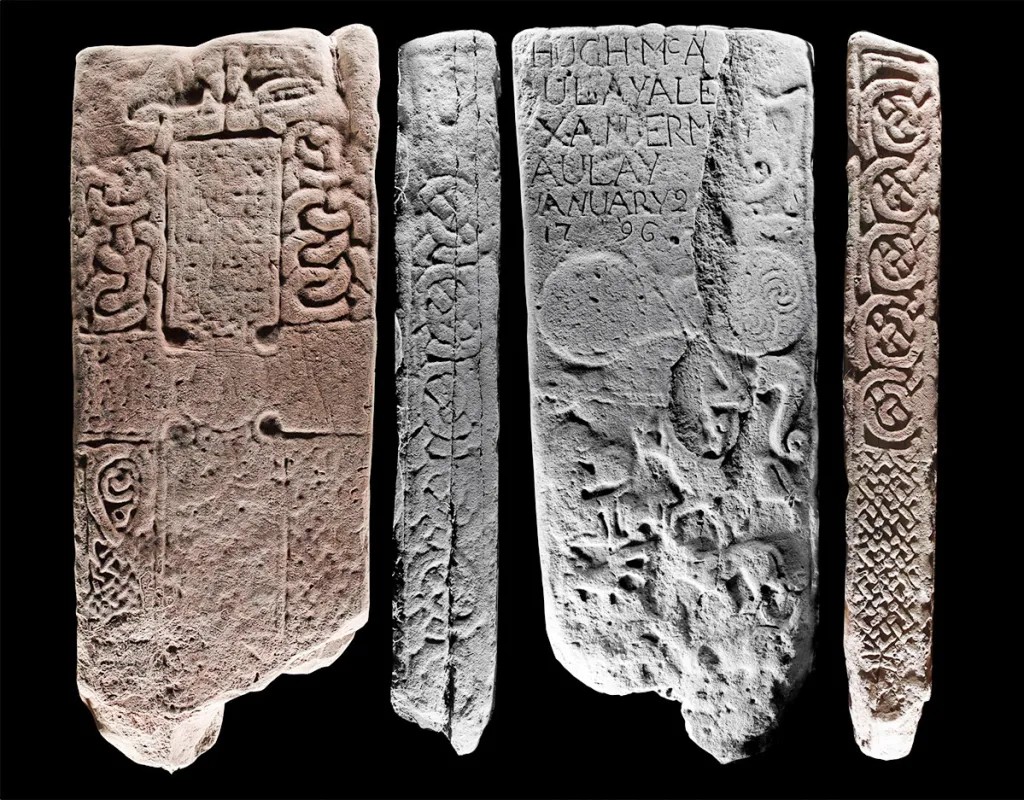
Michael Zambon, who is undertaking an MRes with UHI will talk about his research on the Conan Stone – a Pictish cross-slab discovered near Conon Bridge in 2019 – at this North of Scotland Archaeological Society (NOSAS) event.
The discovery of the Conan Stone by the North of Scotland Archaeological Society (NOSAS) near Dingwall, Ross and Cromarty in 2019 has been described by a leading early medieval art historian as ‘a uniquely significant western extension of the prestigious Pictish symbol-bearing relief sculpture of Easter Ross’ in the Scottish Highlands (Henderson, 2019). Drawing on data from the Early Christian Monuments of Scotland (Allen and Anderson, 1993a;1993b) and other inventories of Pictish stones, a quantitative assessment of a sample of complete, near-complete and fragments of Class II cross-slabs in Scotland was conducted to compare the symbols, figural elements, beasts and ornamentation on the Conan Stone to those found on stones from other areas of Pictland. The goal of the project was to situate the Conan Stone within the development of this ‘transitional group’ of early medieval monuments and determine whether there are greater connections, both structural and stylistic, to stones from either North or South Pictland.
The frequency of the monuments’ structural and decorative elements was tested using a Chi-Square Test of Independence and showed no significant patterning between North and South Pictland. Attention in this thesis was directed towards the often-overlooked and under-studied ornamentation that decorated the background of the cross-slab and infill of the cross. Drawing on Adcock’s observations of interlace (1974), the sculptured ornamentation on the Conan Stone was determined to be of an ‘intermediate maturity’. Just as importantly, the finding of this stone raises questions as to how new material culture can ‘reshuffle’ our current understandings of these monuments rather than simply placing them within established ‘conceptual’ boxes. Finally, using the framework of a ‘migration of ideas’ (Michelli, 1993) the author advocates for a new perspective that views these monuments as ‘silent’ witnesses whose carved surface provides evidence about the movement of ideas that circulated during the early medieval period and influenced the development of this iconic art form in Scotland.
For more details on the stone and its discovery, read the NOSAS blog post.
While Dig It! takes every opportunity to ensure that this information is accurate, we advise that you contact the event organiser before attending the event to avoid disappointment. As “39% of transport emissions come from cars” according to Net Zero Nation, Dig It! also encourages you to walk, wheel, cycle or use public transport to arrive at this event if possible.
Accessibility Information
- Disabled toilet
St Ninian's Church Hall, Culduthel Road, Inverness, IV2 4AN
Thursday 19 March 2026 @ 7:30pm
Price £3 (free for NOSAS members)
Uncover More
Keep Exploring
