Top Four Finds from Scotland’s Playing Fields
You may already know that the world’s oldest football was found in Stirling Castle, but what happens when archaeologists dig deeper into Scottish sports?
Bronze Age spearhead in Angus ⚽
In 2017, a 3,000-year-old bronze spearhead decorated with gold was uncovered at Carnoustie during an excavation of land which was due to be turned into two football pitches.
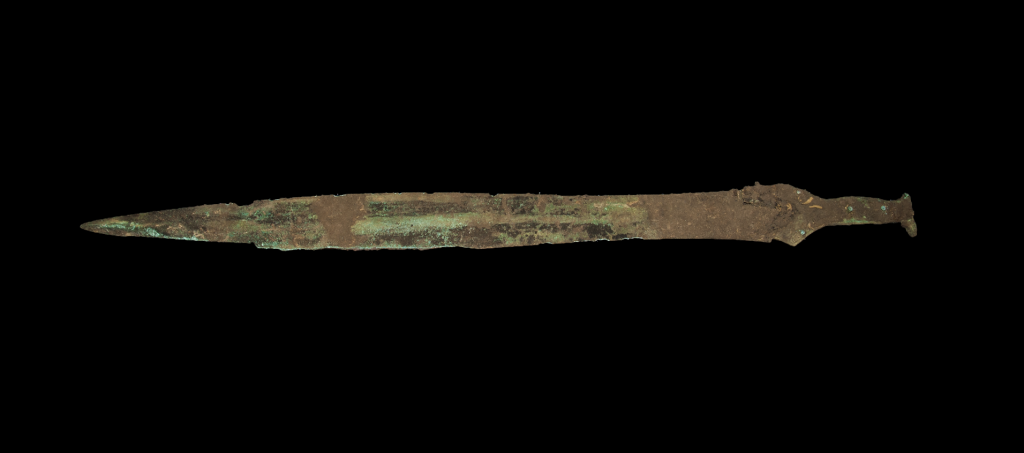
The rare artefact was discovered in a shallow pit alongside a bronze sword (pictured above) with a pommel and scabbard fittings, as well as a sunflower-headed bronze pin. Described as the “find of a lifetime” by GUARD Archaeology , the hoard hinted at the wealth of the local warrior-led society.
Roman altar stones in East Lothian 🏏
In 2010, two carved altar stones were found during the redevelopment of a cricket pavilion in Musselburgh’s Lewisvale Park. One of these rare stones featured an inscription dedicating the altar to the god Mithras, which is Scotland’s first evidence for Mithraism (a religion in the Roman Empire).
Experts from East Lothian Council, Historic Scotland (now Historic Environment Scotland) and AOC Archaeology Group worked together to remove the stones, which “change[d] our view of the Roman religion on the northern frontier”.
The second one showed four female heads representing the seasons, as well as the face of a God (possibly Sol) wearing a solar crown in the centre of the stone. It’s possible that a lantern or candle would have been held up in the hollow rear shaft, allowing light to shine through the pierced eyes, mouth and solar rays.
Wonderful Lewisvale Roman Altars from 2010: Sol and Mithras https://t.co/oQx75apikD #FlashbackFriday pic.twitter.com/xOr4xqbWbf
— Pieta Greaves (@PietaGreaves) 10 February 2017
Victorian “Alton Towers” in Edinburgh ⚽
Before King George V Park was handed over to Hanover and St Bernard’s football clubs, it was home to an open air gym. It opened in 1865 for the city’s factory workers and included machines such as a massive circular rowing contraption called the “Great Sea Serpent”, 100-ft long see-saw and a “merry-go-round” which could seat 600 people.
In 2015, Archaeology Scotland excavated the site in order to learn more about the park’s unusual industrial past.
Archaeologists have begun digging up the Victorian ‘Alton Towers’ in Edinburgh http://t.co/l329U8oKcC pic.twitter.com/MnRVIuOmlX
— The Scotsman (@TheScotsman) 15 May 2015
Roman marching camp in Ayrshire ⚽
Thanks to post-excavation analyses and radiocarbon dating, experts were able to confirm the discovery of a Roman marching camp under an Ayrshire playing field in 2019. GUARD Archaeology had uncovered 26 large, evenly spaced fire-pits and the evidence suggests that they were all used for baking bread.
As the only two known routes for the Roman invasion were further to the east, this site revealed a new route for the invasion down the west coast. The “temporary base of a tented army on campaign” is 20 miles from the nearest Roman camp, which corresponds to a day’s march for a soldier.
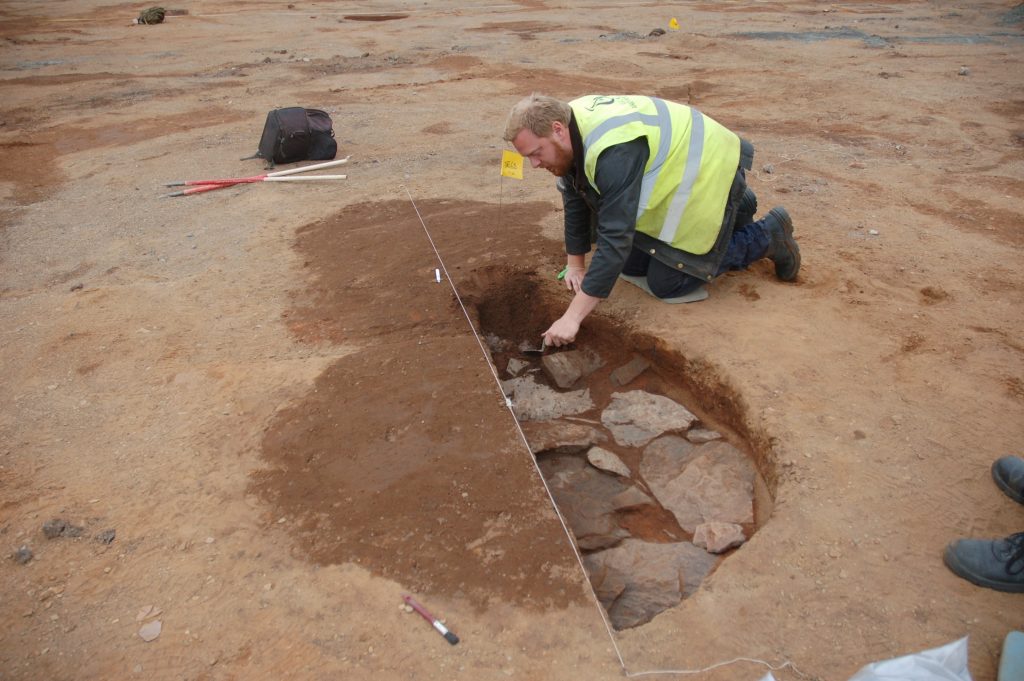
Excavating one of the Roman ovens within the Roman Camp at Ayr Academy © GUARD Archaeology Ltd
If you’re feeling inspired by these discoveries, visit our Events & Digs page to find an activity near you.
Header image: Carnoustie sword © GUARD Archaeology Ltd
