Five of Scotland’s Most Amazing Archaeological Discoveries from 2024
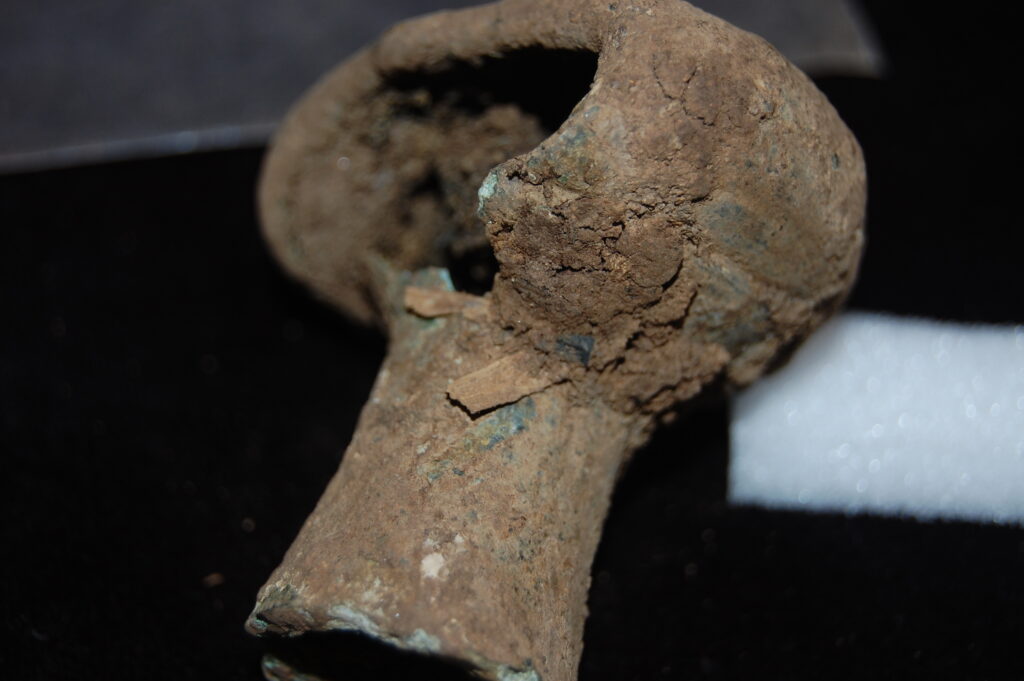
A ‘Celtic’ bangle, Pictish spearbutt, and rare shipwreck are among the most ground-breaking finds.
We’ve compiled our annual list of some of the biggest discoveries from the year to raise awareness of the archaeological work that takes place across the country.
Starting with the oldest discovery on the list:
1) Prehistoric Site in na h-Eileanan Siar (the Outer Hebrides)
In September, prehistoric charcoal and stone tools made from chipped quartz and flint were discovered below the turf on the eroding coast in Harris.
The thin layer of black, charcoal-rich, peaty deposit was first noticed by volunteers working with the SCAPE Trust on a coastal survey on the Nisabost promontory. The tools are made from chipped quartz and flint and are similar to those found on Neolithic (4100 BC to 2500 BC) and Early Bronze Age (2200 BC to 1600 BC) sites in the region.
The promontory is also home to the 3.3m-tall Clach Mhic Leoid (Mcleod’s Standing Stone), which may have had practical or ceremonial uses, and would have existed at the same time as the people who started these fires and created these tools.
The SCAPE Trust’s Joanna Hambly said: “I love finds like this because they reveal the secrets that coastal erosion uncovers—a glimpse into a prehistoric world hidden in plain sight—and remind us that anyone can make these discoveries with a keen eye and curiosity.”
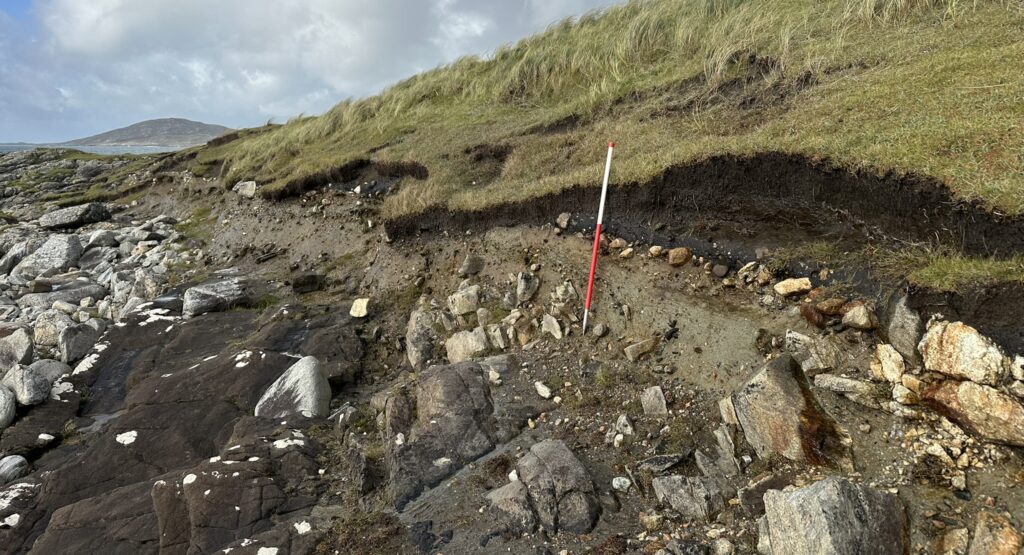
The black, charcoal-rich, peaty deposit (Image Credit: The SCAPE Trust)
2) ‘Celtic’ Bangle in the Highlands
Early in 2024, experts confirmed the discovery of a rare bangle fragment decorated with hand-carved Celtic art motifs.
AOC Archaeology Group unearthed the shale fragment in 2020 during work undertaken for RJ McLeod (Contractors) Ltd on behalf of SSE and Balfour Beatty at Dalchork in Sutherland. It was found at the site of a Bronze Age roundhouse in a layer dated to 351 BC to 55 BC which revealed evidence of re-use in the Iron Age.
The fragment has now been identified by National Museums Scotland’s Dr Fraser Hunter FSAScot who reconstructed the design, which includes crescent motifs, scroll designs and curved lines. This curvilinear style developed on the Continent after 450 BC and has traditionally been referred to as ‘Celtic’.
According to AOC Archaeology Group’s Dawn McLaren, “not only is the find unique in Scotland and extremely rare in Britain, but the fact that it was crafted with exceptional care and a high level of skill and used frequently enough to leave scuff marks and polish gives us an insight into the people who created and carried it thousands of years ago.”

The bangle fragment (Image Credit: National Museums Scotland)
3) Pictish Spearbutt in Fife
In July, a rare spearbutt was unearthed at the site of the East Lomond hillfort beside Falkland in Fife.
The bronze artefact was discovered during the excavations organised by the Falkland Stewardship Trust and the University of Aberdeen. This regular community dig, which brings together members of the public and students, has been uncovering settlement remains extending from around the second or third century AD to around AD 700.
Experts identified the artefact as a spearbutt partly from depictions on Pictish carved stones, including the one at Collessie approximately 7km from East Lomond. They suggest that the spearbutt could have been used in close combat.
According to the University of Aberdeen’s Professor Gordon Noble FSAScot, “the find helps illuminate aspects of the warrior culture of the late Roman Iron Age in lowland Scotland, and to find an actual example of the spearbutts shown on the warrior carvings is very exciting. Only a handful of these objects have been found in Scotland and the rest of Britain and Ireland.”
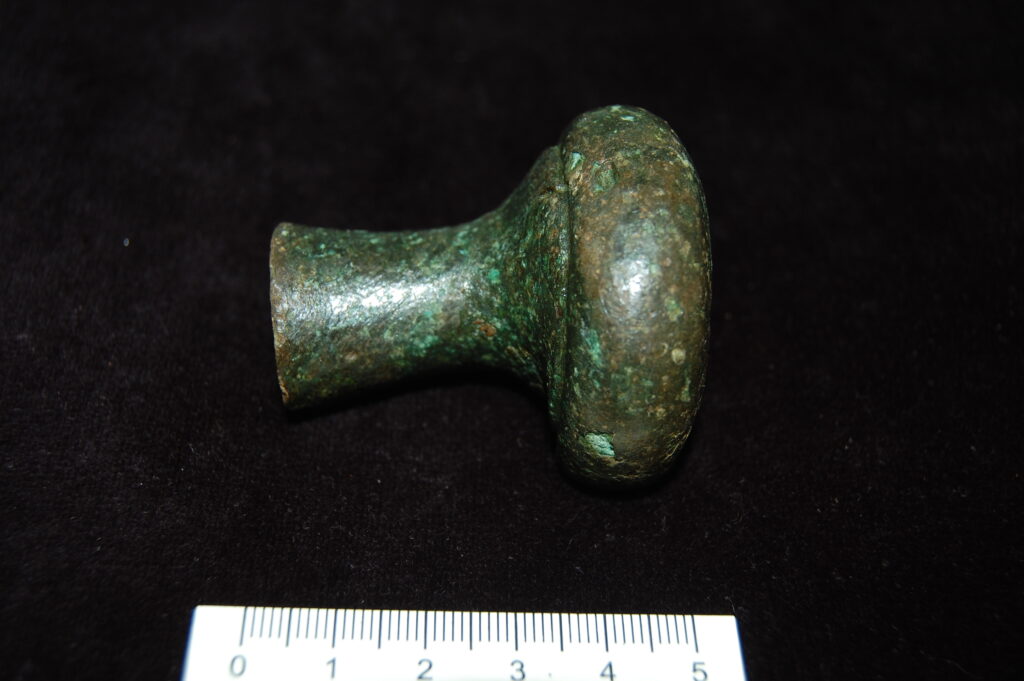
The Pictish spearbutt (Image Credit: Will Murray at the Scottish Conservation Studio)
4) Rare Shipwreck in Orkney
In February, winter storms exposed a large section of a wooden ship on a beach in Sanday which had been preserved by the sands for centuries.
Residents alerted the Orkney Islands Council archaeologist and played a vital role in the first steps of recording the shipwreck. Wessex Archaeology and Dendrochronicle undertook a rapid assessment of the wreck material, commissioned by Historic Environment Scotland. This included the recording of all individual timbers and dendrochronological (tree-ring dating) sampling.
Construction techniques suggest a 17th century date, with a possible origin in England or the Netherlands. This includes the use of wooden pegs (treenails) connecting the frames and planking, a technique that was used in shipbuilding for hundreds of years. If this date is correct, it would be one of only nine identified wrecks of this time period from Scottish waters.
In a race against time, the wreck was transferred to a large water tank funded by the National Heritage Memorial Fund alongside Sanday’s Heritage Centre to stabilise and desalinate the timbers, where they will remain while further analysis, dating and research takes place.
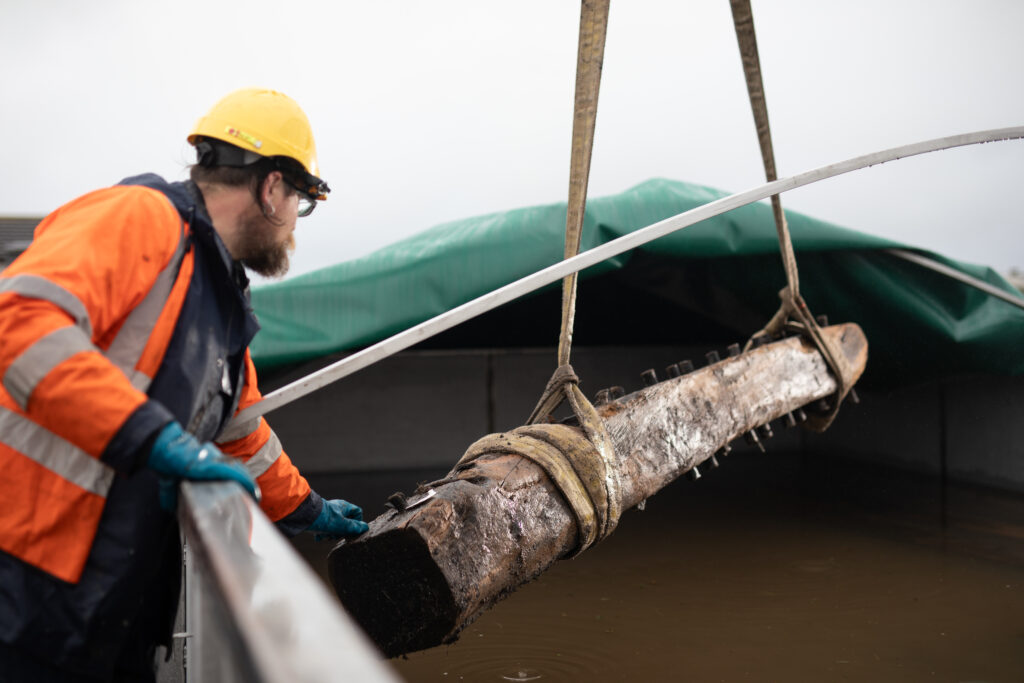
Transferring the wreck to the water tank (Image Copyright: Orkney Island Council)
5) 1988 Glasgow Garden Festival Plant Tag
In June, a team led by University of Glasgow archaeologists uncovered a small plant tag fragment, the first piece of physical evidence excavated from the 1988 Glasgow Garden Festival site.
Garden Festivals were held across the UK in the 1980s and 1990s to stimulate investment and development in former industrial areas. With over 4 million visitors, the Glasgow version was a significant event in the modern rebirth of the city. However, there is no formal written history and almost no above-ground remains across the 120-acre site.
The “RED CAMPION” flower tag was found during the Festival Park excavation, which invited the public to watch and bring their photos, memories and memorabilia. The discovery was then confirmed by a photograph of the Festival site during construction in 1987.
According to the University’s Dr Kenny Brophy FSAScot, “contemporary archaeology is at the forefront of efforts from archaeologists to become more socially engaged and relevant, but it can also be used to excite, enthuse and inspire, as has been happening in Glasgow where there’s a huge amount of nostalgia for the Festival.”
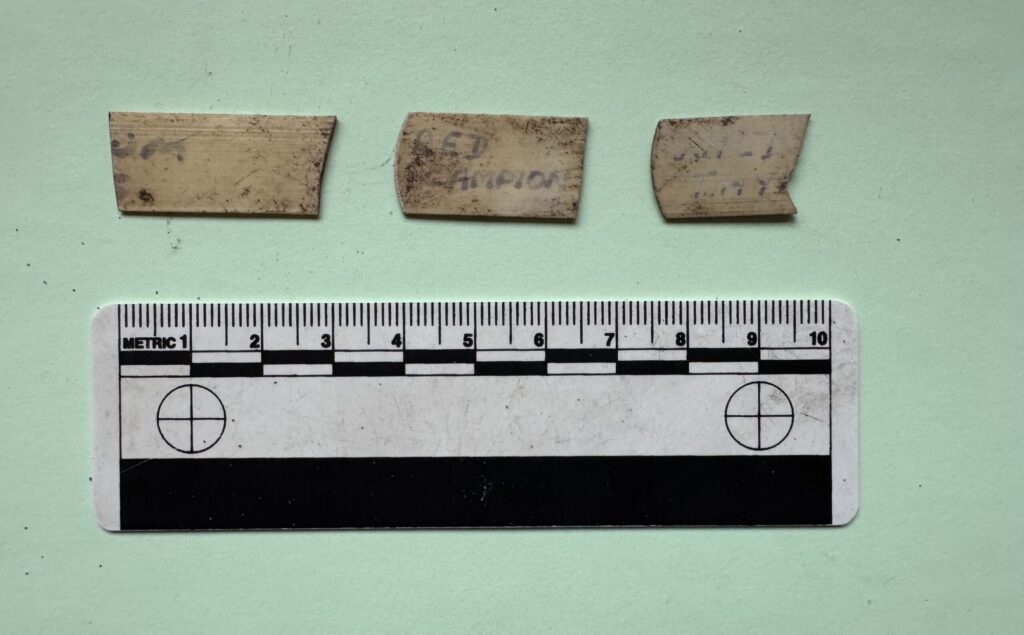
The “RED CAMPION” flower tag (Image Copyright: After the Garden Festival)
Dr Simon Gilmour FSAScot, Director of the Society of Antiquaries of Scotland (who coordinate the Dig It! project), said:
“Our Dig It! project has once again collated a remarkable list of discoveries made across Scotland thanks to the collaborative efforts of archaeologists, curators, students, volunteers and members of the public. I look forward to learning more from those involved, including Dr Brophy and Professor Noble who’ll be delivering the Society’s free public lectures online and in Edinburgh in January and March.
And of course, this is merely a glimpse into the wider range of exciting work that took place this year which revealed insights into an early medieval workshop on Islay, Stirling’s medieval city walls, industrial heritage centres in Edinburgh, and more. If you’re considering participating in archaeological endeavours in 2025, explore the Dig It! website and subscribe to the e-newsletter to find out more about opportunities in your area.”
Dr Susan O’Connor, Head of Grants at Historic Environment Scotland, said:
“Archaeology is a fantastic way that we can learn more about the history of the people and places of Scotland, whilst connecting with our past in a tactile way.
“The breadth of projects and findings that Dig It! has assembled this year showcases the variety of heritage that can be discovered through the sector’s vital work, and we’re thrilled to be able to support the project through our grants funding.”
Want to get involved? Thanks to funding from Historic Environment Scotland, we’re able to advertise free or low-cost archaeology events which are open to everyone with no experience required.
Header Image: Pictish spearbutt (Image Credit: Will Murray at the Scottish Conservation Studio)
