What do the Pictish Symbols on Scotland’s Carved Stones Mean?

The most visible legacy of the Picts is their enigmatic carved stones, which are one of the most iconic symbols of Scotland’s early medieval past. But who made these stones? How? And why? Heritage stone carver David McGovern FSAScot tells us more.
What Are Pictish Symbol Stones?
Pictish symbol stones are what we commonly call stones that were carved during the Pictish period of Scottish history (roughly over 600 years from around AD 300 to AD 900), which carry Pictish symbols or representative art, such as animals. These are either incised into the stone or carved in relief (where details stand out from a background while still being attached to it).
Pictish symbols weren’t just carved on individual stones though. They’re also found carved on bone and metal and into the walls of caves, like at Wemyss in Fife and Covesea in Moray.

Sueno’s Stone in Moray (© Crown Copyright HES)
How Old Are the Pictish Carved Stones in Scotland?
That’s a tough question to answer! It can sometimes be possible to date when carved stones were installed in their locations by radiocarbon dating organic remains in the infill material around the base of the stone. But this doesn’t actually put a date on when someone carved the stone as it could’ve been a long while before – or after – a stone was put in its place. Carvings are therefore very difficult to date by scientific methods and so we rely on art historians to a large extent to estimate their age.
The dating process used by art historians involves comparing the style of the symbols to other materials which have also been dated through style (or in some cases, by dating the burial they were found in), for example brooches.
What we can say is that Pictish stones were likely carved throughout the Pictish period, so they span from the 3rd to the 10th century AD, making them between 1,100 and 1,700 years old. There are carvings that have sometimes been called proto-symbols, which are believed to have been made in the 5th century AD (over 1,500 years ago), for example from Pool in Orkney (see illustration 11 on page 178).
How many Pictish Stones are there in Scotland?
There are over 300 surviving stones from the Pictish period but not all of them carry uniquely Pictish symbols; some stones carved by Picts depict Christianised symbols or images of animals for example.
Of the different periods, Aberlemno 1 in Angus is maybe the best-known early Pictish carved stone (dated to around AD 500); Hilton of Cadboll from the Highlands is an excellent example of a carved stone from the middle Pictish period (which has very detailed Pictish symbols as well as Christian imagery); a late example is Sueno’s Stone in Moray, which was probably erected around AD 900-950.
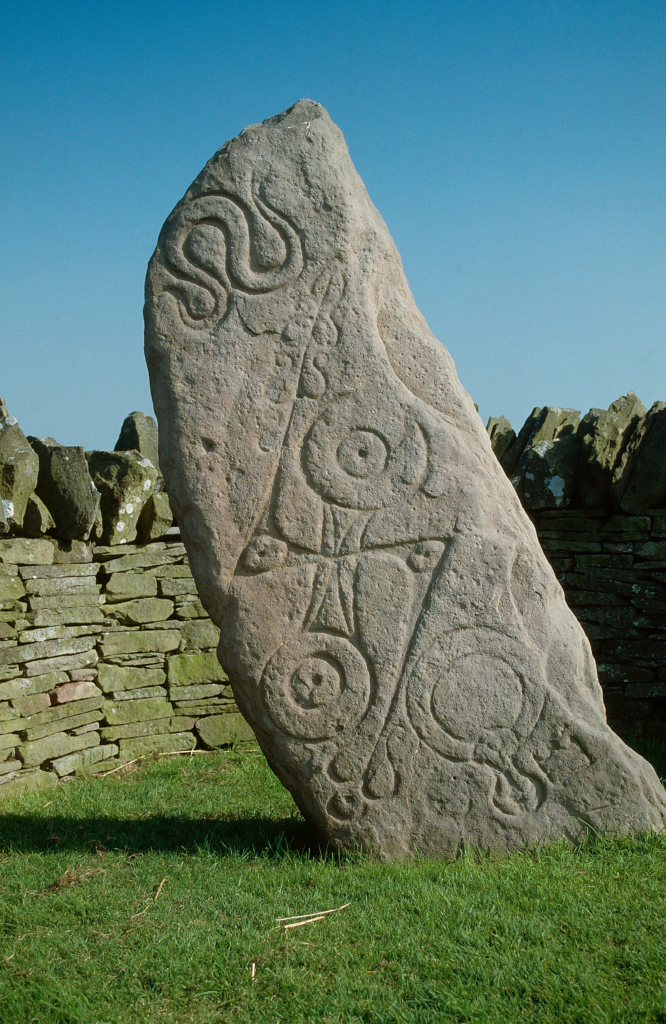
Aberlemno 1 in Angus (© Crown Copyright HES)
Where can I find Pictish Stones in Scotland?
Pretty much anywhere the Picts once lived. At certain times in history, Pictish territory covered most of Scotland north of the Forth, so there are examples as far north as Shetland (for example, at Sandness, Lunnasting, and Mail) and one as far south as Trusty’s Hill in Dumfries & Galloway – a rare find!
The largest concentration of Pictish symbol stones is in Aberdeenshire, and there are a few museums such as the National Museum of Scotland in Edinburgh, Elgin in Moray, Meigle in Perthshire, as well as Dunrobbin Castle and Tarbat Discovery Centre in the Highlands with very important displays of Pictish stones. The Highland Pictish Trail will take you on a route to see some of the best original Pictish carved stones in the landscape, as well as reconstructions.
What are the Common Pictish Symbols?
There are at least 50 Pictish symbols, although some symbols appear more often than others. Some of the most common ones seem to represent real objects, like cauldrons, combs and mirrors.
Geometric symbols that don’t obviously represent real objects also seemed to be popular with Pictish stone carvers, like the famous crescent and v-rod and the double disk and z-rod.
Then there are the animals; real ones (like bears, bulls, salmon and eagles) and mythical ones (like the infamous Pictish Beastie depicting an unknown animal which appears on many of the stones).

One of David’s new designs (© Monikie Rock Art)
What Animals can be found on Pictish Stones?
Wild animals like snakes, animals of the hunt like horses, hounds, boar and stags, and some domestic animals are some of the more common examples. But there are also eagles, wolves, geese, salmon and the very curious Pictish Beastie which has been compared to many animals, such as a dolphin and an elephant.
This creature – seen on the Strathmartine Castle Stone in Angus for example – has also been interpreted as a fantastical beast, like a dragon or the now famous ‘Kelpie’. Animals from further afield may also be depicted, such as a possible camel and crocodile on the Meigle 1 stone in Perthshire (pictured below) and lions at Portmahomack in Easter Ross.
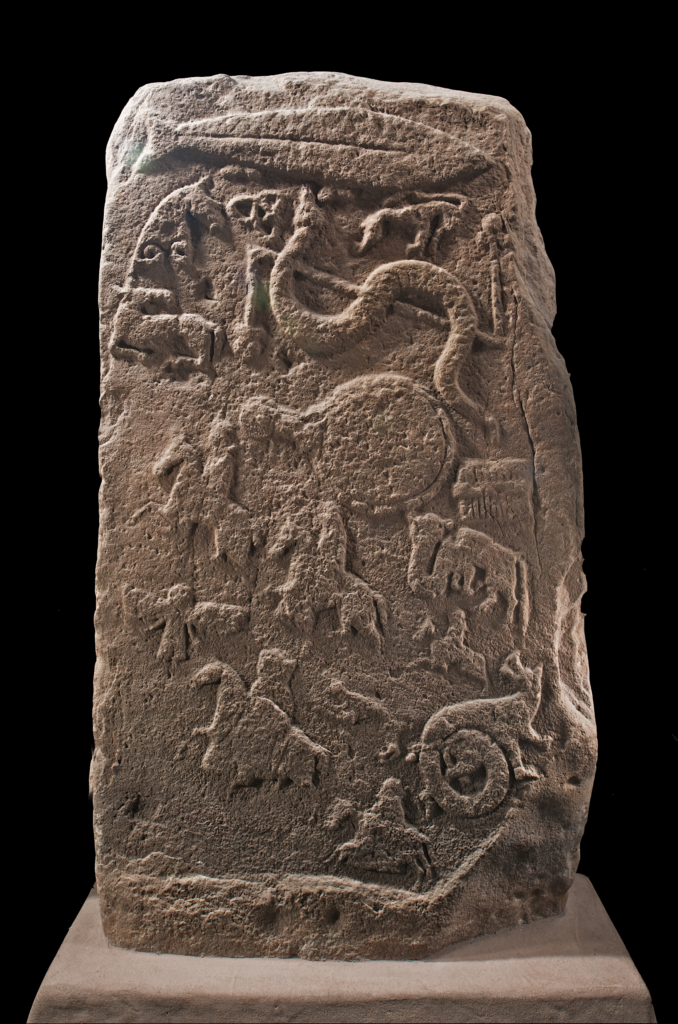
Detail on the Meigle 1 Stone from Perthshire (© Crown Copyright HES)
What Do the Symbols on Pictish Stones Mean?
Nobody knows for sure, but there are some very interesting theories. It’s been suggested that they represent personal names or family names. Others believe they’re a symbolic language, but it would be a very limited one, with a very low number of characters and a reliance on (mostly) symbol pairs (meaning that two symbols needed to appear together to create a word, phrase, name, etc).
Whatever they meant, their significance was likely obvious to those who encountered them. The stone at Dunfallandy in Perthshire may give us our biggest clue as the main person depicted is represented by two symbols. The other people depicted above each of these symbols also have two of their own symbols, and the main subject appears to have acquired one symbol from each of them. If they are the main figure’s parents, it might make sense for this person to have inherited a symbol from each lineage.
We should also bear in mind that the stones are not the only medium on which Pictish symbols would’ve been encountered. A knuckle bone from an Iron Age wheelhouse in Uibhist a Tuath (North Uist) and the Iron Age silver hoard found at Norrie’s Law in Fife remind us that many objects or media (possibly tattoos, for example) might have carried them. This suggests that perhaps lots of Pictish people would’ve understood them.
What Are the Different Classes of Pictish Symbol Stone?
The classification of stones into Class I, Class II and Class III is considered a bit outdated these days. But it still helps people understand what kind of stone we’re talking about.
Class I stones are undressed, natural looking stones with incised symbols.
Class II are dressed slabs (natural blocks of stone which have been shaped, smoothed, and finished ready for decoration) with crosses and mostly relief carvings with Pictish symbols.
Class III are stones presumed to have been carved later than Class II and have no Pictish symbols.
This system has lots of faults, so academics largely avoid it, but it won’t disappear entirely until a more useful system appears!

The Dunfallandy Stone from Perth & Kinross (© Crown Copyright HES)
Who Made Pictish Symbol Stones?
Although we don’t know if there was a specific role for stone carvers in Pictish society, the skill and time needed to carve and place the stones suggest that they probably were the product of a specific skilled trade. The theory that the symbols may represent names, as well as the prominence of the stones, is the reason for believing they may have been gravestones or memorial stones for important people, or that they may be commemorating important battles, alliances or events. If this is true, the stone carvers had a really important job, so they were likely well-regarded in Pictish society.
There’s also a similarity in some carvings that looks to me like the work of the same carver. But some of these similar stones are many miles away from each other! Which suggests that some Pictish craftspeople likely moved around taking on work.
Some of the later Pictish stones have identifiable style “schools” where it’s thought that a master carver was presumably teaching in a workshop and passing on their “style” to others. This may suggest that there was a specific role for stone carvers in Pictish society.
It’s also possible that some stones associated with monasteries, like Meigle, were carved or commissioned by the monks themselves. The Picts had their own monasteries like Portmahomack in Easter Ross, and later on in the Pictish period, they did add large Christian crosses to their stones; to do this, they’d need working knowledge of Christian imagery (or access to people who had that knowledge).

David in his workshop perfecting a replica slab with details reminiscent of the Hilton of Cadboll Stone from the Highlands (© Monikie Rock Art)
How Long Did It Take to Make Pictish Symbol Stones?
Less time than you might think once they had sourced stone from a field or quarry.
Even on a very big project – like the new Skinnet Cross for Caithness – I see great progress every day I work on it and can be finished in months.
This includes the time it takes to mark out the stone in pencil (sometimes using a grid for interlace or key patterns) and carve the design in outline using a lettering chisel before carving in relief.
I also carve incised designs where the lines are cut into the stone by using a point chisel, which is bit like a big nail, to make a series of dots in a line. I think this is how the Picts did it.
What Tools Were Used to Make Pictish Symbol Stones?
Very similar tools to the ones I use in my workshop today, such as hammers and chisels. Although I use tools with modern tungsten carbide tips (a very hard metal alloy) which makes them a good bit harder than tools used by Pictish stone-carvers.
However, the Picts were using very hard tools to carve stone. They used tools made of high carbon steel (iron containing 0.8-2% carbon), which makes it much stronger than other types of iron.

Some of the tools David uses (© Monikie Rock Art)
Were Pictish Symbol Stones Painted?
The influence from Roman painted sculptures and the use of pigment on other Pictish crafts such as pottery and metalwork makes us think that some stones probably were painted (like in this digital reconstruction).
A technique known as Portable X-ray Fluorescence (p-XRF) has also shown pigment evidence on earlier Roman and later medieval stones and a new project is p-XRF surveying early medieval stones, including Pictish ones from Portmahomack.

A painted replica of Kirriemuir 1 Pictish cross-slab from Angus (© Monikie Rock Art)
I worked with Jordyn Patrick, a PhD student looking at pigment use on early medieval stones and Caroline Nickolay, an expert on early medieval pigment production and use, to paint a replica of the Kirriemuir 1 cross-slab from Angus. We only used pigments and binders that could be found locally and the results were spectacular. I hope it stimulates debate about the kind of materials that would’ve been used by Pictish artists 1,000 years ago.
If you’d like to find out more about David’s work, including an ‘as new’ replica of the Skinnet Cross for the Northern Pilgrims Trail which will be installed in the Caithness landscape (getting as close to the original purpose of these monuments as possible) and a replica of the Fiskavaig Stone at the Minginish Community Hall on An t-Eilean Sgitheanach (Isle of Skye), follow along on Facebook and Instagram.
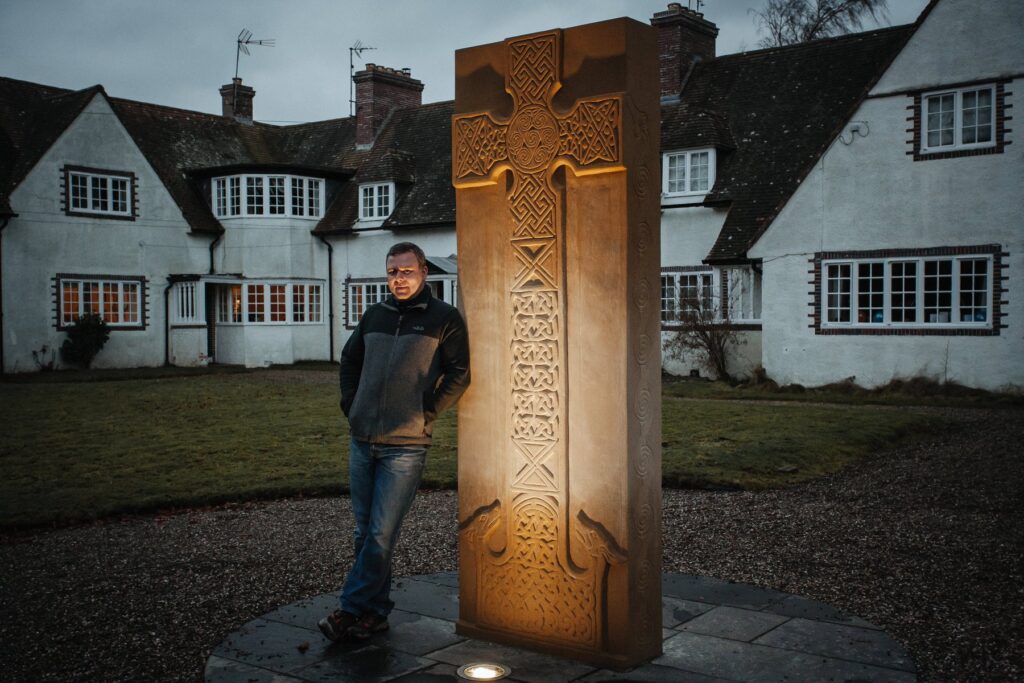
David and one of his works (© Monikie Rock Art)
By David McGovern FSAScot, founder of Monikie Rock Art. David is a heritage stone carver, recreating work from the Pictish period and the late medieval west highland monuments in sandstone and chlorite schist. He also creates new monuments in the Pictish style. His public work can be seen at St Vigeans, Forteviot, Brechin, Skye and more.
Want to keep reading? Dig into more sites in Orkney, cave discoveries, finds from peat bogs, the Picts or the archaeological collection at Paisley Museum.
Tweet
Header Image: © Crown Copyright HES
