How Volunteers Uncovered an Early Mine Shaft at a Jacobite Mansion

Bannockburn House in Stirlingshire may be well known for its connections to Bonnie Prince Charlie, but the 17th-century mansion is also home to a rare visible example of an early mine shaft which was uncovered with the help of local volunteers.
Excavating the Circular Feature: A Cellar?
While Bannockburn House is centuries old, it wasn’t the first building on the site. It was preceded by Drummond’s Ha’, a 16th-century mansion shown on the earliest surviving detailed maps of Scotland which were created over 400 years ago.
The Bannockburn House Trust was curious about a circular feature that had previously been identified by aerial photography and in 2019, a geophysical survey (a method of collecting data from underground) indicated that there could be deposits and a structure beneath the surface.
In 2022, an excavation by Bannockburn House volunteers and the Stirling Field and Archaeological Society in the circular feature revealed a vaulted roof made of roughly hewn rectangular sandstone blocks which had been mortared and pinned with slate.
Was this the remains of the Drummond’s Ha’ cellar? The presence of around 20 pieces of 14th-and 15th-century pottery near the structure during the 2022 dig suggested that this could be the case.

Overhead view of the vault (Image Credit: Dr Murray Cook FSAScot)
Investigating the Vault: An Icehouse?
A dig in 2023 was then planned to identify the extent of the stone remains and when they were used. Volunteers from Bannockburn House, the Stirling Field and Archaeological Society and Stirlingshire Young Archaeologists’ Club spent a week in June clearing the area around the vault.
Their work revealed a roughly circular wall surrounding the vault with what looked like the lintel (support beam) to a doorway on the northern side. This suggested that the structure could be an icehouse (used to store ice and food), rather than a cellar.
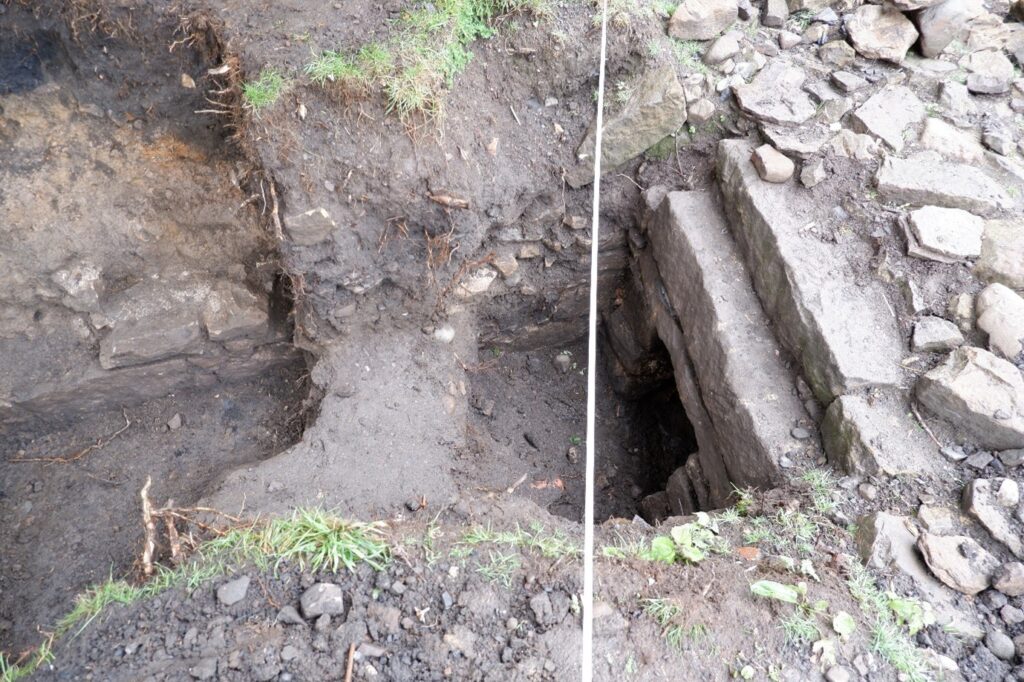
Entrance passage (Image credit: Colin Davenport)
Calling in the Caving Team: It’s a Mine Shaft!
After a doorway and entrance passageway were uncovered a few months later, the Bridge of Allan Well House caving team were recruited to lower a camera into the structure.
Instead of a cellar or icehouse, their work revealed it to be a mine shaft, complete with sockets and ledges cut into the sandstone to support ladders and platforms used for the extraction of coal.
The site uncovered in 2023 doesn’t appear in records such as the Ordnance Survey (historical maps), coal holdings register or abandonment plans, and documentary evidence for the shaft is scarce.
However, there are records of coal being mined in the area by Stirling Burgess William Bell (“Burgess” was a rank or title of a privileged citizen) in the 1560s and subsequently by Sir Robert Drummond of Carnock, who later became the Master of Work to the Crown of Scotland (1579-83). Their mines supplied coal to the 5-km distant castle and borough of Stirling during the reigns of Mary, Queen of Scots and James VI. As Sir Robert would’ve been well versed in the construction, repair and maintenance of royal property, it seems possible that he would have known how to dig the shaft and construct the vault and its supporting wall.
Most other examples have either been infilled or erased by later mineworking, which makes this a rare visible example as described in the 1566 instruction book ‘De re metallica’ by Georg Agricola, which catalogued the state of the art of mining, refining, and smelting metals.
The site has been secured and the team is now arranging to investigate the shaft using a laser scanning technique known as LiDAR (light detection and ranging) and collect further information.

Mine shaft (Image credit: Bridge of Allan Well House Restoration Project)
Inspired to get involved in archaeology? Contact StirlingFAS@gmail.com to find out more about the Stirling Field and Archaeological Society or visit the Dig It! Events page to find an activity near you.
By Colin Davenport, vice-chairman of Stirling Field and Archaeological Society and Branch Leader of Stirlingshire Young Archaeologists’ Club. He’d like to thank Bannockburn House Trust, Dr Murray Cook FSAScot and all the volunteers for their support.
Tweet
Header Image: Bannockburn House © Crown Copyright: HES
