Partying like the Viking Earls in Orkney: What Can Archaeology Tell Us?

Feasting is mentioned no less than twenty times in the Saga of the Orkney Earls (Orkneyinga Saga), at various venues across the islands of Orkney and with different functions – the sealing of deals, the exchange of gifts, the consolidation of friendships and treaties. And all of these activities were accompanied by copious drinking and eating.
The Orkneyinga Saga was written in Iceland in the 13th century (over 700 years ago) and probably informed by a local contributor. It provides an insight into the great feasts hosted by the Norse Earls, particularly at the Bu (meaning “an Earl’s farm”) in Orphir. These events were used to reward loyalty through patronage, but also as a means of keeping potential enemies close enough to keep an eye on them.
The Earl’s Bu at Orphir was home to Earls Pall and Harald and is famous for its beautiful Round Church dedicated to St Nicholas. It may have been inspired by the Church of the Holy Sepulchre in Jerusalem which had been visited by Norse Earls. It was a private church and located close to a building described in the Saga as a drinking hall.
It was said to have had …”a great drinking hall with a door in the south wall…and in front of the hall stood a fine church. On the left as you came into the hall …were big ale vats (OS Chap 66, dated to 1135 AD)”.
What can archaeology reveal about this intriguing site?

Earl’s Bu (Copyright: Dr Colleen Batey)
A Venue Fit for a Viking Earl
There’s a long standing tradition that the Earl’s drinking hall was to be identified in the grass-covered remains of walling by the Round Church. However, it’s clear that these are the fragments of many buildings, one on top of the other. If we’re to identify a building big enough for feasting around a large table, it remains to be found.
It’s also possible that several smaller buildings fulfilled this function, with activities taking place outside – although in Orkney’s climate, having a BBQ is not usually high on the agenda.
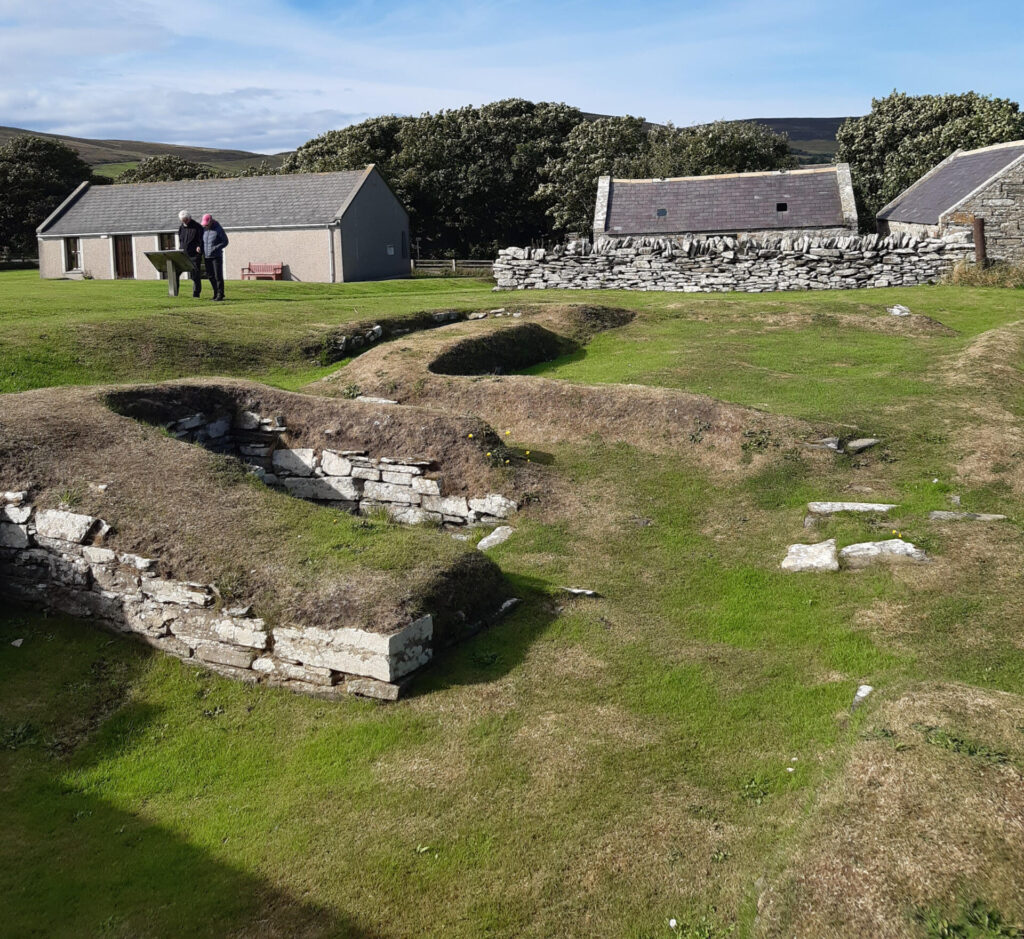
Earl’s Bu (Copyright: Dr Colleen Batey)
What’s Served at a Viking Earl’s Feast?
Close by the grass-covered ruins to the north, the author of this article excavated a horizontal mill from the Norse period. Its significance lies in the fact that it shows that the Earl’s were controlling the milling of grain derived from farmlands both nearby and possibly further afield from islands like Sanday which were known to have been rich in grain production at this time. As barley and oats were ground, who’s to say that oatcakes were not part of the diet?
More significantly though, the mill went out of use after a short period of action and the mill house structure was removed. The underhouse became a focus of the dumping of middens (waste material) and it’s those middens which tell the story of the Norse Earl’s feasts and support the descriptions in the Saga.
Over 70,000 fragments of animal bone from the site have been studied by Prof Ingrid Mainland and they tell of the massive consumption of meat from both cattle and sheep. Selective dumps of cattle and pig bones suggest that these are the result of feasting on choice cuts of meat. In case you were wondering, dressed carcass meat of five Dexter-sized cattle could supply 875kg of meat, which is enough to feed a following of 80 people for several days.
This elite culinary fare (including certain pigeon and chicken bones as well as haddock) suggests that Orphir was a centre of consumption rather than a centre of production, such as Quoygrew on Westray.
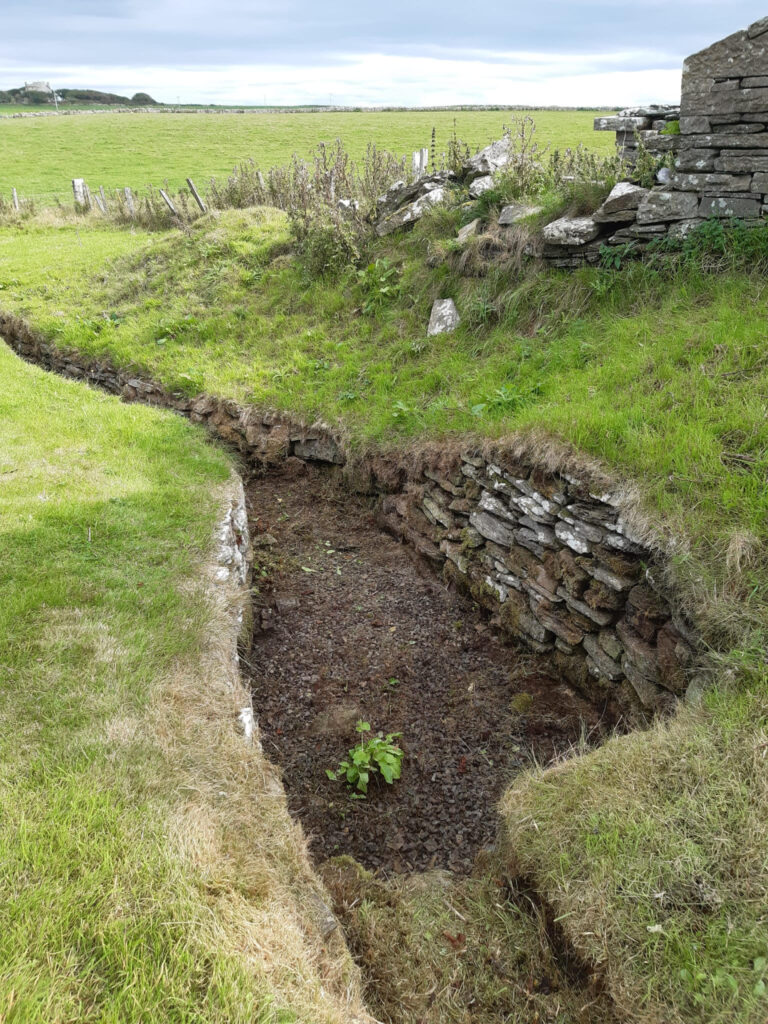
Earl’s Bu Mill (Copyright: Dr Colleen Batey)
What’s Next for the Earl’s Bu?
There’s no doubt that this site was of high status. This can be seen not only in the Orkneyinga Saga narrative, but in the presence of a beautiful Round Church, substantial multi-period buildings (albeit not a single drinking hall), the horizontal mill and the infilling rich midden material.
But there’s always more to learn. Analysis of Norse farming practice can be undertaken from the bones recovered and isotopic work can help identify the origins of the animal that were eaten (whether it be near or far), as well as the age structure of the herds and dairying strategies. We can also learn more about the domestic animals on site, such as cats which might have been brought from York (conceivably as gifts for the Earl) or as stowaways on visiting ships. Stay tuned!

Earl’s Bu Church (Copyright: Dr Colleen Batey)
By Dr Colleen Batey, who has recently retired from the University of Glasgow, Scotland. She now holds honorary Research Fellowships at the University of the Highlands and Islands and the University of Durham and is Honorary Professor at Hunter College, New York. For the past 40 years she has been involved in research on the Viking Age in Scotland, Scandinavia, and the North Atlantic, both as director of excavations and teacher. She has published widely on Scottish and Icelandic archaeology.
Further Reading:
C E Batey, 2003. Excavations at the Earl’s Bu, Orphir, Orkney, c. 1859-1939, in New Orkney Antiquarian Journal, 3 (2003), 29-71
C E Batey with C Freeman 1986. Lavacroon, Orphir, Orkney, Proc Soc Antiq Scot 116, 1986, 285-300. Microfiche 5: A5-D9
P Johnson and C E Batey 2003. Survey at the Earl’s Bu, Orphir, Orkney 1989-91. Geophysical work on a Late Norse Estate Complex. Scottish Archaeological Internet Report 4 (www.sair.org.uk)
I Mainland and C Batey 2019. The nature of the feast: commensality and the politics of consumption in Viking Age and Early Medieval Europe. World Archaeology 50, 5, 1-23
