Prehistoric Artefacts, Medieval Friary and Climate Change Connections Unearthed During Scotland’s Summer of Archaeology
Lessons that can be learned about climate action from a multi-period crofthouse site, a medieval friary and a coastal settlement occupied from around 800 BC have been captured by three artists.
The artworks were commissioned by Dig It! to mark the end of the national Scotland Digs 2022 campaign which celebrated the archaeological activity that took place across the country this summer. This year’s campaign featured a Climate Action Archaeology theme to draw attention to archaeology’s relationship to the climate crisis.
Recycling and Reuse at a Crofthouse Site in Shetland
In July, members of the public joined Archaeology Shetland for a free fieldwork session to test pit and record the remains of the post-medieval crofthouse of Sotersta.
They unearthed Iron Age or Late Bronze Age pottery and recorded elements such as an early Norse building style and large, dressed stones which are uncommon in crofthouses. Their work revealed that the site may have been continuously occupied and modified from as early as 1,000 BC until about the end of the 19th century.
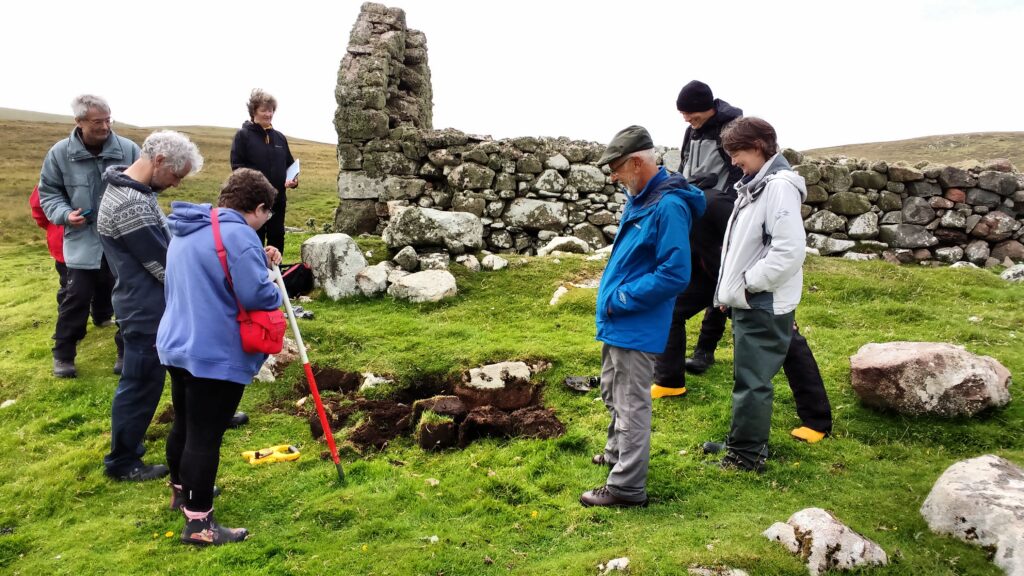
“Suzie’s artwork is reminiscent of a Robert Frost poem in that it beautifully captures the essence not just of the day but of the endeavour itself.” – Stephen Jennings from Archaeology Shetland (Image Credit: Stephen Jennings)
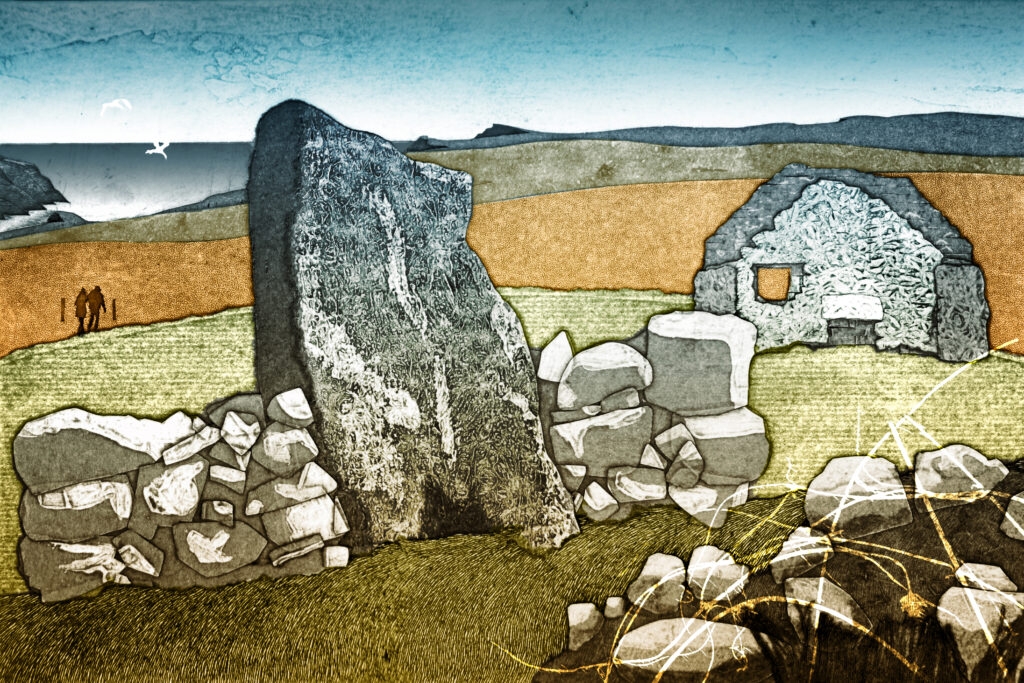
Artist printmaker Suzie Mackenzie, based in East Sutherland, combined elements of the site including the landscape and dressed stone fireplace lintel for her artwork (pictured above). She used recycled materials including foil, plastic and brown paper to construct the printmaking plate which was built up in layers to reflect the way the site and materials had been reused.
Local Natural Materials at a Medieval Friary in Fife
As part of a revised Community Burgh Survey in Inverkeithing, members of the public also helped excavate the gardens at the site of a 14th-century Franciscan Friary in Fife. Finds included medieval pottery fragments, as well as oyster shells, some of which may have been used to fill gaps in the walls over the centuries and some of which had holes suggesting that they may have been hung or had decorative uses.
Dr Gavin MacGregor, now Director of Archaeology Scotland, led the explorations which were funded by The National Lottery Heritage Fund and Historic Environment Scotland through the Inverkeithing Heritage Regeneration scheme delivered by Fife Historic Buildings Trust on behalf of Fife Council.
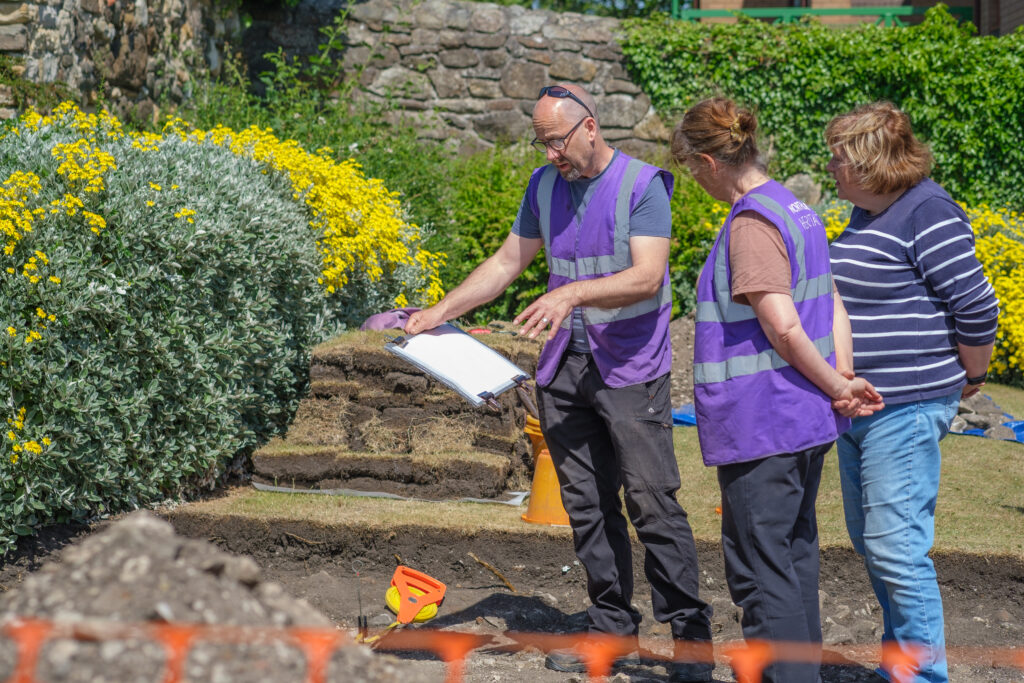
“While much has been lost, it is a fascinating example of reuse and recycle. The buildings have been in continuous use since the 14th century, although that use has evolved. Even the building stone has been repurposed and used in other places and ways.” – Emma Griffiths, Training and Development Officer for the Inverkeithing Heritage Regeneration project (Image Credit: Alexander Henderson)
Illustrator and comic maker Aimee Lockwood, who is based in Caithness, focused on the construction of the buildings and how the site has been used over the centuries. Her work depicts the variety of textures in the stonework and emphasises the oyster shells and the site’s proximity to the harbour.
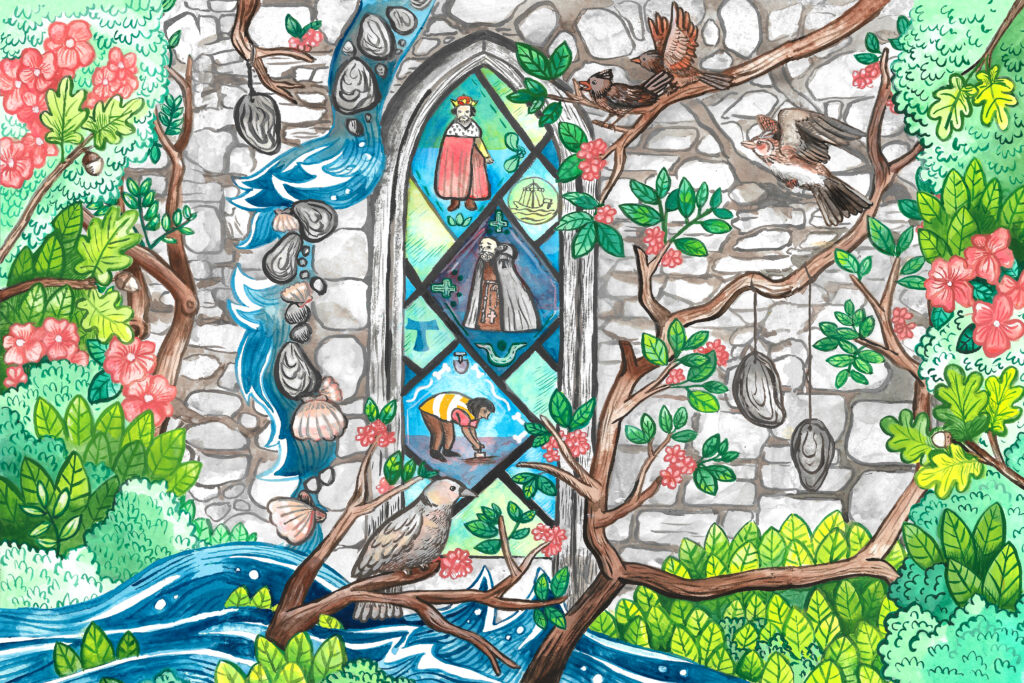
“I was intrigued by the layers of history represented by the different kinds of stonework and building materials found, including oyster shells mixed into the mortar, and so I focussed on the texture of the building itself in my piece. I incorporated references to the varied usages of the site over the years, from royal residence to community garden.” – Aimee Lockwood, the illustrator and comic maker (© Aimee Lockwood 2022)
Erosion and Textile-Working at a Coastal Settlement in Orkney
The Swandro-Orkney Coastal Archaeology Trust also returned to the Knowe of Swandro excavation on Rousay with the University of Bradford. The site, which includes a large settlement occupied from around 800 BC to AD 1,200 and evidence of an even earlier monument beneath it, is being destroyed by coastal erosion exacerbated by climate change.
Thanks to funding from individuals and institutions including Historic Environment Scotland and Orkney Islands Council, archaeologists and volunteers were able to unearth a Roman coin, rare Iron Age glass toggle beads, a furnace, evidence of metal- and possibly glass-making, and textile-working artefacts such as spindle whorls, needles and a decorated weaving comb.
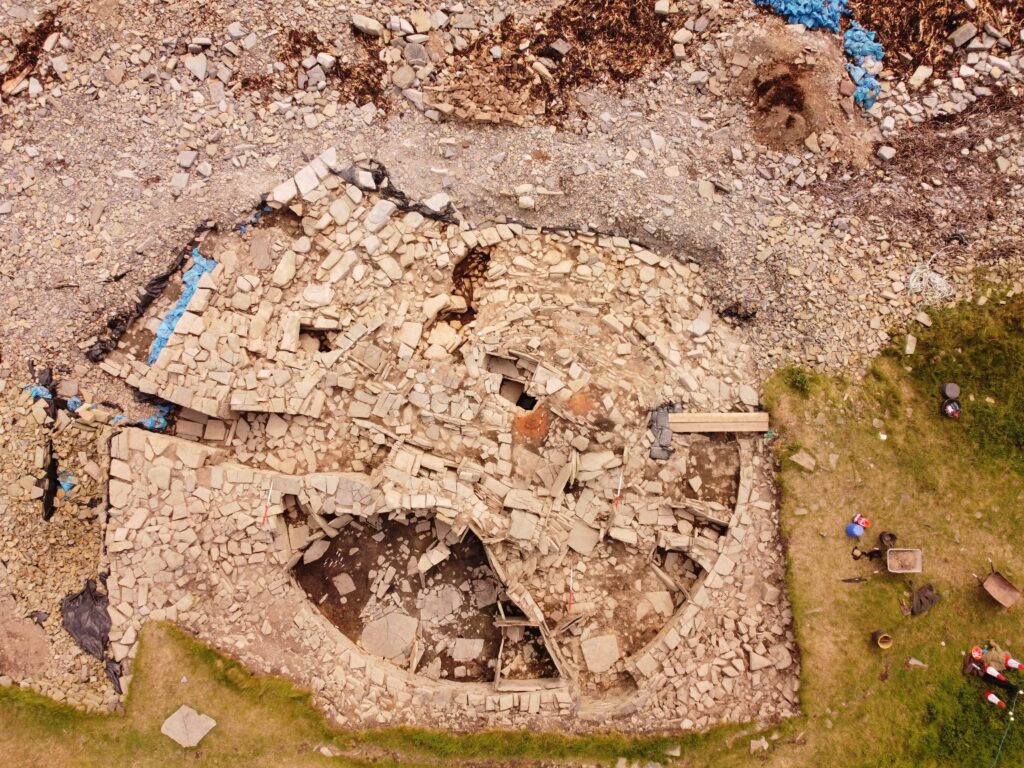
“Renuka’s work…reflects the disappearing evidence of how the former residents lived and worked within these land and seascapes which we are endeavouring to recover; crucial information for our own ability to live sustainably in our changing world.” – Julie Bond, Associate Professor in Archaeology at the University of Bradford (Image Credit: Lindsey Kemp)
Renuka Ramanujam, an Oban-based multidisciplinary artist and designer who specialises in printmaking and textiles, was drawn to aerial images of Swandro. She wanted to capture the encroaching ocean and its effect on the site while highlighting that the erosion has been sped up by human impact which is shown in the hands pulling the blanket of water over the excavation.

“What strikes me about Swandro and the coastal erosion it faces is the risk of losing our connection and insight to another time. It is like losing a building block into understanding who we are.” – Renuka Ramanujam, the multidisciplinary artist and designer (© Renuka Ramanujam 2022)
A Summer of Archaeology
During the campaign, Dig It! shared updates from over 20 fieldwork events across Scotland, most of which were open to the public either as visitors or volunteers with a range of activities available for anyone wanting to try their hand at archaeology. People were also able to follow along online thanks to posts on the Dig It! website and social media under the dedicated hashtag: #ScotlandDigs2022.
In addition to the sites which inspired the new artworks, this included fieldwork at the 5,000-year-old Ness of Brodgar in Orkney by the University of the Highlands and Islands (UHI) Archaeology Institute and Friends of the Ness of Brodgar, a prehistoric monument on the Isle of Arran by archaeology students at the University of Glasgow, and the search for Mesolithic hunter-gatherer-fishers in the Cairngorms by experts from University College Dublin.
Volunteers were also integral to uncovering an Iron Age complex in the Highlands with the UHI Archaeology Institute and Yarrows Heritage Trust, exploring centuries-old weaving mill workers’ accommodation near Stirling with Dr Murray Cook, investigating Pictish strongholds in Fife and Moray with the University of Aberdeen’s Northern Picts project, recording an “industrial ghost town” in Dumfries & Galloway with the Can You Dig It project, excavating possible Viking boat burials on the Isle of Skye with Mull Museum and Argyll Archaeology, and more.
These annual campaigns also highlight the work of commercial archaeology units, such as GUARD Archaeology Limited’s investigation of a hillfort in the Scottish Borders, Archaeological Research Services’ excavation of an Iron Age craftworking site in Moray and CFA Archaeology’s fieldwork in an area containing a known prehistoric burial cairn and a medieval settlement in the Scottish Borders.
Dr Jeff Sanders FSAScot, Project Manager at the Society of Antiquaries of Scotland’s Dig It! project, said:
“We’ve seen a summer of discovery that celebrates both the amazing depth of Scotland’s past and the array of organisations and individuals bringing that story to life through archaeology in the Year of Stories 2022. They’ve also inspired a range of talented artists who’ve captured the long-standing relationship between people and the climate, while empowering us by drawing on the past to encourage meaningful collective and corporate action.”
Amy Eastwood, Head of Grants at Historic Environment Scotland, said:
“The discoveries unearthed this summer allows us to better understand our past and share the stories of Scotland’s people, culture and landscapes, as well as raising awareness of archaeology’s relationship to climate change.”
Erin Fowler, a climate activist who consulted on the campaign, said:
“Recycling and reusing materials is vital in our journey towards a sustainable future, particularly with regards to large contributors to waste such as the construction sector, and the Shetland crofthouse is a great example of how we can learn about sustainable building practices from the past.
The Fife excavation is also a good reminder of how using local natural materials—in this case, oyster shells—was common practice throughout human history and that Scotland still has an abundance of rich materials which can be used to help reduce our greenhouse gas emissions and support local economies.
Furthermore, it’s crucial that we take action to prevent further loss at sites like Swandro in Orkney, for example, by transitioning towards a circular economy with their textile-working artefacts as a source of inspiration.”
Want to keep exploring? Find your next event or dig into over 100 archaeology stories.
Dig It! is coordinated by the Society of Antiquaries of Scotland, primarily funded by Historic Environment Scotland and helps to deliver Scotland’s Archaeology Strategy.
Header Image: “The cardboard printing plate was built up in layers, using recycled materials including fabric, papers and foil to create the textures in the image, before inking and printing it in the same way as an etching. This seemed a fitting way to interpret a site which itself displays layered and re-used resources.” – Suzie Mackenzie, the artist printmaker (© Suzie Mackenzie 2022)
