Seals, Selkies and Stories: What Does Folklore Have to Do with Archaeology?

Over the years, archaeologists and volunteers have unearthed curious finds along the Scottish coastline connected to seals.
In the late 1880s, archaeologists discovered flipper bones from a seal deposited alongside bones from a human hand in a 6,000-year-old shell midden (mound of discarded material) on the island of Orasaigh (Oronsay) in Na h-Eileanan A-Staigh (the Inner Hebrides).
In the early 1990s, excavation at the 2,400-year-old Loch na Beirgh broch (an Iron Age stone tower) on Leòdhas (the Isle of Lewis) uncovered a cache of seal teeth buried around 1,300 years ago beneath a posthole.
In 2019, a 2,000-year-old seal tooth pendant was uncovered at the Knowe of Swandro, a 3,000-year-old settlement on Rousay in Orkney where archaeologists can still hear the seals singing as they work.
How should these finds be interpreted?
SCOTTISH SEAL DISCOVERIES AND THEORIES: SOULS, RITUALS AND SHAPESHIFTING
Archaeologists study past lives through material remains to build narratives about the way people lived and how they moved about. But objects and sites alone can only take them so far. They need to look elsewhere to help build a better understandings of the rich cultural lives people would have led hundreds and thousands of years ago, which can lead to many interpretations of archaeological finds.

Winkles and fish bone in a classic shell midden. This one at Gabhsann (Galson), Lewis probably dates to the Norse period (© SCAPE Trust)
Could the seal flipper bones and the human hand bones deposited together in Cnoc Coig shell midden, for example, have something to do with the frequent role that seals play in Scottish oral traditions, in which they are often thought to represent either the souls of the damned, the bewitched, or the reincarnation of those lost at sea?
Or does the deposit indicate a link being made between the human and the seal, which may reflect a widespread characteristic of prehistoric hunter-gatherer beliefs – that animal and human are not so different?

The interior of Loch na Beirgh broch (© The Beirgh Project)
At Loch na Beirgh broch, some experts believe that the burying of seal teeth beneath a posthole supporting a structure built inside its ruins was ritual in nature, probably to give the structure “luck”.
Dr Simon Gilmour, who is Director for the Society of Antiquaries of Scotland (who coordinate Dig It!) and was part of the team who excavated the site in the early 1990s, notes “perhaps the structure was used for processing sea mammals (but we don’t have any evidence of this), or perhaps the seal is seen as an appropriate animal to incorporate in the building for some reason (perhaps a house whose owners were part of a “seal clan” – like the Conneely clan of Connemara in Ireland – or used the seal as a totem). Any number of reasons can be imagined.”
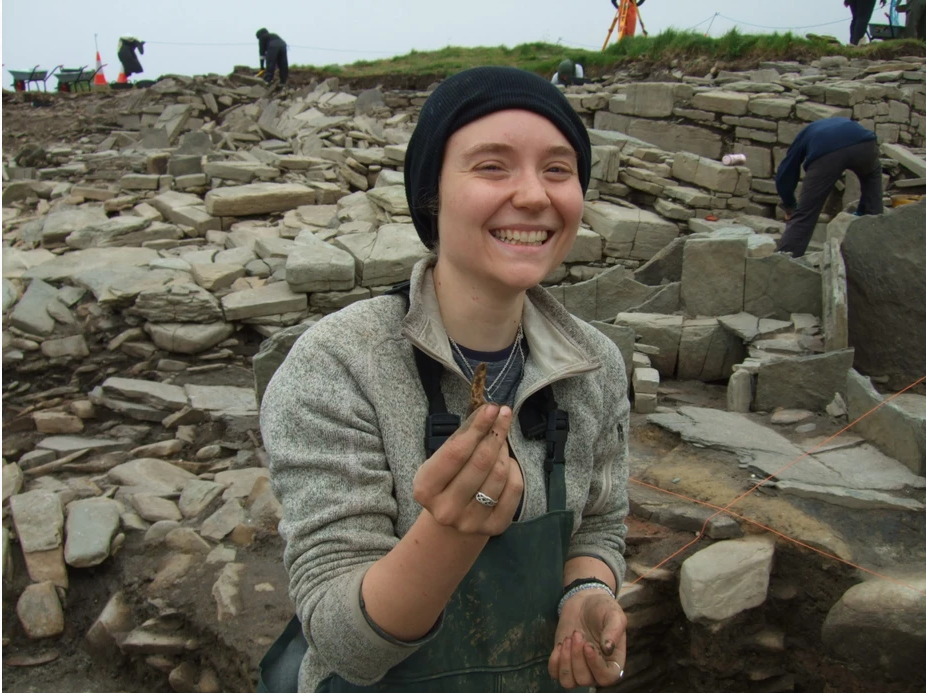
Chloe with the seal’s tooth pendant (© Swandro-Orkney Coastal Archaeology Trust)
And why did the residents at the Knowe of Swandro choose to make a pendant from a seal’s tooth? Was it simply the material they had on offer? Or were seals considered important to this coastal settlement thousands of years ago, which still has plenty of seals visiting the site. If so, what were their beliefs about them?
Dr Julie Bond of the University of Bradford’s School of Archaeological and Forensic Sciences and the Swandro-Orkney Coastal Archaeology Trust says, “animals such as seals and bears are the subject of a lot of shape-shifting and transformation stories around the world and through time, and it’s no coincidence when they have bones in their flippers or paws that look very like human bones; once you have seen seal bones, say in a dead seal on the beach, the idea that they can slip off their skins and become human makes much more sense as an explanation.”
How can experts fill in these types of gaps in our understanding left by material evidence? One option is to consider belief systems from around the world and from back in time, including folklore.
HOW CAN FOLKLORE HELP ARCHAEOLOGISTS?
The connection between archaeology and folklore might not be obvious at first glance; archaeological research is reliant on physical material, while folk tales are ever changing, intangible and sometimes fleeting – not to mention difficult to date with confidence (if at all).
Nevertheless, some archaeologists are turning to folklore to help piece together what the Scottish landscape looked like in the past, and how people once thought about the world around them.
There are sites in Orkney, for example, that no longer exist but that still play a role in local legend. The Odin Stone in Stenness remains one of the area’s well-known monuments because of the numerous traditions associated with it – despite the stone having been destroyed in 1814.
Similarly, the mound of Helliehow (or “Cot Brae”) in Sanday is no longer a visible landmark, but the story of its dweller (the Hogboon) is one of the area’s best-known tales about a mound spirit (with parallels elsewhere in the world).
Because of these tales and traditions, these sites haven’t been completely lost and they continue to form a part of the landscape – at least in memory.
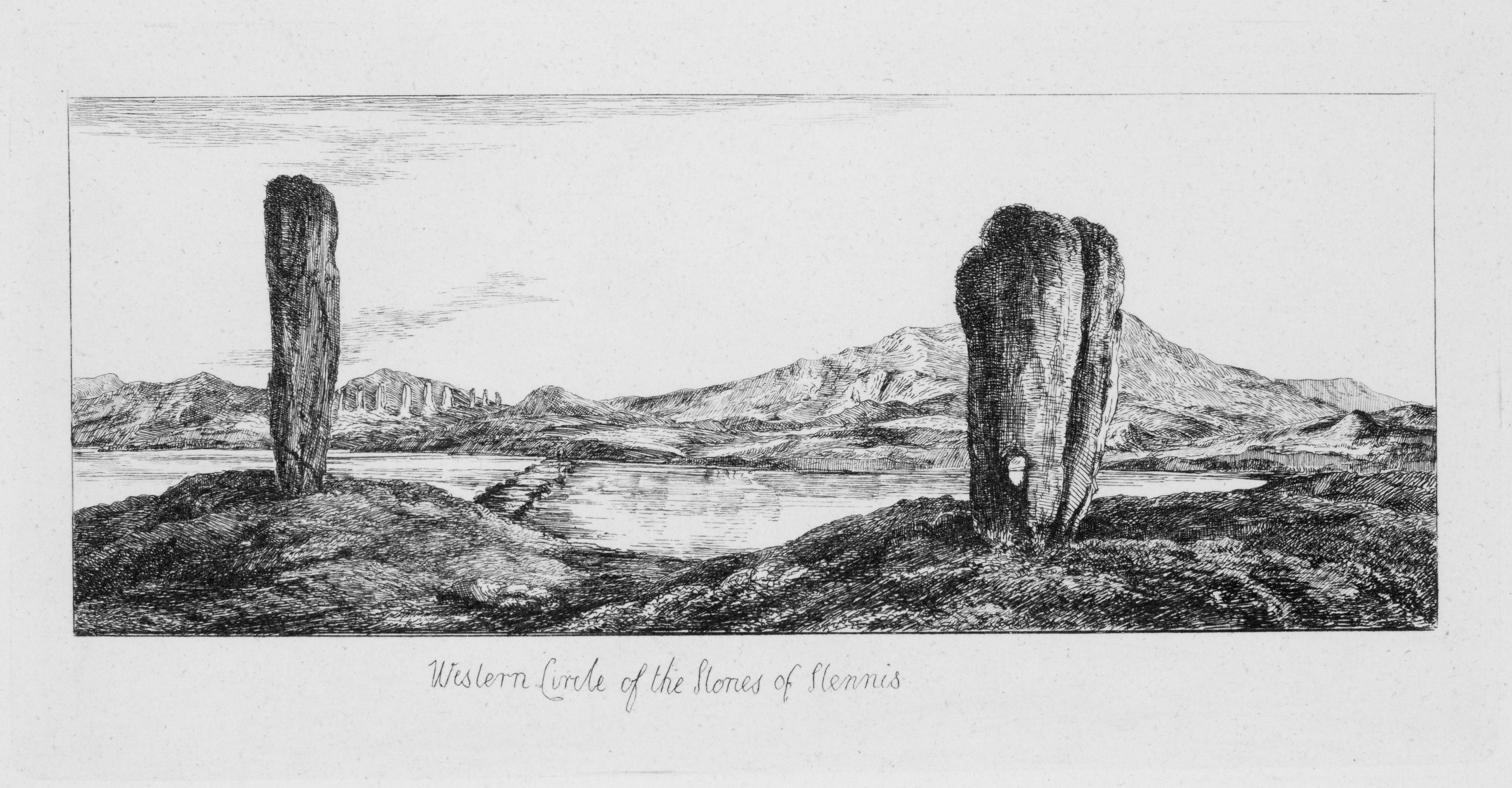
Illustration showing the Watch Stone (on the left) and the Stone of Odin (on the right). The Ring of Brodgar is in the background (© Courtesy of HES)
What’s more, many folk tales still contain traces of key notions and values that have been told from one generation to the next over many years. In particular, tales that feature ancient sites, landscapes and even objects, can provide useful insights into past meanings of what they were, and why they were.
People have always been keen to explain ancient landmarks and objects; to give them a history and a meaning. These tales usually predate the archaeological investigations that experts draw on today, therefore preserving possible earlier interpretations of monuments and objects.
While nobody can claim to fully understand what these artefacts and places meant to past societies (nor can anyone usually say with confidence just how distant a past they’re referring to, or how these meanings developed over time), folk tales can at least offer glimpses of bygone ideas:
“Considering folklore alongside archaeological investigation helps us put sites and artefacts into their local context. This is something that would have been unthinkable just 30 years ago but is now seen as an important part of their interpretation.” – Author and storyteller, Tom Muir
Prehistoric arrowheads, for instance, like this 5,500-year-old example unearthed at Kilwinning Abbey in 2011, were once believed to be “elf shots” or “elf arrows” and turned into amulets and worn for protection. And until recent centuries, artefacts now known as prehistoric stone axes (interpreted as “thunderbolts”) were kept in houses to protect them from lightning storms (indeed these artefacts have been found in many early medieval buildings).
Could these beliefs help archaeologists understand more about why the Swandro pendant was made?
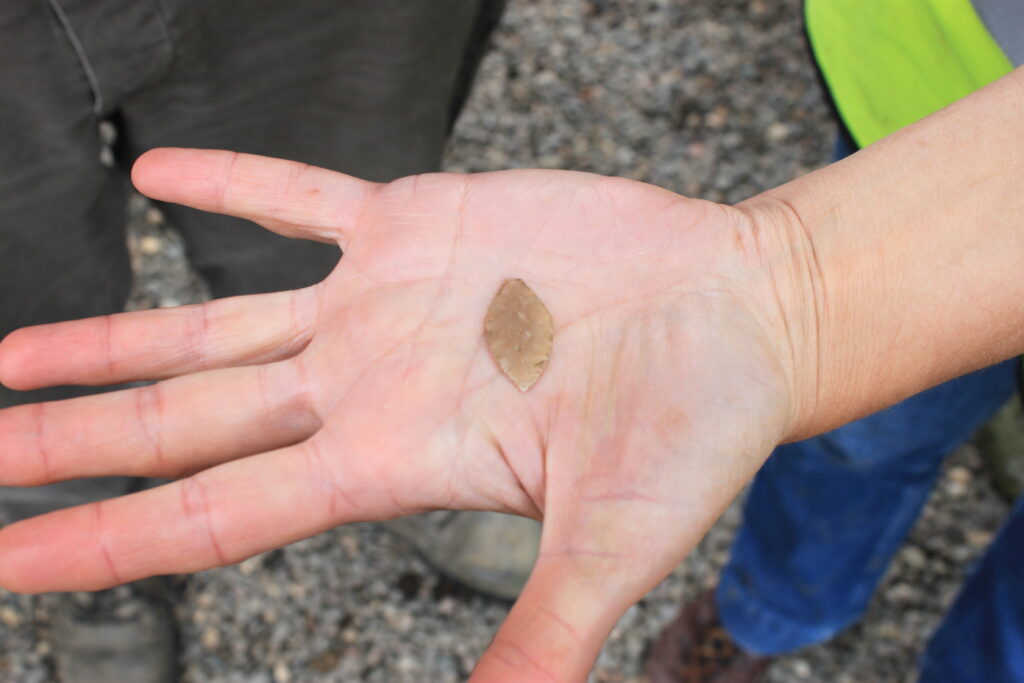
The Neolithic flint arrowhead unearthed at Kilwinning Abbey, known as ‘elf-shot’ (© Rathmell Archaeology Ltd)
In addition, archaeologists have recovered objects that have been incorporated into house foundations, walls, chimneys and hearths as recently as the 19th century. This has also been interpreted as a means of keeping the household safe from harm and is reminiscent of the cache of seal teeth found beneath the foundations at Loch na Beirgh broch.
These might appear like unusual ideas at first glance. A closer look, however, reveals that these beliefs and customs are full of crucial concerns which are still relevant today – such as survival, safety and looking after loved ones. Folklore helps archaeologists understand that (broadly speaking) people still care about the same things today, only our means to cope with these anxieties have changed.
SEALS IN SCOTTISH FOLKLORE
Some of the most famous folktales in Celtic and Norse mythology involve selkies, mythological beings capable of changing from seal to human form by shedding their skin.
Selkie tales tend to involve intense and passionate relationships unfolding between the creatures and humans, who are sometimes said to shed seven tears into the sea in order to attract a selkie mate. However, these stories often have unhappy endings and serve as cautionary tales.

“Kópakonan” selkie-statue, Mikladalur, Kalsoy, Faroe Islands (© kallerna, via WikiCommons, CC BY-SA 4.0)
Despite variations of selkie stories found all over Scotland, a common element is that they must cast off their sealskins to shapeshift. Within these magical skins lay the power to return to seal form, and therefore the sea. If this sealskin was lost or stolen, the creature was doomed to remain in human form until it could be recovered. Because of this, they would hastily snatch up their skins if disturbed while on shore before rushing back to the safety of the sea.
The selkie’s transformation has been interpreted by some in the LGBTQ+ community as a metaphor for the lived experience of trans people or for gender fluidity more generally.
While there’s no evidence to firmly connect these seal discoveries with the legend, it’s possible that elements of the tale (such as the creature’s ability to shapeshift) originated hundreds, or even thousands of years ago, and that the beliefs present in selkie folklore today were shared by people in Scotland’s past.
To celebrate LGBT History Month and Scotland’s Year of Stories 2022, Dig It! explored the connections between archaeology and folklore through the selkie legend in a new piece of artwork by non-binary artist Jem Milton.
QUEER AS FOLKLORE: LGBTQ+ Interpretations of Selkie Folklore
The imagined scene features elements of the selkie legend and the three examples of seals found in Scottish archaeology: the interior of a shell midden containing seal flipper bones and human hand bones, a broch on the cliff edge in the distance and a selkie holding a seal’s tooth pendant which has been thrown to her by a young man on the shore wishing for a selkie bride.
(© Jem Milton 2022)
“I wanted to give a glimpse into the selkie world and the human world, at the same time as depicting a happy trans and happy selkie love story. Some of the features like the seven teardrops and the seal teeth are worked into the story or the characters’ clothing. The fundamental narrative is a human man wishes to the sea for a selkie bride, and a transfemme selkie turns herself into a woman and joins him on land.” Artist, Jem Milton.
Marrying key aspects of the selkie legend with real discoveries, the artwork celebrates queerness, which has traditionally been left out of interpretations of the past, while also reflecting on the role of archaeologists as storytellers.
As advances in science and technology reveal more about Scotland’s former inhabitants, it’s exciting to imagine what the future of archaeology will look like when queerness and folklore are included in these analyses.
Curious about other archaeological connections with folklore? Dig into more Scottish tales in English or Gaelic thanks to Bòrd na Gàidhlig.
Written in collaboration with Nela Scholma-Mason, an archaeologist who has worked in both commercial archaeology and in research. Nela is interested in the way ancient sites are represented in folklore and what this might tell us about past perceptions of such sites. She is also interested in the biographies of lesser-known antiquarians, and she is the creator of Forgotten Stories, a collaboration with the Society of Antiquaries of Scotland that aims to bring the stories of near-forgotten archaeologists back to life.
Jem Milton is a non-binary artist based in Glasgow, making illustrations, comics and infographics, along with graphic recording and running workshops on creative thinking and visual storytelling.
Header Image: (© Jem Milton 2022)



Further Reading:
- Anthology of poetry produced by LGBT Youth Scotland, Wain: LGBT Reimaginings of Scottish Folktales
- Rhind Lectures 2014, “Archaeology and Celtic Myth – an exploration”.
- Gazin-Schwartz, A and Holtorf, C J (1999) Archaeology and Folklore, Routledge.
- Scholma-Mason, N M A (2020) ‘Those Who Dwell under the Hills: Orkney’s Mound Lore and Its Wider Context’ in Folklore 131 (2) 180-203. https://doi.org/10.1080/0015587X.2020.1735154
- Muir, T (1998) The Mermaid Bride and other Orkney Folk Tales, Kirkwall: The Orcadian Ltd.
- The Supernatural Shore: Folklore and folktales of mythical mermaids – with Rowan Morrison by SCAPE
