Top Six Scottish Archaeology Snakes
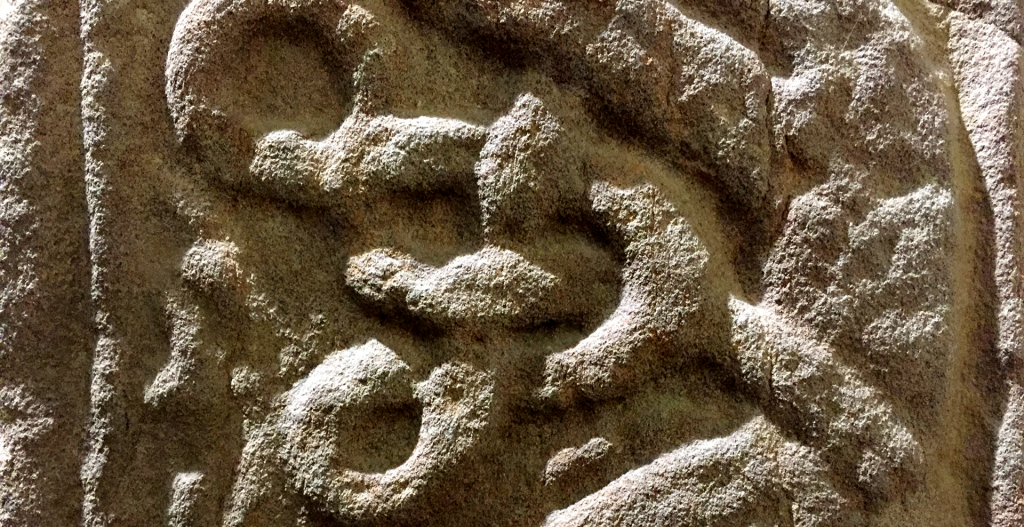
Serpents have slithered their way into thousands of years of Scottish history.
Maeshowe Graffiti
In the mid-1100s while Orkney was under Norwegian rule, Norse crusaders broke into Maeshowe (a 5,000-year-old tomb) during a snowstorm and carved around 30 runic inscriptions and a handful of sketches onto the walls, including a walrus, ‘dragon’ (or lion) and a serpent knot. They’re described as being small, “beautifully executed” and in “typically vigorous Scandinavian style”.

By James Fergusson (1808–1886) – https://archive.org/details/rudestonemonumen00ferg, Public Domain, Link
Aberlemno 2
On the reverse of the carved stone known as Aberlemno 2 as part of the Aberlemno Scultpures Stones in Angus is a battle scene long thought to depict the Blàr Dhùn Neachdain (the Battle of Dunnichen), where the Picts made one of the most decisive victories in the history of the British Isles. On the other side, you’ll find serpents and other creatures biting one another to form intricate patterns; the work of a highly skilled craftsperson.

Cramond Lioness
In 1997, ferryman Robert Graham found a sandstone sculpture from a river near Edinburgh which depicts a lioness devouring a naked bearded man (now in the National Museum of Scotland in Edinburgh). The excavation and recovery were directed by Mr M Collard (for City of Edinburgh Archaeology Service) and Mr F Hunter (for the National Museums of Scotland).
If you can tear your eyes away from this spectacle, you’ll also spot two snakes on the base. Why? It was probably a memorial for a high ranking Roman officer and they symbolise the survival of the soul by representing the good spirit of the deceased and the soul’s shedding of the body.
Wemyss Caves
The Wemyss Caves in Fife contain the largest collection of Pictish inscribed symbols in one place, with designs ranging from the unusual “Thor with his hammer and sacred goat” to the classic Pictish beast. The Save the Wemyss Ancient Caves Society aims to secure the caves, carvings and other archaeological remains; manage and ensure safe access to them for the public; learn and understand more about the people who have lived and worked here through the ages; and share and celebrate the heritage of the Wemyss Caves.
In 2004, Channel 4’s Time Team investigated the Sliding (or Sloping) Cave, which was in use over 1,500 years ago, and discovered carvings which have been referred to as a “double serpent”.
Traprain Law
One of the world’s most infamous snakes can be found amongst the largest known hoard of Roman silver from outside the Roman Empire. The Traprain Law hoard – discovered in 1919 in East Lothian and now in the National Museum of Scotland – is made up over 250 artefacts (most of them hacked to pieces), including a wine jug with biblical decoration. As you may have guessed, it features Adam and Eve in the Garden of Eden with the deceptive serpent wound round a tree.
Culbin Sands Armring
Culbin Sands in Moray has been described as ‘one of the richest archaeological fields in Scotland.’ One of the many finds to emerge from the site is a 1,800-year-old bronze armring depicting a coiled double-headed snake, which would have been worn by someone to show power and status. We know of seven similar bracelets from Scotland, with most of them coming from the north-east.
Stunning bronze bracelet, discovered 1820s in Culbin sands – read about it here: http://t.co/04p0kygr pic.twitter.com/rafAsAKu
— EKOsborneMartin (@EKOsborneMartin) August 20, 2012
If you’re feeling inspired by these finds, visit our Events & Digs page to find an activity near you.
Header: Carvings on the Dupplin Cross
