Discovering Tiriodh (Tiree), the Land Below the Waves
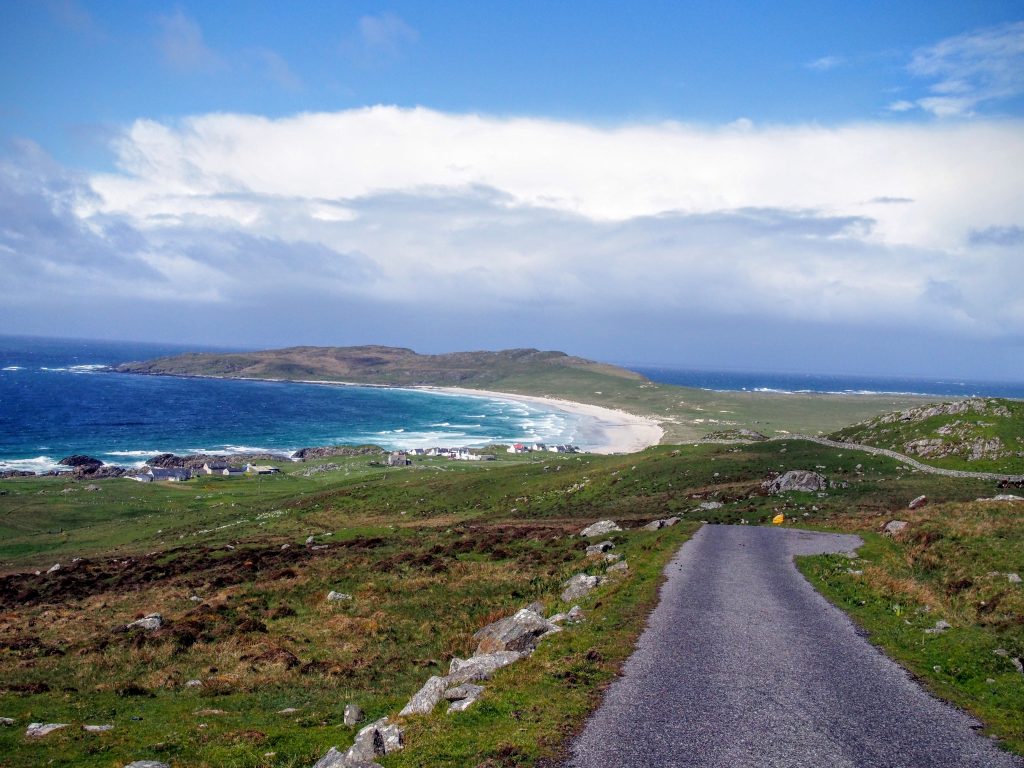
The island of Tiriodh (Tiree) has been inhabited for thousands of years, but nineteenth-century land clearances and the ever-changing sand blow has meant that in the past, archaeological finds have been elusive. Now all that is changing with several recent discoveries showing that a visit to the ‘Land Below the Waves’, the most westerly island of Innse Gall a-Staigh (the Inner Hebrides), is well worthwhile and there is a lot more archaeology to unearth.
A Giant Surprise in Circeabol (Kirkapol)
In 2017 a community dig investigating the evidence for Norse activity on Tiriodh decided to excavate the so-called “Giants Grave” in Circeabol, in the hope that it might be a Viking boat grave. What they found was a burial site more than 2,000 years older than they first thought, with the possible Viking grave turning out to be an Early Bronze Age stone cist (a small stone-built box used to hold the bodies of the dead). Around two-thirds of a male skeleton was found in the cist and it was estimated that he had been in his fifties when he died, was born in the Hebrides and strangely, had eaten very little seafood.
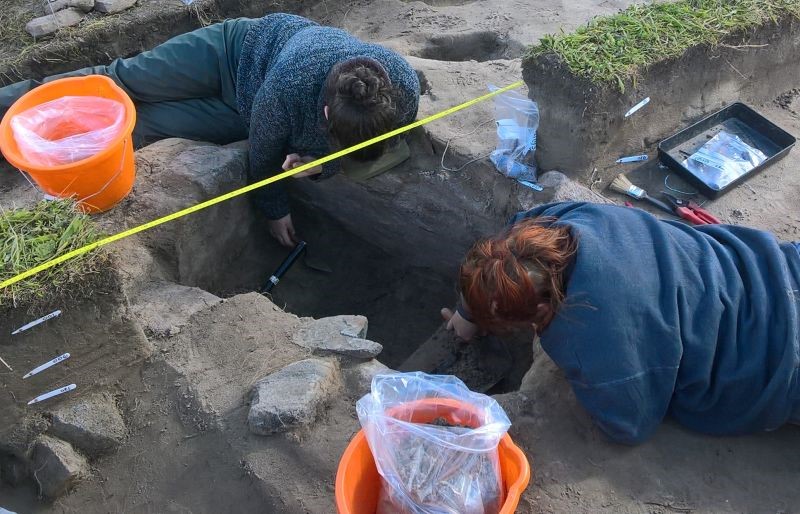
The Bronze Age burial cist by Colleen Batey (Reproduced via http://bit.ly/3b0Avbw with permission from the owner)
Set in Stone at Bhalla
From Neolithic rock art to the remains of early monasteries, Tiriodh is full of archaeological gems surviving in stone. Recent surveys by the North of Scotland Archaeological Society (NOSAS) have confirmed twenty panels of rock art (consisting of simple cups) carved on notable outcrops in two lines across the island. Over two millennia after the prehistoric artists left their mark, the island’s stone was used to construct three monasteries following the arrival of Christianity to Tiriodh. The location of only one is known: that at Teampall Phàraig on the Kenavara headland, where the platforms of the monks’ cells can still be seen. It also has ten surviving stone crosses, including the free-standing MacLean’s Cross in Soroby graveyard, which may date as far back as the ninth-century.

Tiriodh has a magnificent Iron Age landscape, with nineteen Atlantic roundhouses (drystone towers most on rocky coastal locations). The best preserved of these is the broch at Bhalla (Vaul), which was built around 60AD and then inhabited for 200-300 years. The preserved ruins are at shoulder height and standing inside you get a good sense of the scale of the 2,000-year-old dwelling. Evidence of habitation suggests that when the broch was first built it was used as a temporary refuge for the local community rather than a permanent home.
Pins and Needles in Am Baile Nodha (Balinoe)
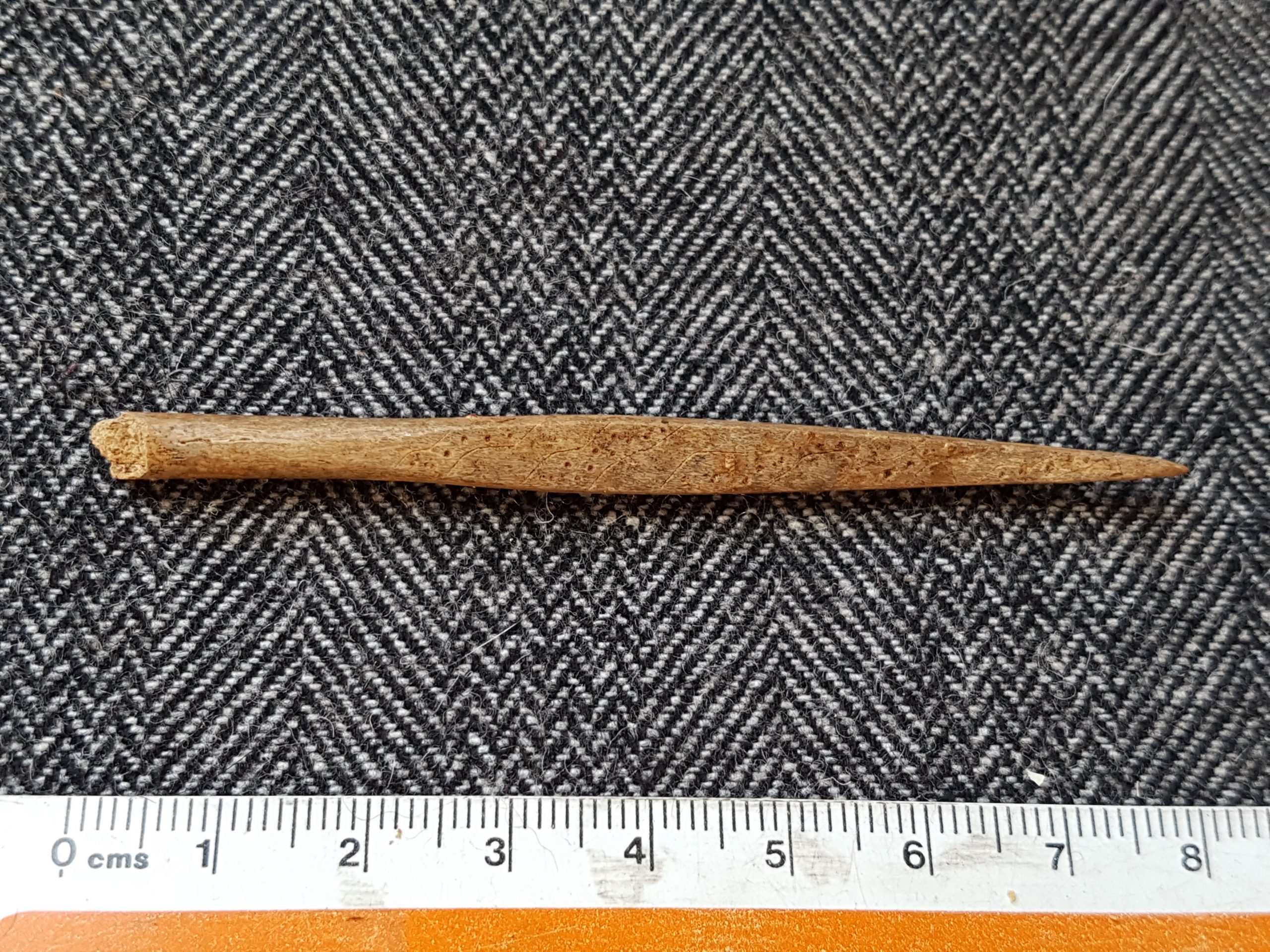
One of the most exciting recent discoveries on Tiriodh is an eroding Viking-Age settlement mound in Am Baile Nodha, known as Baca na Putain. The site has yielded an early medieval carved bone pin, fish bones, a loom weight and charcoal radiocarbon dated to between 790AD and 990AD, a period when Vikings are known to have been living on the island. A metre-deep midden (waste) layer has yielded a late eighth- to a late tenth-century date, including alder, birch and hazel charcoal (proving that woodland survived on Tiriodh into the Early Christian period) and there are plans to continue excavations in 2020. (Note: This mound is on private land, so please contact Dr John Holliday if you want to look round.)
A Lost Fortress in Loch an Eilein
In 1343, King David II granted the royal castle of Iselborgh to John (MacDonald) of Ìle (Islay). This castle may be the same as the fourteenth-century castle listed by Scottish chronicler John of Fordun as ‘turris fortissima’ and located on an islet in Loch an Eilein on Tiriodh. A 130-metre curving causeway to the north of the site suggests that this had previously been the site of a causewayed crannog (a type of ancient loch-dwelling). It’s also a plausible site for a Norse thing (a type of early council or assembly).
The medieval castle was demolished in 1679, but geophysics (a survey method designed to detect archaeological features hidden beneath the soil) in the back garden of the house built on the site showed an outline that could be the foundation. In summer 2019, an investigating team may have found midden material in a surrounding ditch; they are hoping to dig a trial trench in 2020.
“Tha gu leòr den àrceòlas ann an Tiriodh. Tha mi an dòchas gum bi an cuid dhiubh a tighinn, agus tha cuireadh air a thoirt dhan a h-uile duine a tadhal oirnn. Bi mi a’ sealltainn dhuibh an dùthaich!”
“Tiree has lots of archaeology. I hope that some of you will come, as there is an invitation for everyone to come see us. I will show you the land!”
Ready for your next adventure? Learn more about the archaeology of Scotland’s islands in our Discover section.
By Dr John Holliday, Chairperson of An Iodhlann, Tiree’s Historical Centre
Featured Image Credit: Duncan Stephen via Flickr at http://bit.ly/2tpEopv, CC BY-NC 2.0
This article was produced in support of Scotland’s Year of Coasts and Waters 2020-21.

