Top 10 Archaeological Finds from Scotland’s Peat Bogs

From a 3,000-year-old hat to precious offerings to the gods, dig into our top archaeological finds from peat in Scotland.
What is Peat?
Peat is a soggy, mud-coloured substance made of built-up, partially decayed plants or other organic matter. It’s unique to natural areas called peatlands, bogs, mires, moors, or muskegs.
Since bacteria and fungi don’t like the conditions in these areas, dead vegetation (and certain artefacts) decomposes at a phenomenally slow rate. Instead of breaking down right away, the debris lingers and piles up over time, gradually turning into peat.
Peatlands are made over thousands of years – just one metre of peat takes 1,000 years to form – which is another reason why prehistoric objects are often found there.
Covering more than 20% of the country’s land area, Scotland has the majority of the peat in the UK, with most of it found in upland regions.

Mary Ann’s Cottage is a traditional Caithness cottage near the village on Dunnet. Built in 1850, the cottage is now a museum and an example of a Caithness crofter’s cottage – you can see the peat bricks used for fuel piled outside (© VisitScotland / Kenny Lam)
Why Does Peat Preserve Remains from the Past?
Countless artefacts and human remains have been unearthed from Scotland’s peatlands in remarkable condition after hundreds or even thousands of years.
What survives in a peat bog will vary according to the acidity of the peat and the temperature when it was deposited. The preservation of bodies in particular is caused by the unique composition of the bogs, with different types of bogs affecting the mummification process differently.
As peatlands grow, and new peat piles on top of old peat, the older material below rots and releases something called humic acid, also known as bog acid. With pH levels similar to vinegar, the bog acids have the ability to conserve human bodies in the same way as fruit is preserved by pickling. What’s more, because peat forms in areas lacking drainage, peat bogs don’t contain oxygen. This highly acidic and oxygen-free environment denies the organisms that would normally break down human remains any opportunity to start the decomposition process.
An additional feature of anaerobic (devoid of oxygen) preservation by acidic bogs is the ability to conserve other organic items, like food, hair, clothing and wood. But archaeologists have to act quickly – when such specimens are exposed to the atmosphere above ground (when cutting peat for fuel, for example), they may begin to decompose or alter rapidly, like the Ballachulish figure.
Now you know why peat preserves objects and human remains from the past, dig into our top 10 discoveries from Scotland’s peatlands.
The Cladh Hallan “Mummified” Bodies from Uibhist a Deas (South Uist)
The archaeological site at Cladh Hallan consists of a row of roundhouses with central fireplaces built around 1,200 BC (some 3,200 years ago) on the island of Uibhist a Deas (South Uist) in Na h-Eileanan Siar (the Outer Hebrides). Excavation here has uncovered several human remains, including two burials from the northern house. Curiously, one of these bodies (that of an adult woman) had been kept tightly wrapped up for some 300 years prior to being buried in this roundhouse.
The second burial comprised a ‘body’ made up of bones from three different individuals who had also died several centuries before burial: the head and neck belonged to one man, the jaw to another, and the rest of the body to a third. It’s been suggested that the two burials from this house may have been mummified. Analysis of the bones hinted that soft tissue (which would have kept the bodies intact) may have been preserved by temporarily placing the body (or body parts) in an acidic environment such as a peat bog.
It’s believed that people in the Bronze Age may have temporarily buried their dead in peat in order to preserve them, before exhuming them and burying them elsewhere or displaying them for a time (possibly even taking bodies or bones with the family as they moved from place to place).
A Horsehair Hat from the Highlands
In 1961, peat cutting near Kirtomy in Sutherland in the Highlands unearthed a strange organic object. The late Audrey Henshall, of what is now National Museums Scotland (NMS), realised that the artefact had been a prehistoric hat, made of bound strands of horsehair. The shape of the surviving pieces allowed her to piece together how it might have looked: it had probably had a narrow brim, and would have resembled a modern straw boater.
In 2014, this unique find was radiocarbon dated for NMS to 1130 to 930 BC (around 3,000 years ago), which makes it one of the earliest pieces of evidence for the use of domesticated horse in Britain.
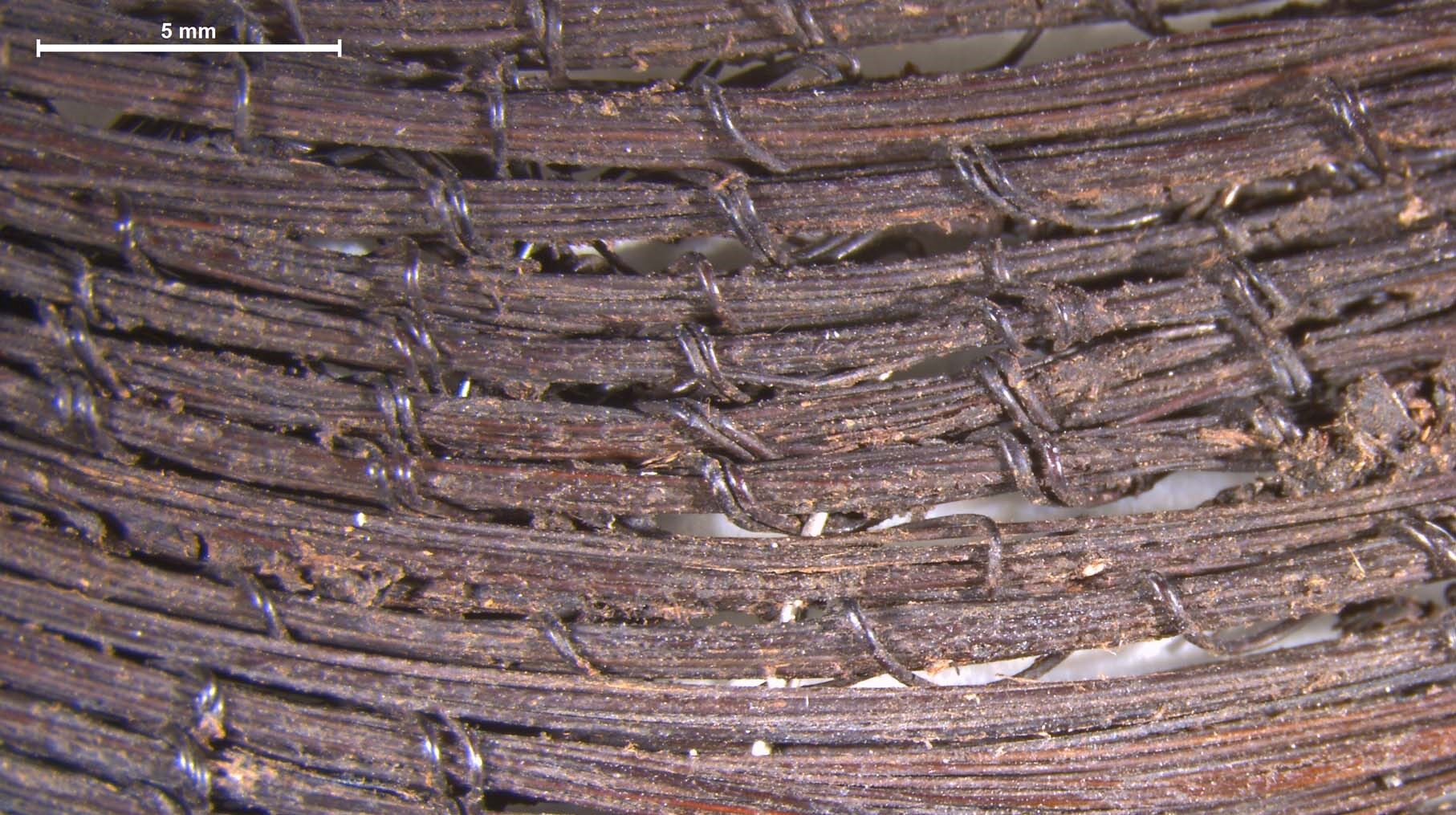
The preserved remains of the horsehair hat (© Alison Sheridan)
The Poolewe Hoard from the Highlands
In 1877, a hoard of nine bronze objects was recovered from a peat bog at Poolewe in Wester Ross in the Highlands. This included axeheads, rings and an object referred to as a “cup-ended ornament”, which may have been used as a cloak fastener or decorative adornment. Due to the style of the axeheads, experts believe the hoard was deposited around 800 BC to 600 BC (some 2,600 to 2,800 years ago). Radiocarbon dating of one of the axe hafts proved this to be the case.
The production of the Poolewe “cup-ended ornament” is very rare and was probably a treasured object, thought to have been several years, or even decades, old when it was deposited with the rest of the hoard. The presence of this older object, as well as the mixed condition of the axeheads, suggests that the hoard (now on display at Gairloch Museum) was perhaps accumulated over time before it was buried in a peat bog.
The Poolewe hoard is important because it tells us more about how hoards were collected and when people stopped burying hoards of precious goods in Scotland. During the period 1100 to 800 BC, over 60 hoards were deposited across Scotland, but soon afterwards, the practice seemed to be dying out. The deposition of the Poolewe hoard may represent the end of Late Bronze Age hoarding practices in Scotland at a time when beliefs and ideologies were changing.
The Deskford Carnyx from Moray
The Deskford carnyx is the head of an Iron Age trumpet found in the bottom of peat moss in Deskford in Moray around 1816. Shaped to resemble the face of a wild boar, it’s crafted from sheet bronze and brass. Because brass is not native to Scotland and instead represents recycled Roman metal, this means that the carnyx is likely somewhere between 1,770 and 1,900 years old. Only the head survives, but a replica shows us how the trumpet would have looked (and sounded) it its heyday.
Excavations by National Museums Scotland in the 1990s examined the spot where the artefact was found and experts concluded that the carnyx ended its life as a sacrificial offering to some unknown deity. Archaeologists think that there was a widespread belief in the Iron Age that wet locations were sacred places where you could contact the gods.
Other offerings deposited in pits cut into the Deskford peat include smashed pottery, joints of meat, and a collection of charm-stones. It’s believed that these were tokens gifted by farming people, asking their gods for good weather or thanking them for a fine harvest. But the carnyx was a spectacular sacrifice, which has led experts to think that it may have been deposited at a time of great danger or celebration.
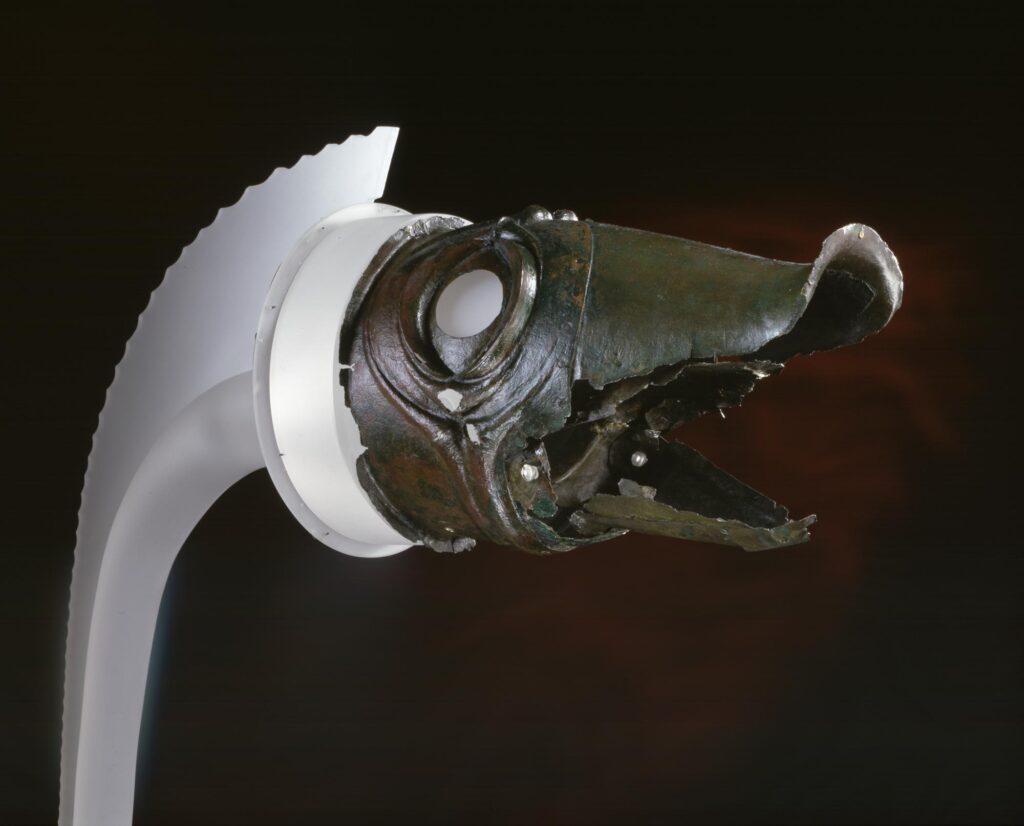
The Deskford Carnyx © National Museums Scotland
Bog Butter from An t-Eilean Sgitheanach (the Isle of Skye)
In 1884, a bronze cauldron was found in a peat bog at Kyleakin on An t-Eilean Sgitheanach in Na h-Eileanan A-Staigh (the Inner Hebrides), along with several wooden kegs containing butter. One of these kegs survives, and the butter within it has been dated to AD 225 to 401 (around 1,600 to 1,800 years ago). The preservation of the wooden container is particularly important as it gives us an insight into the different woodworking techniques being used in the Iron Age.
Other containers with bog butter dating from the Iron Age through into modern times are known from Scotland and Ireland. The reasons behind burying dishes containing butter in peat bogs has been much debated, with preservation and ritual as the most popular answers, although experiments show that the butter becomes rancid after several months. The association of the Kyleakin kegs with a bronze cauldron is unusual and is the best evidence so far for bog butter being used in prehistoric rituals.
The Orkney Hood
This woollen hood was found in peat-moss in Tankerness in 1867 and is probably the oldest and best-preserved sample of textiles in Britain.
The garment was lost, or deliberately deposited, in the bog between 1,385 and 1,750 years ago and the lack of oxygen slowed its decay for hundreds of years. The hood can tell us a lot about weaving at this time; with this piece in particular, it seems that the cloth was woven with hand-spun yarn which varied in thickness, and the changes in direction were being used to mask these variations. Amazingly, experts have been able to determine that the hood was probably made for a child using recycled pieces from an adult’s garment.
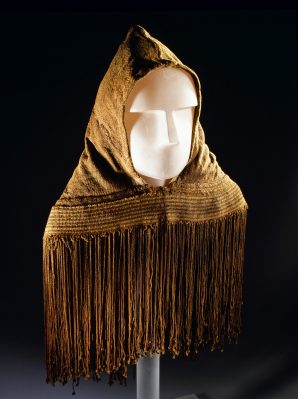
The Orkney Hood (© National Museums Scotland)
A Bronze Armlet from An t-Eilean Sgitheanach (the Isle of Skye)
A rare type of bronze armlet was found by a crofter digging in a peat bog at Duntulm on An t-Eilean Sgitheanach in Na h-Eileanan A-Staigh around 1952. The massive armlet weighs around half a kilogram, is over 1,800 years old, and was crafted in the shape of a snake. Only five other bronze spiral armlets of this kind have been found, all of which were uncovered in Scotland.
Like the Deskford carnyx, this piece can tells us a lot about metalworking in the Iron Age. Most armlets of this type were cast in a long rod, then coiled, however, the cracks along the length of this example suggest that it was made by ‘cold’ casting, a process involving mixing metal powder with a resin to create castings that give the appearance of solid metal. The metal cold-cast process (also known as “bonded bronze”) is faster than making objects from molten metal.
Gunnister Man from Shetland
In 1951, two people were cutting peat at Gunnister on the north mainland of Shetland when they came across the remains of a man. While the acidic conditions in this particular peat rotted much of the body, it kept his clothes and other items incredibly well-preserved. The style of his clothing and the coins found in his purse dates his death to around the 1700s.
The remains also provide various clues about the life of the unidentified man. None of the fabric shows signs of wounds being inflicted and his full purse suggests that he probably wasn’t robbed and murdered. While his clothes were of a fashionable style common in the Netherlands, they were not warm or practical, so he could have been a Dutch whaler who perished in bad weather.
It’s been suggested that he may have been found by locals long after a storm had passed who were unable to carry his body to a nearby cemetery, and so he was carefully deposited in the peat. You can see Gunnister Man’s personal effects on display at the National Museum of Scotland in Edinburgh and replicas in Shetland Museum.

Gunnister Man’s clothes, displayed by the Police Station in 1951 (© Shetland Museum and Archives)
Arnish Moor Man from Leòdhas (the Isle of Lewis)
It’s said that a ghost once haunted a stretch of moor on Leòdhas in Na h-Eileanan Siar – but the apparitions ceased after a body was recovered from a peat bog in the 1960s.
The remains were those of a young man, around 20 to 25 years of age, who was buried with a fracture to the back of his skull. The discovery somewhat links to a story of a young man being killed by his friend while the pair were looking for grouse eggs on Arnish Moor.
According to the tale, the killer hurriedly buried him before heading out to sea to flee his crime. After some time away, he returned and stayed in a hotel, where he was served supper and given some unusual cutlery. The landlady explained the knife and fork had been fashioned from sheep bones discovered on Arnish Moor. When the man picked them up, the handles started to bleed. Horrified, the man confessed to the killing and was hanged for his crime in Stornoway.
The man’s almost perfectly preserved clothing (now in the National Museums Scotland collections) is believed to date back to around 1700 which is around the time when the murder is thought to have taken place on Arnish Moor.
The Balmaclellan Mirror from Kirkcudbrightshire
Around 1861, a beautiful circular mirror was found as part of a hoard of bronze objects when drains were being dug in Balmaclellan, a small village in Kirkcudbrightshire in south-west Scotland.
Dated to the 1st century AD (over 1,900 years ago), the mirror had been carefully wrapped in woollen textile and buried in a peat bog. Decorated bronze and iron mirrors are most common in Southern Britain, and this mirror shows a mixture of influences in its style. The people who made it were probably familiar with southern British Celtic art and Roman art, adapting these to create a distinctive local style. Most notably both faces of the Balmaclellan mirror were smooth for reflecting.
It was a valuable object, important for display as well as for grooming, and experts believe that the mirror was perhaps buried as an offering to the gods.
Bonus: Why are Peatlands Important for the Environment?
In addition to preserving artefacts, peat is hugely important to our planet because it acts as a carbon store, is a great habitat for wildlife and has a role in water management.
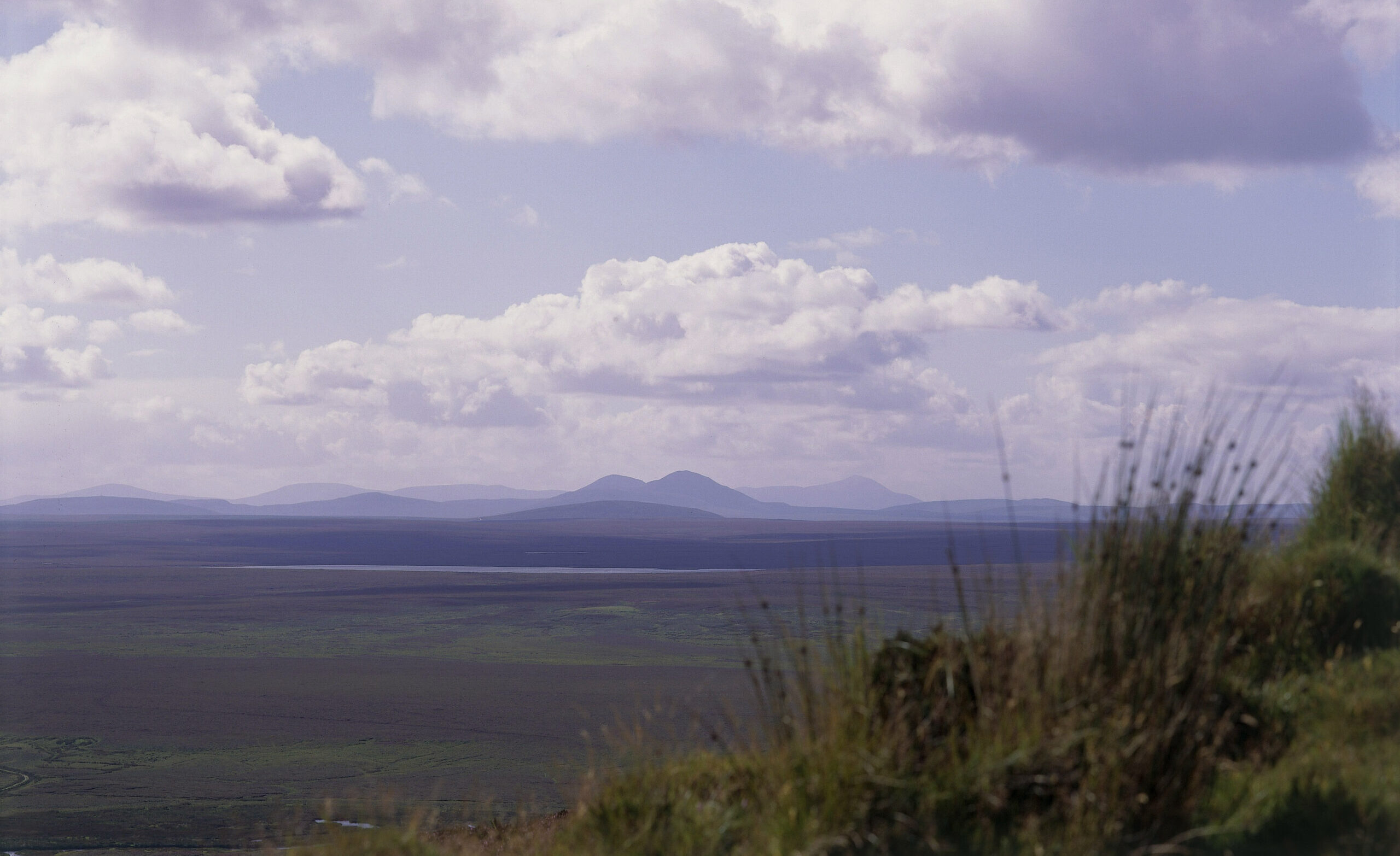
The Flow Country, Sutherland (© VisitScotland / Paul Tomkins)
Peatlands are very special habitats, made up of highly adapted plant species and home to a range of rare and important wildlife. They also absorb carbon from the atmosphere and lock it up within the peat which helps to tackle climate change. In fact, Sutherland’s Flow Country’s blanket bogs alone store more than three times the amount of carbon found in all of Britain’s woodlands.
But to perform its critical functions, peat must be wet and they’ve been mined as a source of fuel for centuries, or cultivated and drained, so that 80% of Scotland’s peatlands are now degraded in some way. As well as being a fire hazard, this dry peat is easily eroded and washed away which releases carbon dioxide into the atmosphere, becoming one of the biggest sources of greenhouse gas.
Fortunately, conservationists are working to manage and restore our peatlands and you can help by reducing your own carbon footprint by choosing more more sustainable forms of travel and using less single-use plastics, for example.
Want to know more? Keep reading about the connections between climate change and Scotland’s heritage.
Header Image: The Flow Country, Forsinard, Sutherland (© George Bayliss via Flickr, CC BY-NC 2.0)
