Top Five Lesser-Known Scottish Castles with Amazing Archaeology
It’s estimated that there are a whopping 2,000 castles in Scotland built between the 1100s and early 1600s AD, with Aberdeenshire in particular boasting more castles per hectare than anywhere else in the UK. Some, like the impressive fortresses of Edinburgh, Stirling and Urquhart on Loch Ness are renowned across the world, but we shouldn’t forget about the hundreds of less well-known sites, some of which have fascinating archaeological stories attached to them.
Cubbie Roo’s Castle, Orkney
On the Orcadian island of Wyre lie the remains of the earliest documented stone castle in Scotland. Popularly known as Cubbie Roo’s (or Cubbie Row’s) Castle, the site was actually built by a 12th-century Norse chieftain, Kolbein Hrúga. Cubbie Roo is the legendary giant in Orkney folklore whose name probably derives from that of Kolbein Hrúga.
According to Orkneyinga Saga, Kolbein Hrúga built a ‘good stone-castle … a really solid stronghold’ on Wyre around AD 1145, over 870 years ago. Another saga (Hákonar Saga, or the saga of Hákon Hákonarson) tells us that the castle was besieged in 1231 and was a ‘very unhandy place to attack’.
The fact that so much of the castle’s foundations still survive today is testimony to the strength of the original design. Excavations in the 1920s and 1930s revealed the massive 8m-square stone tower at the heart of the site, and a further four phases of subsequent building and modifications.
Cubbie Roo’s is an exceptionally rare example of a Norse castle. Hardly any stone castles or other high-status stone buildings are known from the Scandinavian homelands at this time, and there are very few known Norse castles in Britain. Cubbie Roo’s Castle is also important as part of a lordly landscape and is associated with a 12th-century stone chapel, St Mary’s (where a fragment of chain mail was found), and a high-status farm, The Bu, both located nearby.
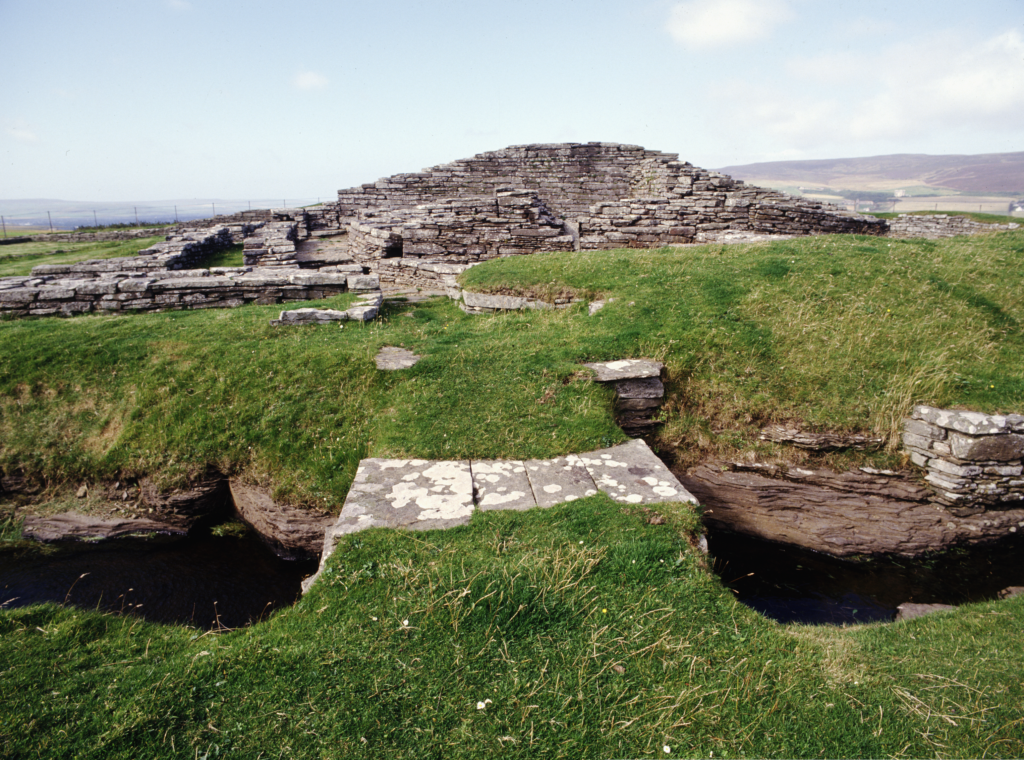
Cubbie Roo’s Castle (© Crown Copyright HES)
Dunnideer Castle, Aberdeenshire
Possibly the earliest tower house on the Scottish mainland, Dunnideer Castle is a fascinating example of a medieval structure partially built from the remains of an existing prehistoric hillfort.
The design consists of a single rectangular tower with 1.9m-thick walls, several floors and a hall. It was built around AD 1260 using stone recycled from an oblong-shaped hillfort on the same site which dates to around 250 BC (over 2,250 years ago), some of which has been vitrified.
In 2005, experts visited Dunnideer and dug a test-pit which exposed a short length of the outside face of the wall of the vitrified fort. A small assemblage of artefacts was also recovered from fieldwalking, metal detecting and test-pitting in the area, including one possible sherd of prehistoric pottery, sherds of medieval and post-medieval pottery, and flint flakes. A bronze spearhead, socketed axe and sword have also been found on the hill near the remains of the fort.
Generally found on hills offering strong defensive positions, vitrified forts are stone enclosures which have been exposed to heat in excess of 1,000 degrees Celsius, which would have been incredibly hard to achieve in the Iron Age. These areas of wall then melted to a point where they formed a glass or glaze. Although there are a lot of vitrified forts in Scotland, we still don’t know exactly why this process occurred.
For most sites, vitrification probably occurred simply as a result of destruction caused during the fort’s capture or perhaps through an accidental fire. But for a tiny number, including Dunnideer, vitrification may have been the desired outcome. According to archaeologist Dr Murray Cook (who has investigated the site), Dunnideer is the second-most vitrified fort in the world, the first being the Pictish stronghold of Tap O’ Noth less than 10 miles to the west. Surprisingly, it seems that both these oblong forts had massive walls but no gates, which has left experts wondering; “how did Iron Age peoples access them”?

Dunnideer Castle (© Astonmartini via Wikimedia Commons, CC BY-SA 4.0)
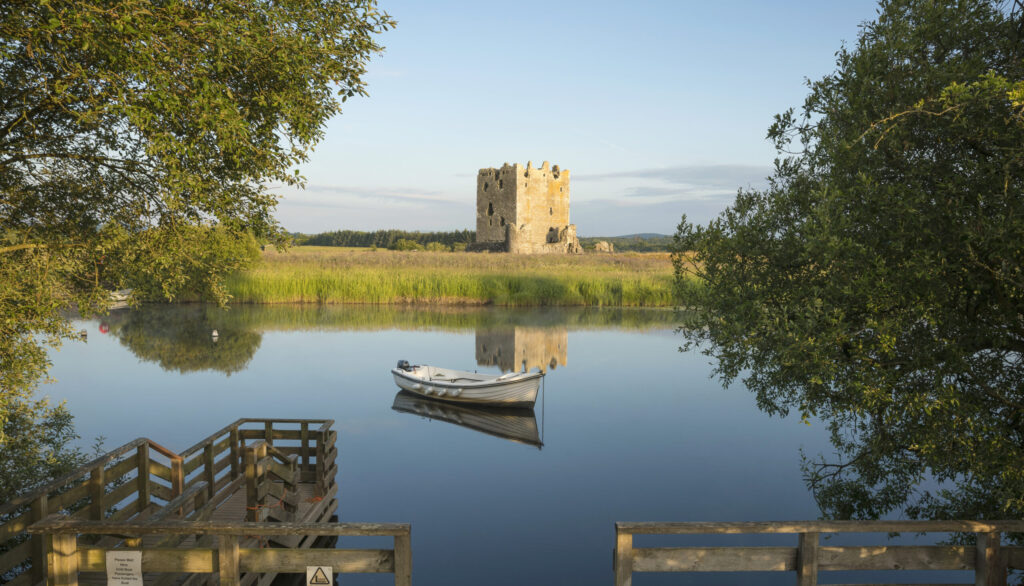
Threave Castle, Dumfries & Galloway
It’s said that Threave Island was the home of the ancient rulers of Galloway 1,000 years ago. Today there is no trace of their fortress, but visitors can still explore the impressive tower built by Sir Archibald Douglas in AD 1369, who is better known as Archibald the Grim and reportedly haunts the building.
Amazingly, due to its carefully chosen location, the castle is still resistant to flood damage despite climate change accelerating erosion to many archaeological sites near water.
Between 1974 and 1978, large-scale excavations were carried out by George Good, of Bristol Museums, and Chris Tabraham, Inspectorate of Ancient Monuments. They uncovered the foundations of two large stone structures, interpreted as a hall block and guest range, one of which contained a chapel.
The excavations also produced a fascinating collection of small finds, most of them recovered from the little harbour on the west side of the tower house, and many of which are now on display in the National Museum of Scotland in Edinburgh. The quantity of leather and wooden objects discovered in the waterlogged deposits tells us much about everyday life in the castle, most notably the wooden platters and bowls bearing the Douglas ‘heart’, branded or carved into their bases. Other items found were a lead seal matrix bearing the Douglas family crest made around 1403 for Princess Margaret, a 15th-century silver locket, and a silver locket used as a reliquary (container for holy relics) shaped like a Maltese Cross.
Dendrochronological (tree-ring dating) and numismatic (coin) evidence from the excavations also revealed that the artillery fortification built around the tower house was constructed around 1450 AD. This is significantly earlier than was previously thought and makes Threave’s artillery fortification the oldest surviving dated artillery work in Scotland, and among the most important in the British Isles.
In 2021, volunteers joined the Galloway Glens Landscape Partnership and the National Trust for Scotland on the Threave Estate to uncover artefacts spanning thousands of years, including a flint flake which could be around 4,500 years old, and lead shot which could date as far back as the 16th century. These excavations show that the site has a history of settlement reaching back centuries before Archibald the Grim’s arrival and further investigation may help add more chapters to the site’s story.

Threave Castle (© VisitScotland / Paul Tomkins)
Crookston Castle, Glasgow
Crookston is Glasgow’s only surviving medieval castle and the city’s second oldest building after the Cathedral.
The first castle on the site was built by Sir Robert Croc, a knight who was given lordship over the valley by King David I of Scotland in 1170 AD, and from whom the area of Crookston takes its name.
The earthwork remains of a defensive ring-ditch built in the late-12th century by Robert to enclose his timber and earth castle (now lost) can still be seen. If you visit the site today, inside the ditch you’ll find the remains of a stone-built castle constructed in the early 1400s by another lord of Crookston with a layout almost unique in Scotland. A silver groat of Robert III, minted AD 1403-06, was found in the foundations of the south-west tower during a detailed survey done from 1998-9, which means that the tower was constructed at least 600 years ago.
Amazingly, thanks to excavations led by Eric Talbot in 1973-4, traces of the Crocs’ timber-built family chapel have been found on the site, which date to around AD 1180, over 840 years ago. The later detailed survey also identified a 20m-wide circular enclosure on the summit of the hill identified as a possible late Iron Age fortification, which could push settlement at the site back a further thousand years.

Crookston Castle in Glasgow (© Historic Environment Scotland)
Sween Castle, Argyll & Bute
On the west coast of Argyll you’ll find what is believed to be the oldest standing castle on the Scottish mainland. Castle Sween and its sea loch take their name from Suibhne (Sven) ‘the Red’, a chieftain of Irish descent and ancestor of the MacSweens who probably built Castle Sween in the late 1100s AD.
The fortress has been excavated several times, and there’s evidence that the site was occupied before the castle was built. Works in the 1920s revealed a stone axe and whetstone (for sharpening tools) in a cave beneath the castle, a Neolithic six-knobbed stone ball, three medieval brooches and implements, and a barbed and tanged arrowhead.
Further excavations in the 1980s found evidence for at least five separate periods of use within the courtyard. One notable find was a harp-peg from the 1400s which is associated with the Lords of the Isles. These excavations also uncovered several inscribed slates, one featuring a character which some believe to be a mermaid. The remains of a nail hole on one broken edge may indicate that this slate was used originally as a roof tile.
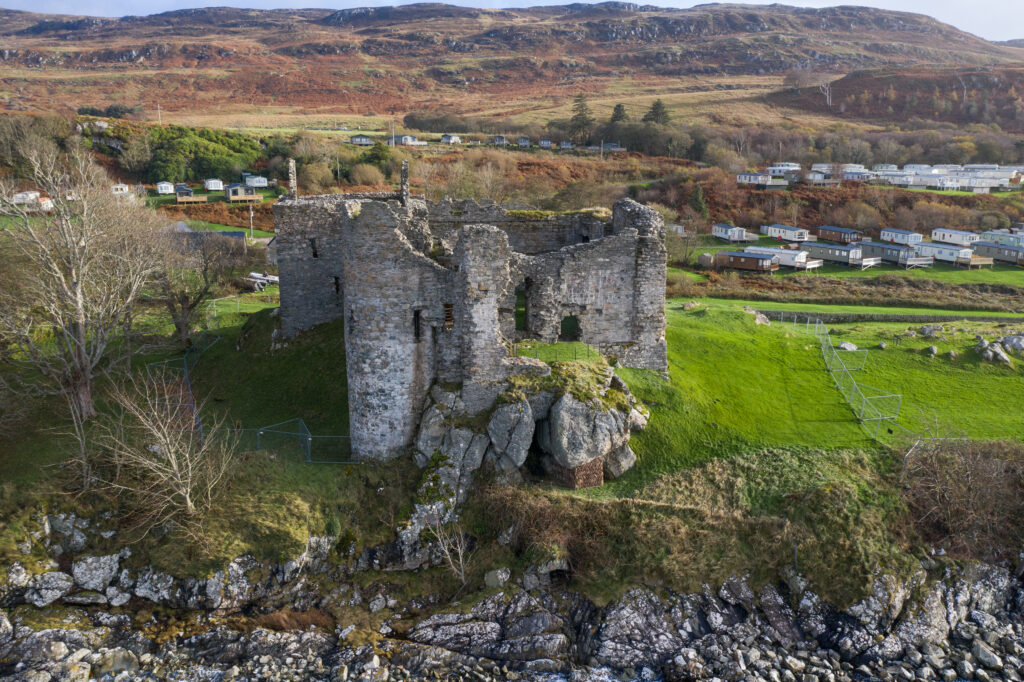
Castle Sween surrounded by fencing during High Level Maintenance investigations (© Historic Environment Scotland)
Ready to explore more Scottish castles with amazing archaeology? Check out The Castle Hunter’s list of top Scottish castles by the coast.
Header Image: Threave Castle and Estate (© VisitScotland / Kenny Lam)
