Castles of the Coasts: Five Seaside Scottish Castles with Awesome Archaeology
Many of Scotland’s most spectacular and lore-laden castles stand astride seas and waterways. For pure capital-R Romance potential, is there anything better than a clifftop castle with stories to tell and the sound of waves lashing the shore below? Here are five Scottish castles – out of a potential cast of hundreds – by the water where archaeological treasures have been unearthed.
Dunnottar Castle
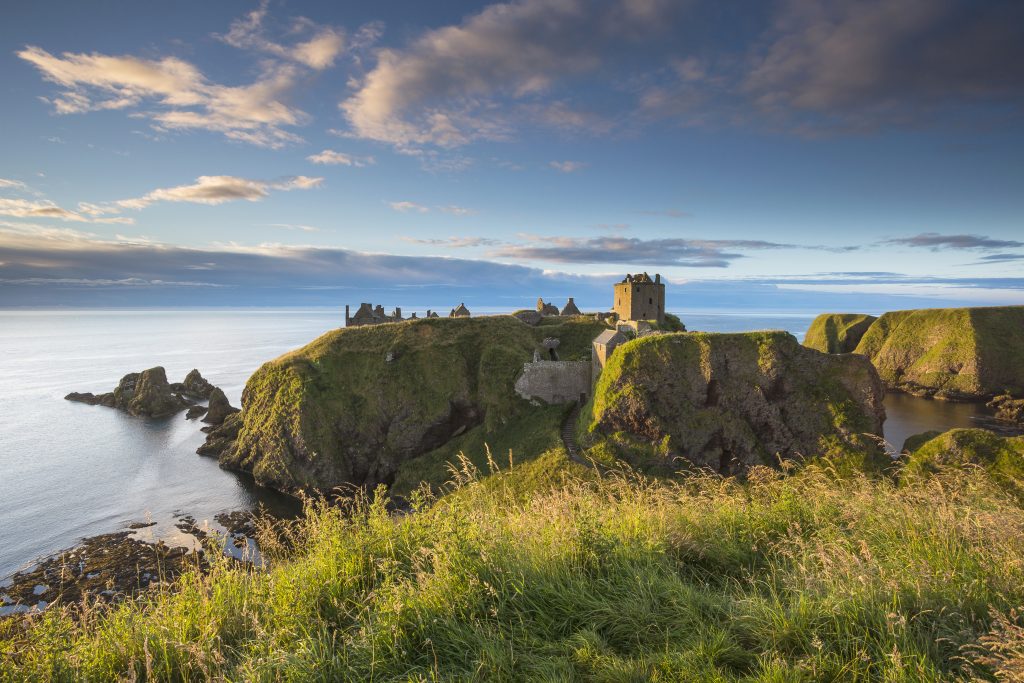
Located just outside Stonehaven upon a fist of rock rising from the North Sea, Dunnottar Castle seems straight out of an epic fantasy series. It is truly one of the anvils upon which Scotland was hammered into shape.
In 934 AD, when Scotland and England were new-born nations, Aethelstan of Wessex besieged Constantine II, King of Alba here. One look at Dunnottar’s location tells you how difficult this must have been. The English king secured Constantine’s submission following the siege, but the arrangement didn’t last and the Scots king attempted a failed invasion of Aethelstan’s kingdom three years later.

Dunnottar Castle. Image by David Weinczok
The castle that stands ruinous today was later the home of the Keiths, who served as hereditary Marischals of Scotland responsible for the Royal Regalia – crown, sword, and sceptre. Famously, the Regalia was kept at Dunnottar when Oliver Cromwell’s army, laden with cannon, laid siege. Five women, Christian Fletcher, Mary Erskine, the Countess Marischal, Elizabeth Douglas, and Anne Lindsay boldly smuggled them out straight through Cromwell’s lines.
Just up the coast from Dunnottar is an equally impressive site of major archaeological interest. Dunnicaer, a sea stack that was once connected to the mainland, has been revealed by archaeologists to be Scotland’s oldest (as yet) Pictish fort. It has so far yielded five Pictish symbol stones, ramparts, and evidence of a bustling community, which is certainly hard to imagine now!
Dhùn Naomhaig (Dunyvaig Castle)
Ìle (Islay) is often described as the beating heart of the Lordship of the Isles, a seaborne sub-kingdom whose power extended from Maol Chinn Tìre (Mull of Kintyre) to Rubha Robhanais (the Butt of Lewis). In that case, Dùn Naomhaig was one of its arteries.
Standing like a beacon atop a rocky crag in Lagavulin Bay – which is now also home to Lagavulin distillery, whose fragrances often blow across to the castle – Dùn Naomhaig was home to Aonghus Óg Mac Domhnaill, steadfast ally of Robert Bruce.

Caisteal Dùn Naomhaig. Image by David Weinczok
Of course, where you have a Mac Domhnaill (MacDonald) and their castle, you’ll likely have a Mac Cailein (Campbell) trying to take it from him (and vice versa, to be fair). During the early 17th century Dùn Naomhaig was hotly contested by the two rival clans.
Evidence of this feud emerged in the form of a rare legal seal dated 1593 and bearing the Latin name IOANNIS CAMPBELL DE CALDER discovered at the castle in 2018. CALDER (a.k.a. Cawdor) took the castle in 1615, but he and his Mac Cailein kin fled before the wrath of Alasdair Mac Colla, a famously ferocious warrior of Clan Mac Domhnaill, in 1646. Mac Colla’s glory was short lived however, as he was forced to surrender in 1647 and hanged from the castle walls.
Broughty Castle
Built as a guardian of the Firth of Tay just a few miles east of Dundee, Broughty Castle is probably best known for how it backfired.
Its master Lord Gray supported an invasion of Scotland in 1547 against Mary, Queen of Scots, and on 20 September the castle was given over to an English army fresh from victory against the Scots at the Battle of Pinkie. The Scots, along with French aid, were able to retake it but not without considerable damage being done to the area – as many as one in ten men, women, and children of Dundee and Broughty were put to the sword.
Just over a century later the Grays backed the Royalists during the English Civil War, prompting the Parliamentarians to attack it. The Grays fled without a shot fired. What was supposed to be a boon to Scotland’s defences turned out to be a massive headache, and more than once!
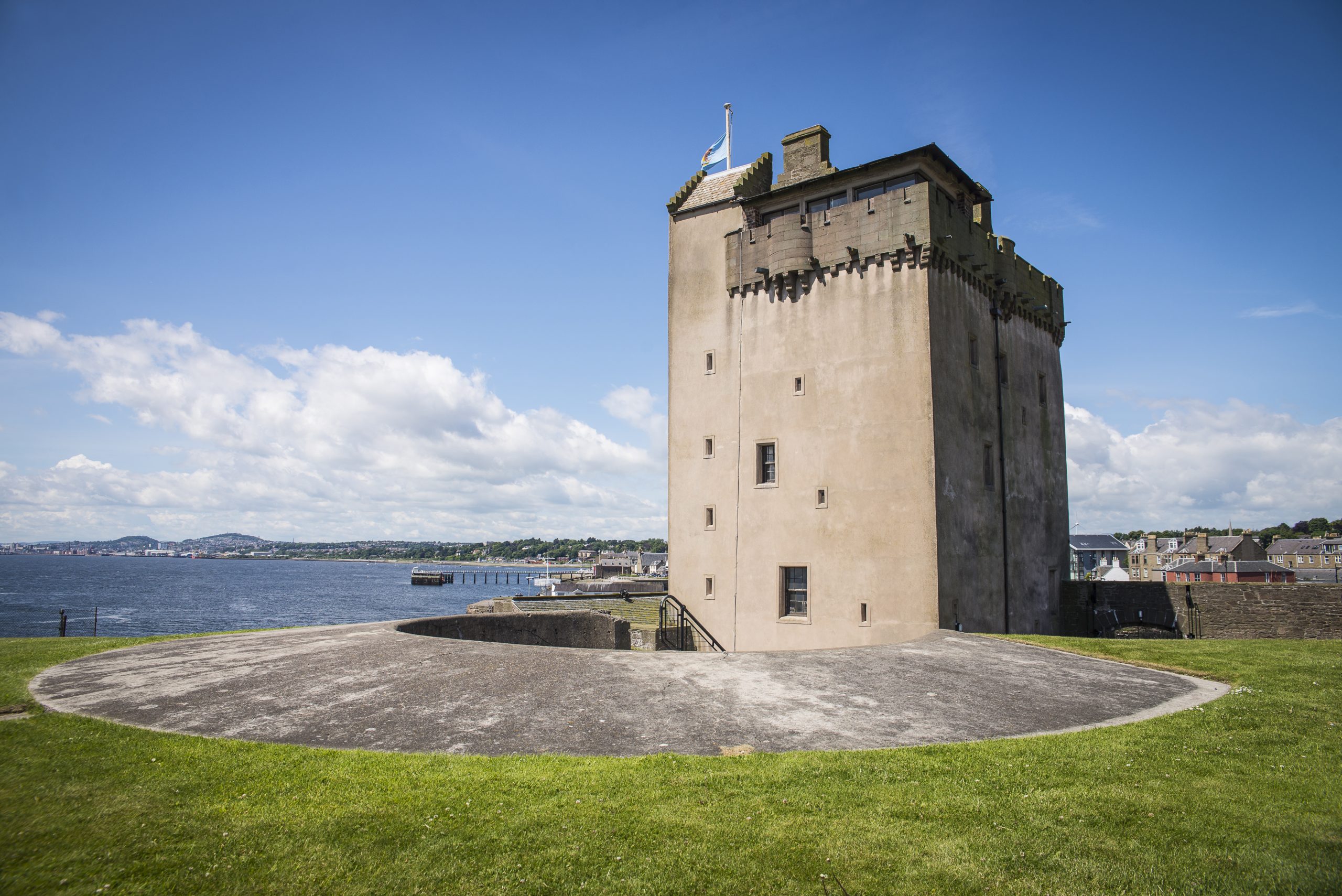
Broughty Castle © VisitScotland / Kenny Lam
Broughty Castle was redeveloped into the more modern-style fort you see today, though much of the original tower remains and the museum inside is well worth a look.
Given Broughty’s turbulent history, perhaps it’s no surprise that a cannonball, possibly from the siege of 1651, was discovered in 2016 during maintenance works on, of all things, the castle’s sewerage works. What other secrets could be hiding down the drain?
Rothesay Castle
Scotland’s only circular castle, the ownership of Rothesay in Bòd (the Isle of Bute) was hotly contested between the kingdoms of Scotland and Norway.
In the 13th century, the water nearly lapped at the castle’s walls, allowing the Norse led by Haakon IV to land a major army here in 1230 and assail the walls. One account tells how the Norse hewed through the walls with their great axes, which sounds impossible, but some say that a great cleft in the curtain wall still visible today might just be proof.

Rothesay Castle. Image by David Weinczok
In 1816 a beautifully carved stone cross-slab was discovered inside the castle, which can be viewed alongside many other artefacts from the island’s rich history in the Bute Museum directly across the street.
Caisteal Tioram (Castle Tioram)
The Clanranald stronghold of Caisteal Tioram (pronounced chee-rum) stands upon a tidal island where the River Shield flows in Loch Moidart.
The country here is rugged, but that wasn’t a problem for Tioram’s inhabitants. It may be remote by land-lubbing standards, but with a sturdy ship one could easily sail to Na h-Eileanan Siar (the Outer Hebrides), Ireland, or round Cape Wrath to Orkney in scarcely more than a day. Now that’s convenience.

Caisteal Tioram. Image by David Weinczok
Plenty of lore swirls around Caisteal Tioram. It’s possible that Robert Bruce took shelter here under the protection of Christina MacRuari – a 14th-centry Scottish noblewoman and leading member of Clann Ruaidhrí – when he was on the run as an outlaw king.
More outlandishly, John, the 12th chieftain of Clanranald, was cruel enough to make Game of Thrones’ Ramsay Bolton blush. He delighted in firing his gun, called ‘The Cuckoo’, at anyone who passed by. A massive black frog began to follow him wherever he went. When John sailed to Lochboisdale on Uibhist a Deas (South Uist), the frog was waiting for him on the shore. It stayed with John till his death bed, when three crows of a rooster – calling back to his beloved gun – heralded his end.
Tioram is in ruins and is now too dangerous to enter, but a hanging bowl dating from the 5th to 8th century was found within, indicating that the site was in use well before ‘Scotland’ even existed.
Ready to go beyond the castle gates? Discover more unique archaeology in Scotland by region with our handy guides.
By David C. Weinczok FSAScot, a writer, presenter, and speaker specialising in Scotland’s ancient and medieval history, especially castles. He is the author of The History Behind Game of Thrones: The North Remembers and shares his adventures through Scottish history through his website.
Featured Image: Dunnottar Castle © VisitScotland / Kenny Lam
This article was produced in support of Scotland’s Year of Coasts and Waters 2020-21.

