Top Five Scottish Archaeological Sites and Artefacts Brought to Life by Digital Technology
Every year, hundreds of archaeological stories covering everything from medieval toilet seats to Iron Age stone lamps are unearthed in Scotland. But the details are not always easy to find.
This is why InSitu, AOC Archaeology’s digital platform, aims to provide free public access to the most illuminating stories from their work and present them in an accessible format for everyone to enjoy. Focusing on discovering the past through digital innovation, InSitu brings to life many of AOC’s projects through interactive 3D models.
The platform currently features a variety of stories, including prehistoric settlements and medieval castles, with articles on specific objects ranging from a Bronze Age Ladder to a First World War steam locomotive. New entries will be added as the results of ongoing projects become available. In the meantime, check out five unmissable Scottish stories below.
Cracknie Souterrain: A Subterranean Secret
Hidden in the remote corner of Borgie Forest in Sutherland, Cracknie Souterrain (one of the best preserved Iron Age structures of this type in Scotland) has recently been recorded in 3D.
Built over 2,000 years ago, this underground tunnel measures 13 meters long and is only about one meter in height. The narrow curving passage slopes downwards to reach a small chamber at the end. The entrance is marked by a narrow hole in the ground – no stairway or above ground structure survives. The walls are carefully built without mortar and it is roofed with large lintel stones overlapping each other.
These mysterious structures were usually built below a large timber roundhouse, and may have been used as cold cellars to store food such as cheese and butter, or as a secure place to house slaves or hostages. They may even have been used for religious and spiritual activities.
The souterrain was recently the subject of an archaeological measured survey by AOC Archaeology. The survey used modern laser scanning techniques to create a stone-by-stone architectural record. The survey results illustrate the well-preserved walls and roof lintels, and supported the excavation of the entrance passage, opening the narrow hole to enable safe access.
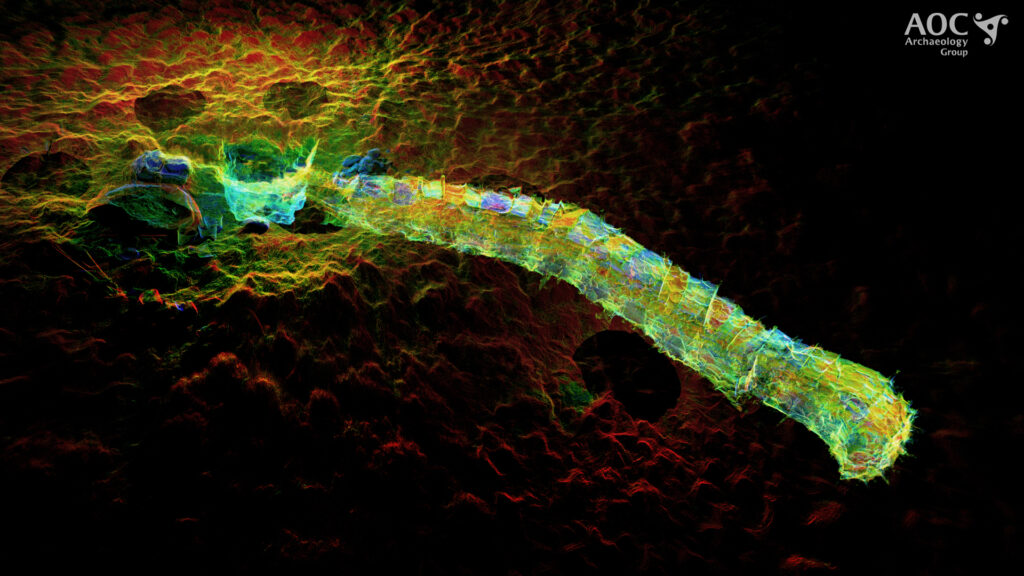
Point Cloud Render of Cracknie Souterrain (© InSitu.org.uk / AOC Archaeology Group)
Clachtoll Broch: An amazing Iron Age time capsule
An icon of the Scottish Iron Age, Clachtoll Broch in the Highlands is a truly remarkable discovery of recent years. The untouched interior, sealed off for over 2,000 years, was fully excavated in 2017.
Archaeological work revealed that the broch was destroyed in a fierce fire, forcing its inhabitants to leave most of their belongings behind as they fled in a rush. The thick layer of ash created a perfect environment for the preservation of the floor levels as they were left at the time of the fire, which allowed for hundreds of artefacts to be retrieved during excavations! These included carved bone tools and stone lamps which provided an extraordinary snapshot into a farming family’s life in Assynt in the Iron Age.
The Clachtoll Broch project was a true blend of archaeological approaches, combining community work, extensive research, experimental archaeology, conservation and innovative recording procedures. The structure of the broch was thoroughly recorded in 3D at different stages of excavation work and 3D-printed replicas of selected artefacts were created for locals to experience.
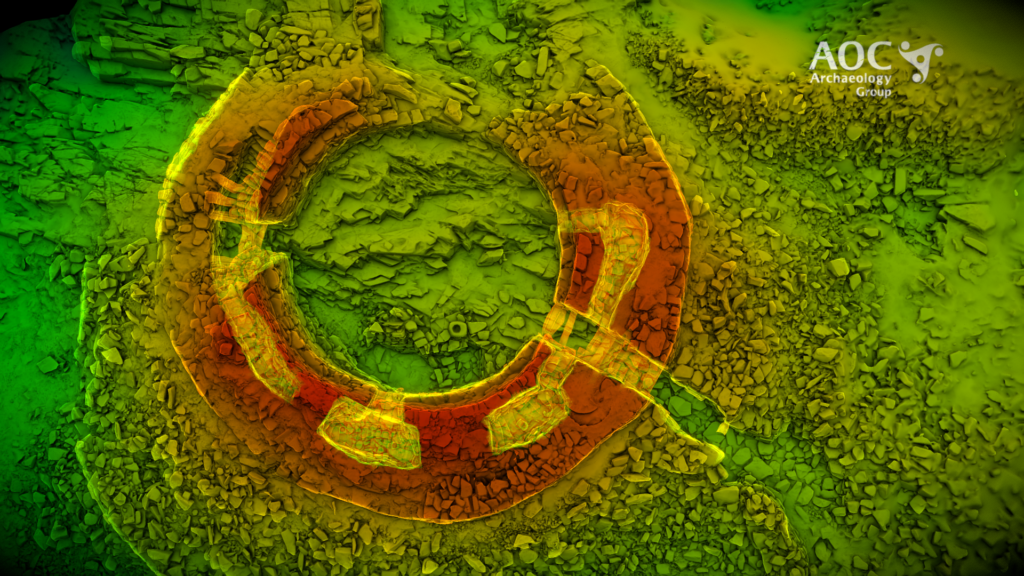
Clachtoll Broch: 3D model showing the layout of internal chambers (© InSitu.org.uk / AOC Archaeology Group)
A Wooden Vessel from the Cairns Broch: a “terrifyingly fragile” 3D puzzle
In 2018, excavations at the Cairns Broch in Orkney uncovered an astonishing Iron Age survival: a 2,000-year-old wooden bowl, preserved in waterlogged conditions within a two-meter-deep, rock-cut, underground structure, complete with a flight of stone stairs.
Wooden artefacts rarely survive in archaeological contexts, so the significance of the bowl was recognised from the outset. It was block-lifted, meaning that it was excavated within a block of the archaeological deposits that surrounded it which ensured that it was supported throughout its removal from the ground.
The block was transported to AOC’s conservation lab in Edinburgh, where it was micro-excavated. It then underwent a range of specialist analyses, 3D recording and painstaking conservation work to discover more about the bowl, its construction and its use. Analysis revealed that the bowl was made of alder log, finely carved, with a very smooth finish on the outside. It was probably burnished (rubbed), possibly with sand or shavings, to give a polished appearance.
The interior is covered in short grooves, traces of the carver’s tools as they hollowed out the vessel. The grooves change direction, showing where the carver repositioned the bowl during work.
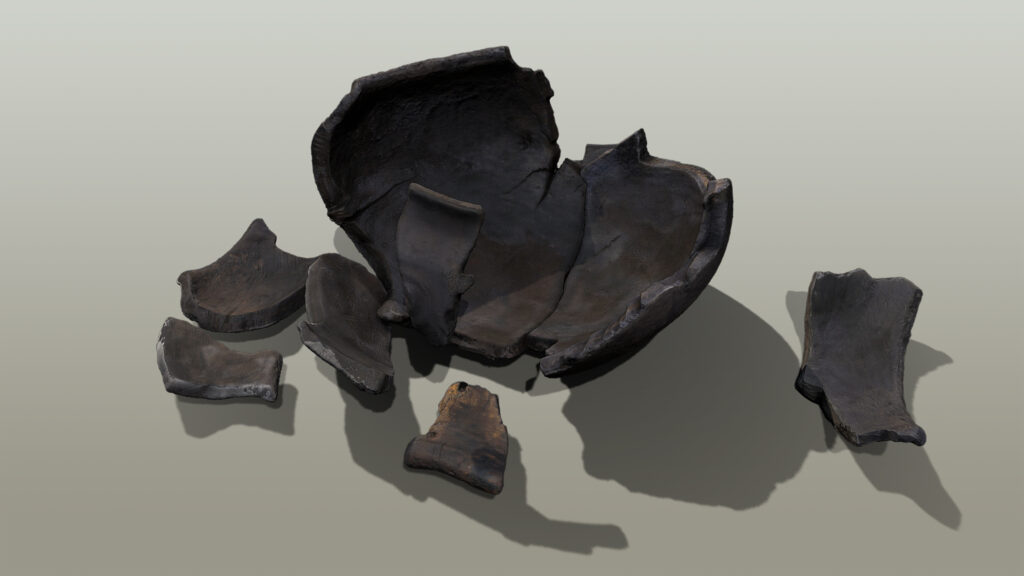
Cairns Bowl: 3D reconstruction created from individually recorded fragments (© InSitu.org.uk / AOC Archaeology Group)
Preston Tower: a medieval tower house with a violent past
Preston Tower was originally a four-storey building, erected in the 15th century AD by Sir Robert Hamilton in Prestonpans, East Lothian.
The tower burned down three times in its history: first in 1544 during the Anglo-Scottish conflict known as the ‘Rough Wooing’. It wasn’t until the early 17th century when it was rebuilt and extended upwards by two storeys. However, it was burnt again in AD 1650 by Oliver Cromwell’s forces following the Battle of Dunbar, after which the tower was rebuilt once again, only to burn down accidentally in 1663.
Following the last fire, the owners left the tower and moved to nearby Preston House leaving the tower uninhabited ever since. In 2022 a comprehensive 3D model of the tower was created as part of the Preston Tower Restoration Project. This served as a base for further restoration works and as an important inspection tool for architects who created a conservation plan for this medieval tower.
A Recreated Township: Bringing Highland History to Life
The Highland Folk Museum located at the edge of the Cairngorms National Park offers a glimpse into traditional life in the Scottish Highlands.
It houses a collection of traditional buildings relocated to Newtonmore from various locations across the north of Scotland. Today, this recreated township features the most prominent examples of indigenous Scottish architecture including a blackhouse, clack mill, and a schoolhouse.
The Tacksman’s House is the largest of the thatched buildings in the township. It was completely reconstructed based on a combination of archaeological evidence, research, and experimentation. It’s an excellent example of Scottish vernacular architecture (domestic and functional architecture rather than public or monumental buildings) from the 1700s AD, which made use of locally available, natural materials, such as stone, timber, turf, and heather.
The 3D model of the building provides a new dimension for people to explore the past and gives us tips on how we can build sustainably in the future.

Tacksman’s House, Highland Folk Museum: 3D point cloud render from combined laser scan and photogrammetry data (© InSitu.org.uk / AOC Archaeology Group)
In Situ, a new platform by AOC Archaeology, focuses on discovering the past through digital innovation and brings to life AOC’s projects through interactive 3D models. With 3D technology and digital storytelling underpinning all featured work, In Situ will be a vehicle for dissemination, sharing, and celebrating AOC’s projects. It will shine a light on a range of projects which often go unseen, confined to technical reports or grey literature. Visit the In Situ website to discover their stories.
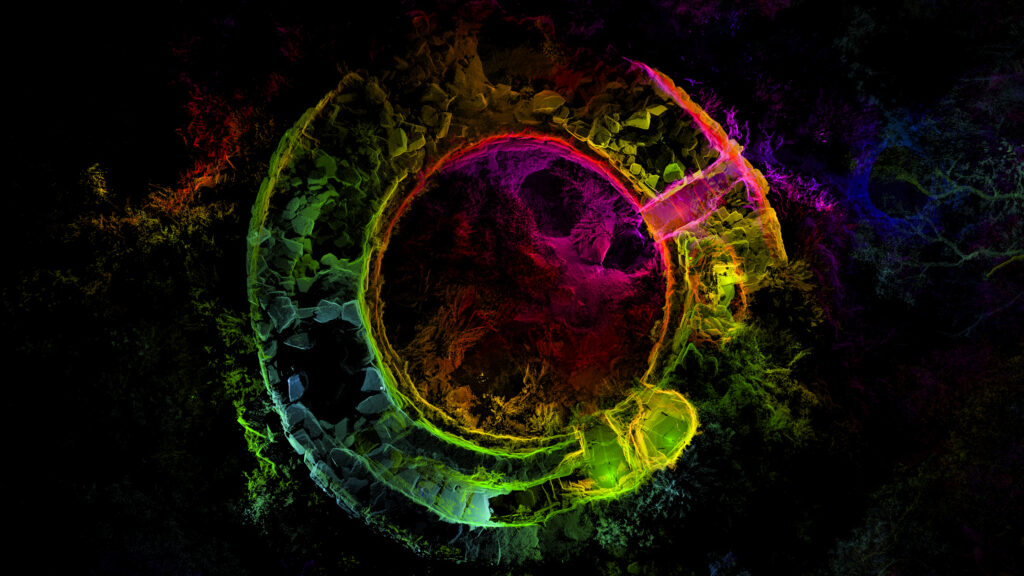
Header Image: A render of the 3D point cloud from Caisteal Grugaig Broch (© InSitu.org.uk / AOC Archaeology Group)
